

Reader Briefing
Reader Briefing
Start here if you need a practical read on anxiety in dating: why it happens and how to navigate it: who should use verification, what signals to check, and what to do before moving from online interest to an in-person plan.
Who this is for
- Readers preparing for a first in-person date.
- Anyone checking identity, profile consistency, and trust signals.
- Online daters improving conversations, profiles, or match screening.
You’ll learn
- How to evaluate identity signals without treating any single check as certainty.
- Which trust signals matter and how to weigh them together.
- How to move from online conversation to a safer first meeting.
- Where GuyID tools fit into a quick pre-date screening workflow.
- When to slow down, ask for more context, or walk away.
- How to turn the article’s advice into a concrete next step.
Bottom line
Verification reduces uncertainty; it does not guarantee future behavior. Use a layered approach: confirm identity signals, compare profile consistency, ask for a short video call, keep early plans public, and slow down when someone pressures you to skip normal safety steps.
Key takeaways
- Identity verification improves confidence, not certainty.
- Verify before meeting privately or sharing sensitive details.
- A short video call can reveal many inconsistencies.
- Pressure to skip reasonable safety steps is useful information.
- Use GuyID tools to turn vague concerns into specific checks.
Free Tools
Catfish Probability Detector
Check whether a dating profile has suspicious identity or photo signals.
Dating Bio Red Flag Detector
Review a bio for scam, pressure, or trust-warning language.
Dating Safety Checklist
Use free GuyID tools before moving from chat to a real date.
Next step
Create your GuyID trust profile
Share consent-based trust signals before a date without turning the conversation into an interrogation.
**Your palms sweat before every first date. You reread every text twelve times before sending. You interpret a two-hour response delay as evidence of rejection. Understanding anxiety in dating means understanding that it’s not a character flaw, not evidence of unreadiness, and not something you need to “fix” before you’re allowed to pursue connection. It’s a neurological pattern that responds to specific strategies — and this guide provides those strategies alongside the deeper understanding of why dating triggers anxiety more intensely than most other social experiences.
NavigateTable of Contents16 sections
Why Dating Triggers Anxiety More Than Almost Anything Else
Anxiety in dating isn’t random — it’s a predictable and well-documented neurological response to a genuinely high-stakes social situation. Understanding the specific triggers helps normalize the experience and identify which management strategies will work for your particular anxiety pattern:
Evaluation vulnerability. Dating is one of the few adult contexts where you present your ENTIRE self — personality, appearance, values, humor, intelligence, social skills — for comprehensive evaluation by a stranger. According to the American Psychological Association’s research on social evaluation anxiety, the breadth of assessment in dating contexts produces more intense anxiety than evaluations in specific domains (job interviews evaluate professional competence; dating evaluates everything). Your brain interprets the evaluation as existential because what’s being assessed isn’t a skill you can improve — it’s who you ARE.
Rejection activates pain pathways. Neuroimaging research from the National Library of Medicine demonstrates that social rejection activates the same brain regions as physical pain — the anterior cingulate cortex and anterior insula. Your brain LITERALLY processes romantic rejection as injury. Anxiety in dating is partly the brain’s pre-emptive pain management: if rejection hurts like physical injury, anxiety about potential rejection functions as the nervous system’s early-warning system trying to protect you from anticipated harm. The anxiety isn’t irrational — it’s your brain’s attempt to keep you safe from something it categorizes as genuinely dangerous.
Uncertainty intolerance. Dating is fundamentally uncertain: you don’t know how the other person feels, whether the connection will develop, or whether the investment will produce a return. For people with low uncertainty tolerance (a trait that correlates strongly with both general anxiety and anxious attachment), the not-knowing is itself the trigger. The anxiety isn’t about a specific feared outcome — it’s about the inability to predict the outcome, which leaves the anxious mind cycling through possibilities without resolution. This uncertainty is compounded in the app-dating era where multiple connections operate simultaneously, each in its own deeply ambiguous state.
Past experience conditioning. If previous dating experiences included ghosting, love bombing followed by withdrawal, breadcrumbing, or painful breakups, your nervous system has learned that dating environments produce pain — and it generalizes that learning to ALL dating contexts, not just the ones that actually hurt you. Anxiety in dating for people with painful dating histories isn’t about the current person; it’s about the pattern your nervous system learned from previous people and now applies indiscriminately.
Types of Dating Anxiety
Pre-Date Anxiety
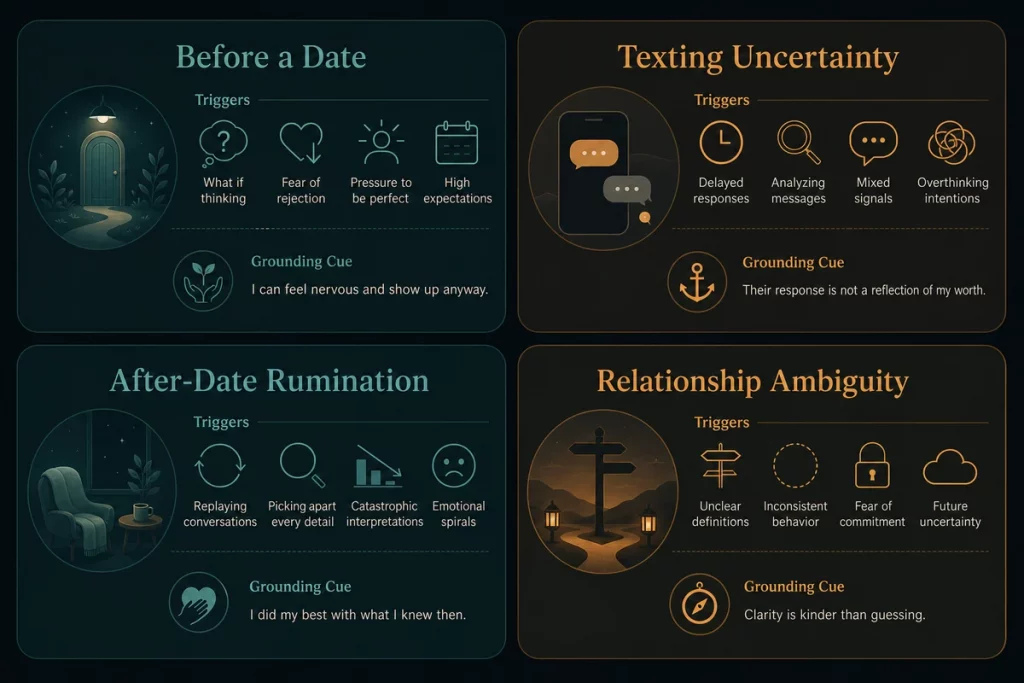
Pre-date anxiety can include racing thoughts, nausea, sweating, a rapid heartbeat, the urge to cancel, or catastrophic predictions. For some people it eases once the interaction begins; for others it persists or signals that the plan does not feel safe. Consider limiting performative over-preparation, arriving early enough to settle into the environment, and remembering that the date is a mutual evaluation rather than an audition.
Texting and Communication Anxiety
The anxiety that clusters around digital communication: agonizing over every message, interpreting response delays as rejection, rereading conversations to search for signs of disinterest, and the compulsive checking that turns your phone into an anxiety-generating device rather than a communication tool. This type of anxiety in dating is amplified by the ambiguity of text-based communication (no tone, no facial expression, no context) and the awareness that the other person is simultaneously communicating with other matches. Management: set specific texting windows rather than responding immediately to every notification, and remember that response time reflects schedule — not interest level — in the vast majority of cases.
Rejection Sensitivity
Hypervigilance for signs of rejection — interpreting neutral behaviors as evidence of disinterest, reading hidden meanings into casual statements, and preemptively withdrawing from connections to avoid the anticipated rejection. Rejection-sensitive anxiety in dating produces a paradox: the vigilance designed to protect against rejection often produces the very outcome it fears, because the anxious behavior (clinginess, reassurance-seeking, or preemptive withdrawal) pushes away the person the anxiety is trying to hold onto. This type correlates strongly with anxious attachment patterns and often has roots in early attachment experiences where the availability of caregivers was unpredictable.
Relationship Progression Anxiety
“Where is this going?” anxiety that intensifies as a connection develops: “Are we exclusive?” “Do they feel what I feel?” “When should I bring up commitment?” “Am I investing in something that will end?” This type peaks during the ambiguous period between casual dating and committed relationship — the zone where attachment has formed but security hasn’t been established. Management: direct communication (“I’d like to talk about where we both see this going”) resolves the uncertainty that feeds the anxiety, even though the conversation itself feels terrifying. The conversation’s outcome — whether it confirms mutual interest or reveals misalignment — is less painful than the indefinite uncertainty of not knowing.
Managing Your Own Anxiety in Dating
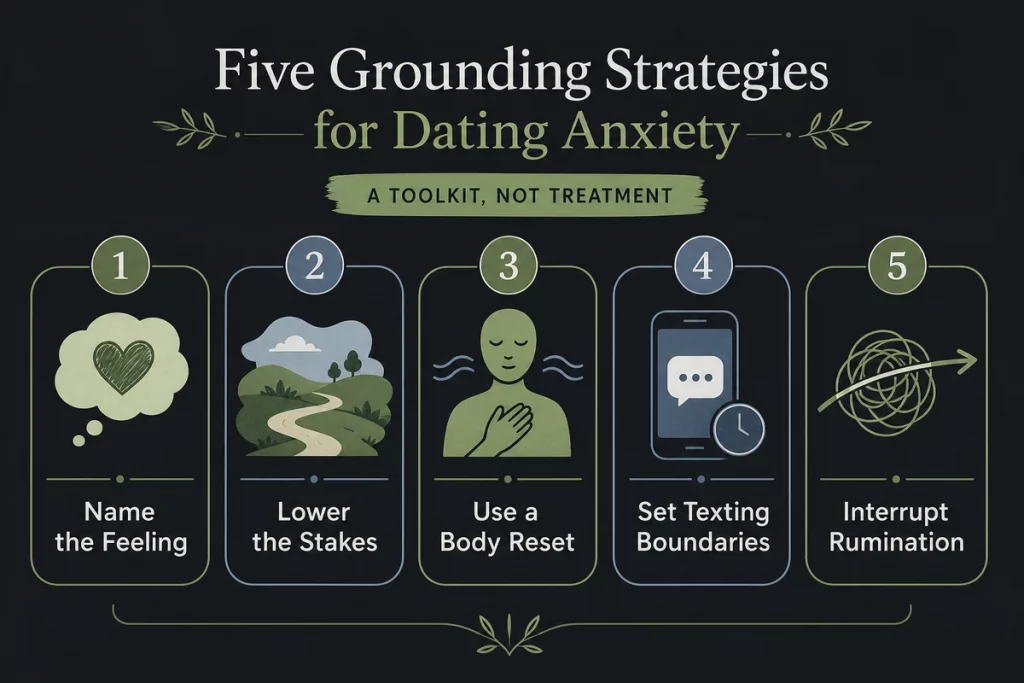
Name it without identifying with it. “I’m feeling anxious about this date” is healthier than “I’m an anxious person who can’t handle dating.” The first framing treats anxiety as a temporary emotional state that will pass; the second treats it as a permanent identity characteristic. Research on cognitive defusion (an Acceptance and Commitment Therapy technique) confirms that naming emotions as experiences rather than identities reduces their intensity and duration. You’re not anxious — you’re experiencing anxiety. The distinction matters neurologically because it activates the prefrontal cortex (rational processing) rather than the amygdala (threat response), producing regulation rather than escalation.
Reduce the stakes mentally. The date is not an audition for your life partner. It’s a conversation over coffee to see if you enjoy each other’s company. That’s it. The mental escalation from “we’re having coffee” to “this could be my future spouse” is what produces the disproportionate anxiety — because the imagined stakes (lifetime partnership) are wildly higher than the actual stakes (one hour, one beverage, one conversation). Bringing your mental frame back to what’s actually happening — “I’m meeting a person for coffee” — reduces anxiety by matching the emotional response to the actual situation rather than the imagined one.
Physical regulation before cognitive strategies. Anxiety is a body experience first and a mind experience second — so body-based management works faster than thought-based management. Before the date: 5 minutes of deep breathing (exhale longer than inhale to activate the parasympathetic nervous system), a 10-minute walk, or progressive muscle relaxation. These techniques reduce the physiological arousal that feeds anxious thinking — because the body calms faster than the mind, and a calm body sends “safe” signals to the brain that thought-based reassurance can’t replicate.
Limit pre-date texting. Extended messaging before meeting creates an imagined version of the person that the real person can’t always match — producing disappointment-driven anxiety when the in-person experience doesn’t align with the text-based one. Keep pre-date communication to logistics and light rapport (5-10 exchanges); save the genuine getting-to-know-you for the in-person meeting where nonverbal cues provide the context that text strips away. Our icebreaker guide and opener guide cover the optimal pre-date messaging balance.
Post-date: resist the analysis spiral. The post-date analysis — replaying every moment, parsing every word, catastrophizing about the pause that lasted too long — consumes emotional energy without producing useful information. Set a “processing window” (30 minutes maximum) for reflecting on how the date felt, then deliberately redirect to other activities. If they text expressing interest in another date, the analysis was unnecessary. If they don’t, the analysis wouldn’t have changed the outcome. Either way, rumination steals present-moment wellbeing without influencing future outcomes. The breakup recovery guide covers rumination management that applies equally to dating-context overthinking.
Dating Someone With Anxiety: What Partners Need to Know
If you’re dating someone who experiences significant anxiety, your response to their anxiety shapes whether the connection deepens or deteriorates. The exhaustion that partners sometimes feel (“dating someone with anxiety is exhausting”) is valid — but understanding the dynamic helps you support without depleting yourself:
Their anxiety isn’t about you. When your anxious partner needs reassurance about the relationship, interprets your busy Tuesday as disinterest, or spirals about a minor miscommunication — the anxiety is about their neurological pattern, not about something you did wrong. Personalizing their anxiety (“they must not trust me” or “I must be doing something wrong”) produces your OWN anxiety, creating an anxiety feedback loop that damages both people. The most helpful response: consistent, calm reassurance without taking the anxiety personally, and without resenting the need for reassurance.
Reassurance works — but it has limits. When your partner asks “are we okay?” for the third time this week, the reassurance they’re seeking is genuine — it’s not manipulation or attention-seeking. Providing it consistently builds the security bank that eventually reduces the frequency of the requests. However, reassurance that becomes a compulsion (they NEED it to function, and the absence of it produces crisis) may indicate that the anxiety has exceeded what partner support can manage and requires professional intervention. You can be supportive without being their therapist — and recognizing the boundary between the two protects both of you.
Predictability may feel more supportive than grand gestures. Consistent communication and follow-through can make expectations clearer, but no partner can regulate another person’s anxiety for them. Agree on realistic communication patterns, give notice when plans change, and avoid alternating dramatic affection with unexplained silence. Reliability matters more than perfect availability.
Encourage professional support without making it an ultimatum. “I’ve noticed your anxiety impacts you a lot — have you considered talking to someone about it? I think you’d benefit, and it might help us too” is supportive. “You need therapy or I can’t do this anymore” is an ultimatum that weaponizes your partner’s mental health as a relationship threat. If the anxiety genuinely exceeds what the relationship can accommodate, that’s a valid boundary — but it should be communicated with care rather than deployed as leverage. The boundary-setting guide covers how to communicate limits with compassion rather than punishment.
Take care of yourself too. Supporting an anxious partner requires emotional energy — and if your own needs aren’t being met because all available energy goes toward managing their anxiety, the relationship becomes unsustainable for both of you. Maintain your friendships, your independent activities, and your own emotional processing. You cannot be a healthy support system if you’re depleted — and your partner’s anxiety doesn’t exempt you from needing a full life outside the relationship. The green flags guide includes mutual support — not one-directional caretaking — as a hallmark of healthy partnership.
When Anxiety in Dating Requires Professional Help
Normal dating anxiety is uncomfortable but manageable — it doesn’t prevent you from dating, it doesn’t dominate your daily functioning, and it subsides once the triggering situation passes. The line between normal nervousness and clinical anxiety isn’t always obvious, but the functional impact provides the clearest diagnostic: anxiety that produces discomfort but doesn’t prevent engagement is normal; anxiety that produces avoidance, impairment, or relationship sabotage has crossed into territory where professional intervention produces dramatically better outcomes than self-management alone. Professional help is warranted when:
Anxiety prevents you from dating entirely — you want connection but the anxiety makes every attempt feel impossible, producing avoidance that keeps you isolated despite your desire for partnership. When anxiety has become a barrier rather than a discomfort, therapeutic intervention (particularly Cognitive Behavioral Therapy for anxiety or Acceptance and Commitment Therapy) provides the tools that willpower alone can’t.
Anxiety dominates your daily functioning during active dating — you can’t concentrate at work, can’t sleep, can’t eat, or can’t engage with non-dating life because the anxiety consumes all available cognitive resources. This level of impairment suggests that the anxiety has exceeded “normal dating nervousness” and entered clinical territory.
Anxiety produces behaviors that damage connections — compulsive checking, accusatory questioning, preemptive withdrawal, or reassurance demands that have ended previous connections. When anxiety-driven behaviors repeatedly sabotage the connections you want, breaking the pattern requires professional support that addresses the root rather than managing the symptoms.
You recognize that the anxiety connects to deeper patterns — childhood attachment disruption, trauma bonding from previous relationships, post-abuse recovery, or generalized anxiety that dating simply amplifies. When anxiety in dating is a symptom of a broader pattern, addressing the underlying cause (rather than managing the dating-specific expression) produces more lasting relief and more sustainable relationship capacity.
The National Domestic Violence Hotline provides referrals for trauma-informed therapy specifically for anxiety rooted in past abusive relationships. If your dating anxiety connects to gaslighting, emotional manipulation, or other abuse experiences, specialized support is more effective than general anxiety treatment.
Regardless of where your anxiety falls on the spectrum, verification reduces one category of dating uncertainty. Use GuyID’s free screening tools to confirm that the person you’re meeting is who they claim to be — because identity certainty removes the “what if they’re not real?” anxiety that app-based dating uniquely produces. Share your Date Mode link through GuyID to demonstrate your own transparency, and use reverse image search on profile photos for additional verification. Every layer of certainty you add removes a layer of anxiety — and while verification can’t address the deeper emotional patterns that therapy targets, it eliminates the practical unknowns that amplify dating anxiety unnecessarily.
How GuyID Helps
GuyID should appear when it is useful, not as a banner ad. A GuyID Trust Profile gives someone a portable way to share trust signals before a date, while identity verification and social vouching help turn vague profile claims into clearer next steps.
Useful next steps:
- Create a GuyID Trust Profile when you want a cleaner way to share verified trust signals.
- Use GuyID free tools and related guides when you need a checklist before meeting someone.
- Treat identity verification as confidence-building, not a guarantee.
- Use social vouching when you want context from people who already know the person.
- Sign up only when the extra trust layer helps the decision you are already trying to make.
Frequently Asked Questions
Is it normal to feel anxious about dating?
Dating involves evaluation vulnerability, rejection risk, and uncertainty — all of which are established anxiety triggers. The anxiety isn’t evidence that something is wrong with you; it’s evidence that your nervous system is responding predictably to a genuinely uncertain social situation. The question isn’t whether you feel anxiety but whether the anxiety is manageable (normal) or debilitating (potentially clinical).
How do I stop being anxious on dates?
You don’t eliminate anxiety — you manage it. Physical regulation (deep breathing, walking) before the date reduces physiological arousal. Mental reframing (it’s coffee with a stranger, not an audition for a life partner) reduces catastrophic thinking. Limiting pre-date texting reduces expectation mismatch. And post-date, setting a 30-minute processing window prevents the analysis spiral. Over time, positive dating experiences gradually recalibrate your nervous system’s threat assessment — each good date teaches the brain that dating environments are safe.
Is dating someone with anxiety exhausting?
It can be — and acknowledging that honestly is healthier than pretending it isn’t. Supporting an anxious partner requires consistent reassurance, predictable behavior, and patience during anxiety episodes. The key: maintain your own wellbeing alongside the support you provide. You can’t sustainably support someone else if you’re depleted. Encourage professional support for their anxiety, maintain your independent social life and self-care, and communicate your own needs directly. Supporting doesn’t mean sacrificing — it means contributing while staying whole.
Should I tell my date I have anxiety?
Not necessarily on date one — but if the relationship progresses, yes. Early disclosure (“I get nervous on dates — bear with me”) can actually reduce anxiety by eliminating the performance pressure of hiding it. As the relationship deepens, fuller disclosure about anxiety patterns helps your partner understand your behavior without personalizing it. The timing: share when trust has been established enough that the disclosure feels safe, not as a first-date conversation topic and not hidden indefinitely.
Does dating anxiety get better with experience?
For most people, yes — gradually. Each positive dating experience provides counter-evidence to the anxiety’s predictions (“see, they didn’t reject you”), slowly recalibrating the threat assessment. Each negative experience that you survive without catastrophe demonstrates resilience (“that was painful but you’re fine”). The trajectory is nonlinear — bad experiences can temporarily increase anxiety — but the overall trend for most people is improvement as the brain accumulates evidence that dating contexts are survivable and sometimes wonderful.