

Reader Briefing
Reader Briefing
Start here if you need a practical read on gaslighting in relationships: 10 signs: who should use verification, what signals to check, and what to do before moving from online interest to an in-person plan.
Who this is for
- People meeting someone from a dating app or social platform.
- Readers preparing for a first in-person date.
- Anyone checking identity, profile consistency, and trust signals.
- People trying to avoid romance scams, fake profiles, or pressure tactics.
You’ll learn
- How to evaluate identity signals without treating any single check as certainty.
- Which trust signals matter and how to weigh them together.
- How to spot inconsistencies, pressure, or behavior patterns that deserve caution.
- How to move from online conversation to a safer first meeting.
- Where GuyID tools fit into a quick pre-date screening workflow.
- How to compare options using practical safety and trust criteria.
Bottom line
Verification reduces uncertainty; it does not guarantee future behavior. Use a layered approach: confirm identity signals, compare profile consistency, ask for a short video call, keep early plans public, and slow down when someone pressures you to skip normal safety steps.
Key takeaways
- Identity verification improves confidence, not certainty.
- Patterns matter more than isolated incidents.
- Verify before meeting privately or sharing sensitive details.
- A short video call can reveal many inconsistencies.
- Pressure to skip reasonable safety steps is useful information.
Free Tools
Catfish Probability Detector
Check whether a dating profile has suspicious identity or photo signals.
Dating Bio Red Flag Detector
Review a bio for scam, pressure, or trust-warning language.
Dating Safety Checklist
Use free GuyID tools before moving from chat to a real date.
Next step
Create your GuyID trust profile
Share consent-based trust signals before a date without turning the conversation into an interrogation.
Gaslighting can undermine a person’s confidence in their memory and perception. It is more than an isolated disagreement or lie: the concern is a repeated pattern of denial, distortion, or blame that makes someone increasingly dependent on the other person’s account of events. This guide breaks down common signs and practical ways to seek support.
NavigateTable of Contents28 sections
What Is Gaslighting in Relationships?
Gaslighting in relationships is a form of psychological manipulation where one partner systematically causes the other to question their own memories, perceptions, and sanity. The gaslighter achieves this through denial (“That never happened”), trivialization (“You’re overreacting”), contradiction (“You remember it wrong”), and diversion (“Why are you always starting problems?”).
What makes gaslighting in relationships uniquely destructive compared to other forms of manipulation is that it attacks the victim’s cognitive foundation — their trust in their own mind. While guilt-tripping exploits empathy and love bombing exploits desire, gaslighting exploits perception itself. A victim who can’t trust their own memory or emotional responses becomes entirely dependent on the gaslighter’s version of reality, which is the ultimate form of control.
The American Psychological Association officially added “gaslighting” to its dictionary in 2022, defining it as manipulating someone into questioning their own reality. Research from the University of Bristol found that gaslighting in relationships causes measurable cognitive effects — including impaired memory, reduced concentration, and heightened anxiety — that can persist for years after the relationship ends.
Gaslighting exists on a spectrum. At its mildest, it’s an unhealthy communication habit that some people use unconsciously to avoid accountability. At its most severe, it’s a deliberate, systematic campaign to dismantle someone’s sense of self — often a component of narcissistic abuse or coercive control.
Where the Term Comes From
The term “gaslighting” comes from the 1944 film “Gaslight” starring Ingrid Bergman, which remains one of the most powerful depictions of psychological manipulation in cinema history. In the film, a husband manipulates his wife into believing she’s going insane by secretly dimming the gas lights in their home and then denying the lights have changed when she notices. He moves objects, creates strange noises, and tells her she’s imagining things — all to make her doubt her own perception so he can control her and steal her inheritance.
The film resonated so deeply with audiences and psychologists that “gaslighting” became the standard clinical and cultural term for this type of manipulation. In 2022, Merriam-Webster named “gaslighting” its Word of the Year, reflecting how widely recognized the concept has become as awareness of gaslighting in relationships has grown dramatically throughout the past decade. The term’s mainstream adoption has been crucial — giving victims language for an experience that previously had no name makes recognition significantly easier.
10 Signs of Gaslighting in Relationships
These are the concrete indicators that gaslighting in relationships is occurring. If you recognize five or more, the pattern is likely present.
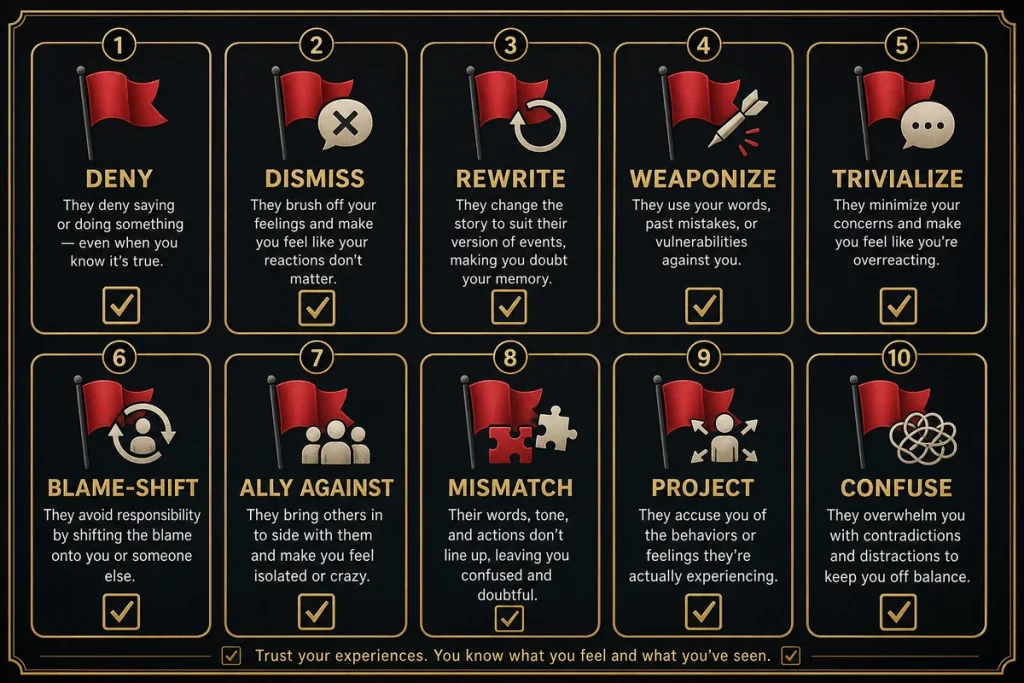
1. You Constantly Doubt Your Own Memory
After conversations with your partner, you frequently feel uncertain about what actually happened. “Did they really say that, or am I misremembering?” You find yourself replaying interactions obsessively, trying to determine whether your version of events is accurate.
Critical Indicator
2. You’re Told “That Never Happened”
You raise a specific incident — something your partner said, did, or promised — and they flatly deny it occurred. “I never said that.” “That conversation didn’t happen.” “You’re making things up.” When this happens once, it might be a genuine memory difference.
Critical Indicator
3. Your Feelings Are Constantly Minimized
“You’re being too sensitive.” “You’re overreacting.” “Stop being so dramatic.” When every emotional response you have is dismissed as excessive, irrational, or inappropriate, you learn to suppress your feelings rather than express them. Over time, you stop knowing what a proportionate emotional response even looks like — because yours have been invalidated so consistently that you no longer trust them.
High Indicator
4. They Rewrite Shared History
Events you experienced together are retold with different details, different contexts, or different outcomes. “That’s not what happened — here’s what actually happened.” Over time, you begin to defer to their version because challenging it leads to conflict, dismissal, or escalation. The gaslighter slowly replaces your lived experience with their curated narrative. This is one of the most common forms of gaslighting in relationships because it operates on events only the two of you witnessed.
High Indicator
5. You Apologize Constantly — Even When You’re Not Wrong
You find yourself saying “I’m sorry” reflexively — after disagreements where you were the wronged party, after expressing valid concerns, even after simply existing in a way that seems to displease them. This reflexive apologizing is a survival mechanism: you’ve learned that apologizing (even falsely) is the fastest path to de-escalation and the return of the “good” version of your partner.
High Indicator
6. They Use Your Past Against You
When you raise a current concern, they deflect to something from your past — a mistake you made, a time you were wrong, a vulnerability you shared. “You lied about X three years ago, so how can I trust your memory now?” This diversion serves two purposes: it avoids the current issue and it establishes a narrative that your credibility is fundamentally compromised. Once established, this narrative makes future gaslighting easier.
Medium Indicator
7. Others Are Recruited to Confirm Their Version
“Even your sister agrees you’re being unreasonable.” “Everyone thinks you’re overreacting.” “My therapist says you have issues.” Whether real or fabricated, these appeals to authority are designed to isolate you from your own perception by suggesting that consensus reality disagrees with you. This is gaslighting by proxy — using real or imaginary third parties to reinforce the distortion.
Medium Indicator
8. You’ve Stopped Sharing Your Feelings
You’ve learned that expressing emotions leads to dismissal, mockery, or arguments — so you’ve stopped. You process internally, hide your reactions, and present a neutral exterior to avoid triggering the gaslighting cycle. This emotional shutdown feels like peace, but it’s actually suppression — and it indicates that gaslighting in relationships has progressed to the point where you no longer feel safe being honest with your partner.
High Indicator
9. You Feel Like You’re “Going Crazy”
The phrase “Am I going crazy?” appears in your thoughts regularly. You feel disoriented, confused, and unable to determine what’s real. You may have difficulty making decisions because you no longer trust your own judgment. This cognitive disorientation is the intended outcome of sustained gaslighting — and it’s the clearest sign that the manipulation is working. You are not losing your mind. Someone is systematically undermining it.
Critical Indicator
10. You Need External Validation for Basic Perceptions
You’ve started asking friends, family, or even strangers to confirm basic facts about your interactions. “Did I overreact?” “Am I remembering this correctly?” “Is it normal to feel this way?” This need for constant external verification means your internal compass has been damaged by gaslighting in relationships — you no longer trust your own perception enough to navigate reality independently.
Critical Indicator
20 Gaslighting Phrases to Recognize
Gaslighters rely on specific language patterns. Recognizing these phrases in context is one of the fastest ways to identify gaslighting in relationships:
| Category | Gaslighting Phrases | What They Really Mean |
|---|---|---|
| Denying reality | “That never happened.” “I never said that.” “You’re making things up.” | “My version of events is the only valid one.” |
| Minimizing feelings | “You’re too sensitive.” “You’re overreacting.” “It’s not that serious.” | “Your emotional responses are invalid.” |
| Deflecting blame | “You’re the one with the problem.” “If you hadn’t done X, I wouldn’t have done Y.” | “I refuse to take responsibility.” |
| Questioning sanity | “You need help.” “Everyone thinks you’re unstable.” “You’re being irrational.” | “I’m pathologizing your valid concerns.” |
| Rewriting history | “That’s not what I meant.” “You misunderstood.” “You’re taking it out of context.” | “Let me reinterpret my own words to avoid accountability.” |
Context matters. Any single phrase said once, in genuine confusion, isn’t gaslighting. The pattern reveals the intent.
The Psychology Behind Gaslighting
Understanding why people gaslight helps you recognize and resist the behavior:
Control through cognitive dependency. The gaslighter’s ultimate goal is to become the sole authority on reality in the relationship. When you can’t trust your own mind, you trust theirs by default. This creates a dependency that’s more powerful than financial or physical control because it operates at the level of perception itself.
Narcissistic personality structures. Research published in the National Library of Medicine shows strong correlations between narcissistic personality traits and gaslighting behavior. Narcissists gaslight to protect their inflated self-image — if they never did anything wrong (because it “never happened”), their self-concept as a perfect partner remains intact. Gaslighting is the mechanism that bridges the gap between the narcissist’s behavior and their self-image.
Avoidance of accountability. Some gaslighters aren’t narcissists — they’re people who have learned that denying, minimizing, and deflecting is an effective way to avoid consequences. They may have learned this pattern from parents who modeled similar behavior. While less malicious in intent than narcissistic gaslighting, the impact on the victim is equally damaging. Understanding these different motivations is important because the appropriate response differs — unconscious gaslighters may respond to therapy, while narcissistic gaslighters rarely do. For related patterns, see our guides on emotional abuse checklists and stonewalling, which often accompanies gaslighting.
Power imbalance maintenance. In relationships with existing power imbalances — age gaps, financial dependency, immigration status, or social standing — gaslighting serves to reinforce the dominant partner’s authority. “You don’t understand how things work” or “You’re not experienced enough to judge” leverages the imbalance to dismiss the less powerful partner’s valid concerns. This form of gaslighting in relationships is particularly common in situations where one partner controls shared finances, immigration paperwork, or housing — creating practical dependency that makes questioning the gaslighter feel too risky.
Gaslighting on Dating Apps
Gaslighting in relationships doesn’t only happen in established partnerships — it begins during the dating phase, sometimes within weeks of matching. Here’s how gaslighting shows up in online dating:
“I never said that” — about messages you can scroll up and read. Early-stage gaslighters contradict things they said in previous messages, hoping you won’t check. This is actually one of the easiest forms of gaslighting to catch because dating apps preserve conversation history. Trust the text thread over the person’s verbal contradiction.
Minimizing your boundaries. “You won’t share your phone number? That’s a bit paranoid, isn’t it?” “You want to stay on the app longer? Most people don’t have trust issues like that.” This frames safety-conscious behavior as pathology — a gaslighting technique that’s particularly effective in the dating context where you’re motivated to seem open-minded and easygoing.
Reinterpreting their own red flags. If you notice concerning behavior and raise it, the gaslighter reframes it. “I wasn’t being possessive when I asked where you were — I was showing I care.” “I didn’t get angry when you mentioned your ex — I was just being honest about my feelings.” Every red flag gets repackaged as a virtue. Trust your initial read, and review our guide on dating app red flags.
The defense against early-stage gaslighting is the same as against other dating manipulation: take your time, maintain outside perspectives, verify identity through GuyID, and trust your perception over anyone else’s reinterpretation of it. Share your Date Mode link to establish a transparency baseline from the start, and use GuyID’s free screening tools to check matches who trigger your instincts.
How to Respond to Gaslighting
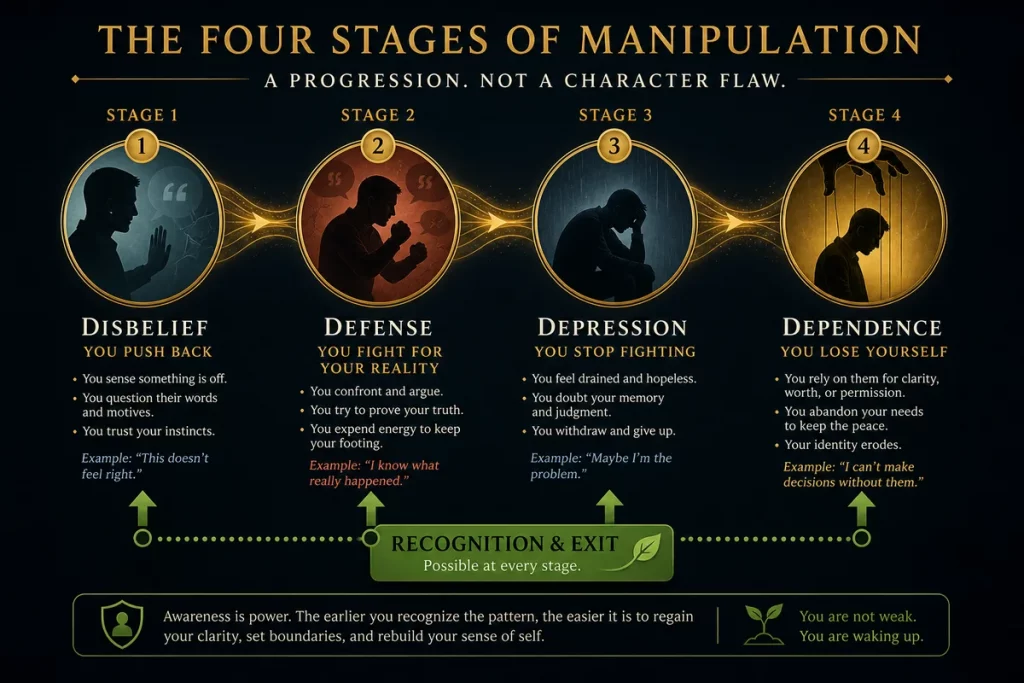
If you’ve recognized gaslighting in relationships you’re currently in, these strategies help you reclaim your reality:
Document everything. Keep a private journal of interactions — what was said, what happened, dates, and your emotional state. When someone is gaslighting you, written records become your anchor to reality. Screenshot text conversations. Save voicemails. Date-stamped documentation directly counters “that never happened” with proof that it did. Store this journal on a device or cloud service the gaslighter doesn’t have access to — this is important for your safety and privacy.
Trust your body. Even when gaslighting confuses your mind, your body often tells the truth. Tightness in your chest, a knot in your stomach, tension in your shoulders — these physical responses indicate that something is wrong even when you can’t articulate what. Learn to treat your body’s signals as valid data.
Maintain external reality checks. Stay connected to friends, family, and therapists who can affirm your perceptions. A gaslighter’s power diminishes the moment you have other voices confirming what you experienced. If your partner discourages these connections, that’s itself a form of control.
Name the behavior calmly. “When you tell me something didn’t happen that I clearly remember, it makes me feel confused and dismissed.” Naming the behavior makes it harder for the gaslighter to operate invisibly. Some gaslighters — particularly those who aren’t fully narcissistic — may become aware of their pattern when it’s identified clearly and without hostility.
Set boundaries on reality disputes. “I’m not willing to debate whether this conversation happened. I remember it, and I trust my memory.” You don’t need the gaslighter to agree with your perception for it to be valid. Agreeing to disagree on basic facts is not compromise — it’s concession to manipulation.
Evaluate whether the relationship is salvageable. If gaslighting is an occasional stress response, couples therapy may help. If it’s systematic and persistent — part of a broader pattern of emotional manipulation or narcissistic abuse — professional guidance for your own exit planning is more appropriate. The National Domestic Violence Hotline (1-800-799-7233) can help you assess your situation. Take our emotional abuse quiz for a structured self-assessment of the full dynamic beyond just gaslighting.
Recovery and Rebuilding Trust in Yourself
The deepest wound of gaslighting in relationships is the loss of self-trust. Recovery is the process of rebuilding it:
Validate your own experience. Practice saying, out loud or in writing: “What happened was real. My feelings about it are valid. I am not crazy.” This sounds simple, but for someone whose reality has been systematically challenged, it’s revolutionary. Self-validation is a skill that was damaged by gaslighting and must be deliberately rebuilt.
Work with a trauma-informed therapist. A therapist experienced in emotional abuse and gaslighting can help you distinguish between genuine self-doubt and gaslighting-induced doubt, process the experience, and develop tools for trusting your perception again. EMDR (Eye Movement Desensitization and Reprocessing) has shown particular effectiveness for gaslighting-related trauma.
Rebuild confidence through small decisions. Start making decisions independently — where to eat, what to wear, how to spend your time — without seeking external validation. Each decision you make and trust is a small act of rebuilding the cognitive confidence that gaslighting in relationships eroded. The goal is to reestablish your relationship with your own judgment.
Learn the patterns for future protection. Understanding gaslighting, emotional manipulation tactics, and narcissistic abuse signs helps you recognize these dynamics early in future relationships. Knowledge is your best protection — the earlier you spot the pattern, the less damage it can cause.
Date with verification, not just intuition. When you’re ready to date again, combine your sharpened awareness with practical tools. GuyID’s Trust Profile system provides identity verification that gaslighters are likely to avoid — because accountability is incompatible with manipulation. Screen matches with free screening tools, run reverse image searches on their photos, check for fake profile red flags, and take your time building trust based on consistent behavior over weeks and months, not words alone. When you’re considering moving off-app, share your Date Mode link to establish mutual transparency from the start. And remember — your experience with gaslighting has given you a pattern-recognition ability that many people lack. That awareness is not baggage; it’s wisdom. Trust it.
How GuyID Helps
GuyID should appear when it is useful, not as a banner ad. A GuyID Trust Profile gives someone a portable way to share trust signals before a date, while identity verification and social vouching help turn vague profile claims into clearer next steps.
Useful next steps:
- Create a GuyID Trust Profile when you want a cleaner way to share verified trust signals.
- Use GuyID free tools and related guides when you need a checklist before meeting someone.
- Treat identity verification as confidence-building, not a guarantee.
- Use social vouching when you want context from people who already know the person.
- Sign up only when the extra trust layer helps the decision you are already trying to make.
Frequently Asked Questions
What is gaslighting in relationships in simple terms?
Gaslighting in relationships is when your partner makes you doubt your own memory, feelings, and perception of reality. They deny things that happened, tell you you’re “too sensitive” or “overreacting,” and rewrite shared history until you stop trusting your own mind and start trusting theirs instead. It’s a form of psychological control that operates by damaging your relationship with your own perception.
Is gaslighting always intentional?
Not always. Some people gaslight as an unconscious defense mechanism — they learned in childhood that denying reality avoids consequences. Others gaslight deliberately and strategically as a tool for control. The impact on the victim is the same regardless of intent. If someone consistently denies your reality, the effect is gaslighting whether or not they “mean to” do it. Intent doesn’t determine harm.
How do you prove gaslighting is happening?
Document everything. Keep a dated journal of incidents. Screenshot text conversations (which preserve exactly what was said). Share your experiences with a trusted friend or therapist who can provide external validation. You don’t need to “prove” gaslighting in relationships to the gaslighter — they’ll deny it. You need to prove it to yourself, which means building a record that your perception can rely on when the gaslighting makes you doubt.
Can gaslighting happen in the early stages of dating?
Yes. Gaslighting in relationships often starts early — with subtle reinterpretations (“I wasn’t being jealous, I was being protective”), boundary minimization (“You’re being paranoid about safety”), and denial of things said in previous messages. The dating app context makes some early gaslighting easier to catch because conversation history is preserved. Trust the text thread, not the verbal reinterpretation.
What’s the difference between gaslighting and a genuine disagreement?
In a genuine disagreement, both people acknowledge the other’s perspective exists, even if they disagree with it. In gaslighting, one person denies the other’s perspective has any validity — their perception didn’t happen, their feelings aren’t real, their memory is wrong. The key distinction is whether your partner says “I see it differently” (disagreement) or “That didn’t happen / You’re imagining things” (gaslighting).
Can a relationship recover from gaslighting?
If the gaslighting is an unconscious pattern (not narcissistic), and the gaslighter genuinely acknowledges the behavior, takes full responsibility, and commits to long-term therapy, recovery is possible but requires significant work from both partners. If the gaslighting is deliberate and the gaslighter denies it when confronted, the prognosis is poor. A couples therapist specializing in emotional abuse can help assess whether repair is realistic.
How long does it take to recover from gaslighting?
Rebuilding self-trust after gaslighting in relationships typically takes 6 months to 2 years with professional support, depending on the duration and severity of the gaslighting. The most persistent effect — second-guessing your own perception — fades gradually as you practice trusting your judgment in low-stakes situations and build a support network that validates your reality. Recovery is not linear, but it is achievable.
Is gaslighting a form of abuse?
Yes. The American Psychological Association recognizes gaslighting as a form of psychological abuse. When sustained over time, gaslighting in relationships causes measurable cognitive and emotional harm — including anxiety, depression, PTSD, and impaired decision-making. In the UK, coercive control (which includes gaslighting) has been a criminal offense since 2015. In the U.S., several states are considering similar legislation. Learn more about related abuse patterns in our emotional abuse checklist.