

Reader Briefing
Reader Briefing
Start here if you need a practical read on narcissistic abuse signs: 13 warnings: who should use verification, what signals to check, and what to do before moving from online interest to an in-person plan.
Who this is for
- People meeting someone from a dating app or social platform.
- Readers preparing for a first in-person date.
- Anyone checking identity, profile consistency, and trust signals.
- People trying to avoid romance scams, fake profiles, or pressure tactics.
You’ll learn
- How to evaluate identity signals without treating any single check as certainty.
- Which trust signals matter and how to weigh them together.
- How to spot inconsistencies, pressure, or behavior patterns that deserve caution.
- How to move from online conversation to a safer first meeting.
- Where GuyID tools fit into a quick pre-date screening workflow.
- When to slow down, ask for more context, or walk away.
Bottom line
Verification reduces uncertainty; it does not guarantee future behavior. Use a layered approach: confirm identity signals, compare profile consistency, ask for a short video call, keep early plans public, and slow down when someone pressures you to skip normal safety steps.
Key takeaways
- Identity verification improves confidence, not certainty.
- Patterns matter more than isolated incidents.
- Verify before meeting privately or sharing sensitive details.
- A short video call can reveal many inconsistencies.
- Pressure to skip reasonable safety steps is useful information.
Free Tools
Catfish Probability Detector
Check whether a dating profile has suspicious identity or photo signals.
Dating Bio Red Flag Detector
Review a bio for scam, pressure, or trust-warning language.
Dating Safety Checklist
Use free GuyID tools before moving from chat to a real date.
Next step
Create your GuyID trust profile
Share consent-based trust signals before a date without turning the conversation into an interrogation.
Harmful patterns can occur whether or not a person has a clinical diagnosis. Focus on observable behavior and its impact rather than diagnosing a partner. People experiencing manipulation or control may question their own perceptions before recognizing the pattern. This guide identifies common warning signs and practical ways to seek support.
NavigateTable of Contents34 sections
What Is Narcissistic Abuse?
“Narcissistic abuse” is a commonly used description for a pattern of manipulative, controlling, and psychologically harmful behavior. It is not a clinical diagnosis, and harmful behavior should be evaluated on its impact rather than on whether a partner has narcissistic personality disorder (NPD).
MedlinePlus, a service of the U.S. National Library of Medicine, describes NPD as a mental health condition involving an excessive sense of self-importance, preoccupation with the self, and lack of empathy. Only a qualified clinician can diagnose NPD. You do not need to diagnose a partner to recognize controlling, degrading, or unsafe behavior and seek support.
What makes this form of abuse uniquely damaging is its invisibility. There are rarely bruises, broken objects, or witnesses. The abuse happens in the space between words — in what is implied, withheld, distorted, and denied. Victims often cannot articulate what is wrong because the narcissist has systematically undermined their ability to trust their own perceptions. Understanding narcissistic abuse signs is the first step toward breaking free.
Why Narcissistic Abuse Is Hard to Recognize
The relationship starts with overwhelming positivity. Narcissists are masters of first impressions. The early phase involves love bombing: intense flattery, grand romantic gestures, constant attention, and declarations of soulmate-level connection. You fall in love with a carefully constructed persona. When the abuse begins, you cling to the memory of that idealized phase.
Abuse escalates gradually. A narcissist does not start with cruelty. They test small boundaries first — a dismissive comment, a subtle put-down disguised as humor, a minor guilt trip. When each test is tolerated, they escalate. By the time the abuse is severe, the victim has been conditioned to accept behavior they never would have tolerated initially.
Gaslighting erodes reality. Among the most powerful narcissistic abuse signs is gaslighting — systematically making you doubt your own memory, perception, and sanity. When you cannot trust your own mind, you become dependent on the narcissist’s version of events.
Intermittent reinforcement creates addiction. The cycle of idealization, devaluation, and intermittent kindness creates a neurochemical pattern similar to addiction. This is the foundation of trauma bonding — the reason victims often return to abusive relationships multiple times before breaking free.
Isolation removes external reality checks. Narcissists systematically distance you from friends, family, and other support systems — monopolizing your time or convincing you that nobody else understands your relationship.
13 Narcissistic Abuse Signs
If you recognize five or more of these narcissistic abuse signs in your relationship, the pattern is significant and warrants serious attention.
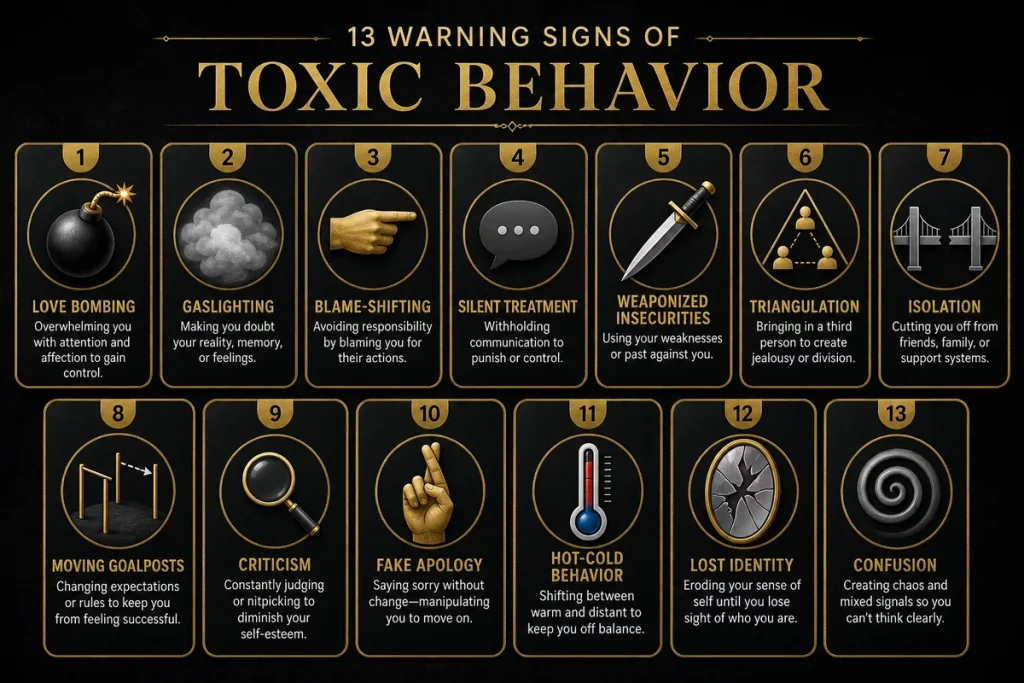
1. Love Bombing Followed by Devaluation
The relationship begins with overwhelming adoration — you are “perfect,” “unlike anyone they have ever met,” the center of their world. They text constantly, plan elaborate dates, and make you feel like the most important person alive. Then, gradually or suddenly, the tone shifts. The person who could not stop praising you now criticizes, dismisses, and diminishes you. The love bombing was not genuine connection — it was a strategic setup to create emotional dependency before the control phase begins. The contrast between who they were and who they become is deliberately disorienting.
What it sounds like early: “You’re the most incredible person I’ve ever met. I can’t believe you’re real.”
What it sounds like later: “You’re lucky I put up with you. No one else would want to deal with your issues.”
Critical Sign
2. Gaslighting
Systematically denying your reality — things that happened did not happen, things said were not said, your emotions are fabricated or exaggerated. The narcissist rewrites shared history to make themselves blameless and you unstable. Over time, you stop trusting your own memory and perception, becoming dependent on their version of events. This is the most psychologically destructive pattern because it attacks the foundation of your mental autonomy — your ability to know what is real.
What it sounds like: “I never said that — you’re making things up again.” “That’s not what happened.
Critical Sign
3. Constant Need for Admiration
The relationship revolves around the narcissist’s need for praise, validation, and attention. Every conversation circles back to them. Your accomplishments are minimized, co-opted, or met with competitive one-upmanship. Your role in the relationship increasingly becomes feeding their ego while your own emotional needs go chronically unmet. If you fail to provide sufficient admiration, you face punishment through coldness, criticism, or anger.
Medium Sign
4. Lack of Genuine Empathy
When you are hurt, stressed, or struggling, the narcissist either ignores your pain entirely, minimizes it (“you’re overreacting”), redirects to their own problems (“well I’m dealing with something worse”), or becomes visibly annoyed that your emotions are inconveniencing them. They may perform empathy convincingly in public settings — but in private, behind closed doors, your suffering is irrelevant unless it directly affects them. The emotional one-sidedness becomes the defining feature of the relationship.
Critical Sign
5. Blame-Shifting and Never Apologizing
The narcissist is never wrong. When confronted with their behavior, they deflect responsibility onto you, external circumstances, or other people. Every conflict is reframed so that you are the cause. Genuine apologies are nonexistent or performative — “I’m sorry you feel that way” (which places responsibility on your feelings rather than their actions) rather than “I’m sorry for what I did.” This is among the most consistent patterns in narcissistic relationships because their fragile self-image cannot tolerate being at fault.
High Sign
6. Silent Treatment as Punishment
When you set a boundary or disagree, the narcissist withdraws completely — refusing to speak or acknowledge your existence. This is calculated punishment designed to create anxiety and submission. See our guide on stonewalling in relationships.
High Sign
7. Triangulation
Involving a third person — an ex, friend, or coworker — to create jealousy, insecurity, or competition. The narcissist positions themselves as highly desirable and you as replaceable, maintaining constant anxiety about the relationship’s stability.
Medium Sign
8. Controlling Behavior Disguised as Concern
Monitoring your phone, questioning your whereabouts, dictating what you wear or who you see — all framed as love or protection. “I’m just worried about you” and “I only check your phone because I care about us” become covers for progressive tightening of control over your autonomy and independence. The control typically escalates from “suggestions” to “preferences” to “demands” to “rules” — each step justified as a natural extension of a caring relationship. By the time you realize your freedom has been systematically removed, the controlling behavior feels normalized.
Critical Sign
9. Weaponizing Your Vulnerabilities
Information you shared during intimate, trusting moments — your deepest fears, childhood insecurities, past relationship traumas, family problems — is stored like ammunition and deployed during conflicts to inflict maximum emotional damage. The narcissist targets the exact wounds they know will hurt most, using the information you gave them in love against you in anger. This is uniquely cruel because it teaches victims that vulnerability itself is dangerous, fundamentally damaging their ability to form trusting, open connections in future relationships.
What it sounds like: “No wonder your father left — you’re impossible to love.” “With your anxiety issues, you should be grateful anyone wants to be with you.”
Critical Sign
10. Public Charm, Private Cruelty
The narcissist presents an impeccable public persona — charming, generous, likable — that bears little resemblance to who they are in private. Nobody believes the victim because “they seem so nice.” This isolation through disbelief is one of the most damaging patterns.
High Sign
11. Emotional Withholding
Affection and warmth are given and withdrawn strategically — rewards for compliance, punishment for independence. Over time you modify your behavior to earn emotional scraps while neglecting your own needs entirely.
Medium Sign
12. Moving the Goalposts
No matter what you do, it is insufficient. You meet one expectation and they create a new one. The target of “enough” is always just out of reach, keeping you perpetually striving for approval that never arrives.
Medium Sign
13. Hoovering (Post-Breakup Manipulation)
When you try to leave, the narcissist “hoovers” you back — reverting to love bombing with promises to change and romantic gestures. The hoovering stops the moment you return, and the cycle restarts. This is the pattern most responsible for keeping victims trapped.
Critical Sign — The Trap
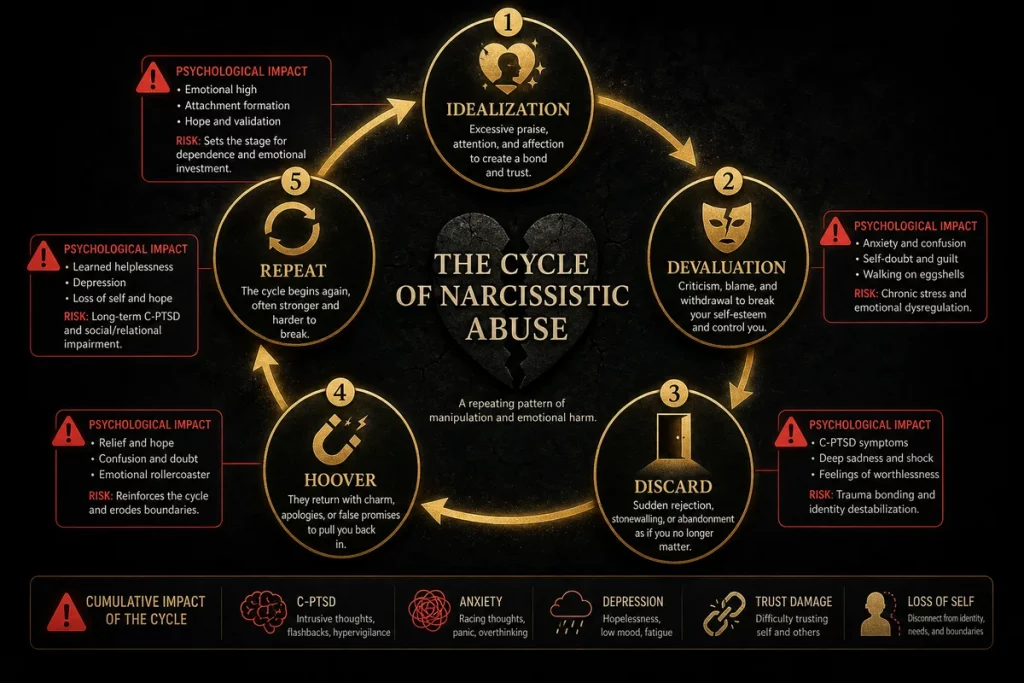
The Narcissistic Abuse Cycle
Narcissistic abuse follows a predictable cycle that repeats with increasing intensity. Understanding this cycle helps you see the full pattern rather than reacting to individual incidents in isolation:
Phase 1: Idealization (Love Bombing). The narcissist showers you with attention, affection, and admiration. You feel like the most important person in the world. This phase can last weeks or months. Everything feels perfect — because it is engineered to feel that way. The idealization creates the emotional bond that makes later abuse difficult to leave.
Phase 2: Devaluation. Criticism begins subtly then escalates. Your accomplishments are minimized, your feelings are invalidated, and your confidence is systematically dismantled. This phase is where most of the 13 narcissistic abuse signs become visible and active.
Phase 3: Discard (or Threatened Discard). The narcissist either leaves abruptly — often for a new source of attention — or threatens to leave to maintain maximum control. The discard is devastating because it confirms the manufactured fear of abandonment.
Phase 4: Hoovering. The narcissist returns with promises, charm, and idealized behavior. The victim, still bonded and grieving, often accepts. And the cycle restarts — each time with shorter idealization phases and more intense devaluation.
Recognizing this cycle is critical because it reveals that the “good times” are not separate from the abuse — they are a functional component of it. The idealization phase exists to create the emotional dependency that makes devaluation possible. Breaking the cycle requires recognizing that the entire pattern is the abuse, not just the individually bad moments. For related patterns, see our emotional abuse checklist and emotional manipulation tactics guide.
Spotting Narcissistic Abuse Signs on Dating Apps
Narcissistic behavior patterns can emerge before the first date. Here is how they show up during matching and messaging:
Instant intensity. Messages escalating from introduction to “I’ve never felt this connection” within days. On dating apps, narcissists use love bombing to accelerate emotional investment before you can evaluate them critically.
Making you feel uniquely special — then withdrawing. “You’re not like the other people on this app” followed by periods of non-response designed to create anxiety. The intermittent engagement pattern starts in the messaging phase.
Boundary testing early. Pushing for personal information or meetings before you are comfortable — then reacting with irritation or guilt when you set limits.
Immediate possessiveness. Asking whether you are talking to other people, expressing jealousy about other matches, or pressuring exclusivity before a real connection exists.
The best defense is taking your time and verifying identity. Use GuyID’s free screening tools to check matches, require video calls before emotional investment, and watch for the red flags above. A verified Trust Score through GuyID adds accountability that narcissists avoid. Share your Date Mode link when moving off-app — it establishes transparency as a non-negotiable from the very beginning, and narcissists will resist or deflect any form of external verification that threatens their control over the narrative.
The Psychological Impact of Narcissistic Abuse
Narcissistic abuse signs don’t just indicate a bad relationship — they indicate a pattern that causes measurable, documented psychological harm. Understanding the impact validates your experience and underscores why recognition matters:
Complex PTSD (C-PTSD). The prolonged, repeated trauma of narcissistic abuse produces symptoms distinct from single-event PTSD: emotional flashbacks (sudden overwhelming feelings triggered by reminders), chronic shame, difficulty regulating emotions, and a persistent sense of being fundamentally damaged. The World Health Organization officially recognized C-PTSD in the ICD-11, validating the trauma experience of relationship abuse survivors.
Cognitive effects from gaslighting. Sustained gaslighting creates measurable cognitive impacts — difficulty trusting your own memory, second-guessing every decision, persistent confusion often described as “brain fog,” and an inability to form confident judgments. These effects can persist for months or years after leaving the relationship, gradually improving with therapy and time.
Anxiety and hypervigilance. After experiencing narcissistic abuse, survivors often develop chronic anxiety and hypervigilance — constantly scanning for danger signals, interpreting neutral statements as potential threats, and bracing for conflict that may never come. While this protective mechanism is an understandable adaptation, it can prevent healthy connection in future relationships if not addressed through professional support.
Depression and self-worth erosion. Years of devaluation, criticism, blame-shifting, and emotional withdrawal fundamentally alter self-perception. Survivors frequently describe feeling worthless, unlovable, and permanently broken. These feelings are not reflections of reality — they are narcissistic abuse signs that have been internalized as identity. Therapy helps distinguish between the narcissist’s distortions and your actual self-worth.
Trust damage in future relationships. The betrayal of narcissistic abuse — where someone who claimed to love you deliberately and systematically harmed you — creates deep distrust that affects all subsequent relationships. Rebuilding the capacity for trust is typically the longest component of recovery, and it’s essential for re-entering dating with healthy expectations. Take our emotional abuse quiz to assess your current experience, or the emotional abuse checklist for a comprehensive pattern evaluation.
Narcissistic Abuse vs. Normal Conflict
Not every difficult relationship involves narcissistic abuse. Here is how to distinguish genuine narcissistic abuse signs from normal relationship problems:
| Normal Relationship Problems | Narcissistic Abuse |
|---|---|
| Both partners sometimes get defensive | One partner is never wrong — blame always flows one direction |
| Occasional thoughtless comments | Systematic undermining of confidence and self-worth |
| Disagreements resolved through compromise | Disagreements end with your submission or silent treatment |
| Both partners apologize and take responsibility | One partner never genuinely apologizes |
| Supporting each other’s friendships and family | Isolating you from your support system |
| Respecting boundaries even when frustrated | Punishing you for setting any boundary |
The key differentiator is pattern and intent. In healthy relationships, both partners contribute to problems and work to resolve them. In narcissistic abuse, one partner systematically controls, undermines, and exploits the other. If the right column describes your relationship, take it seriously.
What to Do If You Recognize These Signs
Trust your perception. If you recognize five or more narcissistic abuse signs from this guide, your perception is not distorted — it is accurate. The fact that you are questioning the relationship means your awareness is intact despite the manipulation.
Reconnect with your support system. Reach out to friends, family, or a therapist. Narcissistic abuse thrives in isolation. External perspectives validate your experience and restore the reality checks that have been systematically removed.
Document the behavior. Keep a private journal documenting specific incidents — what was said, when it happened, how you felt. Written records counter gaslighting by providing an anchor to reality that memory alone cannot provide.
Seek professional support. A therapist experienced with narcissistic abuse can help you develop a safety plan and begin recovery. The National Domestic Violence Hotline (1-800-799-7233) provides free, confidential support for emotional and psychological abuse — not just physical violence.
Set boundaries and observe the response. A reasonable boundary stated calmly reveals character. A healthy partner adjusts behavior. A narcissist responds with rage, guilt-tripping, silent treatment, or DARVO (Deny, Attack, Reverse Victim and Offender). The response to your boundary is the most diagnostic moment in any relationship.
Recovery from Narcissistic Abuse
No-contact is the foundation. Breaking all contact with the narcissist is the single most important recovery step. This means blocking their phone number, email, social media accounts, and any other communication channel. Narcissists use any available channel to hoover, manipulate, and re-engage. No contact isn’t punishment for the narcissist — it’s protection for your healing process. Expect attempts to re-establish contact, especially in the first few months. Prepare for them and maintain your boundary.
Rebuild your sense of self. Narcissistic abuse fragments your identity. Recovery means rediscovering yourself: your values, preferences, opinions, and passions. Start small — even choosing what to eat or what music to play rebuilds the autonomy that was systematically dismantled.
Process the grief. You will grieve the person you thought they were and the future you imagined. This grief is valid even though the relationship was harmful. Allow yourself to feel it without rushing.
Learn patterns to break the cycle. Many survivors unknowingly attract similar dynamics because the patterns feel familiar. Working with a therapist helps you identify vulnerabilities, strengthen boundaries, and recognize narcissistic abuse signs early in future connections.
Re-enter dating safely. When ready, use GuyID to screen for accountability, watch for early warning signs, and take your time. Your experience is not a weakness — it is an education. Take our relationship readiness quiz to assess your timing.
How GuyID Helps
GuyID should appear when it is useful, not as a banner ad. A GuyID Trust Profile gives someone a portable way to share trust signals before a date, while identity verification and social vouching help turn vague profile claims into clearer next steps.
Useful next steps:
- Create a GuyID Trust Profile when you want a cleaner way to share verified trust signals.
- Use GuyID free tools and related guides when you need a checklist before meeting someone.
- Treat identity verification as confidence-building, not a guarantee.
- Use social vouching when you want context from people who already know the person.
- Sign up only when the extra trust layer helps the decision you are already trying to make.
Frequently Asked Questions
What are the early narcissistic abuse signs in dating?
The earliest narcissistic abuse signs are love bombing (overwhelming affection disproportionate to how long you have known each other), boundary testing (pushing past limits and reacting negatively when you hold firm). Possessiveness before commitment, and the “too perfect” feeling — if someone mirrors every preference, they may be performing a persona rather than sharing a genuine personality.
Can narcissistic abuse happen without physical violence?
Yes — most narcissistic abuse is entirely psychological. Gaslighting, emotional withholding, blame-shifting, silent treatment, triangulation, and weaponizing vulnerabilities cause measurable harm without physical contact. The absence of physical violence does not mean the abuse is not real or serious.
Can a narcissist change?
Meaningful change is possible but extremely rare. It requires the narcissist to acknowledge their behavior, commit to long-term specialized therapy, and sustain the effort over years. Most lack the self-awareness or motivation. Waiting for a narcissist to change while enduring abuse is not a viable strategy — focus on protecting yourself first.
Why do I keep attracting narcissists?
Narcissists are attracted to high empathy, people-pleasing tendencies, strong loyalty, and willingness to give second chances. These are genuinely good qualities — but narcissists exploit them. Working with a therapist on boundary-setting and early red flag recognition can break the cycle. Tools like GuyID add accountability that narcissists avoid.
Is narcissistic abuse the same as emotional abuse?
Narcissistic abuse is a specific type of emotional abuse characterized by the narcissistic motivation behind it — the need for control, admiration, and dominance. All narcissistic abuse is emotional abuse, but not all emotional abuse is narcissistic. The emotional manipulation tactics may be similar, but the underlying psychology differs.
How long does recovery take?
Most therapists estimate 6-18 months for initial recovery with active therapeutic support, though full processing may take longer. No-contact with the narcissist accelerates recovery dramatically. The journey is not linear — expect setbacks, grief waves, and gradual strengthening.
Where can I get help?
The National Domestic Violence Hotline (1-800-799-7233) provides free, confidential support. A licensed therapist specializing in narcissistic abuse or trauma recovery can provide individualized guidance. Online communities on Reddit (r/NarcissisticAbuse) offer peer support from people who understand the experience.
Am I being too sensitive or is it narcissistic abuse?
The fact that you are asking is informative — manipulators deliberately make victims question sensitivity to invalidate legitimate concerns. If the relationship consistently makes you feel confused, diminished, or anxious, and you recognize multiple narcissistic abuse signs from this guide, trust your experience. Take our emotional abuse quiz for a structured assessment.
Related Reading
- Narcissistic Abuse Examples: 20 Real Patterns to Recognize
- Psychological Abuse Quiz: 20 Signs You Shouldn’t Ignore