

Reader Briefing
Reader Briefing
Start here if you need a practical read on psychological abuse quiz: 20 signs you shouldn’t ignore: who should use verification, what signals to check, and what to do before moving from online interest to an in-person plan.
Who this is for
- Readers preparing for a first in-person date.
- Anyone checking identity, profile consistency, and trust signals.
- Online daters improving conversations, profiles, or match screening.
You’ll learn
- How to evaluate identity signals without treating any single check as certainty.
- Which trust signals matter and how to weigh them together.
- How to move from online conversation to a safer first meeting.
- Where GuyID tools fit into a quick pre-date screening workflow.
- How to compare options using practical safety and trust criteria.
- When to slow down, ask for more context, or walk away.
Bottom line
Verification reduces uncertainty; it does not guarantee future behavior. Use a layered approach: confirm identity signals, compare profile consistency, ask for a short video call, keep early plans public, and slow down when someone pressures you to skip normal safety steps.
Key takeaways
- Identity verification improves confidence, not certainty.
- Verify before meeting privately or sharing sensitive details.
- A short video call can reveal many inconsistencies.
- Pressure to skip reasonable safety steps is useful information.
- Use GuyID tools to turn vague concerns into specific checks.
Free Tools
Catfish Probability Detector
Check whether a dating profile has suspicious identity or photo signals.
Dating Bio Red Flag Detector
Review a bio for scam, pressure, or trust-warning language.
Dating Safety Checklist
Use free GuyID tools before moving from chat to a real date.
Next step
Create your GuyID trust profile
Share consent-based trust signals before a date without turning the conversation into an interrogation.
Psychological abuse doesn’t leave bruises — which is exactly why it’s so effective at trapping people in harmful relationships without external evidence that anything is wrong. This psychological abuse quiz evaluates 20 behavioral patterns across four dimensions of psychological harm: reality distortion, emotional control, identity erosion, and isolation tactics. Unlike generic relationship assessments, this quiz targets the specific mechanisms through which psychological abuse operates — the patterns that make you question your sanity, doubt your worth, and lose yourself so gradually that you can’t pinpoint when the damage began. If you’re taking this psychological abuse quiz, something prompted you to search for it — and that instinct deserves respect regardless of what the score reveals.
NavigateTable of Contents34 sections
Understanding What This Psychological Abuse Quiz Measures
Psychological abuse — sometimes called emotional abuse, coercive control, or psychological aggression — is a pattern of behavior designed to undermine another person’s autonomy, self-perception, and independent functioning. The American Psychological Association defines it as behavior that produces trauma through verbal or nonverbal acts that symbolically harm another or through the use of threats to harm another. Unlike physical abuse, psychological abuse targets the mind: your sense of reality, your self-worth, your trust in your own judgment, and your connection to people who might help you recognize what’s happening.
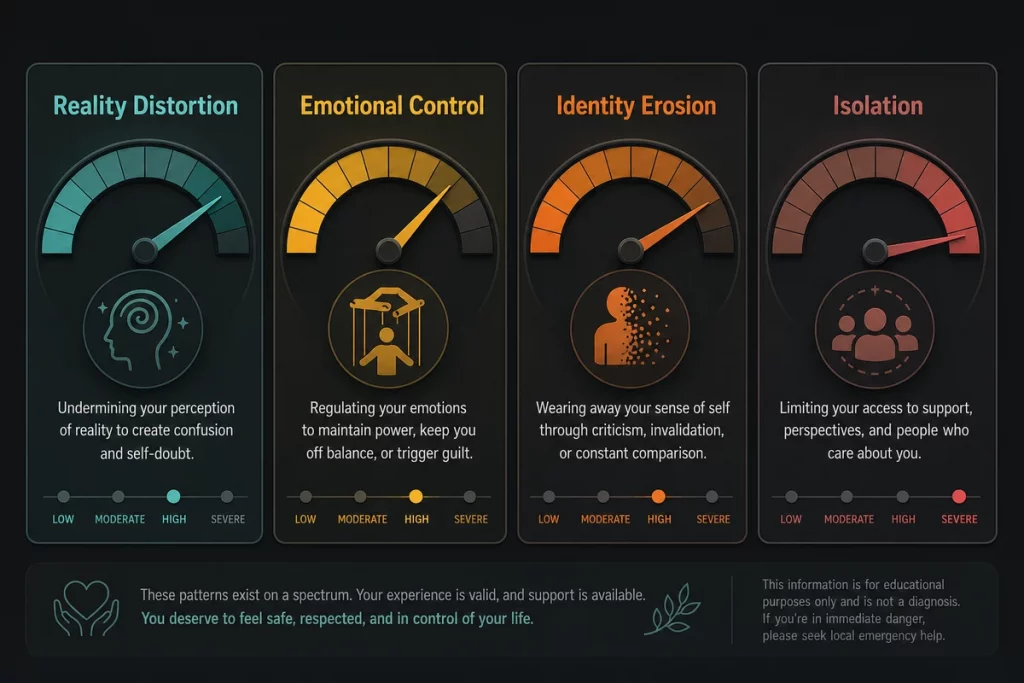
This psychological abuse quiz measures four dimensions that clinical research identifies as the primary mechanisms through which psychological abuse operates:
Dimension 1: Reality distortion. Techniques that undermine your perception of events, your memory, and your ability to trust your own experience — including gaslighting, denial of observable behavior, and rewriting shared history. When your reality is destabilized, you become dependent on the abuser’s version of events because you can no longer trust your own.
Dimension 2: Emotional control. Techniques that regulate your emotional state through intermittent reinforcement, punishment/reward cycles, and emotional withholding — including love bombing followed by withdrawal, stonewalling as punishment, and breadcrumbing that keeps you hoping while providing minimal actual connection.
Dimension 3: Identity erosion. Techniques that gradually dismantle your self-concept, confidence, and independent identity — including chronic criticism, contempt, comparison to others, and the systematic undermining of your competence, attractiveness, intelligence, or social value.
Dimension 4: Isolation. Techniques that separate you from the support systems that would help you recognize and resist the abuse — including criticism of friends and family, manufacturing conflicts between you and your support network, monopolizing your time, and creating dependency that makes independent functioning feel impossible.
Each dimension can operate independently or in combination. The most severe psychological abuse operates across all four dimensions simultaneously — creating a comprehensive system where your reality is destabilized, your emotions are controlled, your identity is diminished, and your support network is eliminated, leaving you entirely dependent on the person doing the damage. This psychological abuse quiz assesses each dimension separately because the pattern of your scores reveals not just WHETHER abuse is present but HOW it operates in your specific relationship — which directly informs the appropriate intervention strategy.
The 20-Question Psychological Abuse Quiz
Score each question: 0 = Never, 1 = Rarely, 2 = Sometimes, 3 = Often, 4 = Always. Answer based on the overall pattern of the relationship — not its best or worst individual moments. Be honest with yourself; the quiz’s accuracy depends entirely on your willingness to acknowledge what’s actually happening rather than what you wish were happening.
Reality Distortion (Questions 1-5)
Q1: Do you question your own memory of events after conversations with your partner?
Score 0-4. The hallmark of gaslighting: “That didn’t happen,” “You’re remembering it wrong,” “I never said that.” When you consistently doubt your own recall of events after your partner provides a different version, your reality-testing capacity is being actively undermined. Occasional memory disagreements are normal; consistent self-doubt about clearly recalled events is not.
Q2: Does your partner deny things you witnessed or experienced firsthand?
Score 0-4. Flat denial of observable reality — “I didn’t yell” (when you heard them yell), “I wasn’t flirting” (when you watched them flirt), “That conversation never happened” (when you remember it clearly) — is among the most disorienting forms of psychological abuse because it forces you to choose between trusting your own senses and maintaining relational peace.
Q3: Has your partner told others a version of events that contradicts what actually happened?
Score 0-4. Rewriting shared history for external audiences — positioning themselves as the victim, omitting their behavior, or fabricating your behavior — serves dual functions: it recruits social support for their narrative while isolating you from people who might validate your experience. When mutual friends hear a distorted version before you can share the real one, the isolation deepens.
Q4: Do you feel like you’re “going crazy” or losing touch with reality?
Score 0-4. This feeling — the sense that you’re losing your grip on what’s real — is the intended outcome of sustained reality distortion. You’re not going crazy; your reality is being systematically destabilized by someone who benefits from your disorientation. This question alone, scored 3 or 4, is a significant indicator on this psychological abuse quiz.
Q5: Does your partner reframe their harmful behavior as caring or protective?
Score 0-4. “I check your phone because I love you.” “I criticize you because I want you to be your best.” “I don’t want you seeing those friends because they’re bad for you.” Reframing control as care makes the abuse nearly invisible because it wraps harmful behavior in the language of love — making you feel ungrateful for objecting to something presented as affection.
Emotional Control (Questions 6-10)
Q6: Does your partner alternate between intense warmth and sudden coldness?
Score 0-4. The warmth/coldness cycle — love bombing followed by emotional withdrawal — creates the intermittent reinforcement that produces trauma bonding. The unpredictability keeps your nervous system in a state of hypervigilance, constantly scanning for signs of which version of your partner will appear — the loving one or the punishing one.
Q7: Do you walk on eggshells to avoid triggering your partner’s anger or withdrawal?
Score 0-4. Chronic eggshell-walking indicates that the relationship has created an environment where honest expression is dangerous. You’ve learned — through repeated experience — that saying the wrong thing, expressing the wrong need, or displaying the wrong emotion produces punishment (anger, silent treatment, contempt, withdrawal). This learned hypervigilance is one of the most reliable indicators measured by any psychological abuse quiz.
Q8: Does your partner use silence, withdrawal, or emotional withholding as punishment?
Score 0-4. The sustained silent treatment — days of withdrawn communication, warmth, and affection following any expression of needs or boundaries — functions as punishment that trains you to suppress your voice. The National Domestic Violence Hotline classifies sustained emotional withholding as psychological abuse. See our is stonewalling abuse guide for the full framework.
Q9: Does your partner’s mood control the household atmosphere?
Score 0-4. When one person’s emotional state dictates whether the home feels safe, tense, joyful, or threatening — and everyone else modulates their behavior to manage that person’s mood — the household operates under emotional dictatorship. Children and partners in these environments develop anxiety, hypervigilance, and people-pleasing behaviors that persist long after the relationship ends.
Q10: Does your partner threaten consequences (leaving, withholding affection, anger) when you express needs?
Score 0-4. Attaching consequences to need-expression — “If you bring this up again, I’m done,” “Don’t ruin tonight by being needy” — conditions you to suppress your needs to maintain the relationship. Over time, the suppression becomes automatic: you stop knowing what you need because you’ve trained yourself not to ask.
Identity Erosion (Questions 11-15)
Q11: Has your self-confidence decreased since this relationship began?
Score 0-4. Healthy relationships build confidence; abusive relationships systematically dismantle it. If you entered the relationship as a confident, self-assured person and now question your competence, attractiveness, intelligence, or social value, the relationship has eroded your self-concept — which is one of the primary objectives of psychological abuse.
Q12: Does your partner criticize you in ways that attack your character rather than specific behavior?
Score 0-4. “You forgot to call” addresses behavior. “You’re so thoughtless and selfish” attacks character. Research from the National Library of Medicine identifies character attacks (contempt, in Gottman’s framework) as both a relationship predictor and a mechanism of identity erosion — because repeated character attacks eventually become internalized as self-beliefs.
Q13: Does your partner compare you unfavorably to others?
Score 0-4. “My ex never complained like you do.” “Why can’t you be more like [person]?” “Everyone else manages this — why can’t you?” Unfavorable comparison serves dual functions: it erodes your self-worth (by positioning you as deficient) and creates competition anxiety (motivating you to try harder to meet standards that will be moved once you approach them).
Q14: Do you feel like a different (diminished) version of yourself compared to before this relationship?
Score 0-4. The loss of your authentic self — your opinions, preferences, confidence, and voice — is the cumulative result of sustained psychological abuse. If friends or family have commented that “you’ve changed” or “you’re not yourself anymore,” their observation from outside the dynamic may be more accurate than your perspective from inside it.
Q15: Does your partner mock, belittle, or dismiss your accomplishments?
Score 0-4. Minimizing your successes — “That’s not a big deal,” “Anyone could have done that,” “Don’t get too full of yourself” — prevents you from building the self-worth that would give you the confidence to challenge the relationship dynamic or leave. Keeping you small keeps you controllable.
Isolation (Questions 16-20)
Q16: Has your social circle shrunk since this relationship began?
Score 0-4. Isolation rarely happens through a single dramatic act — it happens gradually as friends and family become sources of conflict, social events get cancelled, and the relationship absorbs more and more of your available time and energy until maintaining outside connections feels impossible or not worth the cost.
Q17: Does your partner criticize, mock, or express jealousy about your close relationships?
Score 0-4. “Your mother is manipulative.” “Your friends are a bad influence.” “You spend too much time with them and not enough with me.” Each criticism adds friction to your support relationships, making contact with supportive people feel like a source of conflict rather than comfort — which is precisely the isolation objective.
Q18: Do you hide aspects of your relationship from friends and family?
Score 0-4. Secrecy about the relationship’s dynamics — minimizing arguments, hiding the silent treatment, not telling friends what your partner said — indicates that you know on some level that your support system would be alarmed by what’s happening. The instinct to hide is itself diagnostic: you’re protecting your partner from the accountability that exposure would create, and protecting yourself from the reality that other people’s alarm would confirm.
Q19: Does your partner monitor or restrict your communication with others?
Score 0-4. Checking texts, requiring location sharing, timing outings, needing to know who you’re talking to and what about — surveillance presented as security is one of the most recognized forms of coercive control in the psychological abuse literature. Healthy trust requires freedom; controlling trust requires monitoring.
Q20: Do you feel dependent on your partner in ways that make leaving feel impossible?
Score 0-4. Financial dependency, emotional dependency, logistical dependency, or the manufactured belief that you “can’t make it on your own” — dependency creation is the endgame of psychological abuse because it ensures continued access to the person being abused. If leaving feels impossible, examine whether that impossibility reflects genuine barriers or manufactured beliefs about your own incapacity.
Interpreting Your Psychological Abuse Quiz Results
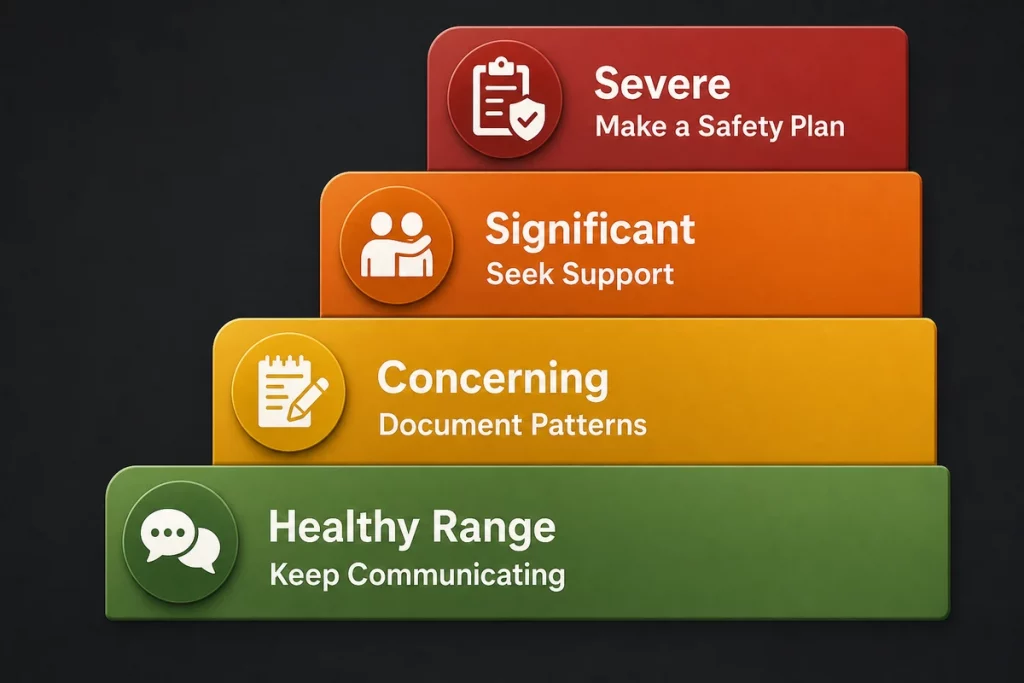
Dimension scores (0-20 each): 0-4 = Healthy range. 5-9 = Concerning patterns present — monitor and consider professional consultation. 10-14 = Significant patterns — professional support recommended. 15-20 = Severe patterns — this dimension indicates active psychological abuse in this domain.
Total score (0-80): 0-15 = Relationship within healthy range with normal challenges. 16-30 = Some concerning patterns that may benefit from couples therapy if both partners engage genuinely. 31-50 = Multiple significant patterns across dimensions — individual therapy is the priority, not couples therapy, because the pattern combination suggests abuse rather than communication failure. 51-80 = Severe psychological abuse across multiple dimensions — contact the National Domestic Violence Hotline (1-800-799-7233) for confidential support and safety planning.
Important single-item flags: Selecting the highest-frequency response on a Reality Distortion question deserves attention even when the total score is lower, because repeated denial or manipulation of your experience can undermine confidence in your own judgment. The highest-frequency response on Q19 (communication monitoring) or Q20 (manufactured dependency) is also a reason to document the pattern and consider confidential support. This quiz cannot determine whether abuse is present or predict escalation.
What to Do With Your Psychological Abuse Quiz Score
If you scored in the healthy range (0-15): Your relationship shows normal challenges. Continue building communication skills, maintaining healthy boundaries, and reinforcing positive patterns. The fact that you took this psychological abuse quiz suggests something prompted your concern — trust that instinct enough to remain observant, even with a low score. Patterns can develop over time, and early awareness prevents escalation.
If you scored in the concerning range (16-30): Some patterns warrant attention before they become entrenched. Show your results to a trusted friend or therapist for an external perspective — people inside a dynamic often minimize patterns that are clearly visible from outside. If your partner is willing to engage with couples therapy, Gottman Method or EFT approaches can address communication and emotional patterns effectively. But monitor whether the concerning patterns improve or worsen — if they worsen despite intervention, reassess using this quiz.
If you scored in the significant range (31-50): Individual therapy — for YOU, not couples therapy. The pattern combination at this level suggests psychological abuse rather than mutual communication failure, and couples therapy in the presence of abuse can provide the abuser with better manipulation tools while requiring you to be vulnerable with someone who weaponizes vulnerability. A therapist experienced in coercive control and psychological abuse can help you develop clarity about the relationship, rebuild the self-trust the abuse has eroded, and plan your next steps from a position of informed strength. Take the trauma bonding test to evaluate whether intermittent reinforcement has created psychological dependency that complicates leaving. Use the emotional abuse checklist for additional structured assessment.
If you scored in the severe range (51-80): You are experiencing psychological abuse. This isn’t a communication problem, a compatibility issue, or something you caused — it’s a pattern of behavior designed to control you through psychological mechanisms. Contact the National Domestic Violence Hotline (1-800-799-7233) for confidential support from professionals who specialize in this exact situation. Individual therapy with a trauma-informed therapist is essential. Safety planning — even if you’re not ready to leave — protects your options and your wellbeing while you process the reality of your situation.
When you’re ready to rebuild. Recovery from psychological abuse takes time, professional support, and deliberate identity reconstruction. When you re-enter dating, use GuyID’s free screening tools for identity verification and watch for the green flags that indicate genuine respect: consistency between words and actions, respect for your pace and boundaries, encouragement of your independence, and the ability to hear feedback without deflecting, gaslighting, or stonewalling. Share your Date Mode link through GuyID — verified, transparent connections are the foundation on which post-abuse recovery builds.
How GuyID Helps
GuyID should appear when it is useful, not as a banner ad. A GuyID Trust Profile gives someone a portable way to share trust signals before a date, while identity verification and social vouching help turn vague profile claims into clearer next steps.
Useful next steps:
- Create a GuyID Trust Profile when you want a cleaner way to share verified trust signals.
- Use GuyID free tools and related guides when you need a checklist before meeting someone.
- Treat identity verification as confidence-building, not a guarantee.
- Use social vouching when you want context from people who already know the person.
- Sign up only when the extra trust layer helps the decision you are already trying to make.
Frequently Asked Questions
Is this psychological abuse quiz a clinical diagnosis?
No — this is a self-assessment tool based on clinical research from the APA, Gottman Institute, and domestic violence frameworks. It helps you identify patterns that warrant professional evaluation. For clinical assessment, consult a therapist experienced in coercive control and psychological abuse. The quiz’s value is in making invisible patterns visible — providing the structured framework that cuts through the minimization and rationalization that keep people in harmful dynamics.
What if I scored high but my partner says I’m the abusive one?
DARVO — Deny, Attack, Reverse Victim and Offender — is a documented tactic where the abusive person claims to be the victim when confronted. If your partner responds to your concerns by positioning themselves as the abused party, this response itself is consistent with the psychological abuse pattern. Share your concerns with a therapist rather than continuing to discuss them with the person whose behavior you’re assessing — they have a vested interest in an outcome that contradicts honest evaluation.
Can psychological abuse happen without physical violence?
Absolutely — and it frequently does. Psychological abuse can exist independently of any physical violence and produces measurable harm: depression, anxiety, PTSD, chronic health conditions, and erosion of self-worth and identity. Research consistently confirms that many survivors of combined physical and psychological abuse report the psychological component as more damaging and harder to recover from than the physical violence. The absence of physical harm does not indicate the absence of abuse.
How do I leave a psychologically abusive relationship?
Safely and with support. Contact the National Domestic Violence Hotline (1-800-799-7233) for safety planning tailored to your specific situation. Individual therapy provides the psychological support for the leaving process. Rebuild your support system before or during the exit — reconnect with friends and family the relationship may have isolated you from. Take the trauma bonding test to understand any psychological barriers to leaving and work with a therapist to address them.