

Reader Briefing
Reader Briefing
Start here if you need a practical read on dating after divorce tips: the complete guide to starting over: who should use verification, what signals to check, and what to do before moving from online interest to an in-person plan.
Who this is for
- People meeting someone from a dating app or social platform.
- Readers preparing for a first in-person date.
- Anyone checking identity, profile consistency, and trust signals.
- People trying to avoid romance scams, fake profiles, or pressure tactics.
You’ll learn
- How to evaluate identity signals without treating any single check as certainty.
- Which trust signals matter and how to weigh them together.
- How to spot inconsistencies, pressure, or behavior patterns that deserve caution.
- How to move from online conversation to a safer first meeting.
- Where GuyID tools fit into a quick pre-date screening workflow.
- How to compare options using practical safety and trust criteria.
Bottom line
Verification reduces uncertainty; it does not guarantee future behavior. Use a layered approach: confirm identity signals, compare profile consistency, ask for a short video call, keep early plans public, and slow down when someone pressures you to skip normal safety steps.
Key takeaways
- Identity verification improves confidence, not certainty.
- Patterns matter more than isolated incidents.
- Verify before meeting privately or sharing sensitive details.
- A short video call can reveal many inconsistencies.
- Pressure to skip reasonable safety steps is useful information.
Free Tools
Catfish Probability Detector
Check whether a dating profile has suspicious identity or photo signals.
Dating Bio Red Flag Detector
Review a bio for scam, pressure, or trust-warning language.
Dating Safety Checklist
Use free GuyID tools before moving from chat to a real date.
Next step
Create your GuyID trust profile
Share consent-based trust signals before a date without turning the conversation into an interrogation.
The divorce is final. The paperwork is done. And now you’re staring at a dating landscape that looks nothing like the one you left when you got married — whether that was 5 years ago or 25. These dating after divorce tips aren’t the generic “put yourself out there” advice that treats post-divorce dating like post-college dating with more baggage. Divorce changes the way you approach connection because you’re bringing hard-won wisdom about what doesn’t work alongside genuine uncertainty about what does. This guide provides the specific, actionable dating after divorce tips that address the unique challenges divorcees face: rebuilt identity, trust recalibration, co-parenting complications, online dating re-entry, and the confidence to pursue what you actually want rather than settling for what seems available.
NavigateTable of Contents14 sections
Dating After Divorce Tips: Are You Actually Ready?
The most important of all dating after divorce tips: determine whether you’re genuinely ready or whether you’re seeking a person to fill the void that the marriage left. According to the American Psychological Association, the emotional recovery from divorce takes 1-3 years on average — and dating before the core processing is complete often produces rebound relationships that replicate the patterns you just escaped or serial dating that masks grief as “moving on.”
You’re ready to date when you can discuss your divorce without emotional flooding — you can describe what happened, acknowledge your role, and explain what you’ve learned without being overwhelmed by anger, grief, or bitterness. You’re ready when you want a partner because you’d enjoy sharing your already-full life with someone, not because you need someone to make your life feel complete. You’re ready when your identity no longer depends on being someone’s spouse — when you’ve rebuilt a sense of self that exists independently of any relationship. And you’re ready when you can encounter a potential partner’s positive qualities without projecting your ex’s negative ones onto them. Our timing guide provides the detailed framework for assessing your specific readiness.
Signs you’re NOT ready yet: you talk about your ex on every date (processing isn’t complete). You’re dating primarily to prove something — to your ex, to yourself, to your social circle (external motivation rather than internal desire). You find yourself comparing every new person to your ex (the ex is still your reference point rather than your own values). You feel desperate rather than curious about meeting new people (desperation produces poor choices because it overrides discernment). If any of these resonate, more processing time — potentially with therapeutic support — will make your eventual re-entry into dating more productive, more enjoyable, and more likely to produce the genuine connection you deserve.
Rebuilding Your Dating Identity After Divorce
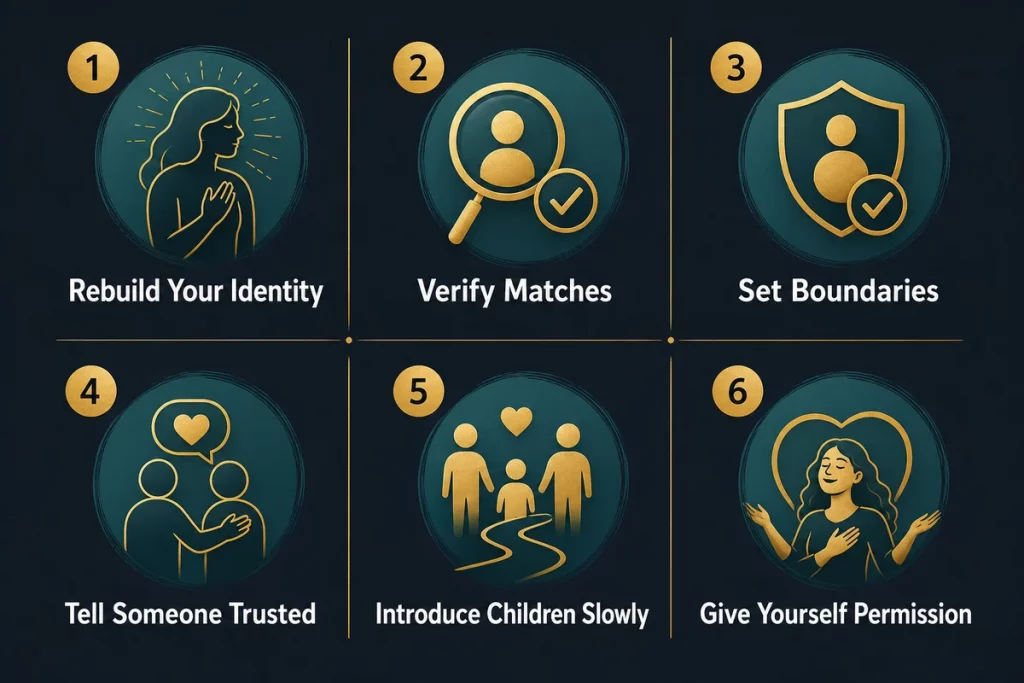
Marriage — especially a long one — absorbs individual identity into “we” identity: shared preferences, shared routines, shared social lives, shared decision-making. Divorce returns you to “I” — but the “I” that emerges is different from the “I” that entered the marriage, and figuring out who that person is represents one of the most important dating after divorce tips: know yourself before asking someone else to know you.
Rediscover your individual preferences. What do YOU like — not what did the marriage compromise to? What music do you choose when nobody else is in the car? What restaurants appeal to you when you’re not accommodating someone else’s preferences? What hobbies interest you that the marriage didn’t make room for? These questions sound simple but they’re genuinely difficult after long marriages where individual preferences were submerged into shared ones. The rediscovery process IS dating preparation — because knowing what you want from life is the prerequisite for knowing what you want from a partner.
Update your self-image. The person your ex-spouse saw — whether that image was accurate or distorted — is not the person the dating world will meet. If your marriage included criticism that eroded your confidence, conscious self-image rebuilding is necessary: what do your friends value about you? What are your genuine strengths? What do you bring to a partnership that’s worth offering? If the marriage involved gaslighting, emotional manipulation, or narcissistic abuse, the self-image distortion may require therapeutic support to correct — because the version of you that the abusive partner constructed isn’t the version that exists in reality.
Clarify your non-negotiables. Divorce teaches you what doesn’t work — which is valuable data for determining what will. Write your non-negotiables: the absolute requirements and absolute dealbreakers for your next relationship. These aren’t preferences (tall, educated, funny) — they’re standards (emotionally available, honest, respects boundaries). The clarity that comes from knowing what you won’t accept again is one of the most powerful dating after divorce tips because it prevents the repetition of patterns that ended your marriage. Common non-negotiables post-divorce include: willingness to communicate during conflict (rather than stonewalling or deflecting), financial transparency, respect for co-parenting obligations, and emotional availability that’s demonstrated through consistent behavior rather than just stated during the honeymoon phase.
Sit with being single before rushing into dating. This is perhaps the most counterintuitive of all dating after divorce tips: the best preparation for a great relationship is becoming comfortable being alone. If singleness feels unbearable — if silence in your house feels threatening rather than peaceful, if weekends without plans produce panic rather than possibility — the discomfort signals that you’re seeking a relationship to escape yourself rather than to share yourself. The ability to enjoy your own company, manage your own emotions, and create a fulfilling daily life without a partner creates the foundation from which the best partnerships emerge — because you’re choosing someone from abundance rather than grasping at anyone from scarcity.
Re-Entering Online Dating After Divorce
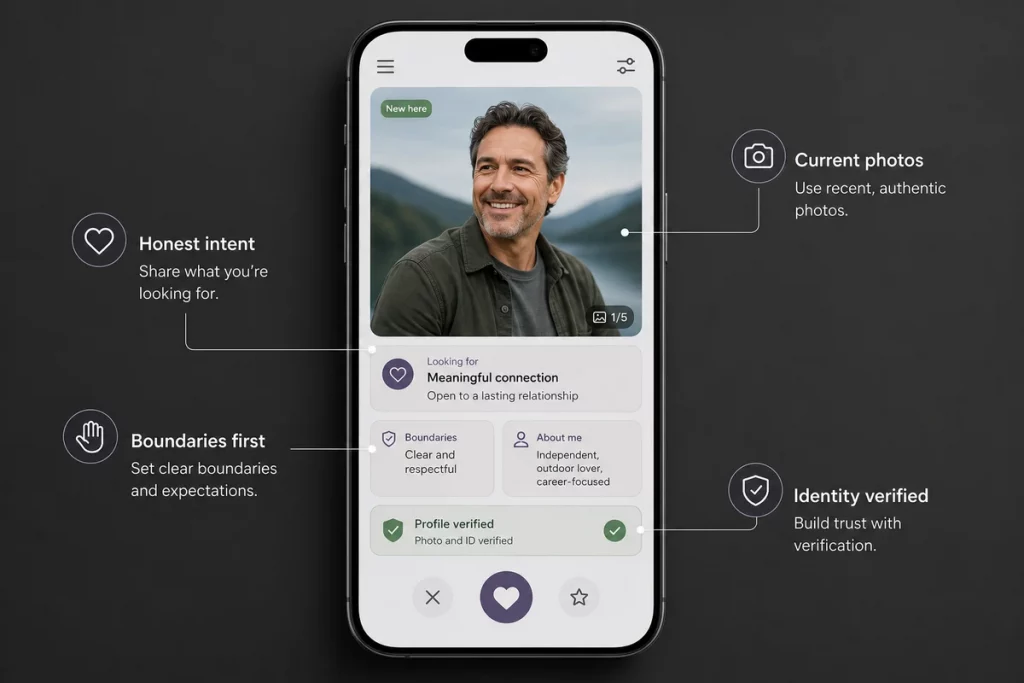
If you married before dating apps existed (or before they became the primary way adults meet), the digital dating landscape can feel overwhelming. Key dating after divorce tips for online re-entry:
Start with one platform. Hinge for relationship-focused dating; Bumble for women-initiate dynamics; Match for the over-40 demographic; or niche platforms for specific communities. Don’t spread yourself across five apps simultaneously — the cognitive load is exhausting and produces burnout before you’ve given any single platform a genuine chance. Research from the National Library of Medicine on dating app fatigue confirms that platform overload decreases match quality and increases dissatisfaction.
Your profile should be honest — not comprehensive. You don’t need to lead with “recently divorced” or provide your relationship history upfront. Your profile should represent who you are NOW — your interests, your energy, your personality. The divorce is part of your story and should be shared as the relationship develops — but it doesn’t need to headline your dating profile. Focus on what you’re looking for, not what you’re recovering from.
Verify before you invest. Online dating introduces deception risks that in-person dating doesn’t: catfishing, romance scams, identity fraud. Use reverse image search on profile photos that look too polished. Video chat before meeting in person. Use GuyID’s free screening tools for identity verification — government ID verification eliminates the most common forms of online dating fraud. Share your Date Mode link through GuyID to demonstrate your own transparency from the start.
Pace yourself. The excitement of new attention after the emotional drought of a failing marriage can lead to constant swiping, an overloaded date schedule, or rapid emotional investment in each match. Choose a pace that leaves enough time for rest and reflection between dates. Fewer, more intentional conversations may make it easier to evaluate each person on their actions rather than using match volume as a measure of progress.
Red Flags and Green Flags When Dating After Divorce
Your divorce experience sharpened your pattern recognition — use it. Key dating after divorce tips for spotting both warning signs and positive indicators:
Red flags specific to post-divorce dating: A match who badmouths their ex extensively (unprocessed anger that will eventually be directed at you). Someone who pushes for rapid commitment (“We’re not getting younger” — urgency that bypasses due diligence). A person who dismisses your divorce experience as something to “just get over” (emotional invalidation). Read our comprehensive red flags guide for the full warning-sign framework.
Green flags specific to post-divorce dating: A match who can discuss their past relationships (including any divorce) with balanced self-awareness — acknowledging both their ex’s contributions and their own. Someone who respects your pace without pressure. A person who has done genuine self-work — therapy, self-reflection, personal growth — rather than jumping from marriage to dating without processing. Someone comfortable with the complexity of your life (kids, co-parenting, financial recovery) rather than wishing it away. A partner who asks thoughtful questions about your experience rather than avoiding the topic entirely or demanding full disclosure prematurely. And someone who demonstrates through consistent behavior that they mean what they say — because after divorce, words without behavioral backing are no longer sufficient to build trust. Our green flags guide and genuine interest signs guide provide the comprehensive positive-indicator frameworks for evaluating new connections with the discernment your experience has earned.
Dating After Divorce Tips When You Have Kids
Co-parenting adds complexity to post-divorce dating that child-free divorcees don’t face — but it doesn’t make dating impossible. It makes it require more deliberation:
Don’t introduce dates to kids early. Most child psychologists recommend waiting 6-12 months of consistent dating before introducing a new partner to children — because children of divorce are already navigating attachment disruption, and meeting a series of new partners who subsequently disappear compounds that disruption. When you do introduce someone, frame them as a friend initially and allow the relationship’s role to expand gradually based on the child’s comfort and the relationship’s proven stability.
Your kids’ wellbeing is non-negotiable. A partner who competes with your children for attention, resents your parenting time, pressures you to reduce time with your kids, or attempts to parent your children before earning that role is demonstrating red flags that predict ongoing conflict. A partner who respects your parenting role, supports your co-parenting relationship (even when your ex is difficult), and takes a patient, secondary role with your children is demonstrating green flags that predict healthy family integration.
Communicate with your co-parent about dating. Depending on your co-parenting relationship, informing your ex that you’re dating — at an appropriate point, not at the first swipe — prevents them from learning through the children or social media, which typically produces worse reactions than direct communication. You don’t owe them details about who you’re dating, but transparency about the fact of dating demonstrates the co-parenting maturity that protects your children from being caught in the middle. Research from the National Library of Medicine on co-parenting dynamics confirms that children’s adjustment to parental dating correlates more strongly with the co-parents’ communication quality about dating than with the dating itself.
Your dating schedule needs to work around your parenting schedule — not the other way around. One of the most important dating after divorce tips for parents: the new relationship adapts to your parenting reality, not vice versa. If a potential partner can’t accept that your Tuesday nights are non-negotiable parent time, or that you need to leave a date early because your child is sick, they’re not equipped for the reality of dating a parent. This isn’t a limitation — it’s a compatibility filter that protects you from partners who would eventually resent the children they claim to accept.
Practical Dating After Divorce Tips That Actually Work
Set boundaries before you need them. Decide in advance: when will you become exclusive? When will you introduce a partner to friends, to family, to kids? What pace of physical intimacy feels right for where you are? What financial boundaries will you maintain (separate finances indefinitely, no co-signing, no lending)? Pre-set boundaries are easier to maintain than boundaries you try to establish in the moment when emotions and chemistry are clouding judgment.
Tell at least one trusted person about your dating life. A friend, sibling, or therapist who can provide honest feedback, reality-check your assessments, and notice patterns you might miss from inside the dynamic. After divorce, your pattern-recognition for love bombing, player behavior, and narcissistic patterns may be sharpened or (paradoxically) dulled — sharpened because you’ve experienced them, or dulled because familiarity has normalized them. An external perspective corrects both distortions.
Give yourself permission to enjoy it. After the grief, legal proceedings, financial upheaval, and identity reconstruction of divorce, dating can feel like an unearned luxury — as if you should still be mourning rather than meeting someone new. Permission to enjoy the process is one of the most underrated dating after divorce tips: you’ve done the hard work, you’ve learned the lessons, and you deserve the experience of connecting with someone who appreciates the person you’ve become. Enjoyment isn’t betrayal of the marriage — it’s evidence of recovery.
Expect setbacks without catastrophizing. Bad dates, mismatched connections, ghosting, disappointment — these are universal dating experiences, not evidence that you’re “too damaged” or “too old” or “too much.” Post-divorce daters sometimes interpret normal dating friction as confirmation of their worst fears about being unlovable or unmarriageable. It’s not. It’s dating. It’s messy for everyone. The ghosting guide and breadcrumbing guide cover common dating frustrations and how to handle them with perspective rather than devastation.
Don’t compare your new dating timeline to your married friends’ relationships. Married friends may project their own relationship anxiety onto your dating life — urging you to “get back out there” before you’re ready, or expressing concern that you’re “being too picky” when you’re actually being discerning. Their timeline isn’t your timeline, and their experience of relationships (continuous partnership) is fundamentally different from yours (rebuilding after loss). The comparison adds pressure that doesn’t serve your genuine interests. Trust your own pacing, informed by the readiness indicators above and the counsel of friends who respect your autonomy rather than projecting their preferences onto your journey.
Consider therapy as a dating asset, not a deficiency signal. Working with a therapist during the post-divorce dating transition isn’t a sign that something is wrong with you — it’s a sign that you’re investing in doing this right. A therapist provides the objective perspective, pattern recognition, and emotional processing support that accelerates both recovery and healthy partner selection. Many of the most successful post-divorce relationships begin during active therapeutic work, because the self-awareness that therapy builds translates directly into healthier partner choices and better relationship dynamics. The National Domestic Violence Hotline provides referrals specifically for those recovering from marriages that included emotional or physical abuse.
How GuyID Helps
GuyID should appear when it is useful, not as a banner ad. A GuyID Trust Profile gives someone a portable way to share trust signals before a date, while identity verification and social vouching help turn vague profile claims into clearer next steps.
Useful next steps:
- Create a GuyID Trust Profile when you want a cleaner way to share verified trust signals.
- Use GuyID free tools and related guides when you need a checklist before meeting someone.
- Treat identity verification as confidence-building, not a guarantee.
- Use social vouching when you want context from people who already know the person.
- Sign up only when the extra trust layer helps the decision you are already trying to make.
Frequently Asked Questions
How soon after divorce should I start dating?
There’s no universal timeline — readiness is emotional, not chronological. Most experts suggest 1-2 years minimum for emotional recovery, but the real indicators are: you can discuss the divorce without emotional flooding, you want a partner to share your life rather than fill a void, and your identity exists independently of being someone’s spouse. See our complete timing guide for the detailed readiness framework.
What are the best dating apps for divorcees?
Hinge for relationship-focused matching, Bumble for women-initiated connections, and Match for the over-40 demographic are the most recommended for post-divorce daters. Start with one platform to avoid burnout. Regardless of platform, use GuyID’s free tools for identity verification — because after divorce, starting with verified trust is more important than ever.
Should I tell dates I’m divorced?
Yes — but timing matters. It doesn’t need to be in your dating profile or first-date conversation. By the second or third date, when conversations naturally deepen, sharing that you’re divorced is appropriate. Be honest and balanced: “I was married for X years, we divorced X ago, and I’ve done the work to be ready for this.” Avoid extended ex-bashing or positioning yourself as entirely blameless — both indicate unprocessed material that new partners will correctly read as a warning sign.
How do I date with confidence after divorce?
Confidence comes from self-knowledge. Rebuild your individual identity before dating: rediscover preferences, update your self-image (especially if the marriage included criticism or abuse), and clarify your non-negotiables. Therapy accelerates this process. Confidence also comes from preparation: use GuyID’s tools to verify matches so you’re meeting real, transparent people. And confidence comes from permission — allowing yourself to enjoy dating as a worthy experience rather than approaching it as a test you might fail.
What’s the biggest mistake people make when dating after divorce?
Rushing — specifically, dating before processing the divorce and seeking a relationship to fill the emotional void rather than to complement an already-full life. The second biggest mistake: repeating patterns. If your marriage ended because of communication failure, control dynamics, or emotional unavailability, dating someone with the same patterns because they’re “familiar” perpetuates the cycle. Use these dating after divorce tips to break the pattern: clarify what didn’t work, identify what you need, and verify that new matches demonstrate those qualities through behavior, not just words.