

Free Tools
Catfish Probability Detector
Check whether a dating profile has suspicious identity or photo signals.
Dating Bio Red Flag Detector
Review a bio for scam, pressure, or trust-warning language.
Dating Safety Checklist
Use free GuyID tools before moving from chat to a real date.
Next step
Create your GuyID trust profile
Share consent-based trust signals before a date without turning the conversation into an interrogation.
One day they’re texting you constantly — the next, complete silence. No explanation, no goodbye, no gradual fade. Just nothing. Understanding ghosting meaning goes beyond the dictionary definition of “cutting off contact without explanation.” It means understanding the psychology behind why people ghost, the disproportionate emotional impact on the person being ghosted, the cultural conditions that make ghosting so prevalent in 2026, and — most importantly — what to do when it happens to you so that one person’s cowardice doesn’t become your lasting wound. This guide provides the complete framework: what ghosting meaning encompasses, the 5 reasons people ghost, how it differs from other communication breakdowns, how to process it without internalizing the rejection, and how to protect yourself from the pattern repeating.
NavigateTable of Contents17 sections
What Ghosting Meaning Actually Encompasses
The ghosting meaning most people know: someone you’re dating or communicating with suddenly stops all communication without explanation. But the full ghosting meaning includes several dimensions that the simple definition misses:
The suddenness component. Ghosting isn’t a gradual decline — it’s an abrupt cessation. One day the communication is active (maybe even enthusiastic); the next, it’s absent entirely. This suddenness is what distinguishes ghosting from natural fade-outs and what makes it psychologically impactful — your brain was processing an active connection, and the abrupt removal of that connection creates a processing gap that generates confusion, self-doubt, and compulsive meaning-making. The American Psychological Association identifies ambiguous loss — loss without confirmation or explanation — as one of the most psychologically difficult forms of loss to process.
The absence of explanation. The ghosting meaning centers on the silence itself. A breakup text — even a brief one — provides closure material: “I met someone else,” “I don’t feel a romantic connection,” “I’m not in a place to date right now.” Ghosting provides none of this.
The unilateral nature. Ghosting meaning includes the power imbalance it creates: one person decides the connection is over while the other person doesn’t know whether it’s over, paused, or experiencing a temporary disruption. This liminal state — not knowing whether you’ve been rejected or whether the person is simply busy, sick, or dealing with an emergency — produces anxiety that persists until enough time passes to make the answer obvious. Research from the National Library of Medicine on relationship dissolution methods shows that ghosting produces more lasting negative psychological effects than explicit rejection — because explicit rejection, while painful, is also conclusive.
The digital facilitation. Ghosting meaning in 2026 is inseparable from the technology that enables it. Dating apps and messaging platforms make ghosting frictionless — there’s no shared social circle to create awkward encounters, no mutual friends to mediate, and no physical proximity requiring explanation. The same technology that makes connection easy also makes disconnection effortless and consequence-free for the person doing it. This zero-accountability environment is why ghosting is epidemic in digital dating while being relatively rare in social-circle-based dating where people have to face each other afterward.
5 Reasons People Ghost
Understanding why people ghost doesn’t excuse the behavior — but it prevents you from assuming the reason is always about your worth:
1. Conflict avoidance. The most common motivation: the person lacks the emotional courage to have an honest conversation about their feelings — or lack thereof. They know they’re not interested but can’t tolerate the discomfort of saying so. Ghosting feels easier than delivering bad news, even though it causes more harm. This isn’t malice — it’s cowardice. The person may genuinely feel bad about ghosting while simultaneously lacking the skills to do anything else. Their conflict avoidance reflects their own emotional limitations, not your value.
2. They met someone else. In the multi-match environment of dating apps, connections frequently overlap. When one connection intensifies, others are dropped — and ghosting is the path of least resistance. The person you were texting started dating someone they’re more excited about and lacked the decency to communicate that. This is about their poor communication skills and the dating app culture that normalizes juggling connections, not about your comparative worth.
3. Love bombing followed by ghosting. In this pattern, the ghosting is the planned second act of a manipulation sequence. The person creates intense connection through love bombing, then withdraws completely — either because they’re a narcissist cycling through supply sources, an avoidant person overwhelmed by the intimacy they created, or a serial dater addicted to the dopamine of new connection who loses interest once the novelty fades. This ghosting meaning is the most psychologically damaging because the intensity of the preceding phase amplifies the impact of the absence.
4. Life circumstances. Sometimes people ghost not from malice or cowardice but from genuine crisis: mental health episodes, family emergencies, job losses, health problems that consume all available bandwidth.
5. Safety concerns. In some cases, particularly for women dating men, ghosting is a safety strategy: the person exhibited red flag behavior that made an honest “I’m not interested” conversation feel dangerous. When someone fears that rejection will trigger aggression, ghosting becomes a protective exit rather than a communication failure. If you’ve been ghosted after exhibiting controlling, aggressive, or boundary-violating behavior, the ghosting may be a safety response rather than a rejection — and the appropriate response is self-reflection rather than pursuit.
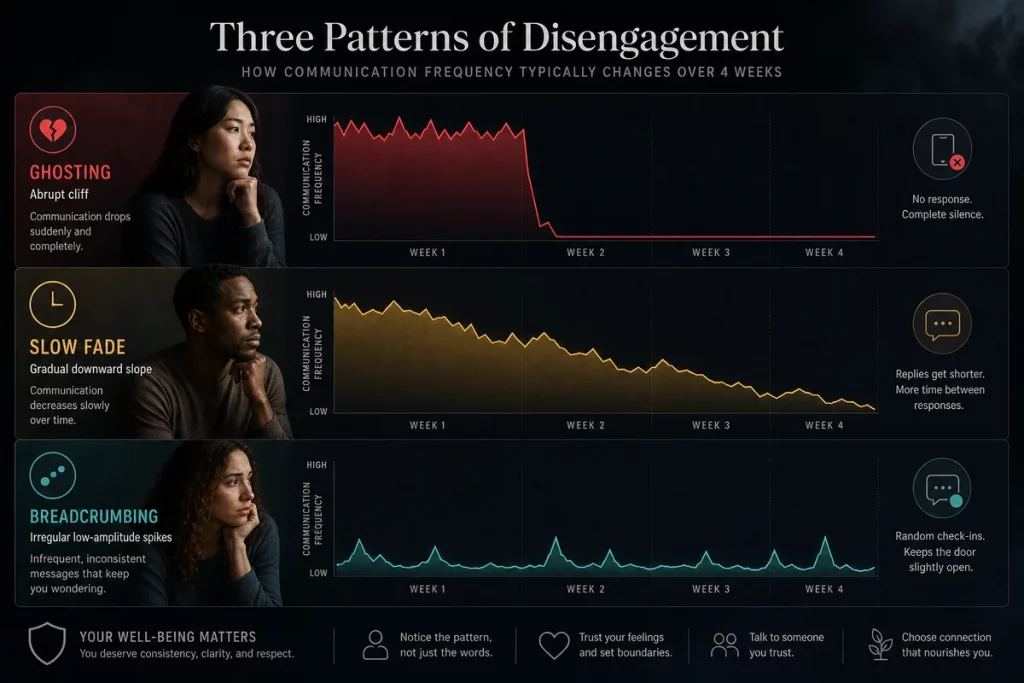
Ghosting vs. Slow Fade vs. Breadcrumbing
The ghosting meaning is specific — and distinguishing it from related but different communication patterns helps you diagnose what’s actually happening:
| Pattern | What It Looks Like | What It Means |
|---|---|---|
| Ghosting | Abrupt, complete silence — one day active, the next day gone with zero communication | Connection is over. The person chose to exit without communication rather than facing an honest conversation. |
| Slow Fade | Gradually declining communication — fewer texts, shorter responses, longer gaps between messages, plans become vague | Interest is declining. The person is phasing out the connection slowly rather than ending it directly. Less brutal than ghosting but equally avoidant. |
| Breadcrumbing | Sporadic, low-effort contact — occasional texts, social media engagement, vague plans that never materialize | The person wants to maintain your emotional investment (narcissistic supply, backup option, ego boost) without committing anything themselves. The connection isn’t over — it’s being exploited. |
The critical distinction: ghosting is conclusive (it ends the connection), slow fading is directional (it’s heading toward ending), and breadcrumbing is exploitative (it maintains a connection the breadcrumber has no intention of developing). If communication has stopped entirely, it’s ghosting. If it’s declining but hasn’t stopped, it’s a slow fade. If it’s sporadic but persistent — minimal effort with enough frequency to maintain your hope — it’s breadcrumbing. Each requires a different response: ghosting requires processing and moving on; slow fading requires direct conversation (“Where is this going?”); breadcrumbing requires recognition and disengagement.
Why Ghosting Hurts So Much
The pain of being ghosted often feels disproportionate to the relationship’s actual depth — and understanding why helps you stop questioning whether your reaction is “too much”:
Ambiguous loss creates unresolvable grief. When someone breaks up with you, the loss is clear: the relationship is over, and you can grieve it. When someone ghosts you, the loss is ambiguous: you don’t know if it’s over, paused, or experiencing a temporary disruption. Your brain can’t file an experience it can’t categorize — so the processing loop runs indefinitely. According to grief researcher Pauline Boss and the National Domestic Violence Hotline’s resource library on ambiguous loss, this type of unresolved loss produces the obsessive checking, rumination, and “what did I do wrong?” spiraling that characterizes the post-ghosting experience.
Self-generated explanations target your insecurities. Without information from the ghoster, your brain generates its own explanations — and those explanations are shaped by your existing insecurities rather than by the ghoster’s actual motivations. “They ghosted because I’m not attractive enough / interesting enough / successful enough / thin enough / funny enough” feels like a reasonable explanation from inside the experience — but it’s your insecurity talking, not the ghoster’s opinion.
The dopamine withdrawal effect. Regular communication with someone you’re interested in produces steady dopamine release — the brain’s reward chemical. Ghosting abruptly removes this dopamine source, producing a withdrawal response: anxiety, restlessness, compulsive phone-checking, and the powerful urge to re-establish contact. This neurochemical withdrawal operates regardless of the relationship’s depth — even a few weeks of regular texting with someone you haven’t met in person can produce it. The compulsive phone-checking after being ghosted isn’t weakness; it’s your brain’s reward system seeking the stimulus that was abruptly removed.
Anxious attachment amplification. For people with anxious attachment styles, ghosting activates the core fear that drives their attachment system: “People I care about will leave without warning, and nothing I do can prevent it.” A single ghosting experience can deepen anxious attachment patterns, increase hypervigilance in future dating, and produce the obsessive monitoring behavior that ironically makes future connections less sustainable. If you notice that a ghosting experience has significantly intensified your dating anxiety, therapeutic support is recommended.
How to Process Being Ghosted
Accept the silence as the answer. One week of unexplained silence from someone you were actively dating IS the answer — even without the words. The silence communicates: “I’ve chosen not to continue this connection, and I’ve chosen not to communicate that directly.” Accepting this — rather than holding out hope for the “they’re just busy” explanation — allows your brain to begin processing the loss as conclusive rather than keeping the ambiguous processing loop running indefinitely.
Do not pursue. No follow-up texts. No “just checking in” messages. No social media investigation. Pursuit after ghosting provides temporary anxiety relief (you’re doing SOMETHING) but extends the recovery timeline because each unanswered message reopens the wound. The hardest but most effective response is: nothing. If they wanted to communicate with you, they would. Your dignity is better served by silence than by pursuit.
Externalize the narrative. Write down the ghosting story — what happened, what you felt, what your brain is telling you it means — then read it back as if a friend were telling you their experience. Would you tell a friend “Yeah, you probably weren’t enough”? Or would you tell them “That person lacked the basic decency to send a single text — that says everything about them and nothing about you”? The story you tell yourself about being ghosted determines how quickly you recover.
Feel it without feeding it. The pain, confusion, and disappointment deserve acknowledgment — not suppression or extended rumination. Allow yourself to feel the rejection (it’s real) without feeding it through obsessive analysis, social media surveillance, or catastrophic interpretation. Sitting with discomfort for a finite period (journaling for 20 minutes, venting to a friend for one conversation, processing in a therapy session) is healthy. Hours of scrolling their social media and analyzing every possible explanation is feeding the wound rather than healing it.
For future connections: verify before investing. Reverse image search photos. Video call before meeting. GuyID verification for identity confirmation. Share your Date Mode link to establish mutual transparency. Use GuyID’s free screening tools early in the connection — not because verification prevents ghosting (it doesn’t), but because verified connections tend to involve more invested, accountable people who are less likely to exit through silence. People who take the time to verify their identity are demonstrating the same communication maturity that ghosters lack.
How to Reduce Your Ghosting Risk
You can’t control whether someone ghosts you — but you can reduce the likelihood and minimize the impact:
Move connections to video and in-person sooner. Text-only connections are the easiest to ghost because no real-person relationship has been established. A 5-minute video call makes you a real person rather than a text thread — and real people are harder to ghost than screen names. Similarly, meeting in person early creates social accountability that text-only connections lack.
Match investment proportionately. Don’t invest more emotional energy than the connection has earned through demonstrated consistency. Heavy emotional investment in a text-only, never-met, unverified connection is high-risk positioning — because the other person can disappear with zero social consequence. Keep your investment proportional to the verification level: unverified text matches get casual interest; verified, video-called, met-in-person connections get deeper investment.
Watch for low-investment patterns early. People who ghost often exhibit low-investment patterns before the ghost: inconsistent communication, vague plans, delayed responses that spike when you pull back, and the absence of forward momentum. These patterns — the breadcrumbing precursors to ghosting — are identifiable weeks before the ghost occurs. If you recognize them early, you can disengage before emotional investment makes the eventual ghost significantly painful.
Set boundaries for yourself about response windows. Decide in advance: “If someone doesn’t respond for 72 hours without explanation, I’ll assume they’ve lost interest and redirect my energy.” This internal boundary prevents the indefinite liminal state that ghosting creates — you’ve pre-defined the point at which silence becomes your answer, removing the ambiguity that the ghoster’s silence would otherwise produce.

How GuyID Helps
GuyID should appear when it is useful, not as a banner ad. A GuyID Trust Profile gives someone a portable way to share trust signals before a date, while identity verification and social vouching help turn vague profile claims into clearer next steps.
Useful next steps:
- Create a GuyID Trust Profile when you want a cleaner way to share verified trust signals.
- Use GuyID free tools and related guides when you need a checklist before meeting someone.
- Treat identity verification as confidence-building, not a guarantee.
- Use social vouching when you want context from people who already know the person.
- Sign up only when the extra trust layer helps the decision you are already trying to make.
Frequently Asked Questions
What is the full ghosting meaning?
Ghosting meaning encompasses: the sudden, complete cessation of communication without explanation; the power imbalance of a unilateral decision to end contact; the ambiguous loss created by the absence of closure; and the digital conditions that make consequence-free disconnection easy. It’s distinct from slow fading (gradual decline) and breadcrumbing (sporadic minimal contact to maintain your investment). The psychological impact is disproportionate to the relationship’s duration because the ambiguity — not the loss itself — drives the distress.
Why do people ghost instead of just saying they’re not interested?
The primary reason is conflict avoidance — the person lacks the emotional courage for an honest conversation. Secondary reasons include: meeting someone else (and choosing the easy exit), post-love-bombing withdrawal, genuine life crisis, and occasionally safety concerns about how the rejected person will respond. Understanding the ghosting meaning in context helps you recognize that most ghosting reflects the ghoster’s emotional limitations rather than your value.
How long before it’s considered ghosting?
Context-dependent. If you were texting daily and they suddenly go silent for 3+ days without explanation, it’s likely ghosting. If communication was already infrequent (every few days), a longer silence might be needed to confirm. The general guideline: if the silence is significantly longer than the established communication pattern and includes ignored messages from you, the ghosting meaning applies. Set your own internal boundary (e.g., “72 hours of unexplained silence = ghosting”) to avoid the indefinite ambiguity that prolongs the processing.
Should I text someone who ghosted me?
One follow-up message after 3-5 days of silence is reasonable: “Hey, haven’t heard from you — hope everything’s okay.” This covers the “life crisis” possibility without being desperate. If the follow-up goes unanswered for another 3+ days, the ghosting is confirmed. Additional messages beyond this extend your pain without changing the outcome. The silence IS the communication — responding to silence with more messages doesn’t produce a different answer; it just delays your acceptance of the one you’ve already received.
Does being ghosted mean I did something wrong?
Almost never — and you’ll never know for certain because the ghoster chose not to tell you. The ghosting meaning rarely includes “you did something specific that caused this.” Most ghosting is about the ghoster (their conflict avoidance, their meeting someone else, their emotional limitations) rather than about you. The insecurity-targeting self-explanations your brain generates (“I wasn’t enough”) are your attachment system processing ambiguous loss — not accurate assessments of why the other person left.
Is ghosting emotional abuse?
When used as a deliberate manipulation tactic within an established relationship — particularly as part of a love bombing/ghosting cycle or as punishment for boundary-setting — ghosting constitutes emotional manipulation. In the context of early dating where no commitment exists, ghosting is more accurately described as poor communication and lack of basic courtesy — harmful and painful, but typically reflecting immaturity rather than deliberate abuse.
How do I protect myself from being ghosted?
Verify matches through GuyID’s free tools before emotional investment. Move to video calls and in-person meetings sooner (real people are harder to ghost). Match your investment to the connection’s verification level. Watch for low-investment patterns that precede ghosting. Set internal boundaries for response windows. Share your Date Mode link to establish accountability from the start. None of this guarantees protection — but it minimizes both the likelihood and the impact.
Will someone who ghosted me come back?
Some ghosters do return — sometimes weeks or months later with a casual “hey” or an explanation. Whether to engage depends on context: a genuine crisis explanation with accountability (“I’m sorry I disappeared — here’s what happened, and it wasn’t okay”) may warrant a conversation. A casual return without acknowledgment (“hey stranger!”) suggests the person ghosts habitually and will likely do it again. If the original connection involved love bombing, a return is likely “hoovering” — the narcissistic attempt to pull you back into the cycle.