
Reader Briefing
Reader Briefing
Start here if you need a practical read on love bombing examples: 15 signs: who should use verification, what signals to check, and what to do before moving from online interest to an in-person plan.
Who this is for
- People meeting someone from a dating app or social platform.
- Readers preparing for a first in-person date.
- Anyone checking identity, profile consistency, and trust signals.
- People trying to avoid romance scams, fake profiles, or pressure tactics.
You’ll learn
- How to evaluate identity signals without treating any single check as certainty.
- Which trust signals matter and how to weigh them together.
- How to spot inconsistencies, pressure, or behavior patterns that deserve caution.
- How to move from online conversation to a safer first meeting.
- Where GuyID tools fit into a quick pre-date screening workflow.
- When to slow down, ask for more context, or walk away.
Bottom line
Verification reduces uncertainty; it does not guarantee future behavior. Use a layered approach: confirm identity signals, compare profile consistency, ask for a short video call, keep early plans public, and slow down when someone pressures you to skip normal safety steps.
Key takeaways
- Identity verification improves confidence, not certainty.
- Patterns matter more than isolated incidents.
- Verify before meeting privately or sharing sensitive details.
- A short video call can reveal many inconsistencies.
- Pressure to skip reasonable safety steps is useful information.
Free Tools
Catfish Probability Detector
Check whether a dating profile has suspicious identity or photo signals.
Dating Bio Red Flag Detector
Review a bio for scam, pressure, or trust-warning language.
Dating Safety Checklist
Use free GuyID tools before moving from chat to a real date.
Next step
Create your GuyID trust profile
Share consent-based trust signals before a date without turning the conversation into an interrogation.
Love bombing is the most seductive red flag in dating — because it feels exactly like falling in love. Excessive compliments, constant texting, grand romantic gestures, declarations of soulmate connection within the first week — these love bombing examples are deliberately designed to feel intoxicating rather than alarming. But the intensity isn’t authentic attraction; it’s a manipulation strategy used to create rapid emotional dependency before the real dynamic — control, devaluation, or exploitation — begins. This guide identifies 15 specific love bombing examples, explains the psychology behind why they work, and provides tools to distinguish genuine enthusiasm from manufactured intensity.
NavigateTable of Contents36 sections
What Is Love Bombing?
Love bombing is a manipulation tactic where someone overwhelms you with excessive affection, attention, flattery, and romantic intensity at the beginning of a relationship — far beyond what the actual connection or time invested would naturally produce. The term originally described cult recruitment tactics where new members are showered with attention to create rapid bonding before the group’s true nature is revealed.
In dating, love bombing serves the same purpose: creating an intense emotional bond before you have enough information to evaluate the relationship objectively. The love bomber floods your dopamine system with constant positive stimulation — compliments, gifts, attention, declarations of love — until you’re neurochemically hooked on the emotional high they provide. Once that chemical dependency is established, the dynamic shifts from idealization to control, and the person you fell for reveals a very different character underneath the performance.
The American Psychological Association recognizes love bombing as a component of narcissistic and emotionally abusive relationship patterns. Research from the National Library of Medicine links love bombing to narcissistic personality traits and the idealization-devaluation cycle that characterizes narcissistic abuse.
What makes love bombing examples so difficult to recognize in real time is that they look and feel like everything you’ve wanted in a partner. The compliments feel genuine. The attention feels earned. The connection feels rare. It’s only in retrospect — or through the lens of documented patterns — that the manufactured nature becomes visible.
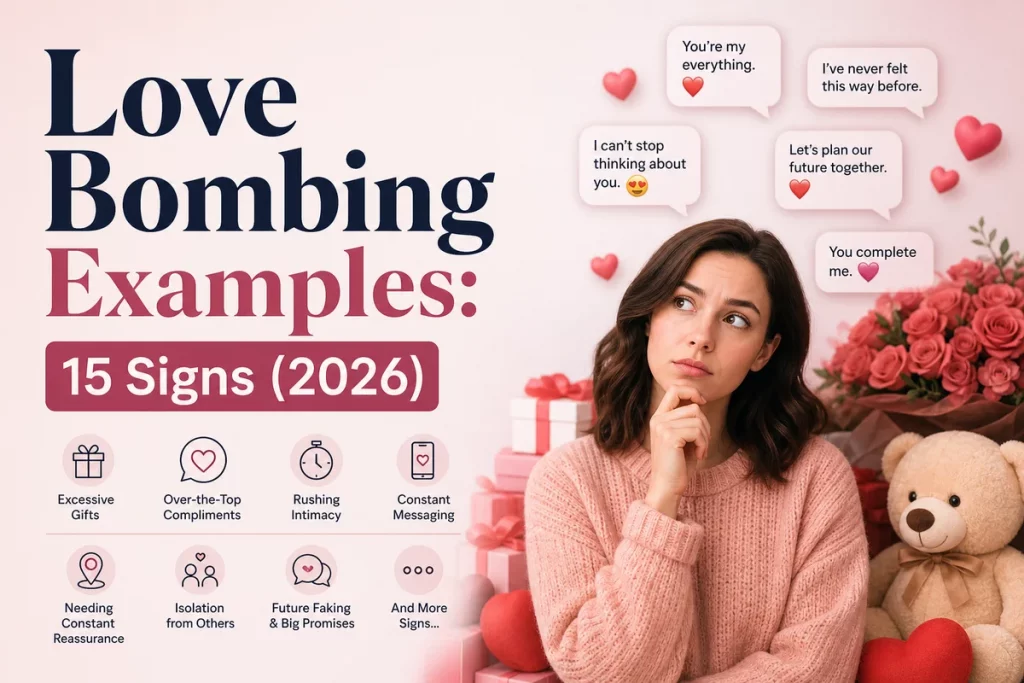
15 Love Bombing Examples
Communication Intensity (Examples 1-4)
1. Constant Texting and Calling — Morning to Night
Good morning texts, check-ins throughout the day, “just thinking about you” messages, evening calls, and goodnight texts — every single day, starting within the first few days of knowing you. The volume is flattering at first but becomes an expectation. If you don’t respond quickly, they express hurt or anxiety. This creates a dependency rhythm — your day revolves around their messages, and their absence feels like withdrawal. Genuine early dating involves frequent but not constant communication with natural gaps where both people live their independent lives.
2. Excessive Compliments That Feel Like Worship
“You’re the most beautiful person I’ve ever seen.” “No one understands me like you.” “You’re literally perfect.” When every interaction includes multiple over-the-top declarations of your perfection, the flattery serves a strategic purpose. It creates an elevated self-image that becomes addictive. When the compliments decrease during the devaluation phase, you chase the high of how they used to make you feel. These love bombing examples are calibrated to make you feel uniquely valued — so the withdrawal of validation becomes uniquely painful.
3. “I’ve Never Felt This Way Before”
Declarations of unprecedented connection within days: “You’re not like anyone I’ve ever met,” “I’ve been waiting my whole life for someone like you,” “This connection is different from anything I’ve experienced.” These statements may be genuine for connections that develop over months. Within the first week, they’re love bombing examples designed to make you feel special while eliminating skepticism. If the connection is genuinely unprecedented, it will still feel that way in three months — there’s no urgency to declare it now.
4. Immediate Social Media Declarations
Posting about you on Instagram, changing relationship status, tagging you in “couple” content before the relationship has had time to develop. Public declarations create social pressure that makes it harder to slow down, and they establish the love bomber’s claim on you in your social networks. If they’re posting “found my person” after two dates, the declaration serves their strategy regardless of how flattering it feels in the moment.
Grand Gestures (Examples 5-7)
5. Expensive Gifts Disproportionate to the Relationship Stage
Jewelry, designer items, concert tickets, or extravagant experiences within the first few weeks. Generous gift-giving creates an implied emotional debt — you feel obligated to reciprocate with emotional investment and commitment. A thoughtful, inexpensive gift showing they listened is genuine. An expensive gift showing they spent money to impress is strategic. Among love bombing examples, expensive gifts are particularly effective because they create a tangible sense of obligation that emotional attention alone doesn’t produce.
6. Elaborate Date Planning Designed to Overwhelm
Five-star restaurants, surprise weekend getaways, helicopter rides, private experiences — all within the first month. The goal isn’t generosity; it’s creating an experience so impressive you can’t imagine going back to “normal” dating. The contrast between their elaborate efforts and what you’d experience with anyone else makes leaving feel like giving up something extraordinary. After love bombing ends, the elaborate dates stop — and you find yourself doing the emotional work while receiving nothing comparable.
7. Showing Up Uninvited with “Surprises”
Appearing at your workplace with flowers, showing up at your gym because they “happened to be nearby,” dropping by unannounced with food. These are boundary violations disguised as romantic spontaneity. Uninvited appearances establish that your space is permeable — that the love bomber has access beyond what you’ve explicitly granted. This love bombing example transitions seamlessly into monitoring and control once the relationship develops.
Future Faking (Examples 8-10)
8. Planning a Future Together Within Weeks
“We should go to Italy this summer.” “I want you to meet my parents next weekend.” “I can see us getting a place together.” Future planning creates an implicit commitment that hasn’t been explicitly agreed to. By talking about your future as a shared certainty, the love bomber makes the relationship feel established before you’ve had time to evaluate whether you actually want it. These love bombing examples exploit your desire for partnership by presenting it as already decided.
9. “Soulmate” and “Destiny” Language
“We were meant to find each other.” “The universe brought us together.” “This is fate.” Destiny framing elevates the relationship from a choice to a cosmic event you’d be foolish to resist. If it’s “meant to be,” then hesitation or boundaries feel like fighting fate rather than exercising healthy judgment. Soulmate language appeals to a deep human desire to feel chosen by something larger than ourselves — which is why it’s among the most effective love bombing examples.
10. Premature “I Love You”
Saying “I love you” within the first few weeks — sometimes the first few dates. Love requires knowledge of someone — their values, their flaws, their behavior under stress, their treatment of others. “I love you” after two weeks means “I love the idea of you I’ve constructed” or “I’m strategically creating emotional commitment.” Genuine love develops through shared experience over months. Premature declarations are love bombing examples that exploit our culture’s romantic “love at first sight” narrative.
Boundary Violations (Examples 11-15)
11. Wanting All of Your Time
Every evening, every weekend, every available moment. Plans with friends are met with disappointment. Time alone is framed as distance. “I just love being with you” sounds romantic but functions as isolation — gradually replacing your social life with a single-person dependency. Time monopolization simultaneously creates bonding (shared time) and isolation (displacing other relationships). It also prevents the outside perspectives that would help you recognize the love bombing.
12. Jealousy Framed as Devotion
“I get jealous because I care so much.” “I can’t stand anyone else looking at you.” “Who was that person you were talking to?” Early jealousy is normalized as passionate investment — but it’s possessiveness previewing the controlling behavior to come. Jealousy without evidence is a love bombing example that transitions into surveillance. If they’re monitoring your interactions within the first month, the intensity will escalate, not diminish.
13. Mirroring Everything You Say and Like
You love hiking? So do they. Your favorite obscure band? Their favorite too. You value family? What a coincidence. Strategic mirroring creates the illusion of unprecedented compatibility — “We have SO much in common!” In reality, the love bomber is constructing a persona engineered to match your preferences. Watch for this: do they ever disagree with you, have different tastes, or express opinions you didn’t already hold? A real person has their own identity. A love bomber reflects yours back at you.
14. Demanding Immediate Exclusivity
“I deleted my dating apps — you should too.” “I can’t stand the thought of you talking to other people.” “We’re clearly meant to be together — why would you need other options?” Premature exclusivity pressure eliminates your ability to compare the love bomber’s behavior against other people’s — removing the baseline that would reveal the intensity as abnormal. Among love bombing examples, exclusivity pressure is particularly manipulative because it’s framed as commitment rather than control.
15. Making You Feel Guilty for Having Boundaries
“I just want to be close to you — why are you pushing me away?” “I flew across the country for you and you can’t even give me the weekend?” “If you really cared about me, you wouldn’t need space.” When boundaries are met with guilt, disappointment, or emotional punishment, the message is clear: your limits are obstacles to overcome, not preferences to respect. This is where love bombing reveals its true nature — because genuine affection respects boundaries. Only manipulation requires their removal.
Love Bombing vs. Genuine Enthusiasm
The most common question about love bombing examples: “How do I tell the difference between love bombing and someone who’s genuinely excited about me?” Here’s the distinction:
| Love Bombing | Genuine Enthusiasm |
|---|---|
| Intensity stays at maximum from day one — no natural ebb and flow | Enthusiasm builds naturally over time as you learn more about each other |
| Compliments focus on how perfect you are — no real curiosity about who you are | Genuine interest in your actual personality, opinions, and experiences |
| They get upset, anxious, or guilt-trip when you set boundaries | They respect your boundaries even when they’d prefer more time/access |
| Future plans are assumed rather than discussed (“We’re going to…”) | Future possibilities are explored collaboratively (“Would you want to…?”) |
| They mirror your interests perfectly — suspiciously few differences | They have their own interests, some shared and some different |
| The relationship feels urgent — slowing down creates anxiety or conflict | The relationship feels secure — slowing down is comfortable for both |
| Their attention feels consuming — you’re losing other parts of your life | Their attention feels enhancing — adding to your existing life, not replacing it |
The single clearest test: what happens when you set a boundary? A genuinely enthusiastic person says “I understand — take the time you need” and means it. A love bomber reacts with disappointment, guilt-tripping, or wounded theatrics designed to make you feel bad for having limits. The response to your boundaries reveals more about someone’s intentions than any amount of romantic behavior.
Why Love Bombing Works So Well
Understanding why love bombing examples feel so compelling helps you recognize the manipulation even when it feels genuine:
Dopamine flooding. Constant attention, compliments, and positive interaction flood your brain with dopamine — the same neurotransmitter activated by addictive substances and gambling. Your brain literally becomes chemically dependent on the love bomber’s attention. When that attention is later withdrawn (during devaluation), the withdrawal feels like depression — because neurochemically, it is.
Confirmation of worth. In a culture where many people carry insecurities about their attractiveness, lovability, and value, someone who mirrors your ideal relationship fantasy and declares you perfect feels like confirmation that you’re worthy of love. Love bombing examples exploit this universal vulnerability — the desire to be seen, valued, and chosen.
The scarcity illusion. “I’ve never felt this way” and “this is a once-in-a-lifetime connection” create a sense that the relationship is rare and irreplaceable. If you let this go, you’ll never find it again. This manufactured scarcity makes you overlook red flags because the perceived cost of losing the connection feels unbearable.
Social proof and commitment escalation. Early public declarations, meeting friends and family, shared future planning, and social media “couple” posts create external social proof that the relationship is “real” and “serious.” Once your social network recognizes you as a couple — and congratulates you, celebrates with you, adjusts their own plans around you as a unit — the social cost of leaving increases dramatically. This is exactly the commitment trap love bombing creates: external validation that makes questioning the relationship feel like disappointing everyone, not just your partner.
What Comes After Love Bombing
Love bombing is Phase 1 of a documented cycle. Understanding what follows removes the surprise that keeps victims trapped:
Phase 2: Devaluation. The person who couldn’t get enough of you gradually becomes critical, distant, and dissatisfied. The compliments decrease. The attention wanes. Criticism — subtle at first, then overt — replaces admiration. You’re confused because the person who adored you now seems disappointed by everything you do. This isn’t a natural relationship adjustment; it’s the emotional abuse cycle transitioning from idealization to devaluation.
Phase 3: Discard or control. The love bomber either abandons you (moving on to a new target who provides fresh narcissistic supply) or establishes a controlling dynamic (using the emotional dependency created during love bombing to maintain power). In the control version, intermittent returns to love bombing behavior keep you hooked — sporadic glimpses of “the person I fell in love with” that create trauma bonds and prevent you from leaving.
Phase 4: Hoovering. If you do leave, the love bomber often returns — with renewed intensity, promises of change, and a revival of the original love bombing examples. This “hoovering” (named after the vacuum cleaner brand) sucks you back into the cycle. Without awareness of this pattern, many victims return to the relationship multiple times before breaking free permanently.
For detailed coverage of this cycle: narcissistic abuse signs | gaslighting in relationships | emotional manipulation tactics
How to Respond to Love Bombing
If you recognize these love bombing examples in a current connection, here’s how to protect yourself:
Slow down deliberately. Resist the urgency. If the connection is genuine, it will survive a slower pace. If it’s love bombing, slowing down will trigger resistance — which is itself diagnostic. Set a personal rule: no “I love you” before three months, no exclusivity before genuine compatibility assessment, no moving in before a year. Timelines force patience that love bombing can’t tolerate.
Maintain your existing life. Keep seeing friends. Keep your hobbies. Keep your routine. A healthy partner enhances your existing life; a love bomber replaces it. If someone makes you feel guilty for maintaining your independence, that guilt is the red flag — not your independence.
Set a boundary and watch the response. “I’m not available this weekend — I have plans with friends.” “I’m not ready to be exclusive yet.” “I appreciate the gifts, but I’d rather you not spend this much.” The response to boundaries is the single most reliable test of whether someone’s intensity is genuine enthusiasm or love bombing. Respect = genuine. Guilt/anger/anxiety = manipulation.
Ask trusted friends for their perspective. Love bombing floods your judgment with neurochemistry. Friends who aren’t inside the dopamine haze can see the pattern more clearly. If multiple people in your life express concern about the intensity — “Don’t you think this is moving really fast?” — listen to them. They’re seeing what the love bombing is designed to hide from you.
Verify before trusting. Use reverse image search to confirm photos are real. Cross-reference on social media for a consistent identity. Run a phone number lookup. Ask for GuyID verification. A genuine person welcomes verification. A love bomber resists it — because accountability threatens the manufactured persona. Share your Date Mode link and observe whether they reciprocate transparency or deflect it.
Trust the pattern over the feeling. Love bombing feels incredible. The feeling is real — the situation creating the feeling is not. If you recognize five or more of the love bombing examples above in your current connection, the pattern is more reliable than the emotion. Your feelings are being deliberately manufactured. The manipulation is sophisticated precisely because it produces genuine emotional responses.
How GuyID Helps
GuyID should appear when it is useful, not as a banner ad. A GuyID Trust Profile gives someone a portable way to share trust signals before a date, while identity verification and social vouching help turn vague profile claims into clearer next steps.
Useful next steps:
- Create a GuyID Trust Profile when you want a cleaner way to share verified trust signals.
- Use GuyID free tools and related guides when you need a checklist before meeting someone.
- Treat identity verification as confidence-building, not a guarantee.
- Use social vouching when you want context from people who already know the person.
- Sign up only when the extra trust layer helps the decision you are already trying to make.
Frequently Asked Questions
What are the most common love bombing examples?
The most frequently reported love bombing examples are: constant texting/calling from day one, excessive compliments that feel like worship, premature “I love you” declarations, expensive gifts disproportionate to the relationship stage. Future planning within weeks, wanting all of your time, and guilt-tripping when you set boundaries. The combination of multiple examples simultaneously is the strongest indicator.
How do I know if it’s love bombing or just excitement?
Set a boundary and observe the response. Genuine excitement respects boundaries — “I understand, take your time.” Love bombing reacts to boundaries with guilt, disappointment, or anxiety — “I thought we had something special.” Also watch for: do they have their own identity (vs. mirroring yours), does the intensity have natural variation (vs. constant maximum), and do they respect your other relationships (vs. competing with them)?
Is love bombing always intentional?
Not always. Some people love bomb unconsciously — repeating patterns learned in their own attachment history or driven by anxious attachment. However, intentionality doesn’t change the impact. Whether deliberate or unconscious, love bombing examples create the same unhealthy dependency and the same damaging cycle. If the behavior matches the pattern, protect yourself regardless of the person’s awareness.
What happens after love bombing stops?
Love bombing typically transitions into devaluation — criticism, emotional distance, and withdrawal of the attention you became dependent on. This creates the abuse cycle: idealization (love bombing) → devaluation → discard → hoovering (return of love bombing to pull you back in). Understanding this cycle before experiencing it is the best protection.
Can you love bomb someone without being a narcissist?
Yes. Intense early attention can occur for different reasons, and the behavior alone does not establish a personality disorder or motive. Focus on observable patterns such as pressure, ignored boundaries, control, and abrupt withdrawal rather than attempting to diagnose the person.
How long does love bombing usually last?
Typically 2-12 weeks — long enough to establish emotional dependency but not long enough for the manufactured intensity to become unsustainable. Some love bombers maintain the phase longer if they’re pursuing a specific goal (marriage, financial access, immigration benefit). The duration varies, but the transition to devaluation is virtually universal when love bombing is the mechanism rather than genuine connection.
Is love bombing a red flag on dating apps?
Yes — and it often starts before you’ve even met in person. Dating app love bombing examples include: extremely long, intense first messages, rapid escalation to “soulmate” language, pressure to move off-app quickly, immediate daily texting rituals, and future planning before the first date. These patterns are dating app red flags that warrant caution. Verify with GuyID’s screening tools before investing emotionally.