
Reader Briefing
Reader Briefing
Start here if you need a practical read on emotional abuse cycle wheel explained: who should use verification, what signals to check, and what to do before moving from online interest to an in-person plan.
Who this is for
- People meeting someone from a dating app or social platform.
- Readers preparing for a first in-person date.
- Anyone checking identity, profile consistency, and trust signals.
- People trying to avoid romance scams, fake profiles, or pressure tactics.
You’ll learn
- How to evaluate identity signals without treating any single check as certainty.
- Which trust signals matter and how to weigh them together.
- How to spot inconsistencies, pressure, or behavior patterns that deserve caution.
- How to move from online conversation to a safer first meeting.
- Where GuyID tools fit into a quick pre-date screening workflow.
- When to slow down, ask for more context, or walk away.
Bottom line
Verification reduces uncertainty; it does not guarantee future behavior. Use a layered approach: confirm identity signals, compare profile consistency, ask for a short video call, keep early plans public, and slow down when someone pressures you to skip normal safety steps.
Key takeaways
- Identity verification improves confidence, not certainty.
- Patterns matter more than isolated incidents.
- Verify before meeting privately or sharing sensitive details.
- A short video call can reveal many inconsistencies.
- Pressure to skip reasonable safety steps is useful information.
Free Tools
Catfish Probability Detector
Check whether a dating profile has suspicious identity or photo signals.
Dating Bio Red Flag Detector
Review a bio for scam, pressure, or trust-warning language.
Dating Safety Checklist
Use free GuyID tools before moving from chat to a real date.
Next step
Create your GuyID trust profile
Share consent-based trust signals before a date without turning the conversation into an interrogation.
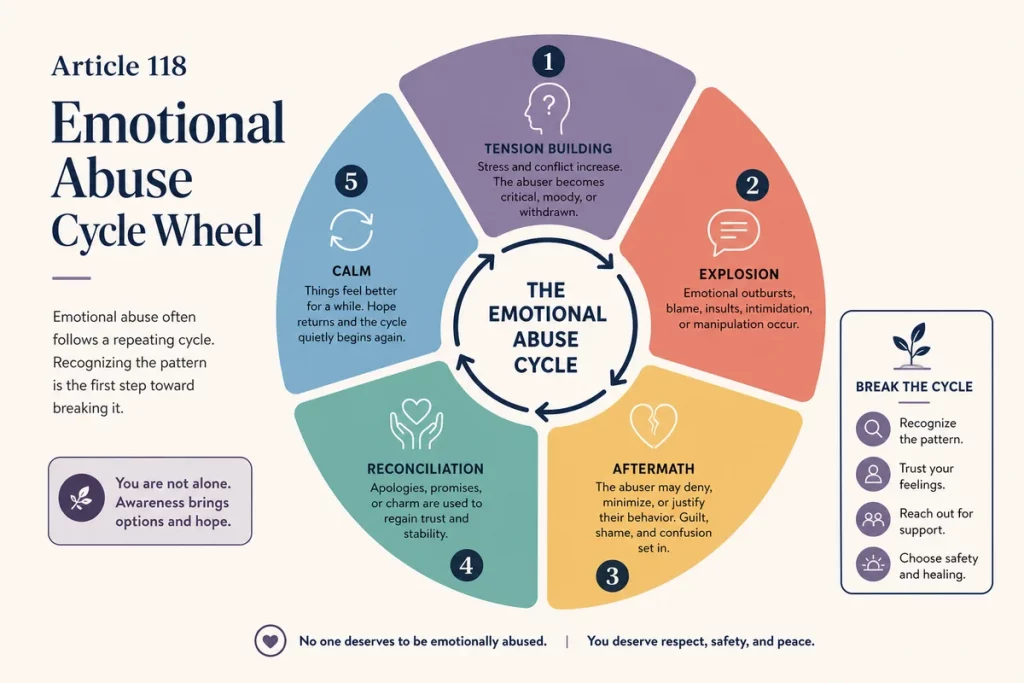
If your relationship feels like an endless loop — explosive conflict followed by apologies and honeymoon periods, then tension building again until the next eruption — you may be trapped in what therapists call the emotional abuse cycle wheel. This repeating pattern of tension, incident, reconciliation, and calm is not a series of unrelated “bad days.” It’s a documented psychological pattern that keeps victims emotionally bonded to their abuser while the abuse escalates over time. Understanding the emotional abuse cycle wheel is one of the most powerful tools for recognizing what’s happening and breaking free from it.
NavigateTable of Contents20 sections
What Is the Emotional Abuse Cycle Wheel?
The emotional abuse cycle wheel is an educational framework used to describe recurring patterns in some abusive relationships. This guide uses a four-phase model as a reflection aid, not a diagnostic rule. Individual experiences do not necessarily follow a fixed or predictable sequence.
What makes this cycle so dangerous is that it creates an emotional rhythm that feels like a normal relationship with “ups and downs” — when in reality, the pattern is a control mechanism. The “good” phases (reconciliation, calm) aren’t genuine recovery; they’re strategic resets that keep the victim invested and hopeful while the abuser regains control and prepares for the next rotation.
The emotional abuse cycle wheel applies to all forms of intimate partner abuse — physical, emotional, psychological, and sexual. This guide focuses specifically on emotional abuse cycles, where the “incident” phase involves manipulation tactics like gaslighting, rage, blame-shifting, silent treatment, and humiliation rather than physical violence. The psychological dynamics are identical.
The 4 Phases of the Emotional Abuse Cycle Wheel
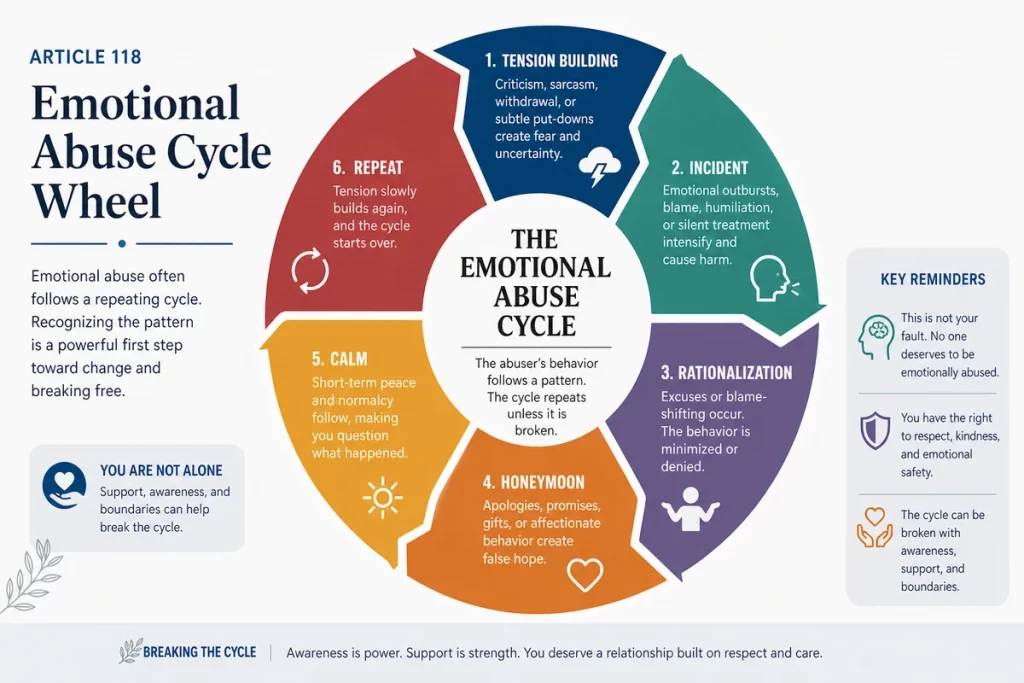
Phase 1: Tension Building
Duration: Days to weeks
What happens: Stress accumulates. The abuser becomes increasingly irritable, critical, and emotionally volatile. Minor annoyances trigger disproportionate reactions. Communication becomes strained. You feel the atmosphere shifting — like a storm approaching. You begin walking on eggshells, carefully monitoring your words and behavior to prevent escalation.
What you feel: Anxiety, hypervigilance, a sense of impending doom. You may try to “fix” the situation by being more accommodating, quieter, more compliant — anything to prevent the eruption you sense is coming.
What the abuser does: Picks fights over trivial things, makes snide remarks, withdraws affection, expresses dissatisfaction with everything you do. The tension phase serves as a control mechanism — your fear of what comes next makes you more compliant and easier to manage.
Phase 2: Incident (Acute Abuse Episode)
Duration: Minutes to days
What happens: The tension erupts. In emotional abuse, this manifests as explosive rage, extended gaslighting sessions, vicious verbal attacks, threats, humiliation, stonewalling that lasts days, or emotional cruelty designed to devastate. The abuser releases the accumulated tension through behavior that leaves you emotionally shattered.
What you feel: Fear, shock, devastation, helplessness. Even if you’ve been through this phase before, the intensity still overwhelms. You may dissociate, shut down emotionally, or experience trauma responses like shaking, crying uncontrollably, or numbness.
What the abuser does: Unleashes the full range of their emotional manipulation tactics. This phase often includes the worst gaslighting, the cruelest use of your vulnerabilities, and the most extreme blame-shifting. The incident phase is where the most psychological damage occurs.
Phase 3: Reconciliation (The “Honeymoon” Phase)
Duration: Hours to weeks
What happens: The abuser shifts dramatically — becoming apologetic, affectionate, attentive, and remorseful. They may cry, promise to change, buy gifts, plan romantic gestures, or return to the love bombing behavior from the relationship’s beginning. This phase is the most psychologically confusing because the person you fell in love with seems to have returned.
What you feel: Relief, hope, love, confusion. The contrast between the incident and the reconciliation creates a rush of positive emotion — similar to the relief after a threat is removed. This neurochemical response mimics the early stages of falling in love, which is what makes the emotional abuse cycle wheel so addictive.
What the abuser does: Says everything you need to hear — “I’m sorry,” “It’ll never happen again,” “I’ll get help,” “You’re the most important person in my life.” These promises are almost never followed by sustained behavioral change. The reconciliation phase exists to reset your hope and keep you in the relationship for the next cycle.
Phase 4: Calm (The “Normal” Phase)
Duration: Days to months
What happens: Things seem genuinely better. The relationship feels stable and even happy. The abuse seems like an aberration rather than a pattern. You may think “We’ve turned a corner” or “That was a one-time thing.” During this phase, the abuser may follow through on some promises — attending a therapy session, being more attentive, reducing criticism.
What you feel: Normalcy, optimism, investment. This phase is where you recommit to the relationship. The calm confirms your hope that the good version of your partner is the “real” one and the abuse was temporary.
What the abuser does: Maintains normal behavior long enough for the emotional wounds to heal and for your guard to drop. Then, gradually, the tension begins building again — and the emotional abuse cycle wheel turns once more.
Why the Cycle Repeats
The emotional abuse cycle wheel doesn’t repeat by accident — it repeats because the cycle itself creates the conditions for its own continuation. Understanding the mechanisms helps explain why intelligent, capable people stay in abusive relationships:
Intermittent reinforcement creates addiction. The unpredictable alternation between pain (incident phase) and pleasure (reconciliation/calm phases) creates a dopamine pattern identical to gambling addiction. Your brain becomes hooked on the “highs” of reconciliation precisely because they follow devastating “lows.” This is the neurological basis of trauma bonding — and it operates below conscious awareness.
Hope is the trap. Each reconciliation phase provides just enough evidence that change is possible. The abuser’s temporary transformation — their tears, their promises, their returned affection — feels like proof that the person you fell in love with is still there. Walking away means abandoning that hope, which feels like losing the relationship twice.
Each cycle normalizes the abuse. With each rotation, your baseline for “normal” shifts. Behavior that shocked you in the first cycle becomes expected by the fifth. The escalation is gradual enough that the new normal never feels dramatically different from the previous normal — even though, over months and years, the severity increases significantly.
Isolation removes external perspective. By the time the cycle is established, the abuser has typically reduced your connections to friends, family, and other reality-checking relationships. Without external voices saying “this isn’t normal,” the cycle’s internal logic goes unchallenged. You measure your relationship against the relationship itself rather than against healthy standards.
Self-blame keeps you invested. Through consistent blame-shifting and gaslighting, the abuser has convinced you that the problems are partly or entirely your fault. “If I could just be a better partner, they wouldn’t get angry.” This belief system — installed by the abuse itself — motivates you to try harder rather than leave, which keeps the cycle turning.
How the Cycle Escalates Over Time
A critical truth about the emotional abuse cycle wheel: it gets worse, not better. Research consistently shows that without intervention, the cycle intensifies with each rotation. Understanding this escalation pattern is essential because it counters the hope — “maybe this time things will really change” — that keeps victims trapped. Here’s how each phase changes over time:
Tension phases get longer. Early in the relationship, calm periods may last months. Over time, the calm phase shrinks while the tension phase expands — until the relationship feels like permanent tension punctuated by brief incidents and minimal reconciliation.
Incident phases get more severe. What starts as criticism and guilt-tripping escalates to gaslighting, threats, and emotional cruelty. The severity increases incrementally — each cycle pushing slightly beyond the previous one — which makes the escalation invisible from inside the relationship.
Reconciliation phases get shorter and less convincing. Early reconciliations may involve genuine-seeming remorse. Over time, the “apologies” become perfunctory — “I’m sorry, okay?” — or disappear entirely, replaced by silence followed by resumption of normal behavior as if nothing happened.
Calm phases disappear. Eventually, the cycle may collapse into a two-phase pattern: tension and incident, tension and incident — with no reconciliation or calm at all. At this stage, the abuse is continuous and the victim is in significant psychological danger.
Important: Research published in the National Library of Medicine shows that emotional abuse escalation is the strongest predictor of eventual physical violence. If your emotional abuse cycle is escalating, please take it seriously. Contact the National Domestic Violence Hotline (1-800-799-7233) for confidential guidance.
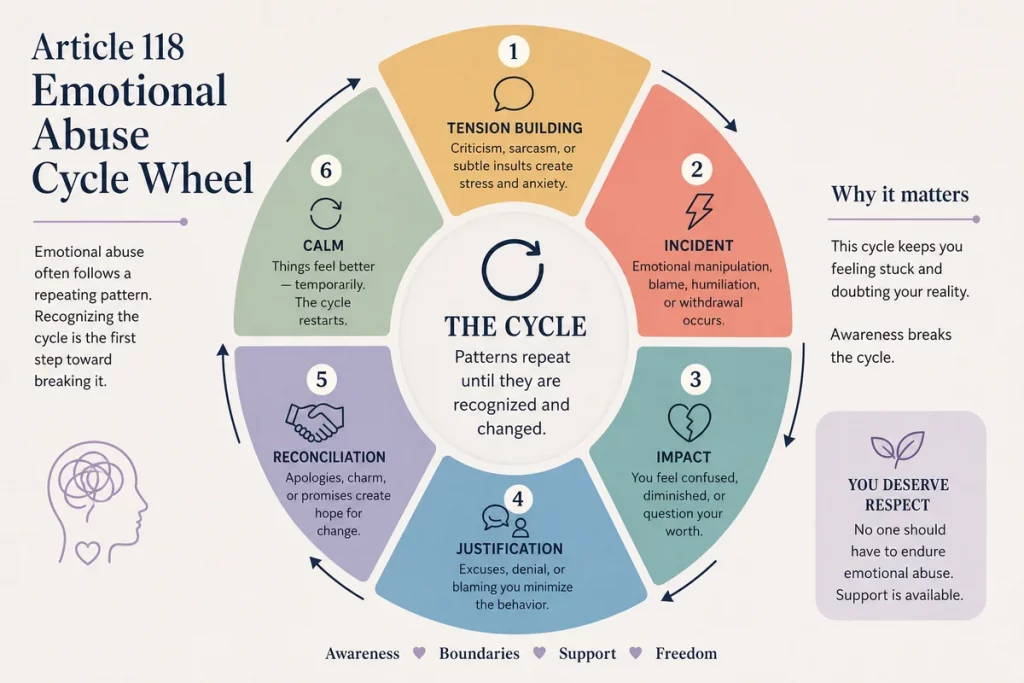
How to Break the Cycle
Breaking free from the emotional abuse cycle wheel requires recognizing the pattern, building external support, and taking deliberate action:
Name the cycle. Once you can identify which phase you’re currently in, the cycle loses some of its power. “I’m in the tension phase” or “This reconciliation doesn’t mean the abuse is over — it means Phase 3 is happening” transforms confusing emotional turbulence into a predictable pattern. Awareness is the first crack in the cycle’s hold.
Document the pattern. Keep a private journal tracking the phases. Note: when tension starts building, when the incident occurs, when reconciliation begins, and how long the calm lasts. Over multiple cycles, you’ll see the pattern clearly — and you’ll see the escalation. Written records also counteract the gaslighting that tells you “it wasn’t that bad” during the calm phase.
Rebuild your support system. Reconnect with friends, family, or a therapist. The cycle depends on isolation — external perspectives break its logic. Share this article with someone you trust. Let them help you see the pattern from outside.
Get professional support. A therapist experienced in abuse dynamics can help you understand the cycle, develop a safety plan, and rebuild the self-trust that the abuse has eroded. The National Domestic Violence Hotline (1-800-799-7233) provides free, confidential guidance specifically for emotional abuse.
Plan your exit during the calm phase. The calm phase is when you have the most clarity, energy, and safety to plan. Use this window to secure finances, gather important documents, arrange a safe place, and inform your support network. Leaving during the reconciliation phase is hardest because hope is strongest — the calm phase provides a clearer emotional window for practical planning. If you’re unsure how to plan, the National Domestic Violence Hotline can walk you through a safety plan step by step. Many people need multiple calm-phase planning sessions before they’re ready to act — this is normal and doesn’t mean you’re failing.
Use our assessment tools. Take the emotional abuse quiz or review the emotional abuse checklist to evaluate the full scope of what you’re experiencing. Understanding the breadth of the pattern strengthens your resolve and validates your experience.
Protect yourself in future relationships. When you’re ready to date again, the awareness you’ve gained is your strongest defense. Watch for early-stage cycling — love bombing followed by withdrawal — which is the embryonic form of the emotional abuse cycle wheel. Use GuyID’s verification and free screening tools to establish accountability from the start, and share your Date Mode link to set a transparency-first foundation.
How GuyID Helps
GuyID should appear when it is useful, not as a banner ad. A GuyID Trust Profile gives someone a portable way to share trust signals before a date, while identity verification and social vouching help turn vague profile claims into clearer next steps.
Useful next steps:
- Create a GuyID Trust Profile when you want a cleaner way to share verified trust signals.
- Use GuyID free tools and related guides when you need a checklist before meeting someone.
- Treat identity verification as confidence-building, not a guarantee.
- Use social vouching when you want context from people who already know the person.
- Sign up only when the extra trust layer helps the decision you are already trying to make.
Frequently Asked Questions
What are the 4 stages of the emotional abuse cycle wheel?
The four stages are: (1) Tension Building — stress accumulates, the abuser becomes irritable and critical, you walk on eggshells. (2) Incident — the abuse erupts through gaslighting, rage, silent treatment, or emotional cruelty. (3) Reconciliation — the abuser becomes apologetic, affectionate, and makes promises to change. (4) Calm — the relationship seems normal and stable, until tension begins building again.
Why can’t I break the abuse cycle?
The cycle creates neurochemical addiction through intermittent reinforcement — the same mechanism that makes gambling addictive. The unpredictable alternation between abuse and affection creates trauma bonds that operate below conscious awareness. Combined with isolation, gaslighting, and self-blame, the cycle is extraordinarily difficult to break without external support. This is not a personal failure — it’s a predictable response to a manipulation pattern specifically designed to prevent escape.
Does the emotional abuse cycle always get worse?
In the vast majority of documented cases, yes. Without intervention, abuse escalates. Tension phases lengthen, incident phases intensify, reconciliation phases shorten, and calm phases diminish. Research shows that emotional abuse escalation is also the strongest predictor of eventual physical violence. If your cycle is escalating, please seek professional support immediately.
Can the abuse cycle be broken without leaving?
Rarely. Breaking the cycle requires the abuser to: recognize their behavior as abusive, take full responsibility, commit to sustained professional therapy, and demonstrate lasting behavioral change. Most abusers lack this capacity or willingness. Couples therapy is generally not recommended for abusive dynamics because the abuser may use the therapeutic setting to further manipulate.
Is the honeymoon phase in the cycle real love?
No. The reconciliation phase feels like love — and the emotions you experience during it are genuine — but the abuser’s behavior during this phase is strategic, not authentic. The apologies, gifts, and affection exist to prevent you from leaving after the incident phase. The clearest evidence: if the “love” were real, the abuse would stop. In the emotional abuse cycle wheel, reconciliation is a tool of control, not an expression of genuine care.
How do I know which phase I’m in?
Tension phase: you feel anxious, hypervigilant, like you’re walking on eggshells. Incident phase: active abuse is occurring — gaslighting, rage, silent treatment, emotional attacks. Reconciliation phase: your partner is suddenly apologetic, affectionate, and promising change. Calm phase: things seem normal and stable. Tracking these phases in a private journal over several weeks will reveal the pattern clearly.
Where can I get help to break the abuse cycle?
The National Domestic Violence Hotline (1-800-799-7233) provides free, confidential guidance. A therapist specializing in abuse or trauma can help you understand the cycle and develop a safety plan. Take our emotional abuse quiz or review the emotional abuse checklist for self-assessment. Support communities on Reddit (r/emotionalabuse, r/NarcissisticAbuse) connect survivors with peer understanding.
Can the emotional abuse cycle happen in dating before a relationship?
Yes — an embryonic version appears in early dating. Love bombing (reconciliation/calm equivalent) followed by sudden withdrawal or criticism (tension/incident equivalent) followed by renewed intense attention (reconciliation again) creates a mini-cycle that hooks you early. Recognizing this pattern during dating — before emotional investment deepens — is your best window for escape. Verify matches with GuyID and watch for dating app red flags.