Free Tools
Catfish Probability Detector
Check whether a dating profile has suspicious identity or photo signals.
Dating Bio Red Flag Detector
Review a bio for scam, pressure, or trust-warning language.
Dating Safety Checklist
Use free GuyID tools before moving from chat to a real date.
Next step
Create your GuyID trust profile
Share consent-based trust signals before a date without turning the conversation into an interrogation.
NavigateTable of Contents29 sections
You suspect someone you’re talking to isn’t who they claim. The photos feel too polished. The stories don’t add up. The video call keeps getting cancelled. Your gut says something is wrong — but you need evidence, not just instinct. A catfish people search is the systematic process of investigating a suspected fake identity to determine who — if anyone — is actually behind the profile. Not to stalk. Not to harass. To protect yourself from the $1.3 billion annual romance scam industry (FTC, 2026) by verifying whether the person you’re investing time and emotion in actually exists as presented. This guide provides every tool, technique, and search method available for conducting a catfish people search — from free options you can use right now to advanced methods for stubborn cases.
When to Run a Catfish People Search
Not every doubt warrants a full investigation. But certain patterns should trigger a catfish people search — because they’re the documented indicators that the person you’re talking to may not be who they claim.
High-Priority Triggers (Investigate Now)
- 🔴 They refuse or repeatedly cancel video calls after days or weeks of enthusiastic texting
- 🔴 Any financial request — regardless of the reason or the relationship duration
- 🔴 Photos seem too polished, too professional, or too consistent in quality (potential AI-generated or stolen)
- 🔴 Story details change between conversations — biographical facts that should be consistent aren’t
- 🔴 They push to move off the dating app to WhatsApp within hours of matching
Moderate-Priority Triggers (Investigate Before Meeting)
- 🟡 Social media presence is very thin — few posts, few followers, recently created accounts
- 🟡 They’re always available to text but never available for calls or video
- 🟡 Their claimed location doesn’t match message timing (3am texts from someone supposedly in your timezone)
- 🟡 Love-bombing intensity — “I’ve never felt this way” in the first week
- 🟡 Career claims that conveniently explain unavailability — military deployed, oil rig, international business
If you recognize 2+ high-priority triggers or 3+ moderate triggers: run the investigation. The 30 minutes you invest now may prevent weeks of wasted emotional investment — or thousands of dollars in scam losses.
The 5-Layer Investigation Method
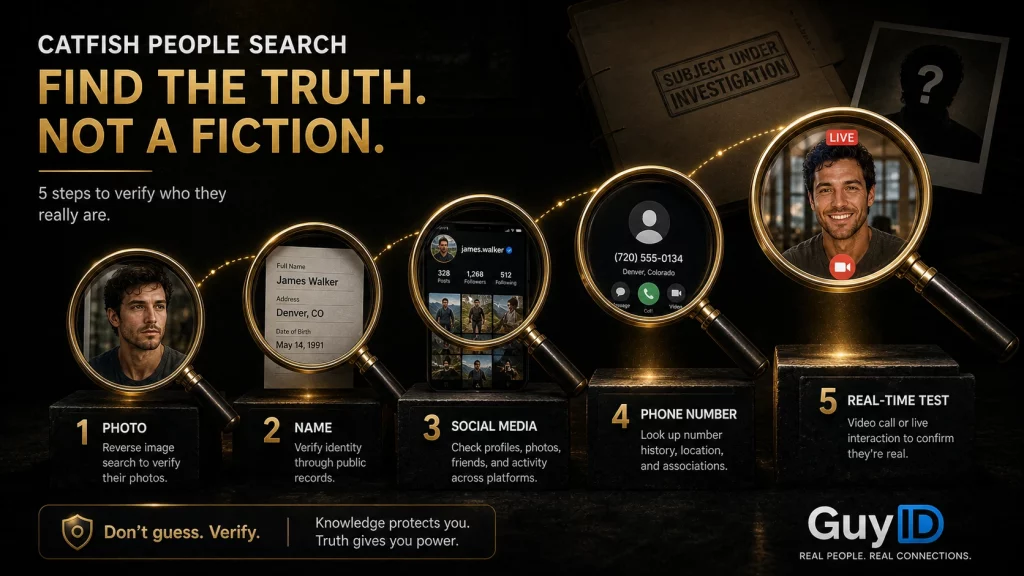
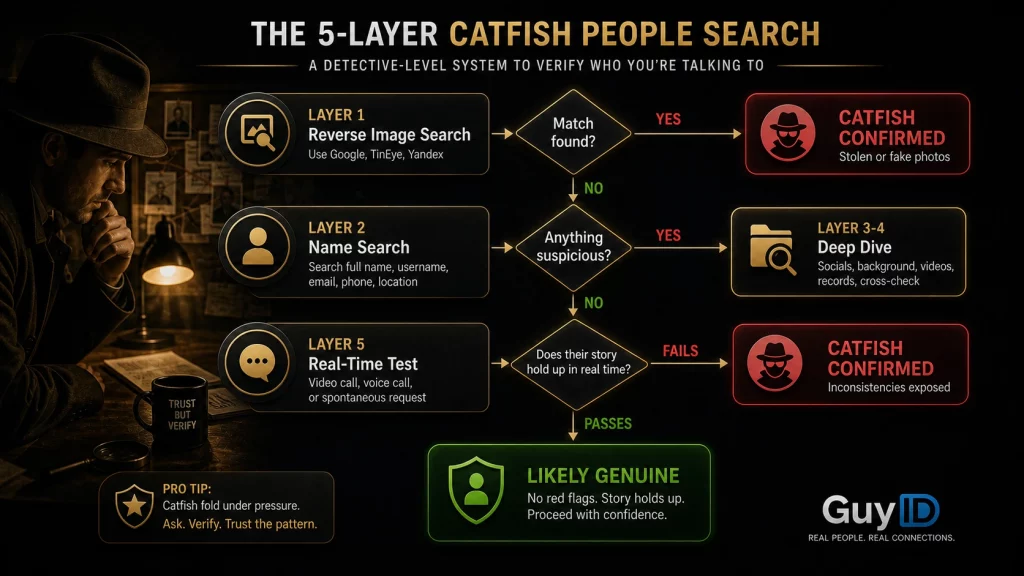
A thorough catfish people search uses five investigation layers — each designed to catch a different type of deception. Run them in order: each layer builds on the previous one’s findings.
| Layer | What It Searches | What It Catches | Cost |
|---|---|---|---|
| 1. Reverse Image | Their photos against the internet | Stolen photos linked to different identities | Free |
| 2. | |||
| 3. Social Media | Their digital footprint across platforms | Thin, inconsistent, or recently fabricated online presence | Free |
| 4. | |||
| 5. Real-Time Verification | Their ability to prove identity on demand | Anyone who can’t appear as their claimed identity in real time | Free |
Inline visual 1
Layer 1: Reverse Image Search (Most Important First Step)
The reverse image search is the single most effective catfish detection tool — catching the majority of fake profiles that use stolen photos from real people’s social media, stock photo sites, or modeling portfolios.
How to Run It
- GuyID Reverse Image Search (recommended first): Upload their photo to GuyID’s free tool. Searches across multiple databases. Results in seconds. No account required.
- Google Images: Go to images.google.com → click the camera icon → upload the photo or paste the URL. Google searches its index for matching or visually similar images.
- TinEye: tineye.com — specialized reverse image search engine. Useful for finding exact matches that Google may miss, particularly older images.
- Yandex Images: yandex.com/images — the Russian search engine has an exceptionally strong facial recognition search. Particularly effective for finding photos that appear on non-English websites.
How to Interpret Results
- Photo found under a different name: 🔴 Definitive catfish — the photo belongs to someone else. The person you’re talking to is using a stolen identity.
- Photo found on a stock photo site: 🔴 Definitive fake — nobody uses their own stock photos on a dating profile.
- Photo found on multiple dating profiles with different names: 🔴 Serial scam operation reusing the same photos across platforms.
- No results found: 🟡 Ambiguous — could mean it’s a genuine personal photo (good) OR an AI-generated image with no source (requires further investigation). Proceed to Layers 2-5.
Searching Multiple Photos
Don’t stop at one photo. Search every photo on their profile. A catfish may use a mix of stolen photos from different sources — and one may be traceable even if others aren’t. Also search any photos they’ve sent you in conversation — selfies, vacation photos, daily life images. The more photos you search, the higher the probability of finding a match.
Layer 2: Name and Identity Search
If Layer 1 doesn’t produce definitive results (AI-generated photos return nothing), Layer 2 searches the person’s claimed identity against real-world records.
Free Methods
- LinkedIn search: Search their claimed name + claimed profession. Real professionals have LinkedIn profiles. Absence doesn’t confirm catfish (not everyone uses LinkedIn), but presence with matching details (photo, career, location) provides strong verification. Mismatched details are a red flag.
- Facebook/Instagram search: Search their name on social platforms. Look for: matching photos, consistent biographical details, a posting history stretching back years (hard to fabricate), and mutual connections with real people.
- Google name search: “First Last” in quotes + their claimed city. Real people have digital footprints: news mentions, professional profiles, directory listings, organization memberships, alumni associations. A person with zero Google results for their claimed name + city is either extremely private or doesn’t exist as claimed.
Paid Methods
- People search sites: BeenVerified, Spokeo, TruthFinder, WhitePages Premium — search by name, location, age. Return associated addresses, phone numbers, relatives, and sometimes social media profiles. Useful when free methods are inconclusive.
- Background check services: More comprehensive than people searches. Include criminal records, court filings, and sex offender registry. $20-100+. Most valuable when Layer 2 confirms the name is real and you want to verify they’re safe to meet.
Layer 3: Social Media Cross-Reference
Layer 3 maps the person’s claimed identity against their social media footprint — looking for the depth and consistency that only genuine, long-term social media use produces.
What Genuine Social Media Looks Like
- Account age: years old, not weeks or months
- Posting history: regular posts stretching back years with natural evolution
- Social connections: tagged in others’ photos, comments from real people, mutual connections with other genuine accounts
- Content consistency: interests, locations, life events match what they’ve told you in conversation
- Photo variety: casual + polished, solo + with friends, different settings and timeframes
What Fabricated Social Media Looks Like
- 🟡 Account created recently (weeks/months before matching with you)
- 🟡 Very few posts or followers — thin digital presence
- 🟡 No interactions from other people — no comments, no tags, no shared content
- 🟡 All photos are professional/polished quality — no casual real-life content
- 🔴 Profile information contradicts what they’ve told you (different location, different career)
- 🔴 Friends list is mostly other accounts with similar thin profiles (potential fake network)
Cross-Platform Consistency Check
Search their name across multiple platforms (LinkedIn, Facebook, Instagram, Twitter/X). A real person has consistent biographical information across platforms — same name, same general career, same location, same approximate age. Inconsistencies between platforms (different career on LinkedIn vs what they told you, different city on Facebook vs their dating profile) are strong catfish indicators.
Layer 4: Phone Number and Communication Search
If the person has shared their phone number (after moving to WhatsApp or text), the number itself can be investigated.
Phone Number Investigation
- Reverse phone lookup: Search the number on Google (in quotes: “555-123-4567”). Real numbers often appear in business directories, social profiles, or online records. Results matching their claimed name and location = positive signal. No results = ambiguous. Results under a different name = red flag.
- Carrier check: Free tools like FreeCarrierLookup.com identify whether a number is a landline, mobile, or VoIP. Mobile = expected. VoIP (Google Voice, TextNow, Skype) = 🟡 potential disposable number used for anonymity. Scammers frequently use VoIP numbers that can be created and discarded.
- WhatsApp profile photo: Check if their WhatsApp profile photo matches their dating profile photos. Mismatched WhatsApp photo = they’re using different photos in different contexts (why?).
- Caller ID apps: Truecaller and similar apps can sometimes identify the name associated with a phone number through crowd-sourced databases.
Layer 5: Real-Time Verification Tests
The most decisive layer in the catfish people search — because real-time tests require the person to prove they exist as claimed, on demand, in the moment.
The Spontaneous Selfie Test
“Hey, can you send me a selfie right now holding up [number] fingers next to something [color]?” A real person does this in 10-15 seconds. A catfish — whether using stolen photos, AI-generated images, or managing multiple targets — can’t produce a matching spontaneous photo on demand. Excuses (“My camera is broken,” “I’m not looking good right now,” “I’ll send one later”) to a 10-second request are functionally a confirmation of catfishing.
The Video Call Test
“Want to do a quick video call? Just 5 minutes — would be nice to see you before we keep going.” A genuine person agrees. A catfish can’t appear on camera as their stolen/AI identity. Repeated refusal after weeks of texting = near-certain catfish. If they agree: apply active deepfake testing (head turns, hand-over-face, environment tour) to catch the small percentage who use real-time deepfake overlays.
The Specificity Test
“Show me around your kitchen!” or “What does the view from your window look like right now?” Requests for specific, real-time environmental proof that requires being in the location they claim. A real person living in their claimed apartment can show you their kitchen in 5 seconds. A scam operator in a different country cannot.
The GuyID Trust Profile Request
“Do you have a GuyID Trust Profile? I check before meeting anyone from an app.” This is the most efficient Layer 5 test: a verified Trust Profile confirms government ID + social vouches + Trust Tier in 10 seconds. A catfish can’t produce one — because government ID verification requires the real documents they don’t possess. The request itself is the filter. The response is the verdict.
How to Interpret Your Results
| Finding | Interpretation | Action |
|---|---|---|
| Photos found under different name | 🔴 Confirmed catfish — stolen photos | Stop all contact. Report. Block. If money sent: report to FBI IC3 + FTC. |
| Refused video call 3+ times | 🔴 Near-certain catfish | Stop investing. Disengage. No meeting without video call. |
| No image results + thin social media + VoIP number | 🟡 Strong catfish indicators — possibly AI-generated identity | Apply Layer 5 tests (spontaneous selfie, video call, GuyID request). Response determines verdict. |
| Name matches LinkedIn + social media + passes video call | ✅ Likely genuine — multiple data points align | Proceed with normal first date safety. Request GuyID Trust Profile for full confirmation. |
| Passes all 5 layers + has GuyID Trust Profile at TRUSTED | ✅✅ Strong confirmation — identity verified across every dimension | Meet with confidence following standard first date safety. |
What to Do When You Confirm a Catfish
Step 1: Stop All Contact
Do not confront, explain, or give them a chance to “explain.” Confrontation gives the catfish information about what triggered your suspicion — which they use to refine their technique for the next victim. Stop responding. Block on all channels.
Step 2: Report Everywhere
Report the profile on the dating app where you matched (include evidence: screenshots, reverse image search results). Report on WhatsApp/social platforms if they contacted you there. Your report contributes to the platform removing the profile — protecting the next person.
Step 3: If Money Was Involved
Report to FBI IC3 (ic3.gov) and FTC (reportfraud.ftc.gov). Contact your bank immediately about the transactions. If crypto was involved, report to the FBI’s cryptocurrency fraud unit. Financial recovery is difficult but not impossible if reported quickly. See the complete catfish recovery guide.
Step 4: Process the Experience
Being catfished is an emotional experience — even if you caught it early. You invested time, emotion, and trust in a fabricated person. Allow yourself to process the feelings without shame. 20+ million Americans have encountered fake profiles. You’re not naive — you were targeted by a professional operation. Talk to someone you trust about what happened.
The Easier Path: Verify Before Investigation Becomes Necessary
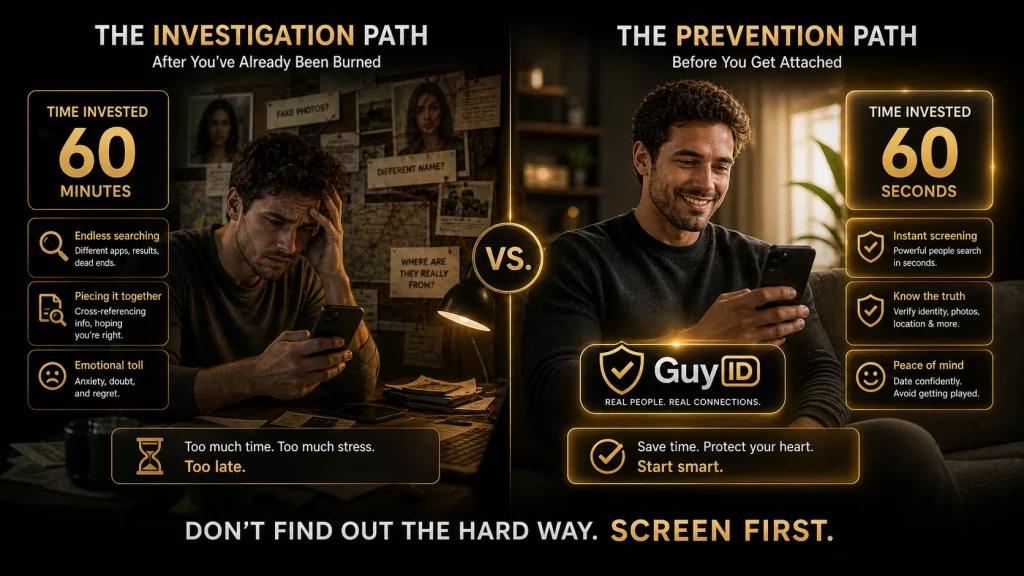
A catfish people search takes 30-60 minutes when suspicion is already high and emotional investment already exists. The easier path: verify identity before emotional investment begins — so the investigation never becomes necessary.
The 60-Second Prevention vs 60-Minute Investigation
GuyID’s free screening tools — reverse image search, catfish probability detector, bio red flag detector — take 60 seconds per match and catch the majority of fakes before conversation begins. The GuyID Trust Profile check takes 10 seconds and confirms government-verified identity with social vouches. Together: 70 seconds of prevention that eliminates the need for 60 minutes of investigation.
The proactive approach: screen every match with free tools (60 seconds), request a Trust Profile before meeting (10 seconds to check), and video call within the first week (5 minutes with active testing). If all three pass: the catfish question is resolved. If any fail: you’ve invested minutes, not months.
The tools exist. Apply them before the question “Am I being catfished?” becomes urgent — because by then, the emotional cost has already been paid.
Frequently Asked Questions
How do I find out if someone is catfishing me?
What’s the best catfish search tool?
Can reverse image search detect AI-generated photos?
What should I do if I confirm someone is a catfish?
Is it legal to investigate someone I’m dating online?
How can I avoid needing to investigate in the first place?
What if the reverse image search finds nothing?
How long does a catfish people search take?
Inline visual 2
Related Reading
- Two-Step Verification for Dating: Why One Step Isn’t Enough (2026)
- How to Spot a Catfish on Social Media (2026)
Evidence note
The FTC reported 64,003 romance-scam reports in 2023, with $1.14 billion in reported losses and a $2,000 median reported loss (Federal Trade Commission, 2024).