Free Tools
Catfish Probability Detector
Check whether a dating profile has suspicious identity or photo signals.
Dating Bio Red Flag Detector
Review a bio for scam, pressure, or trust-warning language.
Dating Safety Checklist
Use free GuyID tools before moving from chat to a real date.
Next step
Create your GuyID trust profile
Share consent-based trust signals before a date without turning the conversation into an interrogation.
A catfish account can cause financial, identity, privacy, and emotional harm. With generated photos and synthetic profiles becoming easier to create, spotting a catfish on social media requires more than gut instinct. This guide gives you 14 practical signs, verification tools, and steps to take if you have already been targeted.
NavigateTable of Contents32 sections
What Is a Catfish on Social Media?
A catfish on social media is someone who creates a fake online identity — using stolen or AI-generated photos, fabricated personal details, and invented life stories — to deceive other people into emotional or financial relationships. The term comes from the 2010 documentary “Catfish” and has since entered mainstream vocabulary as social media catfishing has become increasingly common.
Catfishing happens on every social media platform: Facebook, Instagram, TikTok, Snapchat, Twitter/X, LinkedIn, and dating apps.
Not every fake profile operator has the same motivation. Some want money (romance scams). Some want emotional validation. Some want revenge against an ex. Some are predators seeking to exploit vulnerable people. And some are simply bored and seeking entertainment at others’ expense. Regardless of motivation, the impact on victims is real and often severe — financial loss, emotional trauma, trust issues, and in some cases, physical danger.
Understanding how to identify a catfish on social media is a core digital literacy skill in 2026, whether you’re dating online, networking professionally, or simply connecting with new people. For a broader overview of catfishing specifically in dating contexts, see our guide on how to tell if someone is catfishing you.
Why Do People Catfish on Social Media?
Understanding motivations helps you recognize the patterns. Here are the primary reasons people create catfish accounts on social media:
Financial fraud (romance scams). These accounts create fake identities to build romantic connections that eventually lead to money requests. The Federal Trade Commission documents recurring stories used by romance scammers and advises people not to send money or invest based on an online relationship.
Emotional validation and loneliness. Some people create idealized online personas because they’re unhappy with their real identity. They use stolen photos of attractive people to receive attention, compliments, and emotional connection they feel unable to get as themselves. While the motivation may be sympathetic, the impact on their victims — who invest real emotions in a fabricated person — is genuinely harmful.
Revenge and harassment. Catfish accounts are sometimes created to impersonate someone else — often an ex-partner, rival, or target of harassment. The fake account may post embarrassing content, damage the real person’s reputation, or harass their contacts. This form of catfishing can constitute identity theft, defamation, or cyberbullying, depending on jurisdiction.
Predatory behavior. Some social media catfishers are predators who use fake identities to build trust with vulnerable individuals — particularly minors, elderly people, or people going through emotional crises. The fake identity provides cover for manipulation, exploitation, or abuse that the predator would be unable to accomplish under their real identity.
Scam infrastructure. Organized fraud networks maintain thousands of catfish accounts across social media platforms as part of their operational infrastructure. These accounts are used for romance scams, investment fraud, phishing campaigns, and identity harvesting. A single fraud operation may control hundreds of catfish profiles simultaneously, each at different stages of engagement with different targets. See our analysis of why people create fake dating profiles for more on the organizational side.
14 Signs You’re Talking to a Catfish on Social Media
These red flags apply across all social media platforms. A single sign may not confirm catfishing, but three or more together should trigger serious caution.
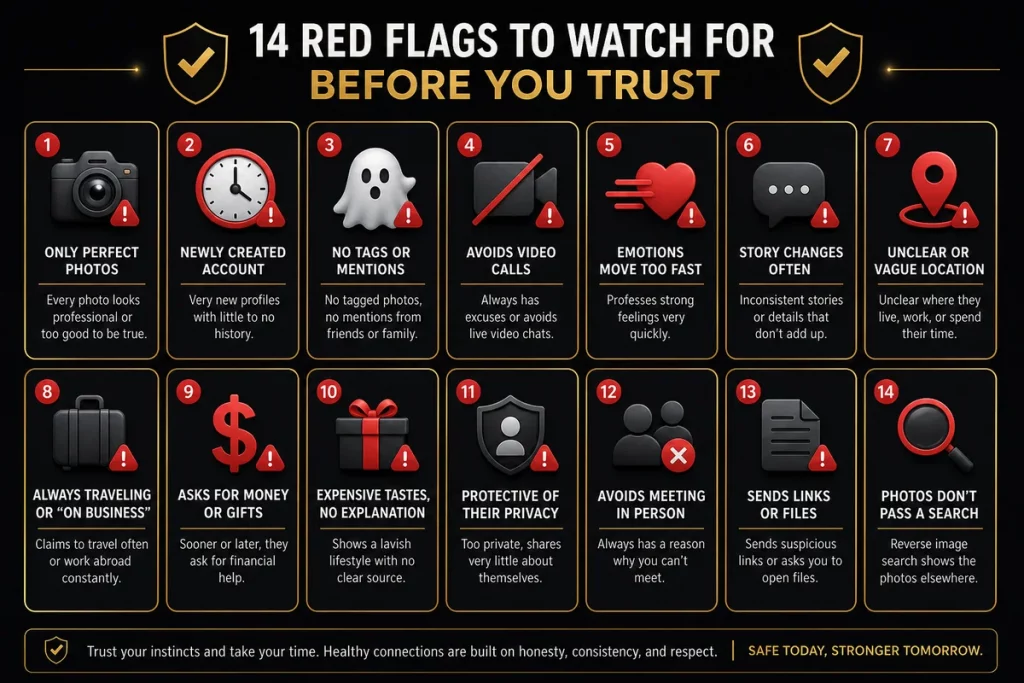
1. Their Photos Look Professional or Too Perfect
Real social media accounts have a mix of quality — professional photos alongside casual shots, blurry group pictures, and unflattering candids. A catfish on social media typically has only high-quality, well-lit photos that look like they came from a modeling portfolio or stock photo site. Every image is flattering, every angle is perfect, and there are no spontaneous or casual moments.
High Indicator
2. They Have Very Few Photos — or Too Many That Look Staged
Catfish accounts either have very few photos (because they only have a limited number of stolen images) or an overwhelming collection of images that all look like they were taken in the same session or by the same photographer. Look for consistency over time — a real person’s photos span years, seasons, and situations.
Medium Indicator
3. No Tagged Photos from Other People
This is one of the most reliable catfish indicators. Real social media users are tagged in other people’s photos — at events, gatherings, holidays, and everyday moments. A catfish on social media can upload their own photos but cannot appear in other real people’s tagged photos. If someone has dozens of self-uploaded images but zero tags from friends, that’s a major red flag.
High Indicator
4. Their Account Is New
Check when the account was created. A genuine social media presence accumulates over years — posts dating back to 2015, 2018, or earlier. A catfish account was typically created within the past few months. On Facebook, look at the “Joined” date. On Instagram, scroll to their earliest posts. A new account with dozens of polished photos but no history before this year is suspicious.
High Indicator
5. Low Engagement on Their Posts
A real person with 500 followers gets likes and comments from friends — inside jokes, birthday wishes, reactions to life events. A catfish account may have hundreds or thousands of followers (often purchased) but minimal genuine engagement. Look for the quality of interactions, not the quantity of followers. Generic comments like “Nice pic!” from other suspicious-looking accounts don’t count.
Medium Indicator
6. They Won’t Video Chat
This is the #1 verification test, and it’s decisive. A real person will agree to a quick video call or FaceTime. A catfish physically cannot show you the face of the person they’re impersonating. If someone refuses video after two polite requests, they are not who they claim to be.
Critical Indicator
7. Inconsistencies in Their Story
Pay attention to details. They said they live in Chicago but their timezone doesn’t match. They claim to be a doctor but don’t know basic medical terminology. They mentioned a sister last week but referred to being an only child this week. Catfish managing multiple fake identities often mix up details. Keep mental notes and watch for contradictions.
Medium Indicator
8. They Message You First with Unusual Flattery
A stranger reaching out with excessive compliments — “You’re the most beautiful person I’ve ever seen,” “I feel an instant connection just looking at your profile” — is following a catfish script. Real people initiate conversations based on shared interests, mutual connections, or contextual topics. Over-the-top flattery from a stranger is a manipulation technique, not a compliment.
Medium Indicator
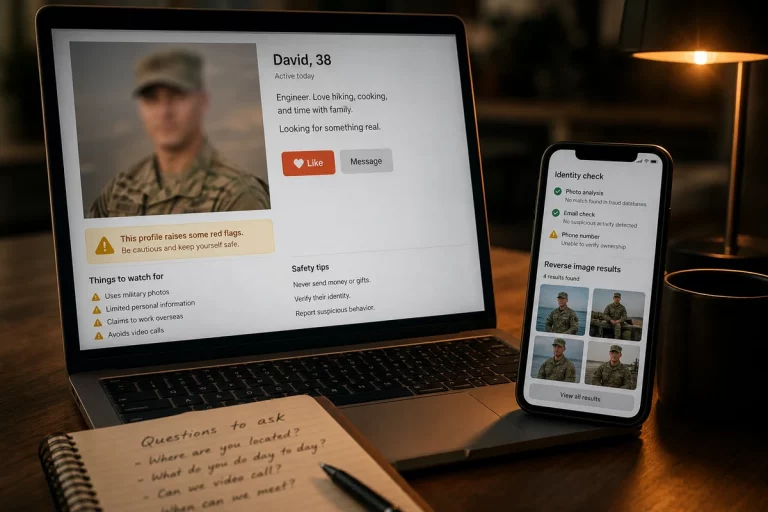
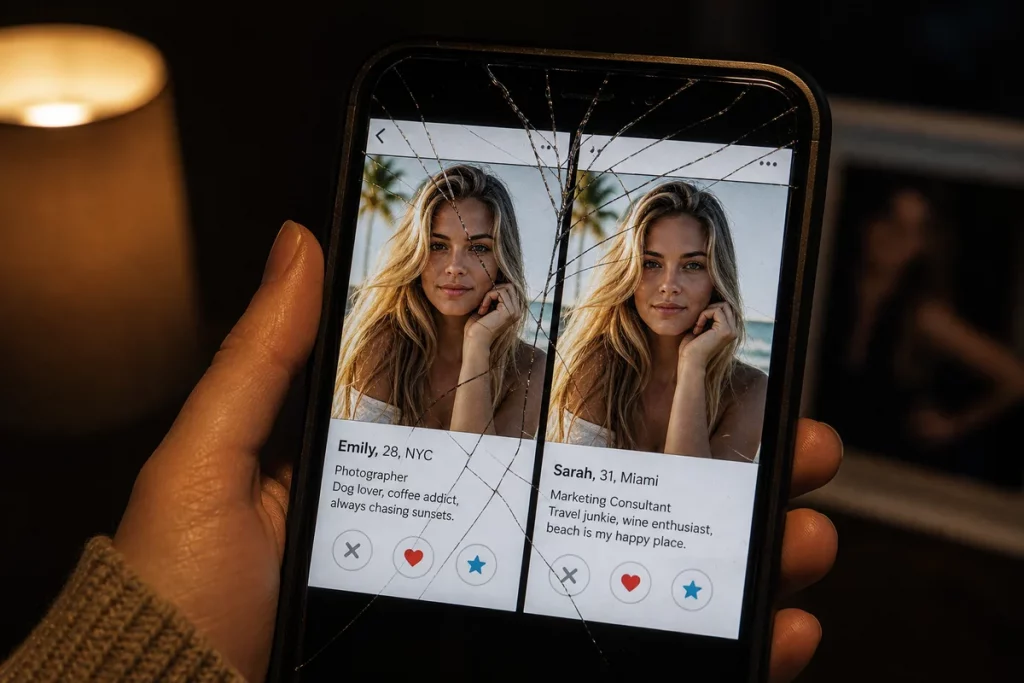
9. Their Reverse Image Search Returns Multiple Identities
The definitive catfish test. Run their profile photos through Google Reverse Image Search, TinEye, or reverse image search tools designed for dating. If the same photos appear on other profiles under different names, on stock photo sites, or on scam-warning databases, you’ve confirmed a catfish. This is the most reliable method for identifying a catfish on social media in 2026.
Definitive Indicator
10. They Escalate Emotionally at an Unnatural Speed
Love declarations within days, discussions of marriage and future plans within weeks, and intense emotional dependency before you’ve even met — this is love bombing, and it’s a hallmark of both catfish and romance scammers. Genuine emotional connection develops over time through shared experiences, not through accelerated texting.
High Indicator
11. They Avoid Meeting in Person
While genuine scheduling conflicts happen, a pattern of consistent avoidance over more than a few weeks is a clear signal. A catfish can never meet you because they don’t look like their photos.
High Indicator
12. They Ask for Money or Financial Information
The ultimate confirmation. Any request for money — emergency funds, travel costs, medical bills, investment opportunities, gift cards, or cryptocurrency — from someone you’ve only met online is fraud. This applies regardless of how long you’ve been communicating, how genuine the relationship feels, or how compelling the story sounds. Learn the full pattern of romance scam warning signs.
Confirmed Catfish / Scam
13. Their Friends List Looks Suspicious
On Facebook especially, examine their friends list. A catfish account often has friends that are also fake — similar creation dates, similar photo quality, similar lack of genuine engagement. Or their friends are clustered geographically in a region that doesn’t match their claimed location. A real person has friends from different life stages, schools, workplaces, and locations.
Medium Indicator
14. Their Content Lacks Personal Voice
Scroll through their posts and captions. Real people share opinions, inside jokes, complaints about traffic, photos of meals, random observations, and content that reflects a genuine personality. Catfish accounts post generic motivational quotes, reposted memes, and surface-level captions that could belong to anyone. The absence of authentic personal voice is a subtle but reliable indicator.
Medium Indicator
Where Catfish Operate: Platform-by-Platform
Catfish on social media adapt their tactics to each platform’s unique features. Here’s how catfishing looks across the major platforms:
Catfish exploit Facebook’s friend-of-friend trust model, join local community groups to appear legitimate, and use Facebook Messenger for private conversations. Facebook Dating adds another layer of exposure. Red flag: a Facebook account with recent creation date, few friends, and mostly shared meme content.
Instagram: The platform most associated with stolen attractive photos. Instagram catfish create aspirational lifestyle accounts — travel photos, fitness content, luxury settings — all stolen from real influencers or generated by AI. They initiate contact through DMs and story replies. Red flag: a polished account with high follower count but low genuine engagement (comments from real friends).
TikTok: Increasingly targeted by catfish who repost other people’s videos, create accounts using viral clips, or use AI voice cloning to create synthetic content. TikTok’s algorithm can surface catfish accounts to millions of users, giving them a veneer of legitimacy through view counts. Red flag: an account with high views but no original video content or face-to-camera interaction.
LinkedIn: Professional catfishing has surged since 2023. Fake profiles claiming executive roles at real companies are used for investment scams and pig butchering. LinkedIn’s professional context makes users more willing to share details and accept connection requests. Red flag: a recently created profile with a vague job title at a large company, no mutual connections, and an unsolicited message about “opportunities.”
Dating apps (Tinder, Bumble, Hinge): Catfishing on dating apps follows all the same patterns but with accelerated timelines because users are explicitly seeking romantic connection. The emotional stakes are higher and the deception is more targeted. For platform-specific protection, see our guides on Hinge scams, Bumble scams, and fake profiles on Tinder.
AI-Generated Catfish: The 2026 Threat
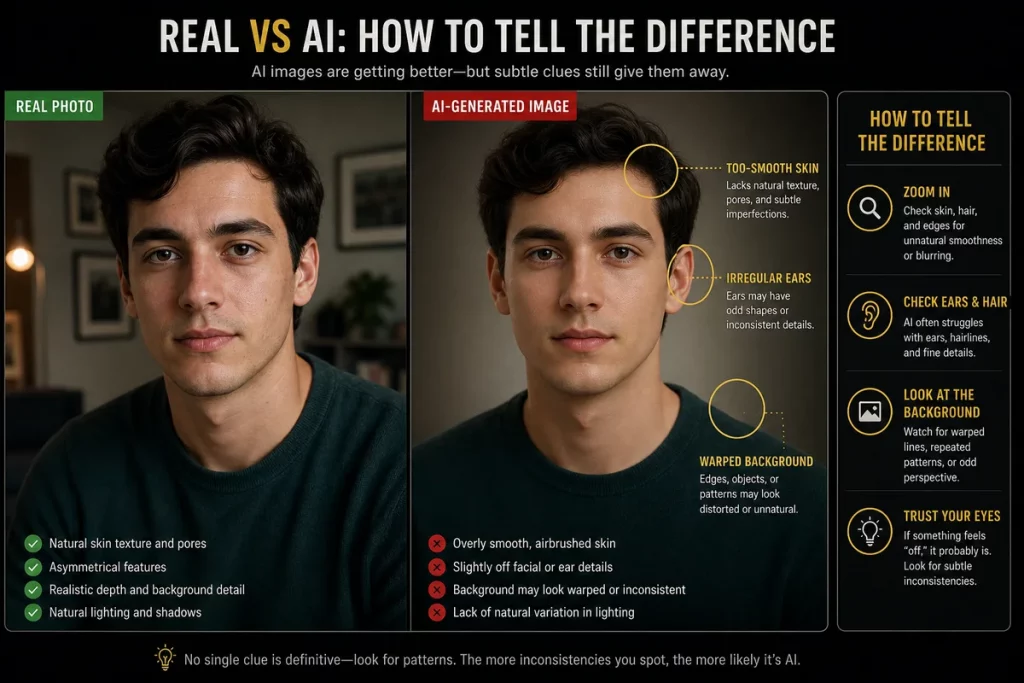
AI has fundamentally changed the catfishing landscape. Tools like Midjourney, DALL-E, and Stable Diffusion can generate photorealistic faces that have never existed — eliminating the risk of reverse image search detection that catches traditional catfish. Here’s what you need to know about the AI-powered catfishing threat:
AI faces pass casual inspection. Generated faces are now nearly indistinguishable from real photos at normal social media resolution. The telltale signs — irregular ears, asymmetric jewelry, distorted backgrounds, extra fingers — are less common in the latest generation of AI models.
AI can generate entire photo sets. A catfish no longer needs to steal one person’s photos. They can generate dozens of images of the same fictional person — in different outfits, locations, and lighting — creating a consistent fake identity that looks organic. This makes traditional verification methods less effective.
How to detect AI-generated photos: Look for subtle inconsistencies in skin texture, irregular hair patterns, earrings that don’t match between photos, backgrounds that seem warped or blurry, and teeth that look too uniform. Zoom into details — AI still struggles with fine elements like text on clothing, complex jewelry, and realistic hands. Use AI photo detection tools for systematic analysis.
The verification solution: Because AI can generate convincing photos but cannot generate a real human identity, the most reliable defense against AI catfish is identity verification that goes beyond photos. GuyID’s government ID verification confirms the person behind the profile is real, while social vouching from friends and colleagues provides authenticity that no AI can fabricate.
How to Verify Someone’s Identity Online
If you suspect you might be talking to a catfish on social media, use these verification methods in order — each increases your confidence level:
Step 1: Reverse image search (2 minutes). Run every photo they’ve shared through Google Reverse Image Search, TinEye, and GuyID’s free screening tools. If their photos appear on other profiles under different names, you’ve confirmed the catfish.
Step 2: Social media cross-reference (5 minutes). Ask for their Instagram, Facebook, and LinkedIn profiles. Check creation dates, friend/follower quality, engagement patterns, and consistency across platforms. A real person’s social media tells a coherent story across years. A catfish’s doesn’t.
Step 3: Video call (5 minutes). Request a live video call. This is the single most effective verification method — it eliminates catfish who can’t show the face they’re impersonating. Two refusals is a definitive answer.
Step 4: GuyID verification (2 minutes). Ask them to complete GuyID’s government ID verification and share their Trust Profile. This confirms their real name through a government-issued document, builds credibility through peer vouching, and creates a verified identity that no catfish can fake. Share your Date Mode link as a mutual trust signal.
What to Do If You’ve Been Catfished
If you’ve discovered that someone you’ve been communicating with is a catfish on social media, take these steps:
Stop all communication immediately. Block them on every platform. Don’t confront them — this gives them time to delete evidence and may escalate to threats if they have compromising information.
Preserve all evidence. Screenshot every conversation, photo, and profile detail before blocking. Save financial transaction records if money was exchanged. This evidence is critical for law enforcement reports and fraud recovery.
Report the fake account. Report to the social media platform (Facebook, Instagram, etc.) as a fake profile / impersonation. Report to the dating app if applicable. Report to the FBI’s IC3 and the FTC if money or personal information was compromised. For the complete reporting process, see our guide on how to report a scammer.
If money was lost, contact your financial institution. Ask immediately which dispute or recall options apply to the payment method. Use the romance scam loss calculator to document total exposure.
Seek emotional support. Being catfished is a genuine form of betrayal that can cause lasting trust issues, shame, and emotional pain. These feelings are valid. Consider speaking with a therapist, joining a support group, or confiding in a trusted friend. The Cybercrime Support Network offers free resources for victims. For more on the recovery process, see our guide on what to do if you’ve been catfished.
How to Protect Yourself Going Forward
These habits dramatically reduce your risk of encountering a catfish on social media:
Make reverse image search a reflex. Before engaging with any new person online — whether on a dating app, social media, or professional network — run their photos through reverse image search. This 30-second habit catches the majority of catfish immediately.
Require video before emotional investment. Don’t let an online connection develop into emotional attachment without a live video call first. This single rule eliminates nearly all catfish because they cannot show the face they’re impersonating.
Verify through GuyID for serious connections. When an online connection becomes meaningful, ask them to verify through GuyID. Government ID verification combined with peer vouching provides the certainty that photos and conversations alone never can.
Be skeptical of unsolicited contact. People who reach out to you unprompted with excessive flattery, romantic interest, or business opportunities are more likely to be catfish than genuine connections. Real relationships typically develop through mutual contexts — shared groups, common interests, dating app matches — not cold DMs.
Protect your own photos. Catfish steal photos from real people. Set your social media profiles to private, disable photo downloads where possible, and be mindful of what you share publicly. Your photos could end up on a catfish account, causing harm to others in your name.
How GuyID Helps
GuyID should appear when it is useful, not as a banner ad. A GuyID Trust Profile gives someone a portable way to share trust signals before a date, while identity verification and social vouching help turn vague profile claims into clearer next steps.
Useful next steps:
- Create a GuyID Trust Profile when you want a cleaner way to share verified trust signals.
- Use GuyID free tools and related guides when you need a checklist before meeting someone.
- Treat identity verification as confidence-building, not a guarantee.
- Use social vouching when you want context from people who already know the person.
- Sign up only when the extra trust layer helps the decision you are already trying to make.
Frequently Asked Questions
How common is catfishing on social media?
There is no single reliable prevalence rate across all social networks. Catfish accounts are a documented risk, and generated photos can make fabricated profiles easier to create. Evaluate the account’s history, consistency, images, and willingness to verify rather than relying on a broad percentage.
What is the fastest way to detect a catfish?
Two methods work fastest: (1) Reverse image search their photos — takes 30 seconds and catches catfish using stolen images. (2) Request a live video call — takes 5 minutes and is conclusive. A catfish cannot show you the face of the person they’re impersonating. Together, these two steps detect virtually any fake profile or catfishing attempt.
Can AI-generated photos be detected?
Sometimes, but it’s getting harder. Look for subtle signs: irregular skin texture, asymmetric jewelry or earrings, warped backgrounds, teeth that look too uniform, and hands with unusual finger counts or positioning. Specialized AI detection tools can help, but the most reliable defense is identity verification that goes beyond photos — like GuyID’s government ID verification.
Is catfishing illegal?
Catfishing itself isn’t illegal in most jurisdictions — simply pretending to be someone else online isn’t a crime. However, catfishing that involves financial fraud (romance scams), identity theft, sextortion, impersonation for harassment, or targeting minors is illegal and prosecutable. Several states have introduced or are considering anti-catfishing legislation. Regardless of legality, platforms prohibit fake accounts in their terms of service.
Which social media platform has the most catfish?
Instagram is the most common platform for photo-based catfishing. LinkedIn has seen the fastest growth in professional catfishing for investment scams. TikTok has emerging catfish threats through video content theft. Every major platform has significant catfish activity — no platform is immune.
What should I do if someone catfished me using my photos?
Report the fake account to the platform for impersonation — every major platform has an impersonation report form. Screenshot the fake profile for evidence. Set your own accounts to private and disable photo downloads. If the fake account is being used for fraud or harassment, file a police report and report to the FBI’s IC3. Consider adding watermarks to any remaining public photos.
How do I protect my children from social media catfish?
Teach them the core verification skills: reverse image search, the video call test, and the red flags of fake accounts. Discuss sextortion specifically — the FBI has flagged it as an epidemic among young people. Encourage them to keep social media profiles private and to tell a trusted adult if an online stranger becomes overly friendly, flattering, or asks for personal information or photos. A catfish on social media targeting a young person is a serious safety threat.
Can a catfish be prosecuted?
Yes, when the catfishing involves criminal activity. Romance scam catfish can be prosecuted for wire fraud, mail fraud, and money laundering. Sextortion catfish face federal charges. Identity theft catfish face state and federal identity theft statutes. The FBI and international partners have made significant arrests of catfish networks. Filing reports with the FBI’s IC3 and local police contributes to these investigations.