Free Tools
Catfish Probability Detector
Check whether a dating profile has suspicious identity or photo signals.
Dating Bio Red Flag Detector
Review a bio for scam, pressure, or trust-warning language.
Dating Safety Checklist
Use free GuyID tools before moving from chat to a real date.
Next step
Create your GuyID trust profile
Share consent-based trust signals before a date without turning the conversation into an interrogation.
Bumble’s 40+ million active users and premium branding make it a high-value hunting ground for professional scammers who’ve learned to work within — and around — the platform’s unique rules. This guide exposes the most common bumble scams, the red flags that reveal them, and exactly how to protect yourself.
NavigateTable of Contents26 sections
How Common Are Bumble Scams?
Bumble scams are more widespread than the company’s safety-focused branding might suggest. While Bumble actively positions itself as one of the safest dating apps available — and it does have some of the strongest moderation tools in the industry — no platform is truly scam-proof.
The Federal Trade Commission warns that romance scammers use fabricated identities and common crisis stories to obtain money. Bumble’s safety features can reduce some abuse, but they cannot establish a match’s intentions.
The “women message first” mechanic does reduce one type of scam — unsolicited messages from male-presenting scam accounts. But it doesn’t eliminate fraud. Scammers simply create attractive profiles that women are likely to initiate contact with, or they create female-presenting profiles targeting men on Bumble’s platform. Bumble scams succeed because they exploit trust, not because they bypass technical barriers.
Why Scammers Target Bumble
Several Bumble-specific features create opportunities that scammers exploit:
The “women message first” model creates a false safety halo. Because women initiate conversations, users assume that matches are pre-screened or inherently safer. This lowered guard is exactly what scammers count on. The thinking — “If she messaged me first, she must be real” — bypasses the critical verification step that catches most fraud on other platforms.
Bumble’s user base trends older and higher-income. Bumble users skew slightly older (25-44) and higher-income compared to Tinder’s broader demographic. For scammers running investment fraud or high-value romance scams, this means targets with more money to steal. Bumble’s premium tiers (Bumble Boost, Bumble Premium) further signal financial capacity.
Bumble BFF and Bumble Bizz expand the attack surface. Bumble’s companion modes for friendship and professional networking create additional entry points. Bumble scams aren’t limited to romantic contexts — scammers use BFF mode to build trust-based relationships and Bizz mode to pitch “business opportunities” that are actually investment fraud. See our analysis of Bumble’s safety features for a full assessment.
Photo verification has known limitations. Bumble’s photo verification uses AI to compare a real-time selfie against profile photos. While this catches basic catfish, it doesn’t prevent a real person from running a scam. Verified bumble scams — where the scammer is a real person using their own photos but fake intentions — are increasingly common and harder to detect.
The 24-hour message window creates urgency. Bumble’s timer — where matches expire if the woman doesn’t message within 24 hours — creates artificial pressure that scammers exploit. Users feel compelled to engage quickly rather than taking time to verify the match, which plays directly into the scammer’s hands.
8 Most Common Bumble Scams in 2026
These are the specific bumble scams you’re most likely to encounter on the platform today.
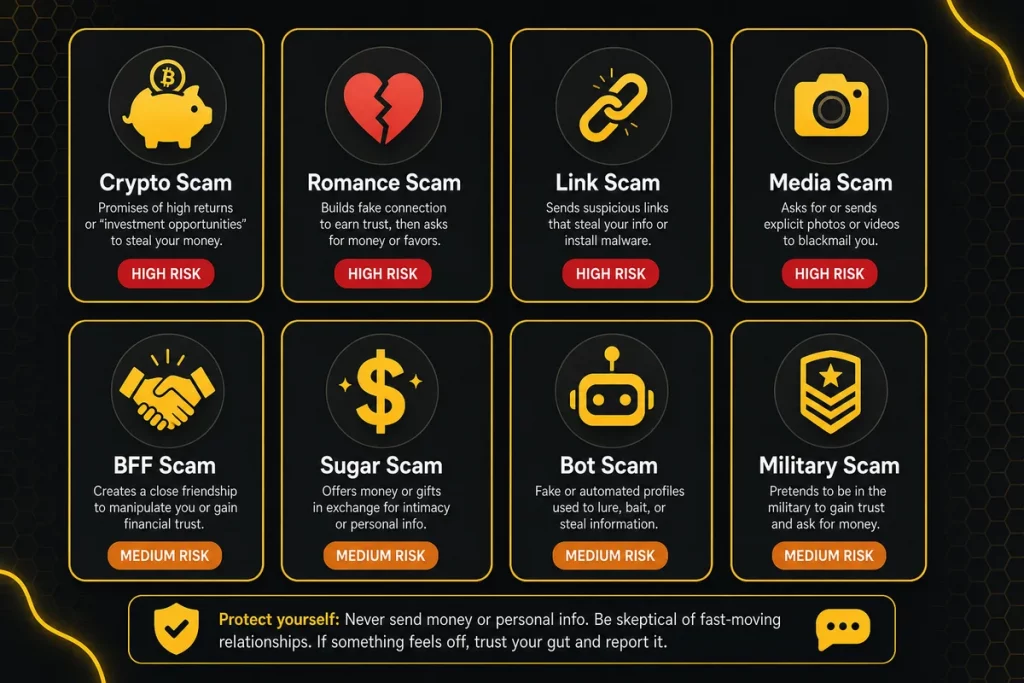
1. The Crypto Investment Scam (Pig Butchering on Bumble)
The most financially devastating of all bumble scams. After matching and building rapport for 2-6 weeks, the scammer introduces cryptocurrency trading as a casual topic — mentioning their “side income” or showing screenshots of profits. They guide you to a fake trading platform that shows artificial gains, encouraging larger deposits until they vanish with your money.
How to spot it: Any mention of crypto, forex, stocks, or “investment opportunities” from a dating match is a scam. Real romantic interests don’t pitch financial products. Read our full breakdown of pig butchering romance scams.
Critical Risk — Highest Financial Loss
2. The Classic Romance Scam
The scammer creates an attractive profile, builds emotional connection over weeks of daily messaging, then fabricates a crisis requiring your financial help. On Bumble specifically, romance scammers often target men by creating compelling female profiles that initiate contact with thoughtful opening messages — exploiting the assumption that “she messaged first, so she’s real.”
How to spot it: They refuse video calls, say “I love you” within weeks, and eventually request money. Use romance scam detection techniques and reverse image search.
High Risk
3. The Verification Link Scam
After a brief conversation, the match sends a link claiming you need to “verify your identity” through an external site, or says they only meet people who are “verified” through a specific website. The link leads to a phishing page that steals your credentials, installs malware, or charges your credit card for a fake “verification service.” These bumble scams exploit the growing awareness of verification by weaponizing it.
Risk: Identity theft, financial fraud, malware infection
How to spot it: Legitimate verification happens within the Bumble app itself or through established services like GuyID. Never click verification links sent through chat.
High Risk
4. The Sextortion Scam
The scammer builds rapport, moves to a private platform, then escalates to exchanging intimate photos or video. Once they have compromising material, they threaten to send it to your employer, family, or social media contacts unless you pay. On Bumble, these scams often target men who assume the “women message first” model means they’re talking to a real woman — when in reality, the account may be operated by anyone.
How to spot it: Be cautious about intimate content sharing with anyone you haven’t met. If threatened, do not pay — report to police and the FBI’s IC3.
Critical Risk — Psychological + Financial
5. The Bumble BFF Scam
Scammers use Bumble’s friendship mode to build trust-based relationships that eventually lead to financial exploitation. Because BFF mode feels lower-stakes than dating, users drop their guard further. The scammer becomes your “friend” over weeks, then introduces a business opportunity, investment, MLM scheme, or financial emergency. These are among the most overlooked bumble scams because victims don’t associate friendship apps with fraud.
How to spot it: Friends made on apps who quickly pivot to money, investments, or business opportunities are running a scam — even on BFF mode.
Medium Risk
6. The Sugar Daddy/Mommy Scam
A match offers financial support — a weekly allowance, help with rent, or gifts — in exchange for companionship. To “receive” the payment, you need to share bank details, pay a “processing fee,” send gift cards as a “trust test,” or sign up for a payment platform that captures your financial information. The promised money never materializes.
Potential loss: Any amount sent can be difficult to recover.
Genuine generosity doesn’t require your bank routing number.
Medium Risk
7. The Bot Scam
Automated accounts that send generic but convincing opening messages, then quickly try to move you off Bumble to external links — usually adult content sites, premium Snapchat accounts, or phishing pages. Bumble’s AI detection catches many bots, but sophisticated ones mimic human conversation patterns well enough to evade detection for hours or days.
Risk: Phishing, malware, credit card fraud
How to spot it: Responses that feel slightly generic, unusually fast reply times, and early attempts to share links or move to external platforms. Ask a specific, context-dependent question — bots can’t handle nuanced follow-ups.
Medium Risk
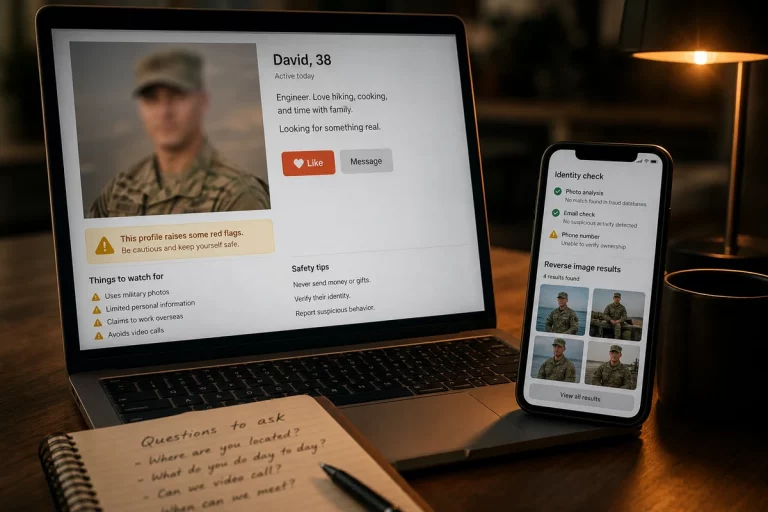
8. The Military / Deployed Professional Scam
A match claims to be deployed military, a traveling doctor, or an overseas contractor — providing an excuse for never being available to meet or video chat. This is a variation of the military romance scam adapted specifically for Bumble. The deployment story creates an emotional hook (admiration, sympathy) and a practical barrier to verification.
How to spot it: Anyone who can’t video chat within two weeks of matching, regardless of their claimed profession, should be treated with extreme caution.
High Risk
Red Flags That Expose a Bumble Scammer
These patterns consistently reveal bumble scams across all scam types:
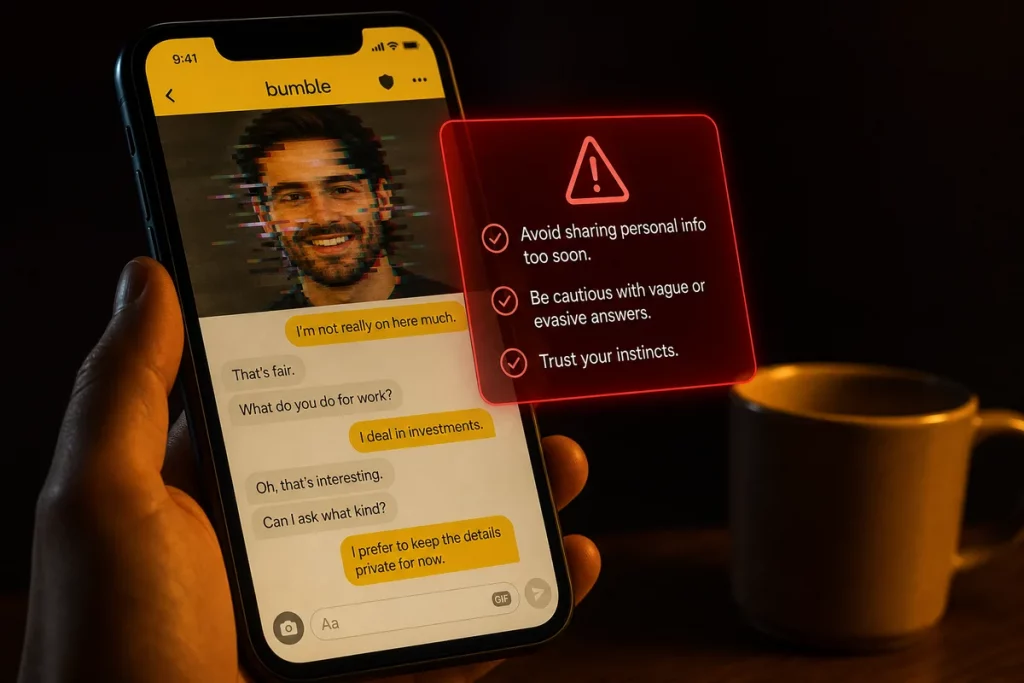
They want off Bumble fast. Within a few messages, they push to move to WhatsApp, Telegram, or text — “The app is glitchy,” “I don’t check Bumble often,” “It’s easier to talk on WhatsApp.” Scammers want you off the platform where their profile can be reported and their behavior monitored. While moving off-app eventually is normal in dating, doing so within the first day is suspicious. Follow the safe WhatsApp transition guidelines.
Their photos are suspiciously polished. All professional-quality shots, no candid photos with friends, no location-tagged images, and a profile that looks more like a modeling portfolio than a dating profile. Run their photos through reverse image search for dating profiles to check for stolen images.
The conversation feels scripted. Their messages are well-written but generic — they could be sent to anyone. They mirror your interests without adding specific personal details. They deflect when you ask about verifiable things (workplace name, Instagram handle, neighborhood they live in). Genuine people share specific, messy, human details naturally.
Emotional acceleration. Intense compliments, declarations of connection, and “I’ve never felt this way about anyone” within the first week. This love bombing creates emotional dependency that overrides critical thinking — exactly the state a scammer needs you in before the financial ask.
The inevitable money moment. Every Bumble scam — whether it takes days or months — ends with a request for money, financial information, gift cards, cryptocurrency, or account credentials. This is the universal endpoint.
They dodge verification of any kind. They won’t video chat, won’t share social media, won’t meet in a public place, and won’t verify through GuyID or any identity confirmation tool. Every refusal to verify is a data point that they have something to hide. See our comprehensive fake profile red flags checklist.
Does Bumble’s Safety System Protect You?
Bumble has invested significantly in safety features — more than most dating apps. For users wondering whether bumble scams are preventable through the platform alone, here’s an honest assessment of what works and what doesn’t:
What Bumble does well: Photo verification using AI facial matching, a Private Detector that uses AI to identify and blur unsolicited intimate images before the recipient sees them, a block-and-report system that removes flagged profiles quickly, and a dedicated Trust & Safety team that investigates reports. Bumble also shares safety reports with law enforcement and participates in industry anti-fraud coalitions.
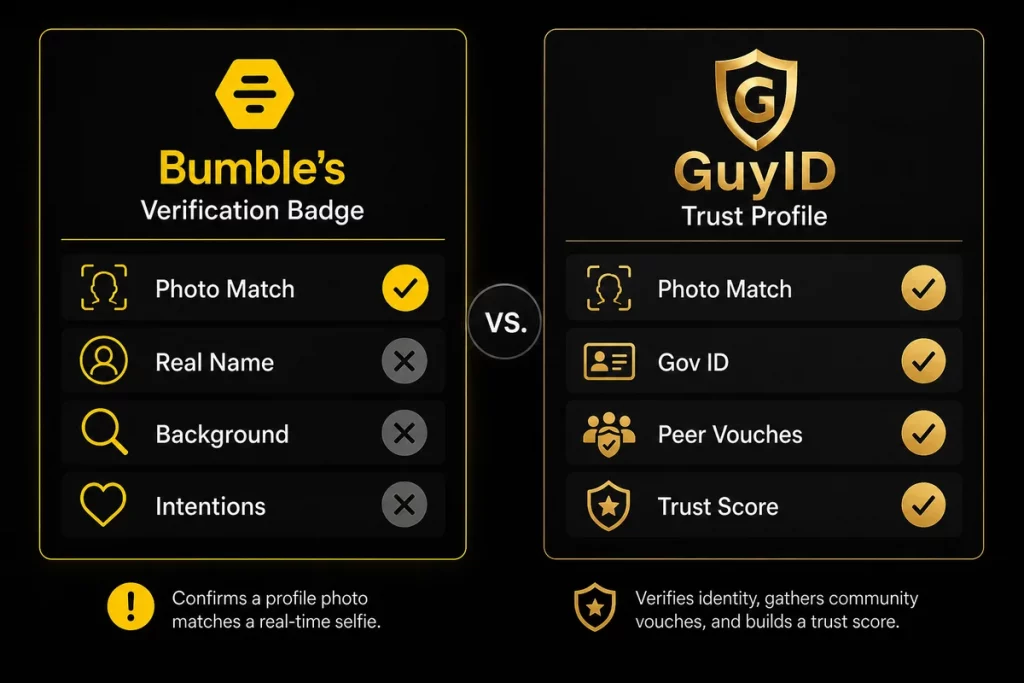
Where Bumble falls short: Photo verification only confirms the person matches their photos — not their identity, intentions, or history. Bumble scams where a real person uses real photos but fake intentions pass through verification completely. The platform doesn’t verify names, doesn’t check criminal records, and doesn’t confirm relationship status. These are significant gaps that leave users vulnerable.
For a complete assessment of Bumble’s safety infrastructure, read our in-depth Bumble safety review for 2026 and understand how Bumble verification actually works.
The gap between what Bumble verifies and what you actually need to know is exactly why tools like GuyID exist. A GuyID Trust Score adds government ID verification, social vouching from real people, and a portable trust profile that works across every platform — the layers that Bumble’s system doesn’t provide.
What to Do If You’ve Been Scammed on Bumble
Act immediately if you’ve been scammed — every single hour matters for financial recovery:
Block and preserve evidence. Screenshot all conversations, transaction records, profile details, and photos before blocking the scammer on Bumble and all other platforms. This evidence is essential for law enforcement and financial recovery efforts.
Contact your financial institution. Call your bank’s fraud department, credit card company, or payment provider immediately. Credit card charges can be disputed under the Fair Credit Billing Act. Wire transfers may be reversible if reported within 72 hours. For cryptocurrency, report to the exchange platform and provide transaction hashes.
Report to Bumble. Open the conversation → tap the three dots → “Report & Block” → select the reason and provide details. For cases involving financial loss, contact Bumble support directly through the Help Center with comprehensive evidence.
File law enforcement reports. Report to the FBI’s IC3 at ic3.gov, the FTC at ReportFraud.ftc.gov, and your local police. In Canada, report to the Canadian Anti-Fraud Centre. For the complete reporting process, see our guide on how to report a scammer.
Get support. Romance fraud causes real emotional trauma. The Cybercrime Support Network offers free resources, and speaking with a therapist or counselor can help process the experience. Being scammed reflects the scammer’s criminality, not your judgment.
How to Report Bumble Scams
Bumble takes fraud reports seriously and has one of the more responsive moderation teams in the industry. Here’s how to report bumble scams effectively:
In-app reporting: Open the suspicious profile or conversation → tap the three dots (⋯) in the upper right → select “Report & Block” → choose the most relevant category → add details in the text field. Be specific — mention financial requests, suspicious links, inconsistencies in their story, and any other evidence.
Email escalation: For complex cases or financial fraud, email feedback@team.bumble.com with the subject line “Fraud Report” and include: your account details, the scammer’s profile information, screenshots, financial transaction details, and a timeline. Escalated reports receive priority review.
External agencies: Always file parallel reports with the FBI’s IC3, FTC, and local police. Bumble reports protect other Bumble users; law enforcement reports enable broader investigation and potential money recovery. See how to report someone on a dating app for platform-specific instructions.
How to Protect Yourself on Bumble
These habits protect you from bumble scams while keeping the dating experience enjoyable:
Video call before the first date. This single habit eliminates the majority of bumble scams. A 5-minute FaceTime or Google Meet call confirms the person is real, matches their photos, and can hold a genuine conversation. If they refuse after two polite requests, unmatch immediately.
Stay on Bumble for the first week. Resist pressure to move to WhatsApp or other platforms immediately. Bumble’s reporting and moderation tools protect you — but only while you’re on the platform. Give the conversation time to reveal red flags before moving off-app.
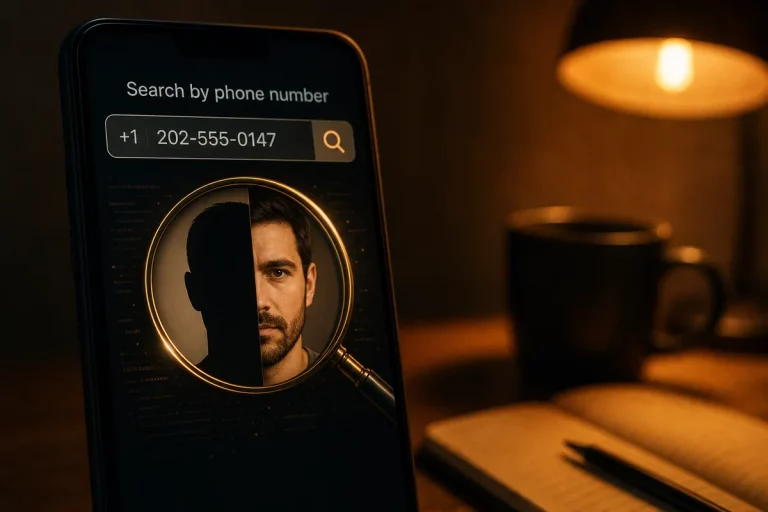
Reverse image search every match that seems too good to be true. It takes 30 seconds. Drag their photos into Google Images, TinEye, or use GuyID’s free screening tools. If their photos appear elsewhere under a different name, you’ve caught a scammer before they caught you.
Never share financial information or send money. This rule applies regardless of circumstances, sob stories, investment opportunities, or processing fees. No amount of emotional connection justifies sending money to someone you’ve never met in person. Zero exceptions.
Verify identity beyond Bumble’s photo check. Bumble verification tells you the person looks like their photos. Ask them to verify through GuyID for government ID confirmation. Share your Date Mode link when transitioning off the app — it provides verified trust information without exposing personal details, and it immediately filters out anyone with something to hide.
Check their social media presence. A genuine person has an established social media footprint — years-old accounts, tagged photos with friends, consistent location information, and engagement from real people. A brand-new Instagram with 12 followers and stock-quality photos is a red flag. Ask for their handle and verify it before moving off Bumble. Cross-referencing their dating profile with an established social media account is one of the simplest and most effective ways to detect bumble scams before they progress.
Tell a trusted friend. Scammers thrive on isolation and secrecy. Before moving off Bumble with a new match, share their profile screenshots with a trusted friend. An outside perspective catches red flags that emotional investment can obscure. If the match objects to you sharing their profile with friends, that itself is a warning sign — genuine people don’t need secrecy at the start of a connection.
How GuyID Helps
GuyID should appear when it is useful, not as a banner ad. A GuyID Trust Profile gives someone a portable way to share trust signals before a date, while identity verification and social vouching help turn vague profile claims into clearer next steps.
Useful next steps:
- Create a GuyID Trust Profile when you want a cleaner way to share verified trust signals.
- Use GuyID free tools and related guides when you need a checklist before meeting someone.
- Treat identity verification as confidence-building, not a guarantee.
- Use social vouching when you want context from people who already know the person.
- Sign up only when the extra trust layer helps the decision you are already trying to make.
Frequently Asked Questions
Are bumble scams common?
Yes. Bumble scams are increasing year-over-year in line with broader dating app fraud trends. The “women message first” model reduces some spam but does not prevent sophisticated romance scams, investment fraud, or sextortion.
Does Bumble verification prevent scams?
No. Bumble’s photo verification confirms the person matches their profile photos — it does not verify their name, intentions, criminal record, or whether they’re running a scam. A real person using real photos can still perpetrate bumble scams like investment fraud or sextortion. Verification is one safety layer, not a comprehensive safeguard. For identity confirmation, use GuyID’s government ID verification.
How do I report a scammer on Bumble?
Open the scammer’s profile or conversation → tap the three dots → “Report & Block” → select the relevant reason and provide details. For financial fraud cases, also email feedback@team.bumble.com with evidence. Always file parallel reports with the FBI’s IC3 and FTC to contribute to broader law enforcement investigations.
Is Bumble safer than other dating apps?
Bumble has stronger moderation tools than most competitors — including photo verification, Private Detector for inappropriate images, and responsive reporting. The “women message first” model reduces unsolicited harassment. However, no app is scam-proof, and bumble scams still occur regularly. The safest approach combines platform features with personal verification habits: video calls, reverse image search, and identity verification through GuyID. See our ranking of the safest dating apps in 2026.
Can you get scammed on Bumble BFF?
Yes. Bumble BFF scams involve fraudsters building friendship connections then pivoting to financial exploitation — MLM recruitment, “business opportunities,” investment pitches, or fabricated emergencies. Because BFF mode feels lower-stakes than dating, users often have lower defenses. The same vigilance rules apply: never send money to app-based connections, and be wary of friends who quickly introduce financial topics.
What’s the most common Bumble scam?
The verification link scam is the most common by volume — quick, low-effort phishing attempts that target large numbers of users simultaneously. Romance scams fall in between, targeting fewer victims but extracting significant emotional and financial damage from each one.
How do scammers bypass Bumble’s women-message-first rule?
Scammers create attractive profiles designed to be swiped right on, then wait for women to message first. Once the conversation starts, the scammer takes over. Alternatively, scammers create female-presenting profiles to target men, initiating the first message themselves. On Bumble Bizz and BFF modes, there’s no gendered messaging restriction, giving scammers direct access. The women-first rule reduces spam but doesn’t prevent targeted bumble scams.
Can I get my money back after a Bumble scam?
It depends on the payment method, provider, jurisdiction, and speed of reporting. Contact your financial institution immediately to ask about dispute or recall options, file appropriate fraud reports, and use our romance scam loss calculator to document your exposure.