Free Tools
Catfish Probability Detector
Check whether a dating profile has suspicious identity or photo signals.
Dating Bio Red Flag Detector
Review a bio for scam, pressure, or trust-warning language.
Dating Safety Checklist
Use free GuyID tools before moving from chat to a real date.
Next step
Create your GuyID trust profile
Share consent-based trust signals before a date without turning the conversation into an interrogation.
Hinge users can encounter romance fraud, investment pitches, phishing, identity theft, and other scams despite the platform’s relationship-focused positioning. This guide explains nine recurring patterns, the evidence that should increase caution, and what to do if you are targeted without claiming an unsupported platform-specific growth rate.
NavigateTable of Contents27 sections
How Common Are Hinge Scams?
Hinge scams are more prevalent than most users realize. While Hinge doesn’t publicly disclose fraud statistics, multiple data points paint a concerning picture:
The Federal Trade Commission warns that romance scammers commonly use fabricated identities and stories before asking for money. Hinge users should treat platform verification as one signal, not proof of a person’s identity or intent.
The reason? Hinge attracts a user base that’s serious about relationships, typically older (25-45), and willing to share detailed personal information through its prompt-based profile system. For scammers, this means higher-value targets who are more emotionally invested from the start.
Understanding the landscape of hinge scams is the first step toward protecting yourself. Let’s look at why this specific platform has become a hunting ground.
Why Scammers Target Hinge Specifically
Hinge’s design philosophy — which genuinely creates better dating experiences for legitimate users — inadvertently creates advantages for scammers:
The prompt system reveals personal vulnerabilities. Hinge profiles include answers to prompts like “My biggest fear,” “I’m looking for someone who,” and “A life goal of mine.” Scammers study these responses to craft personalized manipulation strategies. If your prompt says you value honesty above all else, they’ll build their entire persona around being “refreshingly honest.” If you mention loneliness or a recent breakup, they know you’re emotionally available and potentially vulnerable.
Comment-first engagement creates false intimacy. Unlike Tinder’s simple swipe, Hinge encourages users to comment on specific photos or prompts before matching. Scammers exploit this by sending thoughtful, personalized comments that feel genuine — because they’ve been crafted specifically to mirror your interests. This creates a sense of connection before you’ve verified anything about the person.
Hinge’s “designed to be deleted” branding lowers defenses. The marketing message implies that Hinge users are serious and genuine. This halo effect means users are less suspicious of profiles on Hinge than they would be on apps perceived as more casual, like Tinder or Bumble. Scammers know this and deliberately choose Hinge over other platforms.
Premium pricing creates a false sense of security. Hinge’s paid features (Hinge+, HingeX) are more expensive than competitors, which creates an assumption that scammers wouldn’t invest in premium subscriptions. In reality, the ROI for a scammer who extracts thousands of dollars from a single victim far exceeds the cost of a monthly subscription.
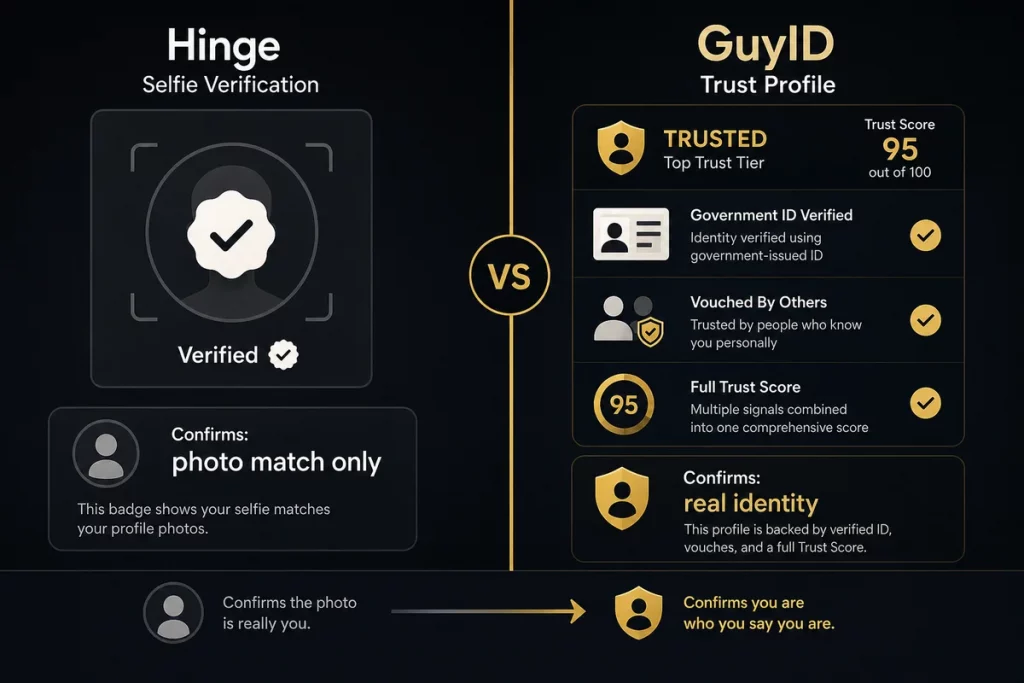
Verification gaps remain. While Hinge has introduced selfie verification, the system can be bypassed with sophisticated photo manipulation. Hinge’s verification doesn’t confirm identity — it only confirms that a live person matches the profile photos. A real person running a scam passes verification easily. For deeper identity verification, tools like Hinge’s verification system need to be supplemented with third-party verification.
9 Most Common Hinge Scams in 2026
These are the specific hinge scams you’re most likely to encounter. Each follows a predictable pattern once you know what to look for.
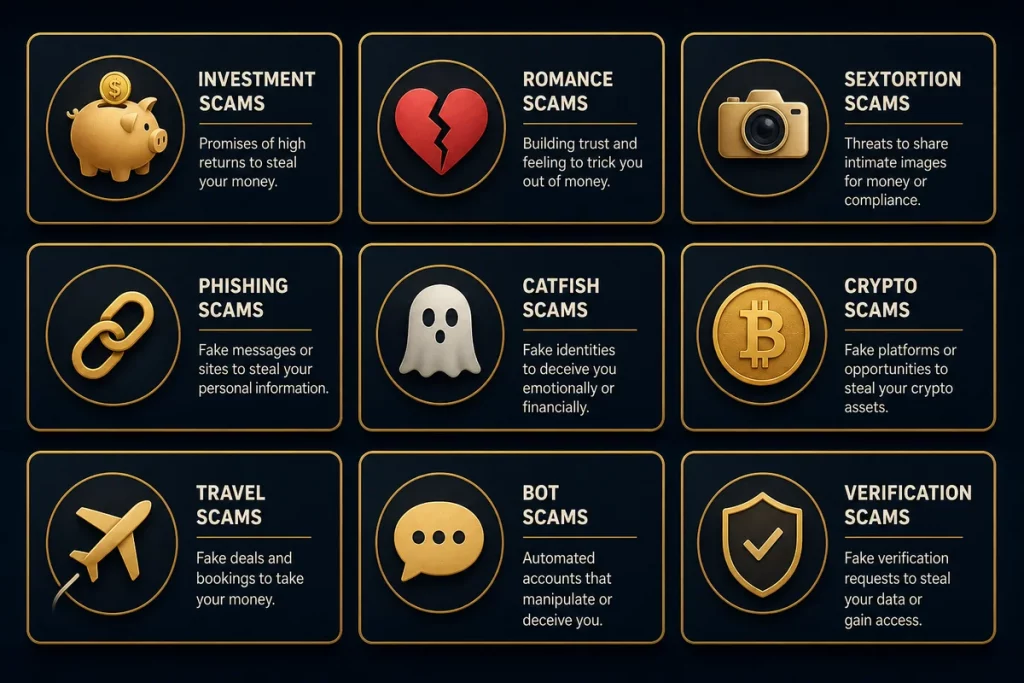
1. The Romance Investment Scam (Pig Butchering)
The most financially devastating of all hinge scams. The scammer builds a genuine-feeling relationship over 2-4 weeks, then casually mentions their success with cryptocurrency or forex trading. They’ll show you screenshots of “profits” and eventually invite you to invest through a platform they recommend. The platform is fake — designed to show growing returns that encourage larger deposits. When you try to withdraw, the money is gone.
Potential harm: Loss of deposited funds and additional fee demands
Time to execute: 4-12 weeks
How to spot it: Anyone who brings up investments, crypto trading, or “a great opportunity” in a dating context is running this scam. No exceptions. Read our full guide on pig butchering romance scams.
Critical Risk — Highest Financial Loss
2. The Classic Romance Scam
The traditional romance scam adapted for Hinge. The scammer creates an attractive profile using stolen photos, builds emotional connection through daily messaging, then manufactures a crisis requiring financial help — a medical emergency, travel costs to visit you, or a business problem.
Potential harm: Financial loss and prolonged emotional manipulation
Time to execute: 3-8 weeks
How to spot it: They refuse video calls, profess love quickly, and eventually ask for money. Check their photos with reverse image search.
High Risk
3. The Verification Code Scam
After matching and chatting briefly, the scammer asks you to “verify” yourself by clicking a link or sharing a verification code sent to your phone. The link leads to a phishing site that harvests your login credentials, or the code is actually a Google Voice or two-factor authentication code that gives the scammer access to your accounts. This is one of the fastest-moving hinge scams — it can happen within hours of matching.
Average loss: Account compromise + potential identity theft
Time to execute: Hours to days
How to spot it: Never share verification codes with anyone. Legitimate dating verification happens through the app itself, not through external links.
High Risk
4. The Sugar Daddy/Mommy Scam
A match quickly offers financial support — a weekly allowance, rent payments, or gifts — in exchange for companionship or attention. To receive the “payment,” you need to provide bank details, pay a “processing fee,” or send gift cards as a “trust test.” No money ever arrives, but yours leaves.
Potential loss: Any amount sent can be difficult to recover.
Time to execute: Days
Real generosity doesn’t require your bank account number.
Medium Risk
5. The Sextortion Scam
The scammer builds rapport, moves to a private messaging platform, then escalates to exchanging intimate photos or video chat. Once they have compromising material, they threaten to share it with your contacts, employer, or publicly unless you pay. This is one of the most psychologically damaging hinge scams because victims feel complicit and ashamed.
Potential harm: Repeated payments, coercion, and emotional distress
Time to execute: 1-3 weeks
How to spot it: Be extremely cautious about sharing intimate content with someone you haven’t met. If threatened, do not pay — report to police and the FBI’s IC3 immediately.
Critical Risk — Psychological + Financial
6. The Fake Profile / Catfish Scam
Not all catfish want money — some create fake profiles for emotional manipulation, ego validation, or to lure victims into meeting dangerous situations. On Hinge, catfish profiles are often more sophisticated than on other apps because the prompt system requires more creative deception. They’ll have well-written prompts, stolen photos from less-popular social media accounts, and consistent but fabricated backstories.
Risk: Emotional damage, wasted time, potential physical danger
How to spot it: Use catfish detection techniques and fake profile checking tools.
Medium Risk
7. The Crypto/NFT Pitch Scam
A variation of the investment scam where the match claims expertise in cryptocurrency or NFTs and wants to “help you get started.” They’ll direct you to a specific exchange or wallet, often one they control. Some use legitimate exchanges but have you send crypto to their wallet address. The crypto community crossover with dating apps has made these hinge scams increasingly sophisticated.
Potential harm: Financial loss, identity misuse, or account compromise
How to spot it: Anyone mentioning crypto, blockchain, NFTs, or trading platforms in a dating context is running a scam.
High Risk
8. The “Let’s Move to WhatsApp” Phishing Scam
The match wants to continue chatting on WhatsApp, Telegram, or another platform — but the link they send isn’t a real messenger URL. It’s a phishing page designed to capture your phone number, email, or login credentials. Even legitimate platform transitions can be risky — see our guide on safe WhatsApp transitions.
Risk: Account compromise, phishing, identity theft
How to spot it: Never click links sent through dating apps. If moving to WhatsApp, exchange phone numbers directly and initiate the contact yourself.
Medium Risk
9. The Advance Fee / Travel Scam
After building connection, the match agrees to meet but claims they need help with travel costs — a plane ticket, hotel, gas money, or visa fees. They may send fake booking confirmations to make the request seem legitimate. You send money, they never arrive, and communication gradually stops.
Potential loss: Any advance payment may be unrecoverable.
How to spot it: Never send money for someone else’s travel to meet you. If they can’t afford to travel, they can video chat instead.
Medium Risk
Red Flags That Reveal a Hinge Scammer
Beyond the specific scam types above, these universal red flags apply to all hinge scams:
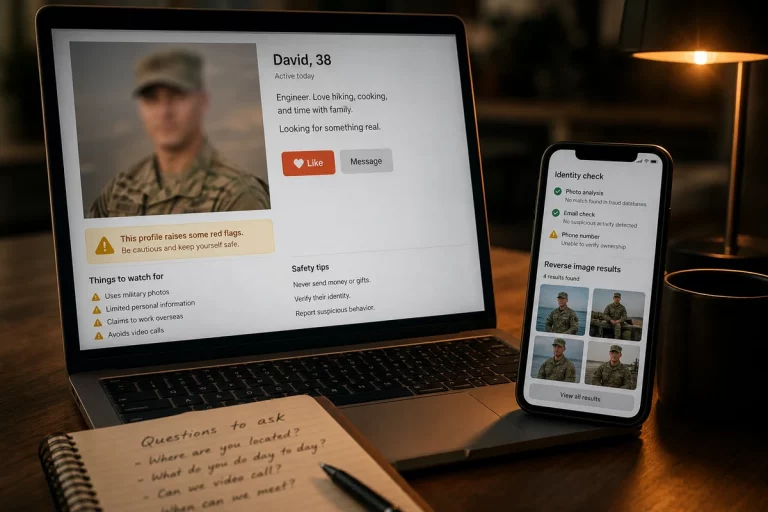
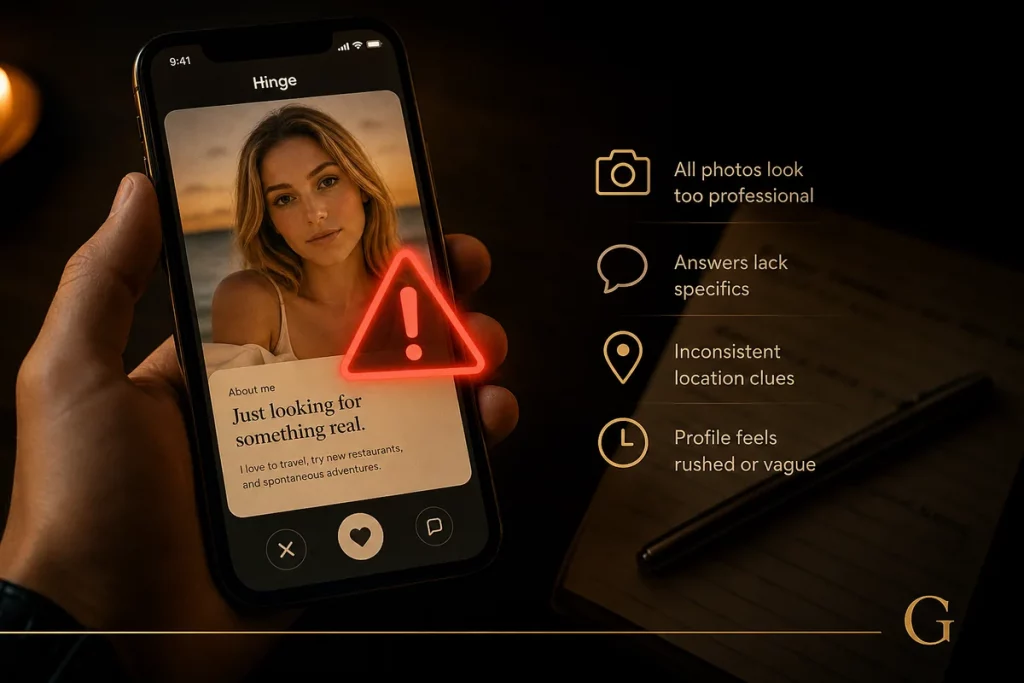
Their profile is too perfect. Professional-quality photos in exotic locations, a high-status career (doctor, engineer, military officer, entrepreneur), and prompts that read like they were written by a copywriter. Real profiles have imperfections — blurry group shots, candid photos, and prompts that are occasionally awkward or funny. Scammer profiles are curated to attract, not to be genuine.
They match your interests exactly. You love hiking? So do they. You’re into jazz? Their favorite genre. You value deep conversations? They’ve “been looking for someone like you.” While shared interests happen naturally, a match who mirrors every single preference is likely studying your profile and reflecting it back — a classic manipulation technique.
Conversation moves fast but stays surface-level. Scammers are excellent at creating the feeling of deep connection through frequent messaging, compliments, and emotional declarations. But if you pay attention, they rarely share verifiable details about their life — specific workplace names, tagged social media accounts, mutual connections, or details that could be fact-checked.
They avoid anything verifiable. They won’t add you on Instagram (or their account is brand new with few followers). They won’t introduce you to friends. They won’t do a video call without an excuse. They won’t meet in a public place. Every form of real-world verification is deflected with a plausible-sounding reason. Check for common dating app red flags and learn how to spot fake dating profiles.
Watch where the interaction is heading. Requests for money, verification codes, login credentials, identity documents, or sensitive financial details are reasons to stop and reassess.
Does Hinge Verification Protect You?
Hinge’s selfie verification feature asks users to take a real-time selfie that’s compared against their profile photos using facial recognition technology. While this is a positive step, it has significant limitations when it comes to preventing hinge scams:
What Hinge verification confirms: The person behind the account looks like the person in the photos. This eliminates basic catfish who use entirely stolen photos.
What Hinge verification does NOT confirm: The person’s real name, their intentions, their criminal history, their relationship status, or whether they’re running a scam. A real person with real photos can still be a scammer, con artist, or dangerous individual. Verification means “this person exists” — not “this person is safe.”
For a detailed comparison of what dating app verification actually proves versus what most users assume, read our analysis of what verified really means on dating apps and our breakdown of how Hinge verification works.
To go beyond selfie matching and actually verify someone’s identity, you need government ID verification combined with social proof — which is exactly what GuyID’s Trust Profile system provides. A GuyID Trust Score confirms identity through government-issued ID, builds credibility through peer vouching, and creates a portable verification profile that works across every dating platform.
What to Do If You’ve Been Scammed on Hinge
If you’ve fallen victim to hinge scams, take these steps immediately — speed matters for financial recovery:
Stop all contact. Block the scammer on Hinge, WhatsApp, and any other platform. Do not tell them you know it’s a scam — this gives them time to cover their tracks. Just block and move on.
Preserve all evidence. Screenshot every conversation, transaction receipt, and profile detail before blocking. Save photos they sent, email addresses, phone numbers, and any links or websites they directed you to. This evidence is critical for law enforcement.
Contact your bank immediately. If you sent money, call your bank’s fraud department as soon as possible and ask what dispute or recall options apply to the payment method.
File reports with law enforcement. Report to the FBI’s IC3, the FTC at ReportFraud.ftc.gov, and your local police department. Each report contributes to broader investigations. For a complete walkthrough, see our guide on how to report a scammer.
Seek emotional support. Being scammed is not a reflection of your intelligence — these are professional criminals. The emotional impact can be as severe as an actual breakup. Consider speaking with a therapist, joining a support group, or confiding in a trusted friend. The Cybercrime Support Network offers free resources for fraud victims.
How to Report Hinge Scams
Report the scam profile directly within the Hinge app and to external agencies. Reporting hinge scams effectively requires filing in multiple places — each serves a different purpose in shutting down the operation.
Within Hinge: Open the scammer’s profile or conversation → tap the three dots (⋯) → select “Report” → choose the most relevant reason (typically “Scam or fraud” or “Fake profile”) → provide details in the text field. Be as specific as possible — mention financial requests, suspicious links, and any inconsistencies you noticed. Hinge’s Trust & Safety team reviews reports and can remove profiles, ban devices, and flag connected accounts. Reports are typically processed within 24-72 hours.
Via Hinge support: For complex cases or if you’ve lost money, contact Hinge support directly through the app’s Help Center. Provide your report with all evidence — screenshots, financial details, and a timeline. Escalated reports receive dedicated investigation from Hinge’s fraud team.
External reporting: File with the FBI’s IC3 at ic3.gov, the FTC at ReportFraud.ftc.gov, and your local police. If you’re in Canada, report to the Canadian Anti-Fraud Centre. These reports feed into national and international fraud databases. For the full reporting roadmap, see how to report someone on a dating app.
How to Protect Yourself on Hinge
These practical steps will protect you from hinge scams without ruining your dating experience:
Require video chat before meeting. A 5-minute video call eliminates the majority of hinge scams. If they refuse video after two polite requests, unmatch and move on. No genuine prospect will object to a quick FaceTime before a first date.
Reverse image search their photos. Before investing emotional energy, run their profile photos through Google Reverse Image Search or dedicated dating reverse image search tools. If their photos appear on other profiles or stock photo sites, they’re not who they claim to be.
Never send money to a match. No matter how compelling the story, how deep the connection, or how urgent the emergency — do not send money, gift cards, cryptocurrency, or financial information to someone you’ve met on Hinge. This rule has zero exceptions.
Stay on the app longer. Scammers want to move you off Hinge quickly because the app’s reporting tools are a threat to their operation. Staying on the platform for at least a week of conversation gives Hinge’s fraud detection systems time to flag suspicious behavior and gives you time to assess the person’s legitimacy.
Check for verification depth. Hinge’s selfie verification is a start, but ask your match to verify through GuyID for government ID confirmation. Share your Date Mode link when moving off the app — it shows your verified Trust Profile without revealing personal information, and it signals that you take safety seriously.
Trust your instincts. If something feels off — if the person seems too good to be true, if the conversation feels scripted, if you’re being pushed toward money or personal details — trust that feeling. Your instincts evolved to protect you. Use GuyID’s free screening tools to verify what your gut is telling you.
How GuyID Helps
GuyID should appear when it is useful, not as a banner ad. A GuyID Trust Profile gives someone a portable way to share trust signals before a date, while identity verification and social vouching help turn vague profile claims into clearer next steps.
Useful next steps:
- Create a GuyID Trust Profile when you want a cleaner way to share verified trust signals.
- Use GuyID free tools and related guides when you need a checklist before meeting someone.
- Treat identity verification as confidence-building, not a guarantee.
- Use social vouching when you want context from people who already know the person.
- Sign up only when the extra trust layer helps the decision you are already trying to make.
Frequently Asked Questions
Are hinge scams common?
Scams continue to affect dating platforms, but the cited FTC material does not establish a reliable Hinge-specific annual growth rate. Platform controls reduce some abuse but do not replace personal verification and reporting.
How do I know if someone is real on Hinge?
Selfie verification helps, but it is not conclusive. Request a live video call, reverse-search profile images, and compare key biographical claims across independent sources with the person’s consent. No single check proves that someone is safe or honest.
What are the biggest red flags for hinge scams?
The biggest red flags are: refusing video calls, professing love within days, wanting to move to WhatsApp or Telegram immediately, mentioning investments or cryptocurrency, requesting money for any reason. A profile that seems too perfect with professional photos and no candid shots, and inconsistencies in their story when you ask follow-up questions.
Can you get scammed on Hinge even with verification?
Absolutely. Hinge’s selfie verification confirms that the person matches their photos — it does not verify their name, intentions, criminal history, or whether they’re running a scam. A real person with real photos can still operate hinge scams like investment fraud, sextortion, or advance fee schemes. Verification is one layer of safety, not a guarantee.
What do I do if a Hinge match asks for money?
Do not send money to a dating-app match you have not independently verified. Report and block suspicious profiles, and if you already sent money, contact your financial institution and the appropriate authorities.
How does Hinge handle scam reports?
Hinge’s Trust & Safety team reviews reports and can remove profiles, ban associated devices, and flag connected accounts for investigation. Reports are typically reviewed within 24-72 hours. For urgent cases involving financial loss or threats, contact Hinge support directly through the Help Center for expedited review. Also file external reports with law enforcement.
Is Hinge safer than Tinder or Bumble?
No dating app is inherently safe — each has different scam patterns. Hinge’s detailed profiles can actually give scammers more information to exploit. Tinder has higher volume of spam-type scams while hinge scams tend to be more targeted and higher-value. The safest approach on any platform is personal vigilance: video calls before meeting, reverse image searches, and identity verification through GuyID. See our full comparison of the safest dating apps in 2026.
Can Hinge scammers be caught?
Yes — law enforcement is making increasing progress. The FBI and international partners have made significant arrests of romance scam networks, including operations running hinge scams from West Africa, Southeast Asia, and Eastern Europe. Your report to the FBI’s IC3, FTC, and Hinge contributes to these investigations. Blockchain analysis has also improved cryptocurrency recovery. Filing reports matters.