Reader Briefing
Reader Briefing
Start here if you need a practical read on red flags when dating in your 60s female: who should use verification, what signals to check, and what to do before moving from online interest to an in-person plan.
Who this is for
- People meeting someone from a dating app or social platform.
- Readers preparing for a first in-person date.
- Anyone checking identity, profile consistency, and trust signals.
- People trying to avoid romance scams, fake profiles, or pressure tactics.
You’ll learn
- How to evaluate identity signals without treating any single check as certainty.
- Which trust signals matter and how to weigh them together.
- How to spot inconsistencies, pressure, or behavior patterns that deserve caution.
- How to move from online conversation to a safer first meeting.
- Where GuyID tools fit into a quick pre-date screening workflow.
- How to compare options using practical safety and trust criteria.
Bottom line
Verification reduces uncertainty; it does not guarantee future behavior. Use a layered approach: confirm identity signals, compare profile consistency, ask for a short video call, keep early plans public, and slow down when someone pressures you to skip normal safety steps.
Key takeaways
- Identity verification improves confidence, not certainty.
- Patterns matter more than isolated incidents.
- Verify before meeting privately or sharing sensitive details.
- A short video call can reveal many inconsistencies.
- Pressure to skip reasonable safety steps is useful information.
Free Tools
Catfish Probability Detector
Check whether a dating profile has suspicious identity or photo signals.
Dating Bio Red Flag Detector
Review a bio for scam, pressure, or trust-warning language.
Dating Safety Checklist
Use free GuyID tools before moving from chat to a real date.
Next step
Create your GuyID trust profile
Share consent-based trust signals before a date without turning the conversation into an interrogation.
Dating after 60 comes with a paradox: you have more life experience than ever — but the dating landscape has changed so dramatically that your experience may not protect you the way you’d expect. The red flags when dating in your 60s female daters need to watch for aren’t identical to the warning signs you learned in your 20s and 30s. Some are the same human patterns wearing older faces. But others are specific to this life stage — financial exploitation targeting women with retirement assets, widower grief that hasn’t been processed, adult children who sabotage new relationships, and romance scammers who specifically target women over 60 because they statistically lose the most money to dating fraud. This guide provides the age-specific red flag framework that protects your safety, your finances, and your heart without making you so guarded that you miss genuine connection.
NavigateTable of Contents18 sections
Why Red Flags When Dating in Your 60s Female Are Different
The red flags when dating in your 60s female daters face aren’t just the standard warning signs applied to older faces — they’re fundamentally shaped by the realities of this life stage. Your accumulated wisdom is an asset, but the specific threats targeting this demographic require specific awareness that general dating advice doesn’t provide. Understanding why the landscape is different helps you calibrate your awareness appropriately:
Higher financial stakes. At 60+, you’ve likely accumulated retirement savings, own property, may have pension income, and possibly received inheritance or insurance settlements. These assets make you a higher-value target for financial exploitation — not just from obvious scammers, but from seemingly legitimate partners who gradually integrate themselves into your financial life before the exploitation becomes visible. The National Library of Medicine reports that adults over 60 lose more money to romance fraud than any other age group, with women over 60 losing an average of $9,000 per incident — and that figure dramatically underrepresents the actual losses because many victims don’t report the fraud due to embarrassment.
Different isolation patterns. Many women dating after 60 have experienced widowhood, divorce after long marriages, retirement-related social network changes, or the departure of adult children — any of which can reduce the social connections that serve as natural protection against unhealthy relationships. When your social circle is smaller, a new romantic partner occupies a proportionally larger share of your social and emotional world, which increases vulnerability to love bombing, isolation tactics, and emotional manipulation.
Technology-enabled risks. Online dating platforms are now the primary way people over 60 meet romantic partners — and the digital dating environment introduces risks that didn’t exist in earlier dating eras. Catfishing, romance scams, photo fraud, and identity deception all operate through digital channels that many women over 60 are still developing comfort with. The red flags when dating in your 60s female daters need to recognize include digital-specific signals that require different awareness skills than in-person dating provided.
Financial Red Flags Specific to Dating After 60
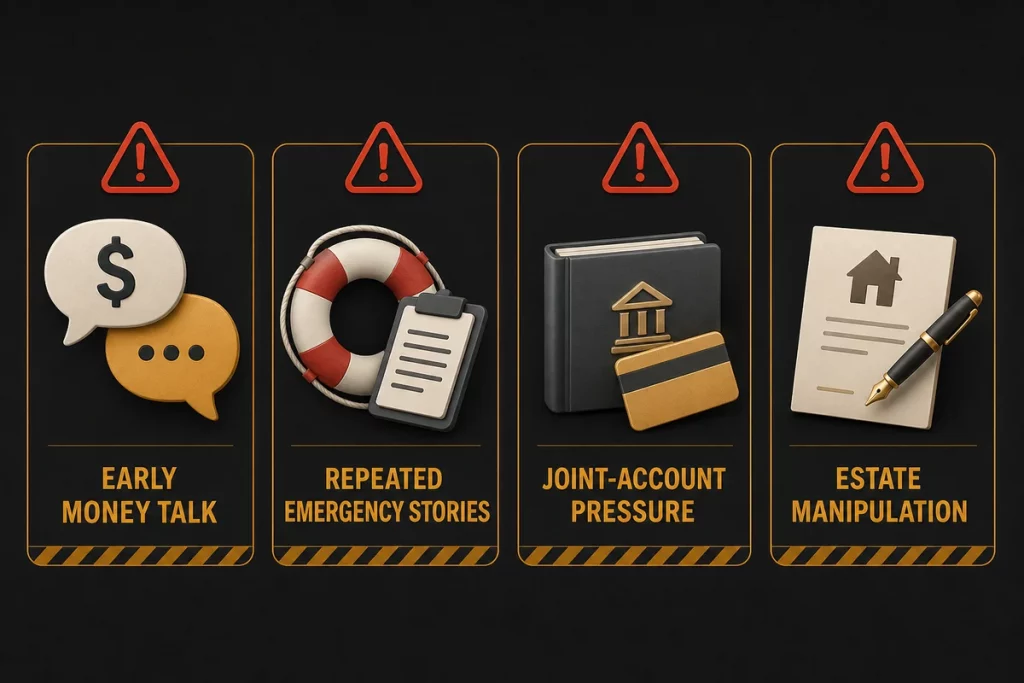
Financial exploitation is the highest-stakes risk category for women dating after 60 — and the warning signs are often subtle because sophisticated exploiters build genuine emotional connections before the financial component appears. The following patterns should trigger immediate heightened awareness:
Discusses Finances Too Early
A new romantic interest does not need details about your retirement accounts, property values, or investment portfolio within the first few dates. If someone repeatedly steers conversation toward your financial situation early — “Do you own your home?” “How’s retirement treating you financially?” “Did your late husband leave you comfortable?” — treat the pattern as a reason to slow down and protect private financial information. A single question may be ordinary conversation; persistent probing combined with pressure, urgency, or requests for money is more concerning.
Financial “Emergencies” Within Months
The pattern: relationship develops quickly, emotional connection intensifies, then a financial crisis appears — medical emergency, business setback, travel complication, legal issue — and the person either directly requests money or creates circumstances where offering money feels like the natural response. This is the signature pattern of romance scams and it targets women over 60 disproportionately. Any financial request or implied need within the first 6 months of a relationship is a red flag regardless of how genuine the emergency appears.
Pressure to Combine Finances or Move In Quickly
Rushing toward financial integration — joint accounts, moving in together, adding names to property titles, changing beneficiaries — within the first year is a red flag when dating in your 60s female daters should take seriously. Legitimate partners who respect your autonomy understand that financial integration at this life stage requires careful, deliberate planning — ideally with input from a financial advisor and estate attorney. Pressure to combine quickly often indicates that the person wants access to your resources before you have time to evaluate the relationship’s viability.
Vague About Their Own Financial Situation
They ask about your finances but become evasive about their own. They describe their career in impressive but unverifiable terms. They claim past wealth but current “temporary” difficulties. This asymmetry — knowing everything about your financial picture while revealing nothing about theirs — creates an information imbalance that favors exploitation. Transparent partners are willing to have reciprocal financial conversations when the relationship reaches the appropriate stage.
Interfering With Your Financial Advisors or Family
If a new partner discourages you from consulting your financial advisor, suggests your adult children are “too controlling” about your finances, or implies that your existing estate plan doesn’t reflect the new relationship — these are isolation tactics designed to remove the protective barriers between them and your assets. Anyone who genuinely cares about you will support your relationships with the people and professionals who protect your interests.
Emotional Red Flags Specific to Dating After 60
Unprocessed grief presenting as intense romantic interest. If you’re dating a widower (see our dating a widower red flags guide), watch for signs that grief is driving the connection rather than genuine romantic interest: constant references to the late spouse, comparing you favorably or unfavorably to her, keeping the home as a shrine, or moving from grief to intense romantic pursuit suspiciously quickly. A widower who hasn’t processed his loss may be seeking a replacement rather than a new partner — and the replacement dynamic inevitably collapses when you fail to be the person he actually lost. Our widow dating guide provides the complete framework for evaluating grief-readiness.
Love bombing calibrated for your life stage. Love bombing after 60 often takes different forms than the dramatic gestures targeting younger women: daily phone calls that feel attentive rather than controlling, constant availability that seems devoted rather than surveillance-like, premature talk of “spending our remaining years together” that exploits mortality awareness, and overwhelming helpfulness with practical tasks (home repairs, errands, technology help) that creates dependency disguised as care. The underlying pattern is the same — disproportionate intensity designed to accelerate attachment — but the age-appropriate packaging makes it harder to recognize.
Dismissiveness toward your independence. “You don’t need to work at your age.” “Let me handle that — you shouldn’t worry about finances.” “Your friends don’t understand what we have.” Any pattern of diminishing your autonomy, competence, or independent relationships is a red flag when dating in your 60s female daters must recognize — because the same gaslighting and control tactics that operate in younger relationships become more dangerous when they target the independence that protects your safety, finances, and wellbeing.
Adult children weaponization. A partner who uses your relationship with your adult children as a manipulation tool — either by turning your children against them (“they’re just after your money”) or by turning you against your children (“they’re controlling and don’t want you to be happy”) — is exploiting one of the most sensitive dynamics in post-60 dating. Healthy partners navigate the adult-children dynamic with patience and respect, understanding that your children’s concerns (even when excessive) come from love.
Rushing exclusivity and commitment. “I don’t want to waste time dating around at our age.” “We’re not getting any younger — why wait?” These urgency-based appeals exploit mortality awareness to pressure faster commitment than the relationship’s foundation justifies. While it’s true that time feels more precious after 60, rushing past due diligence because of age-related urgency is exactly how exploitation succeeds. A genuine partner understands that taking time to build a solid foundation ISN’T wasting time — it’s the wisest investment of it. Our signs of a player guide covers the broader manipulation tactics that accelerate relationships for unhealthy purposes across all age groups.
Digital and Scam Red Flags
The red flags when dating in your 60s female daters encounter online require specific awareness:
Too good to be true profiles. Military officer stationed overseas. Successful businessman traveling internationally. Widowed professional who shares every interest you listed in your profile. The most effective romance scam profiles are designed to be exactly what their target wants — and scammers targeting women over 60 craft profiles featuring financial stability, emotional availability, shared values, and circumstances that conveniently explain why they can’t meet in person immediately.
Refusal to video chat. In 2026, there’s no legitimate reason a real person can’t do a video call. “My camera is broken,” “I’m in an area with poor internet,” “I’m more comfortable with text” — these excuses, sustained beyond the first week of communication, indicate that the person doesn’t look like their photos because they’re either catfishing or using stolen images. Use reverse image search on any profile photos that feel too professional or too polished.
Rapid relationship escalation online. Declarations of love before meeting in person, calls you “my darling” or “my love” within days, plans a future together through text messages — this isn’t romance; it’s a scripted manipulation playbook that targets vulnerability and loneliness. Romance scammers use emotional acceleration because the faster the attachment forms, the sooner the target will comply with financial requests. The Federal Trade Commission identifies premature declarations of love from online-only contacts as the single most consistent predictor of romance fraud across all age groups, with women over 60 being the demographic that suffers the highest average losses per incident.
Green Flags to Look For After 60
Understanding the red flags when dating in your 60s female is essential — but equally important is recognizing what HEALTHY looks like so that warranted caution doesn’t become paralyzing hypervigilance:
A partner who respects your pace and doesn’t pressure for rapid commitment, financial integration, or lifestyle changes. Someone who welcomes your adult children’s involvement (even if it’s occasionally uncomfortable) rather than trying to minimize it. A person whose life story is consistent, verifiable, and includes both successes and failures rather than a curated highlight reel. Someone who has their own financial stability and doesn’t need yours. A partner who encourages your independence, friendships, and activities rather than gradually replacing them with couple-only time. See our complete green flags guide for the full framework — the principles apply across all ages, with the financial and family dimensions carrying additional weight after 60.
Additional green flags specific to post-60 dating include: a partner who has done genuine self-reflection about past relationships and can articulate what they learned rather than positioning themselves exclusively as the victim in every story. Someone who has a rich, independent social life — friends they see regularly, hobbies they enjoy alone, a daily routine that doesn’t depend on a partner to fill it. A person comfortable with silence and low-key activities rather than needing constant dramatic intensity to maintain engagement. And critically, someone whose interest in you is specific — they’re drawn to particular things about who YOU are, not to the generic category of “someone to spend time with.” Genuine interest looks different from loneliness seeking any available partner, and at this life stage, distinguishing between the two is especially important. Our genuine interest signs guide helps you identify the behavioral indicators of authentic romantic interest versus companionship convenience.
How to Protect Yourself While Staying Open
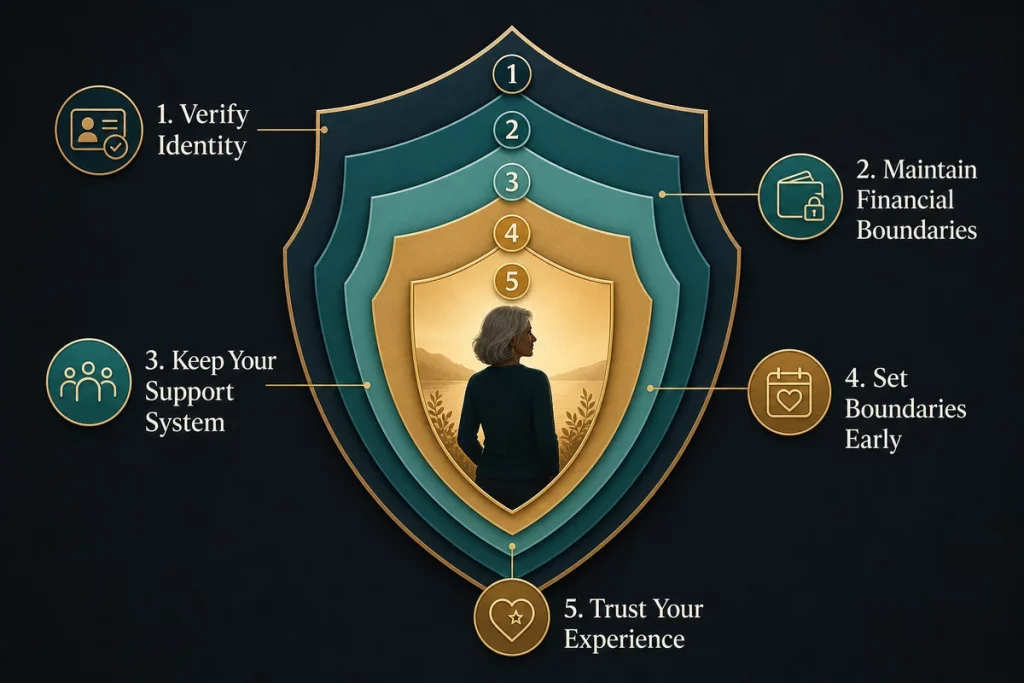
Verify before you invest. Use GuyID’s free screening tools for identity verification. Run a reverse image search on profile photos. Google their name plus city. Check if their professional claims are verifiable through LinkedIn or company websites. These steps take minutes and can save months of emotional investment in someone who isn’t who they claim to be. Share your Date Mode link through GuyID — a partner whose identity is already verified through government ID eliminates the most common category of post-60 dating fraud.
Maintain your financial boundaries absolutely. No money to anyone you’ve been dating less than a year — period. No adding names to accounts. No co-signing. No “investing” in their business. No lending money “temporarily.” These boundaries aren’t cynical — they’re the financial equivalent of wearing a seatbelt. You maintain them not because you expect a crash but because the cost of not having them when you need them is catastrophic. Consult your financial advisor or estate attorney before any financial integration with a new partner at this life stage.
Keep your support system engaged. Tell friends and family when you’re dating someone new. Introduce the partner to trusted people in your life relatively early. Ask your inner circle for honest feedback — and listen to it, even when it’s not what you want to hear. The isolation that makes exploitation possible begins when the new partner becomes the only voice in your ear. Your people are your protection — maintain those connections fiercely, and be wary of any partner who encourages you to deprioritize them.
Set boundaries from the beginning. Boundaries are easier to set at the start of a relationship than to impose after patterns have been established. Communicate your pace, your financial boundaries, your expectations for communication, and your non-negotiables clearly and early. A partner who respects your boundaries from the beginning is demonstrating the respect that predicts healthy long-term partnership. A partner who tests, pushes, or dismisses your boundaries from the beginning is demonstrating the pattern that predicts exploitation.
Trust your life experience — it’s your greatest asset. You’ve survived decades of relationships, career challenges, family dynamics, and personal growth. That experience gave you instincts about people that no verification tool can replicate. When something feels off — when the charm seems too polished, the story too perfect, the intensity too early, or the interest too convenient — pay attention. Your gut feeling at 60+ is informed by thousands of human interactions that your 20-year-old self hadn’t yet experienced. The goal isn’t to override that instinct with optimism — it’s to pair it with the verification tools that confirm whether the instinct is protecting you from a genuine threat or making you unnecessarily cautious. Combine your life experience with GuyID’s verification tools and you have the most comprehensive dating safety system available: time-tested human judgment backed by identity-verified transparency.
How GuyID Helps
GuyID should appear when it is useful, not as a banner ad. A GuyID Trust Profile gives someone a portable way to share trust signals before a date, while identity verification and social vouching help turn vague profile claims into clearer next steps.
Useful next steps:
- Create a GuyID Trust Profile when you want a cleaner way to share verified trust signals.
- Use GuyID free tools and related guides when you need a checklist before meeting someone.
- Treat identity verification as confidence-building, not a guarantee.
- Use social vouching when you want context from people who already know the person.
- Sign up only when the extra trust layer helps the decision you are already trying to make.
Frequently Asked Questions
What are the biggest red flags when dating in your 60s as a woman?
Financial red flags top the list: early discussions about your finances, financial “emergencies” within months, pressure to combine finances or move in quickly, and interference with your financial advisors or family. Emotional red flags include love bombing calibrated for your life stage, unprocessed grief in widowers, and dismissiveness toward your independence. Digital red flags include too-perfect profiles, refusal to video chat, and rapid online escalation before meeting in person.
How do I avoid romance scams after 60?
Slow the relationship down whenever someone creates urgency, secrecy, or financial pressure. Arrange a live video conversation, review photo and profile consistency, keep finances separate, and never send money because of an online relationship emergency. Keep trusted friends or family informed and use the romance-scam warning guide when stories or behavior conflict.
Is it safe to date online after 60?
Yes — with appropriate precautions. Online dating is now the primary way people over 60 meet partners, and millions of successful relationships begin online. The key protections: verify identities before meeting, maintain financial boundaries absolutely, video chat before in-person meetings, tell someone where you’re going for first dates, and use platforms with verification features. The risk isn’t online dating itself — it’s online dating without verification, which is why tools like GuyID exist.
How do I date after being widowed?
There’s no “correct” timeline — readiness is emotional, not chronological. You’re ready when you can honor your late spouse’s memory without it dominating every conversation, when you want a new partnership rather than a replacement for what you lost, and when you can maintain boundaries around your finances and independence. Our widow dating guide provides platform recommendations, and the widower red flags guide helps you evaluate potential partners’ grief-readiness.
Should I tell my adult children I’m dating?
Yes — and relatively early in the process. Your adult children serve as a valuable protective layer: they can notice red flags you might miss, provide honest feedback about new partners, and help with practical verification. Their concerns (even when overprotective) come from love. A partner who discourages you from telling your children or who frames their involvement as “controlling” may be trying to remove the people most likely to identify warning signs. Healthy partners welcome your family’s engagement.