Reader Briefing
Reader Briefing
Start here if you need a practical read on best widow dating websites: who should use verification, what signals to check, and what to do before moving from online interest to an in-person plan.
Who this is for
- People meeting someone from a dating app or social platform.
- Readers preparing for a first in-person date.
- Anyone checking identity, profile consistency, and trust signals.
- People trying to avoid romance scams, fake profiles, or pressure tactics.
You’ll learn
- How to evaluate identity signals without treating any single check as certainty.
- Which trust signals matter and how to weigh them together.
- How to spot inconsistencies, pressure, or behavior patterns that deserve caution.
- How to move from online conversation to a safer first meeting.
- Where GuyID tools fit into a quick pre-date screening workflow.
- How to compare options using practical safety and trust criteria.
Bottom line
Verification reduces uncertainty; it does not guarantee future behavior. Use a layered approach: confirm identity signals, compare profile consistency, ask for a short video call, keep early plans public, and slow down when someone pressures you to skip normal safety steps.
Key takeaways
- Identity verification improves confidence, not certainty.
- Patterns matter more than isolated incidents.
- Verify before meeting privately or sharing sensitive details.
- A short video call can reveal many inconsistencies.
- Pressure to skip reasonable safety steps is useful information.
Free Tools
Catfish Probability Detector
Check whether a dating profile has suspicious identity or photo signals.
Dating Bio Red Flag Detector
Review a bio for scam, pressure, or trust-warning language.
Dating Safety Checklist
Use free GuyID tools before moving from chat to a real date.
Next step
Create your GuyID trust profile
Share consent-based trust signals before a date without turning the conversation into an interrogation.
Dating after losing a spouse is one of the most emotionally complex and uniquely challenging experiences in adult life — and choosing the right platform matters more than it does for any other demographic. The best widow dating websites understand that you’re not starting fresh; you’re carrying a profound love alongside a desire for new connection. Generic dating apps weren’t designed for this emotional complexity, and the wrong platform can produce experiences that range from mildly insensitive to genuinely harmful and retraumatizing. This guide reviews the best widow dating websites in 2026 — from specialized platforms built exclusively for widowed individuals to mainstream apps with features that serve widowed users well — with honest, unsponsored assessments of what each platform genuinely offers, what each platform lacks, and how to navigate online dating while honoring both your past and your future.
NavigateTable of Contents25 sections
Why Widowed Daters Need Different Widow Dating Websites
Widowed individuals face a distinct set of dating challenges that divorced, single, and never-married users don’t share and often don’t understand — and these specific challenges require platform features, community norms, and community norms that generic dating apps typically lack:
The absence of a “clean break.” Divorced daters can frame their past relationship as something that ended. Widowed daters are navigating something that was taken — often without warning, often leaving a love that never stopped. This distinction shapes everything: how they describe their relationship status, how they discuss their past, what triggers emotional responses, and what kind of partner understands their experience. The best widow dating websites create space for this complexity rather than forcing it into the binary framework of “single” or “it’s complicated.”
Judgment from multiple directions. Widowed daters face unique social scrutiny: “Too soon” from some, “It’s been long enough” from others, “Your late spouse would want you to move on” (unsolicited), and “How could you replace them?” (cruel). The American Psychological Association identifies this social judgment as a significant barrier to post-loss dating readiness — and the best widow dating websites mitigate it by creating judgment-free spaces where everyone understands the context without requiring explanation.
Predatory targeting. Widowed individuals — particularly those who are newly bereaved, financially vulnerable from loss-related expenses, or emotionally isolated — are disproportionately targeted by romance scammers. The FTC reports that widowed adults report higher rates of romance fraud than any other demographic — because sophisticated scammers specifically and deliberately target the emotional vulnerability, social isolation, and potential financial resources that widowhood creates. This makes safety and verification features on widow dating websites not a nice-to-have but an essential requirement.
Different relationship goals. Many widowed daters aren’t looking for a replacement for their late spouse — they’re looking for companionship, connection, and a different kind of love that coexists with the love they still carry. Some want remarriage; others want committed partnership without marriage; others want companionship without cohabitation. The best widow dating websites accommodate this range of relationship goals rather than assuming everyone wants the same thing.
The 7 Best Widow Dating Websites
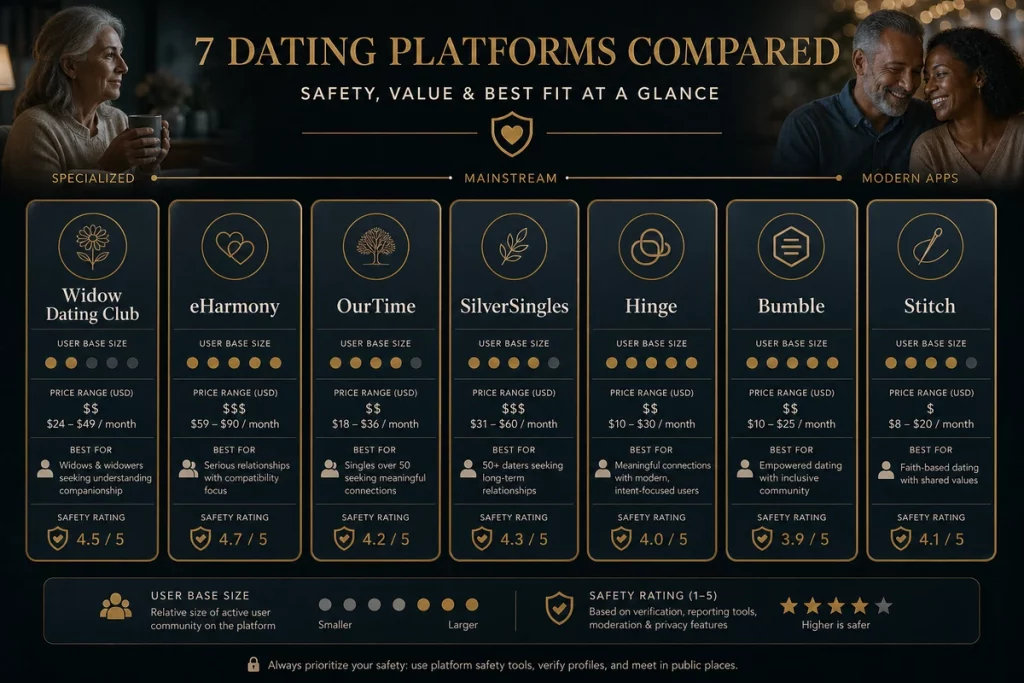
1. The Widow Dating Club
Best for: Widowed users who want a community-first approach
A dedicated platform exclusively for widowed individuals, The Widow Dating Club combines dating profiles with community features — forums, group discussions, and shared resources for navigating post-loss dating. The exclusive focus on widowed users means everyone on the platform understands the emotional context without explanation. Best for users who value community understanding over user volume.
2. eHarmony
Best for: Widowed users seeking serious, compatibility-matched relationships
eHarmony’s detailed compatibility questionnaire and algorithm-based matching serve widowed users well because the platform pre-filters for relationship seriousness and compatible values — reducing the frequency of matches who don’t understand or respect the widowed experience. The “widowed” relationship status option is prominently supported, and the user base skews older and more relationship-oriented than swipe-based apps. Among mainstream widow dating websites, eHarmony consistently ranks highest in user satisfaction for widowed demographics.
3. OurTime
Best for: Widowed daters over 50
OurTime is designed specifically for the 50+ demographic — which includes a significant proportion of widowed users. The platform’s age-focused design means the user base understands life experiences that younger demographics may not, including loss. Features include both dating and activity partner matching, accommodating widowed users who want companionship without necessarily seeking romance. Among platforms for older widowed adults, OurTime has the largest user base. Limitations: owned by Match Group (same parent company as Tinder), with reports of cross-platform profile recycling and aggressive upselling. Safety verification is minimal — photo verification only, no identity confirmation.
4. SilverSingles
Best for: Educated, professional widowed daters over 50
SilverSingles uses a personality-based matching system derived from the Five-Factor Model of personality, producing compatibility scores that help widowed users identify matches whose communication styles, values, and relationship expectations align with theirs. The platform attracts a more educated, professional demographic than OurTime — which may matter for widowed users whose social circles contracted after loss and who want intellectually compatible companionship. Research from the National Library of Medicine on post-loss dating satisfaction shows that value alignment is the strongest predictor of successful new relationships after widowhood.
5. Hinge
Best for: Widowed users under 50 who want a modern dating experience
Hinge’s prompt-based profiles give widowed users tools to communicate their experience authentically — prompts like “The one thing I’d love to know about you” and “I’m looking for someone who…” allow natural disclosure of widowed status without it dominating the profile. The relationship-oriented user base (see our Tinder vs Hinge comparison) aligns with widowed users seeking meaningful connection rather than casual encounters. Among mainstream widow dating websites, Hinge offers the best balance of modern design, relationship intent, and profile depth for users under 50. Limitations: not designed for widowed users specifically, so experiences with insensitive matches are possible; smaller user pool than Tinder in less populated areas.
6. Bumble
Best for: Widowed women who want messaging control
Bumble’s women-first messaging system gives widowed women control over who initiates conversation — reducing unwanted contact from users who may be insensitive about loss or who exhibit love bombing patterns. The platform’s BFF mode also allows widowed users to seek platonic friendships alongside romantic connections — addressing the social isolation that often accompanies widowhood. Limitations: the 24-hour message window creates time pressure that widowed daters in earlier stages of readiness may find stressful; the boost features can feel like pay-to-play; not designed for widowed users specifically.
7. Stitch
Best for: Widowed daters seeking companionship without necessarily seeking romance
Stitch takes a fundamentally different approach from traditional widow dating websites by offering both romantic matching and activity-based companionship — hiking groups, dinner companions, travel partners, and event buddies. For widowed individuals who aren’t ready for romance but crave social connection, Stitch provides an entry point that doesn’t require the romantic framing of traditional dating platforms. The community-activity approach reduces the pressure of “dating” while facilitating the organic connections that sometimes develop into something more. Limitations: smaller user base (especially outside Australia, US, and UK), limited free features, and the activity-based focus means some users aren’t interested in romantic connection at all.
Mainstream Apps That Work for Widowed Users
Beyond the dedicated widow dating websites, several mainstream platforms serve widowed users if used strategically:
Match.com offers a “widowed” status option and attracts a relationship-seeking demographic. The larger user base compared to niche platforms means more potential matches, particularly in smaller markets where dedicated widow dating websites may lack critical mass. Match’s profile depth and communication tools support the nuanced self-presentation that widowed dating requires.
Facebook Dating leverages existing social connections — friends of friends, group members, event attendees — which can provide the social context and implicit trust that stranger-based platforms lack. For widowed users whose social circles have contracted, Facebook Dating’s integration with existing community connections offers a gentler re-entry into dating than anonymous matching platforms.
Coffee Meets Bagel limits daily matches to a curated selection, reducing the overwhelm that widowed users in earlier readiness stages may experience on high-volume platforms. The quality-over-quantity approach and the longer conversation windows (7 days) accommodate the slower pace that post-loss dating often requires.
What to Avoid in Widow Dating Websites
Not all platforms marketed toward widowed users are legitimate or helpful:
Sites with minimal user verification. Any platform marketed to widowed users that doesn’t offer at minimum photo verification should be approached with extreme caution. Scammers specifically target widowed individuals — and platforms without verification make their job easier. Look for: photo verification, phone number verification, and ideally the ability to link third-party identity verification like GuyID.
Sites that exploit grief for profit. Some platforms marketed to widowed users charge premium prices for basic features while providing minimal moderation, few active users, and poor user experience — essentially monetizing grief without delivering value. Check independent reviews (not testimonials on the platform’s own site), look for BBB ratings and complaint histories, and verify the user base is active before committing to a subscription.
Sites with no community moderation. Forums and community features on these platforms require active moderation to prevent: grief-shaming (“You should have moved on by now”), unsolicited advice about the deceased spouse, romantic solicitation in support forums, and scam attempts disguised as peer support. Unmoderated communities can produce more harm than benefit for vulnerable users.
Free sites with no revenue model beyond ads. If a platform targeting widowed daters is entirely free and supported by advertisements, the platform’s incentive is to maximize your time on site (more ad impressions) rather than to produce successful matches (which would reduce your engagement). The business model should align with your goals — platforms that succeed when you succeed (through subscriptions or per-match fees) have better incentive alignment than ad-supported models.
Safety Concerns Specific to Widowed Daters
Widowed individuals face heightened safety risks that require additional vigilance on any dating platform — specialized widow dating websites included:
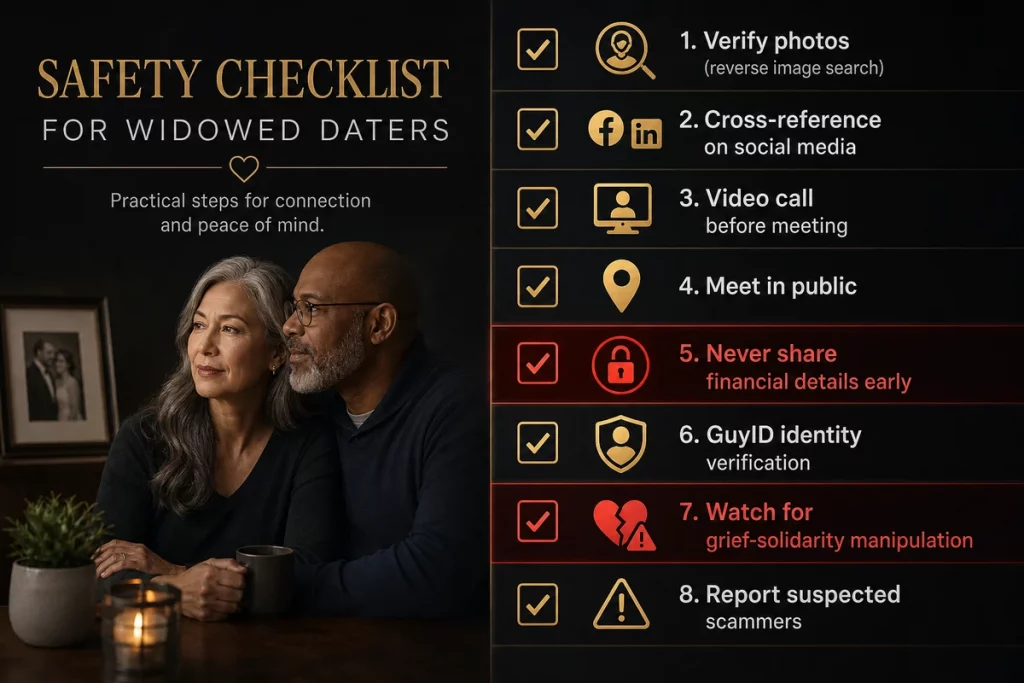
Romance scam targeting. Scammers research targets — and recently widowed individuals are identifiable through obituary listings, social media memorials, and public records. A scammer who opens with “I lost my wife too” establishes instant emotional connection through shared experience — and this fabricated commonality accelerates trust formation in ways that other demographics don’t experience. Use reverse image search on every match’s photos. Cross-reference on social media for a consistent digital footprint. Watch for dating app red flags — particularly emotional intensity that escalates rapidly and eventual money requests.
Financial exploitation. Widowed individuals may have received life insurance payouts, pension benefits, or estate assets that make them financial targets. Scammers on widow dating websites specifically probe for financial information — “Do you own your home?” “Did your spouse leave you comfortable?” — framed as getting-to-know-you conversation. Never share financial details with someone you haven’t met in person and verified independently. Use GuyID’s free screening tools before emotional investment reaches the point where financial requests feel reasonable.
Emotional manipulation through shared grief. A manipulator who claims widowed status (whether truthfully or not) can use the shared grief experience to accelerate emotional intimacy beyond what the actual connection warrants. This is love bombing adapted for the widowed context — using grief solidarity rather than romantic intensity as the bonding mechanism. The same protective strategies apply: pace the connection, verify identity through GuyID verification, and set boundaries that protect your healing process even when the other person seems to understand it perfectly.
Verify every match. Regardless of which widow dating websites you use: reverse image search photos, video call before meeting in person, meet in public for the first several dates, and share your Date Mode link through GuyID to establish mutual transparency. The emotional vulnerability of post-loss dating makes verification more important, not less — because the consequences of encountering a scammer or manipulator are amplified when you’re already carrying grief.
How to Know You’re Ready
There’s no universal timeline or calendar-based formula for dating readiness after loss — but these indicators help you assess where you are in the process:
You want THIS, not just “not being alone.” Dating from loneliness (filling the void your spouse left) produces different outcomes than dating from genuine desire for new connection. Loneliness-driven dating tends to produce rebound-like patterns — rapid attachment to anyone who provides relief, followed by disappointment when the new person can’t replace what was lost. Genuine readiness includes wanting connection as an addition to a life that can function independently, not as a solution to unbearable emptiness.
You can talk about your late spouse without destabilizing. Talking about your spouse will happen in dating — and it should. A new partner who can’t accommodate your history isn’t the right partner. Readiness means you can mention your late spouse in appropriate contexts (shared memories, explaining your journey, answering questions) without the conversation producing acute grief that derails the interaction. Brief emotional moments during these conversations are entirely normal and expected; sustained emotional flooding suggests the grief work has more processing to do before dating adds value.
You’re not seeking permission. If you’re asking friends, family, and articles whether “it’s okay” to date, you may be seeking external validation for a decision you’re not yet internally confident about. When you’re ready, the question shifts from “Is it okay?” to “How do I do this well?” The absence of guilt about dating doesn’t mean the absence of grief — it means the grief has evolved enough to coexist with forward movement.
You can handle rejection without it confirming your worst fears. Post-loss dating includes rejection — and rejection after losing a spouse can activate the grief response: “I’m going to lose everyone I care about.” If a match ghosting or a date not leading to a second date would produce grief-level distress rather than normal dating disappointment, additional grief processing may be needed before the vulnerability of dating is manageable.
Profile Tips for Widowed Daters
Whether to disclose widowed status in your profile. There’s no single correct approach, but the predominant advice from therapists and experienced widowed daters: include it. “Widowed” in your status or a brief mention in your bio (“Widowed. Ready for a new chapter.”) filters for people who understand the context and filters out people who can’t handle it. This pre-filtering saves you from the often awkward and emotionally draining mid-conversation disclosure and the rejection that sometimes follows it. On dedicated widowed-focused platforms, disclosure is implicit — on mainstream apps, explicit mention helps set appropriate expectations from the start.
Don’t make your profile a memorial. Your dating profile is about who you are now and who you want to meet — not a tribute to your late spouse. Brief, contextual mention is appropriate. Multiple references, photos of your late spouse, or extensive descriptions of your grief shift the profile’s purpose from “attracting compatible matches” to “processing loss publicly.” The latter is valid work — but it belongs in therapy and support groups, not on a dating profile.
Show your present life. Photos of activities you currently enjoy, recent travel, current hobbies, and current social interactions demonstrate that you have a life you’re actively living — not just a loss you’re recovering from. Matches want to see who you are today, not just who you were before. The best profiles on these platforms balance acknowledgment of the past with visible investment in the present and openness toward the future.
Be clear about what you’re looking for. Companionship? Casual dating? A committed relationship? Remarriage? Widowed daters have the full range of relationship goals — and being specific helps attract compatible matches while repelling incompatible ones. “Looking for companionship and connection — open to seeing where things go” is more useful to potential matches than “Just seeing what’s out there.”
How GuyID Helps
GuyID should appear when it is useful, not as a banner ad. A GuyID Trust Profile gives someone a portable way to share trust signals before a date, while identity verification and social vouching help turn vague profile claims into clearer next steps.
Useful next steps:
- Create a GuyID Trust Profile when you want a cleaner way to share verified trust signals.
- Use GuyID free tools and related guides when you need a checklist before meeting someone.
- Treat identity verification as confidence-building, not a guarantee.
- Use social vouching when you want context from people who already know the person.
- Sign up only when the extra trust layer helps the decision you are already trying to make.
Frequently Asked Questions
What are the best widow dating websites in 2026?
The best widow dating websites depend on your age, location, and goals. The Widow Dating Club offers a widowed-only community. eHarmony provides compatibility-matched serious relationships. OurTime serves the 50+ demographic. SilverSingles targets educated professionals. Hinge works well for widowed users under 50. Bumble gives women messaging control. Stitch offers companionship alongside romantic matching. All benefit from additional verification through GuyID because none verify identity beyond photos.
How soon after losing a spouse should I start dating?
There’s no universal timeline — readiness is individual, not chronological. Some people are ready within months; others need years. The indicators described in the readiness section (wanting connection vs. filling void, ability to discuss your spouse without destabilizing, internal confidence rather than permission-seeking, ability to handle rejection) are more reliable readiness markers than any calendar timeframe. A therapist experienced in grief and relationships can help you assess where you are in your specific journey.
Are widowed people targeted by scammers on dating sites?
Yes — disproportionately. The FTC reports higher romance fraud rates among widowed adults than any other demographic. Scammers target the emotional vulnerability, potential financial resources, and social isolation that widowhood creates. On these platforms specifically, scammers may fabricate widowed status to establish grief solidarity. Always verify: reverse image search photos, video call before meeting, never share financial information early, and use GuyID’s free tools for identity verification.
Should I mention being widowed in my dating profile?
Yes — most therapists and experienced widowed daters recommend including it. A brief mention (“Widowed. Ready for a new chapter.”) filters for people who understand the context and filters out those who can’t handle it. This pre-filtering saves you from uncomfortable mid-conversation disclosures. On dedicated widow dating websites, the context is implicit. On mainstream apps, explicit mention sets appropriate expectations and attracts matches who are genuinely compatible with your situation.
Is it okay to still love my late spouse while dating someone new?
Absolutely — and any partner worth dating understands this. Love for a deceased spouse doesn’t diminish with time or with new love; it coexists. A healthy new partner doesn’t compete with your late spouse — they understand that your capacity for love expanded through your marriage, and that capacity now includes room for someone new alongside continued love for someone gone. Partners who express jealousy of a deceased spouse reveal an insecurity that’s a red flag for the relationship’s viability.
Are free widow dating websites safe?
Free platforms can carry additional risk because lower barriers to entry may make them easier for scam accounts to access. If budget is a concern, compare free trials on paid widow dating websites with mainstream apps that offer verification features. Regardless of platform cost, a brief personal verification check through GuyID’s free tools can add useful context before you invest further.
How do I protect myself from financial scams on dating sites?
Never share financial details (income, assets, account information) with someone you haven’t met in person and verified independently. Be alert to financial probing disguised as casual conversation (“Do you own your home?” “Did your spouse leave you comfortable?”). Never send money to someone you’ve met online, regardless of the reason. Use reverse image search and GuyID verification to confirm identity before emotional investment reaches the point where financial requests might feel reasonable. Report suspected scammers to the platform and the FTC.
What’s the difference between widow dating websites and regular dating apps?
Dedicated widow dating websites provide: a user base that understands loss without explanation, community features (forums, support groups) alongside dating, and norms that accommodate grief alongside romance. Regular dating apps offer: larger user bases, more modern interfaces, and more advanced matching algorithms. The fundamental tradeoff is specificity and community understanding vs. scale and modern technology — niche platforms provide deep community understanding while mainstream platforms provide significantly greater user volume. Many widowed daters use both: a niche platform for community and a mainstream app for broader matching, with GuyID verification applied across both.