

Reader Briefing
Reader Briefing
Start here if you need a practical read on breadcrumbing in dating: signs & response: who should use verification, what signals to check, and what to do before moving from online interest to an in-person plan.
Who this is for
- Readers preparing for a first in-person date.
- Anyone checking identity, profile consistency, and trust signals.
- People trying to avoid romance scams, fake profiles, or pressure tactics.
- Online daters improving conversations, profiles, or match screening.
You’ll learn
- How to evaluate identity signals without treating any single check as certainty.
- Which trust signals matter and how to weigh them together.
- How to spot inconsistencies, pressure, or behavior patterns that deserve caution.
- How to move from online conversation to a safer first meeting.
- Where GuyID tools fit into a quick pre-date screening workflow.
- How to compare options using practical safety and trust criteria.
Bottom line
Verification reduces uncertainty; it does not guarantee future behavior. Use a layered approach: confirm identity signals, compare profile consistency, ask for a short video call, keep early plans public, and slow down when someone pressures you to skip normal safety steps.
Key takeaways
- Identity verification improves confidence, not certainty.
- Patterns matter more than isolated incidents.
- Verify before meeting privately or sharing sensitive details.
- A short video call can reveal many inconsistencies.
- Pressure to skip reasonable safety steps is useful information.
Free Tools
Catfish Probability Detector
Check whether a dating profile has suspicious identity or photo signals.
Dating Bio Red Flag Detector
Review a bio for scam, pressure, or trust-warning language.
Dating Safety Checklist
Use free GuyID tools before moving from chat to a real date.
Next step
Create your GuyID trust profile
Share consent-based trust signals before a date without turning the conversation into an interrogation.
They text just enough to keep you interested but never enough to build anything real — and the worst part is, it works. This manipulation pattern involves sending sporadic, low-effort signals of interest that maintain someone’s emotional investment without any intention of developing the connection into a genuine relationship. Unlike ghosting (which ends the connection) or the slow fade (which gradually diminishes it), this dynamic keeps the connection technically alive while starving it of the substance it needs to grow. Every “thinking of you” text, every late-night “hey,” every vague “we should hang out” that never converts to actual plans is a crumb — designed to keep you following the trail without ever arriving at a meal. This guide explains how breadcrumbing dating works, why it’s so effective, how to recognize the pattern, and how to respond when you realize the crumbs will never become something more.
NavigateTable of Contents23 sections
What Breadcrumbing Dating Looks Like
Breadcrumbing dating operates through a specific pattern of minimal, intermittent contact that creates maximum emotional engagement from the recipient while requiring minimal investment from the breadcrumber:
The sporadic text. Every 3-7 days, a message appears: “Hey, thinking about you” or “How’s your week going?” or a reaction to your social media story. The message requires no effort, leads to no substantive conversation, and creates no forward momentum — but it reactivates your hope and resets the clock on your patience. Each sporadic text is a crumb: individually meaningless, collectively sufficient to prevent you from concluding the connection is dead.
The phantom plan. “We should totally get dinner this week.” “I want to take you to that place I mentioned.” “Let’s plan something soon.” These enthusiastic suggestions generate the feeling of progression without the reality of it — because the plans never materialize. When the proposed day arrives, silence or a last-minute cancellation replaces the anticipated date. The playbook depends on future promises substituting for present action.
The social media engagement without real engagement. They like your photos, react to your stories, and leave flirtatious comments — but don’t respond to your DMs with depth or initiate real-world interaction. Social media engagement is the lowest-effort form of breadcrumbing dating because a single tap communicates “I exist in your awareness” without requiring any investment in the connection itself. If someone’s primary mode of maintaining contact is through double-taps rather than conversations, the pattern is clearly operating.
The late-night “hey.” Messages that arrive after 10 PM, especially on weekends, that go nowhere substantive. These messages exploit the intimacy of late-night communication — the lowered defenses, the suggestion of being on their mind when others aren’t available, the emotional vulnerability that nighttime naturally produces — to generate disproportionate emotional response from minimal textual input. The late-night text is a crumb calibrated for maximum emotional impact per character typed. Research from the National Library of Medicine on digital communication patterns confirms that late-night message timing produces disproportionate emotional response in recipients compared to identical messages sent during daytime hours — which means the breadcrumber who texts at midnight is exploiting a documented psychological vulnerability, whether or not they’re consciously aware of the mechanism.
The compliment that goes nowhere. “You looked amazing in that photo.” “I can’t stop thinking about our conversation.” These statements feel like investment — someone who’s complimenting you must be interested, right? But in breadcrumbing dating, compliments serve the same function as any other crumb: generating emotional response without creating forward momentum. The distinction between a breadcrumbing compliment and a genuine-interest compliment: the genuine compliment is followed by action (making plans, continuing conversation, deepening engagement), while the breadcrumbing compliment exists in isolation — a standalone dopamine delivery that provides the emotional hit without any substance behind it. If compliments arrive regularly but plans, depth, and progression don’t, the compliments are crumbs, not connection.
8 Signs of Breadcrumbing Dating
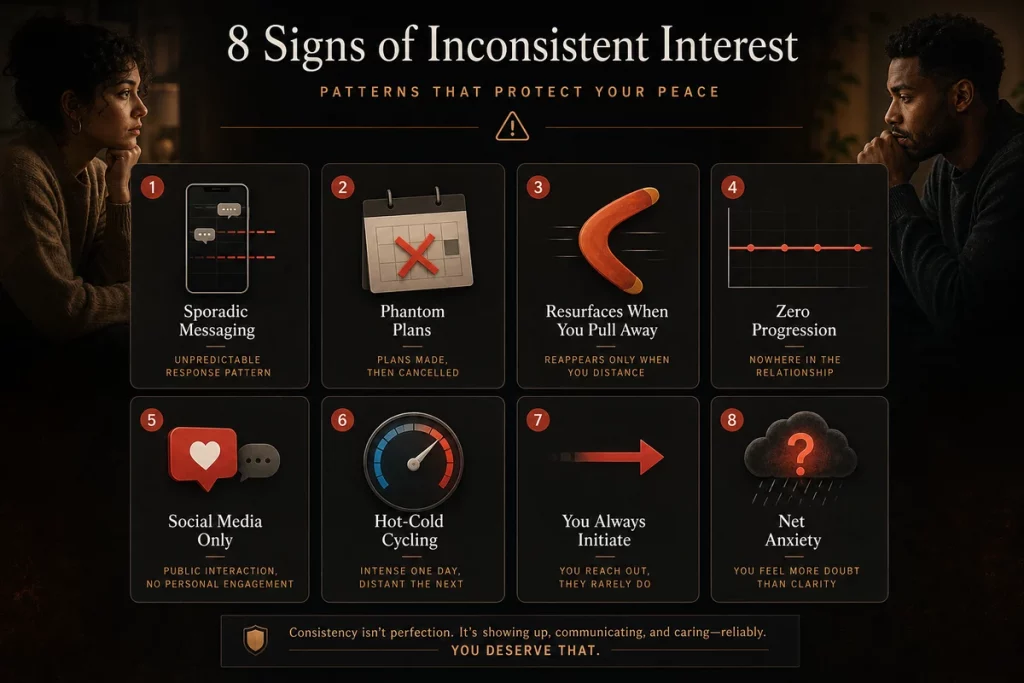
1. Communication Is Intermittent and Low-Effort
Messages every few days, brief and generic. No depth, no follow-up questions, no continuation of previous threads. The communication pattern is just enough to maintain awareness but nowhere near enough to build genuine connection. If you removed the breadcrumber’s messages from your phone and showed the remaining conversation to a friend, they’d see a one-sided effort where you’re investing paragraphs and receiving sentence fragments in return.
2. Plans Are Suggested but Never Happen
Enthusiastic suggestions that never convert to calendar events. “Let’s grab coffee this weekend” followed by silence when the weekend arrives. The strategy here is generating the feeling of investment (they’re making plans!) without the accountability of following through (the plans evaporate). After two or three phantom plans, the pattern is established — and additional patience won’t change it.
3. They Resurface When You Start Moving On
You stop texting first. You start dating someone new. You post photos looking happy without them. Suddenly — increased attention, longer messages, actual plan suggestions. This isn’t a realization of your value; it’s a response to threatened supply. The pattern is most diagnostic here: attention is rationed to the minimum required to maintain your investment, and that minimum recalibrates upward when your investment threatens to disappear. Once you’re re-engaged, the attention returns to crumb-level — confirming that the increase was strategic rather than genuine.
4. The Connection Never Progresses
Weeks or months pass with no deepening of emotional intimacy, no movement toward exclusivity, and no integration into each other’s real lives. The relationship exists in the same ambiguous space it occupied on week one — neither developing nor ending. This stagnation is the structural hallmark of breadcrumbing dating because progression requires investment the breadcrumber is unwilling to make. A genuine connection shows trajectory; a breadcrumbed connection shows flatline.
5. They Engage on Social Media More Than in Real Life
Story reactions, post likes, flirtatious comments — all visible, all public, all requiring zero real engagement. Social media this social media pattern is particularly effective because it’s visible to others (creating the appearance of connection) while being hollow in practice (no actual conversation or plans). If someone’s dating effort exists primarily in your notification tab rather than your message thread, you’re being breadcrumbed.
6. Hot-Cold Communication Cycling
Three days of engaged texting followed by a week of nothing. An intense conversation that feels like a breakthrough followed by complete withdrawal. This unpredictable pattern isn’t accidental — it’s the intermittent reinforcement mechanism that makes breadcrumbing dating psychologically powerful. The inconsistency produces more attachment than consistent communication would because your brain treats each “hot” phase as an unpredictable reward that demands vigilant monitoring. See our narcissism and breadcrumbing guide for the deeper psychological mechanics.
7. You’re Always Initiating
If you stopped texting first, the communication would stop entirely — and you suspect this but haven’t tested it because the confirmation would be painful. The imbalance of initiative is one of the clearest indicators because it reveals that the connection’s existence depends entirely on your effort. A genuine connection features mutual initiation; a breadcrumbed connection features your effort plus their response (when convenient).
8. You Feel More Anxious Than Happy
The overall emotional experience of the connection is negative — more time analyzing, waiting, and worrying than feeling connected, valued, and secure. If anxiety about the connection exceeds enjoyment of it, the dynamic is this dynamic regardless of how good the occasional “hot” moments feel. Genuine connections produce a predominantly positive emotional experience. Breadcrumbing produces predominantly anxiety punctuated by brief relief — the emotional signature of early-stage trauma bonding.
Breadcrumbing vs. Ghosting vs. Slow Fade vs. Genuine Interest
| Pattern | Communication | Intent | Outcome |
|---|---|---|---|
| Breadcrumbing dating | Sporadic, low-effort, maintains hope | Keep you available without committing | Indefinite stagnation — connection never develops or ends |
| Ghosting | Abrupt, complete silence | End connection without conversation | Conclusive — the connection ends (eventually, through silence) |
| Slow fade | Gradually declining engagement | Passively withdraw without confrontation | Directional — heading toward ending but drawn out |
| Genuine interest | Consistent, proportionate, builds over time | Develop a real connection | Progressive — the relationship deepens and moves forward |
The critical distinction: breadcrumbing is the only dating pattern that maintains the connection indefinitely without either developing or ending it. Ghosting is painful but conclusive. The slow fade is painful but directional. Breadcrumbing is painful AND indefinite — which is what makes it the most psychologically taxing of the three, because there’s no natural endpoint that forces closure. The breadcrumber will continue dropping crumbs for as long as you continue picking them up.
Why Breadcrumbing Dating Is So Effective
Intermittent reinforcement is addictive. The American Psychological Association identifies variable-ratio reinforcement schedules — where rewards are delivered unpredictably — as the most powerful mechanism of behavioral conditioning. Slot machines use this mechanism to keep people playing. Breadcrumbing dating uses the same mechanism to keep people hoping. Each crumb is an unpredictable reward that maintains your engagement without providing enough substance to satisfy it — creating the same “just one more” compulsion that gambling addiction exploits.
Hope requires minimal evidence. Human psychology is wired for optimism — and breadcrumbing dating exploits this by providing just enough evidence to sustain hope. A single text every five days is technically “communication.” A vague plan suggestion is technically “effort.” These minimal inputs provide the evidence your hope needs to justify continued investment — even when a clear-eyed assessment of the behavioral pattern would reveal that the connection is stagnant and one-sided.
Sunk cost accumulates invisibly. Each week of waiting adds to the time you’ve already invested — making walking away feel increasingly irrational because the investment you’ve made “will be wasted” if you leave. This sunk cost fallacy operates particularly effectively in breadcrumbing dating because the investment accumulates gradually (a week here, a month there) rather than in a single dramatic moment — making it harder to identify the cumulative total until you’ve been in the dynamic for months and realize you’ve invested enormous emotional energy in a connection that has given you nothing but crumbs in return. The economic reality: the time you’ve already invested is gone regardless of what you decide next.
Anxious attachment amplifies everything. Anxiously attached individuals are disproportionately susceptible to breadcrumbing dating because their nervous system is calibrated to monitor relational signals obsessively, interpret ambiguity as potential rejection, and pursue connection more intensely when it feels threatened. The breadcrumber’s withdrawal triggers the anxious person’s pursue response; the pursuit provides the breadcrumber’s narcissistic supply or ego boost; the breadcrumber’s minimal response provides the anxious person’s crumb — just enough to prevent complete disengagement. The cycle self-perpetuates because both parties’ psychological needs are being met — just in profoundly unhealthy ways that leave one person progressively more depleted. Breaking this cycle requires the anxiously attached person to override the pursue impulse with the uncomfortable but liberating recognition that the crumbs will never, under any circumstances, become a full meal. A therapist experienced in attachment patterns can support this specific override because the neurochemical pull of intermittent reinforcement is genuinely difficult to resist through willpower alone — professional guidance provides the structured support that makes disengagement achievable rather than merely aspirational.
How to Respond to Breadcrumbing Dating
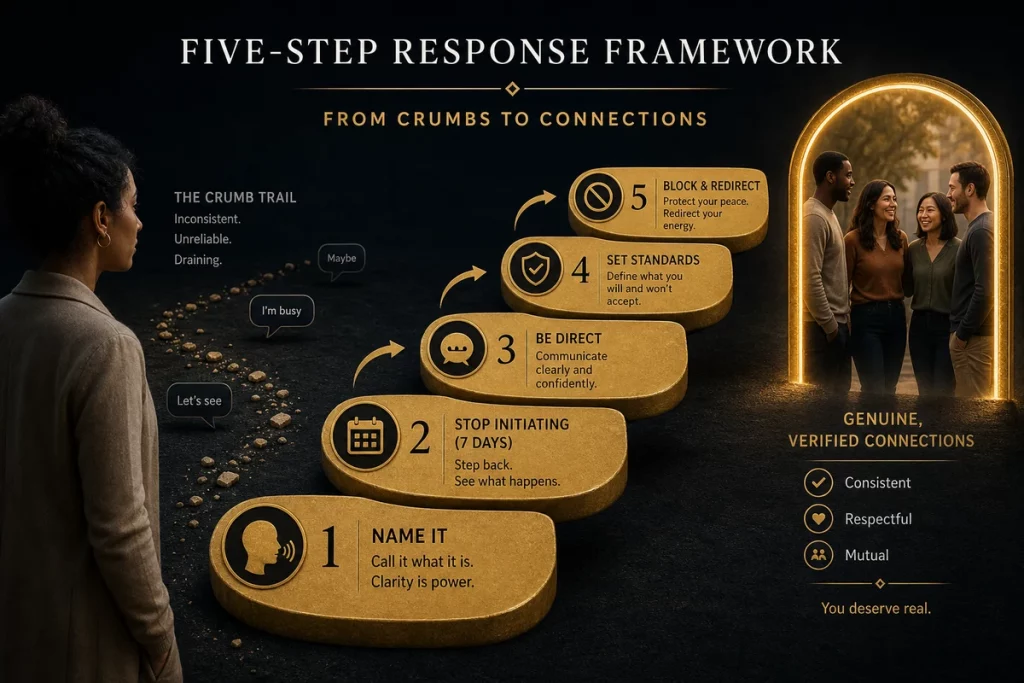
Step 1: Name it. “I’m being breadcrumbed” is a more accurate and more empowering framing than “They’re just busy” or “Maybe they’ll come around.” Accurate naming breaks through the ambiguity that breadcrumbing dating requires to function — because once the pattern has a name, it becomes recognizable as a documented dynamic rather than a unique situation that might resolve differently.
Step 2: Stop initiating for 7 days. Don’t text first for one full week. Don’t like their posts. Don’t react to their stories. Observe what happens in the absence of your effort. A genuinely interested person will notice and reach out. A breadcrumber will either let the silence extend (confirming they only engaged when you prompted it) or reach out with a crumb (confirming the pattern). Either outcome provides diagnostic data.
Step 3: If they reach out during your test, be direct. “I’ve noticed our communication has been pretty one-sided. I’m looking for something consistent and reciprocal. Where do you see this going?” This direct question forces a clear response — because the breadcrumbing pattern can’t survive direct communication about the dynamic itself. The response tells you everything: genuine engagement and behavioral change (green flag) or deflection, charm without commitment, or silence (pattern confirmed).
Step 4: Set your standard and enforce it. “I need consistent communication, actual plans that happen, and a connection that moves forward. If that’s not available, I’m redirecting my energy.” This isn’t an ultimatum — it’s a boundary that clearly communicates what you need and what you’ll do if it’s not met. Enforce it. If the pattern continues unchanged after direct communication, the pattern will not change through additional patience.
Step 5: Block and redirect. If Steps 1-4 confirm the breadcrumbing dating pattern, block on all platforms without extended explanation. “I wish you well, but this isn’t what I’m looking for” is sufficient. Then redirect: update your dating profile, engage with matches who demonstrate green flags, verify new connections through GuyID’s free screening tools, and share your Date Mode link through GuyID to build the next connection on verified, reciprocal trust from the start. The energy you’ve been spending on crumbs is now available for connections that actually deserve it.
How GuyID Helps
GuyID should appear when it is useful, not as a banner ad. A GuyID Trust Profile gives someone a portable way to share trust signals before a date, while identity verification and social vouching help turn vague profile claims into clearer next steps.
Useful next steps:
- Create a GuyID Trust Profile when you want a cleaner way to share verified trust signals.
- Use GuyID free tools and related guides when you need a checklist before meeting someone.
- Treat identity verification as confidence-building, not a guarantee.
- Use social vouching when you want context from people who already know the person.
- Sign up only when the extra trust layer helps the decision you are already trying to make.
Frequently Asked Questions
What is breadcrumbing in dating?
Breadcrumbing dating is the practice of sending sporadic, low-effort signals of interest — occasional texts, social media engagement, vague plans — to maintain someone’s emotional investment without any intention of developing the connection into a genuine relationship. Unlike ghosting (which ends contact) or the slow fade (which gradually reduces it), breadcrumbing keeps the connection technically alive while denying it the substance needed to grow. See our narcissism and breadcrumbing guide for the deeper psychological mechanics.
How do I know if I am being breadcrumbed?
Breadcrumbing is a repeated pattern of occasional attention without meaningful progress. Look for vague plans, long gaps, renewed contact when you pull away, and an ongoing imbalance in who initiates. Judge the pattern over time rather than one delayed reply.
Why do people breadcrumb instead of just saying they’re not interested?
People may breadcrumb because they are ambivalent, avoid uncomfortable conversations, enjoy attention, or want to preserve an option. The motive cannot be known from messages alone. Focus on whether their behavior consistently meets your stated needs and boundaries.
Is breadcrumbing dating worse than ghosting?
In terms of cumulative psychological impact, often yes. Ghosting is acutely painful but eventually conclusive — after enough silence, your brain accepts the ending and begins processing. Breadcrumbing dating is chronically painful and never conclusive — the intermittent crumbs prevent the closure that would allow processing. The total anxiety accumulated over weeks or months of breadcrumbing typically exceeds the acute distress of a single ghosting event.
Should I confront a breadcrumber?
A direct question about the dynamic is more productive than a confrontation. “I’ve noticed our communication is pretty one-sided — where do you see this going?” forces clarity that the breadcrumbing dating pattern can’t survive. Their response — genuine engagement with behavioral change, or deflection and continued pattern — tells you everything. If the direct conversation doesn’t produce observable change within 1-2 weeks, the answer is in the unchanged behavior, not in whatever words they used in the conversation.
Can a breadcrumber become a real partner?
Very rarely. Breadcrumbing dating is a pattern of minimal investment — and people who invest minimally at the beginning don’t typically escalate to full investment later. The behavior serves their needs (attention, ego boost, backup option) at zero cost, and there’s no structural incentive to change what’s already working for them. A genuine shift would require them to independently recognize the pattern, take accountability, and demonstrate sustained consistent behavior. See our guide on toxic relationship transformation for the conditions that genuine change requires.
How do I stop falling for breadcrumbing?
Verify matches early through GuyID’s free tools — verified people are more invested. Set internal benchmarks: if communication doesn’t become consistent and reciprocal within 2-3 weeks, disengage rather than waiting. Use the stop-initiating test at the first sign of imbalance. Address anxious attachment patterns that make breadcrumbing disproportionately compelling. And look for green flags rather than just the absence of red flags — a person who shows consistent initiative, follow-through, and proportionate interest is demonstrating the opposite of breadcrumbing dating.
Is breadcrumbing a form of emotional abuse?
When deliberate and sustained — particularly as part of a narcissistic supply strategy — this pattern constitutes emotional manipulation because it intentionally exploits someone’s emotional vulnerability for personal benefit without regard for the psychological harm caused. When driven by ambivalence or conflict avoidance rather than deliberate strategy, it’s more accurately described as poor communication — still harmful, but reflecting emotional immaturity rather than calculated abuse. The National Domestic Violence Hotline can help you assess whether the breadcrumbing is part of a broader abusive pattern.