

Free Tools
Catfish Probability Detector
Check whether a dating profile has suspicious identity or photo signals.
Dating Bio Red Flag Detector
Review a bio for scam, pressure, or trust-warning language.
Dating Safety Checklist
Use free GuyID tools before moving from chat to a real date.
Next step
Create your GuyID trust profile
Share consent-based trust signals before a date without turning the conversation into an interrogation.
You’re three months out and still checking their social media at 2 AM. Or you’re three weeks out and already dating someone new — and wondering if that means you didn’t care enough, or if you’re just healthier than you thought. The question everyone asks after a relationship ends — how long does it take to get over a breakup? — has no universal answer, because “getting over it” depends on relationship length, attachment style, breakup circumstances, support systems, and whether you do the internal work that turns loss into growth or just wait for time to pass. This guide replaces the vague “give it time” advice with the actual psychology of breakup recovery, the factors that determine YOUR timeline, and the concrete steps that shorten the process without skipping the healing.
NavigateTable of Contents21 sections
What the Research Says About How Long Does It Take to Get Over a Breakup
The most-cited research on breakup recovery comes from a 2007 study published in the Journal of Positive Psychology (indexed in the National Library of Medicine), which found that 71% of participants reported experiencing significant positive emotional recovery within approximately 11 weeks (about 3 months) of a breakup. This finding launched the popular “three-month rule” — but the study’s limitations are as important as its conclusions:
The study measured emotional recovery in relatively young participants (college students) whose relationships averaged shorter durations. How long does it take to get over a breakup when the relationship lasted 10 years with shared children, combined finances, and a mutual social network? Significantly longer than three months. The three-month benchmark applies to moderate-length relationships (6 months to 2 years) in relatively young adults with strong social support — not as a universal timeline for all breakup recovery.
A 2015 study from Binghamton University found that while women reported higher immediate emotional distress after breakups, they recovered more completely over time — while men experienced less acute initial pain but were more likely to carry unresolved grief forward into subsequent relationships, sometimes for years. This gender difference in recovery patterns means that recovery speed depends partly on how you process emotions: people who engage with the grief (painful but productive) recover faster than people who avoid it (less painful initially but slower recovery).
The most honest answer to how long does it take to get over a breakup: between 3 months and 18 months for most people, with significant variation based on the factors below. The American Psychological Association notes that if grief from a breakup significantly impairs daily functioning (work, sleep, appetite, social engagement) beyond 6 months, professional support may be beneficial — not because 6 months is “too long” to grieve, but because persistent impairment suggests the grief has become complicated and may benefit from therapeutic intervention.
7 Factors That Determine Your Recovery Timeline
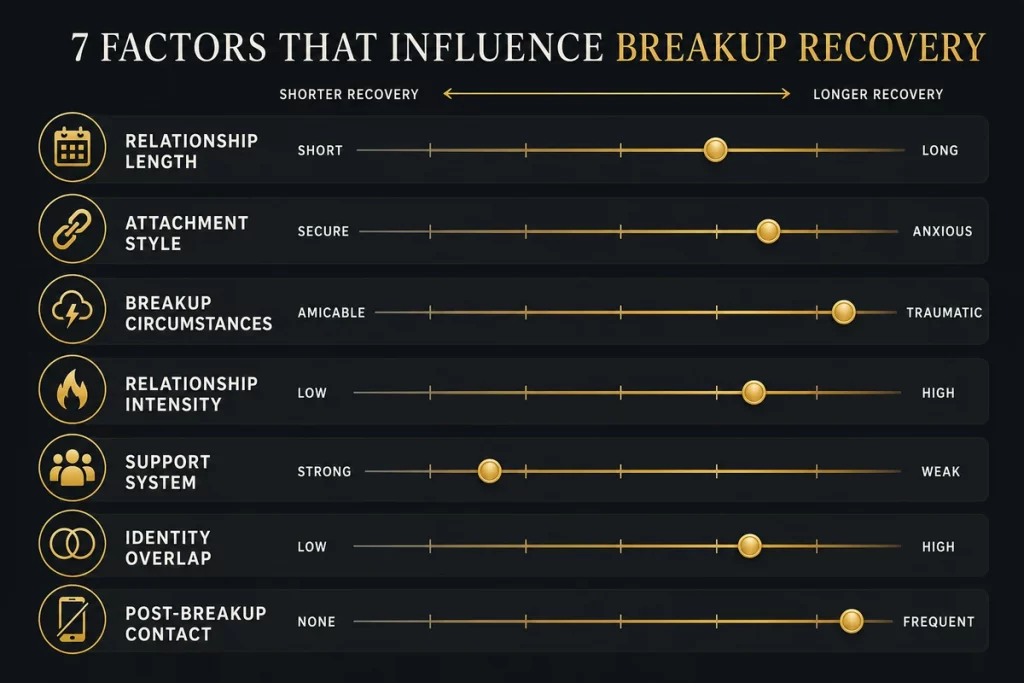
1. Relationship Length and Depth
A 6-month dating relationship and a 10-year marriage involve fundamentally different levels of attachment, identity integration, logistical entanglement, and future planning. The recovery timeline scales roughly with the relationship’s depth — not just its duration. A short but intensely emotional relationship may require more recovery time than a longer but emotionally shallow one. The key variable is how deeply the relationship was integrated into your identity, daily routines, future vision, and emotional regulation — the more integration, the more reconstruction recovery requires.
2. Attachment Style
Your attachment style significantly impacts recovery speed and pattern. Anxiously attached individuals typically experience the most intense initial grief — the abandonment fear at the core of anxious attachment gets activated at maximum intensity, producing consuming rumination, desperate urges to reconnect, and difficulty separating self-worth from partner-validation. Avoidantly attached individuals may appear to recover quickly (jumping into new activities or relationships) while suppressing grief that surfaces months or years later. Securely attached individuals tend to grieve proportionally and recover most smoothly.
3. Who Initiated the Breakup
The person who was broken up with typically has a longer recovery timeline — not because they loved more, but because they had less time to psychologically prepare. The initiator often processes much of their grief BEFORE the breakup (during the decision-making period), so their post-breakup recovery is partially complete by the time the breakup occurs. The person who was left experiences the full grief cycle after the event, starting from a position of shock rather than preparation.
4. Breakup Circumstances
A mutual, respectful breakup (“we’ve grown apart and we both know it”) involves simpler grief than a betrayal breakup (infidelity, discovering a hidden life) or an abusive breakup (leaving someone who gaslit, manipulated, or abused you). Betrayal breakups add trust devastation to relationship loss. Abusive breakups add the complexity of trauma bonding, identity reconstruction, and processing what was done to you alongside processing the loss of what you thought you had.
5. Support System Quality
People with strong social support networks (close friends, family, community) consistently recover faster from breakups than isolated individuals. Support serves multiple functions: reality-checking (“no, you’re not crazy”), emotional processing (“tell me what you’re feeling”), practical assistance (helping with logistics of separation), and social replacement (providing connection that the relationship previously monopolized). The recovery timeline when you have nobody to talk to? Significantly longer than when you have people who genuinely care about your wellbeing.
6. Identity Overlap
If your identity was heavily enmeshed with the relationship — “we” replaced “I,” your partner’s interests became your interests, your social life was entirely shared — recovery requires identity reconstruction in addition to grief processing. You’re not just losing a partner; you’re losing the version of yourself that existed within the relationship. This identity reconstruction takes time, self-exploration, and deliberate effort to rebuild an independent sense of self that the enmeshment eroded.
7. Post-Breakup Contact
Continued contact with the ex — texting, social media monitoring, “friendly” meetups, on-again-off-again dynamics — consistently extends recovery timelines. Every contact reactivates the attachment system, resetting the recovery clock and preventing the emotional detachment that healing requires. Research on no-contact periods confirms that clean breaks produce faster, more complete recovery than graduated contact reduction — which is counterintuitive but neurologically logical: the attachment system can’t deactivate when it keeps receiving stimulation from the attachment figure.
The Stages of Breakup Recovery
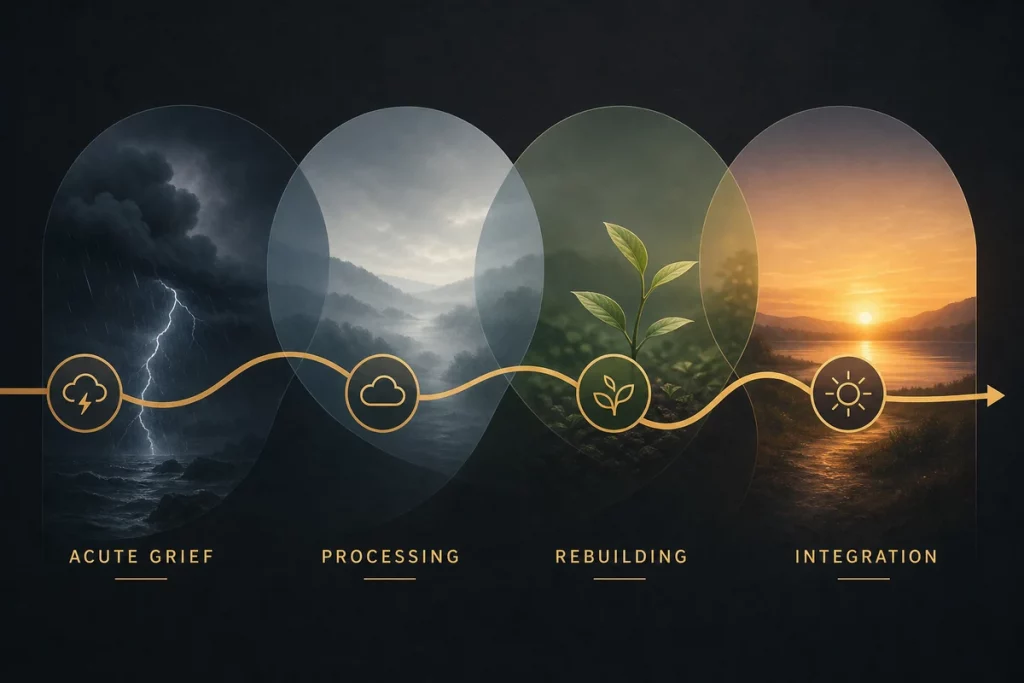
How long does it take to get over a breakup? The answer becomes clearer when you understand which stage you’re in — because each stage has its own timeline and its own work:
Stage 1: Acute grief (Weeks 1-4). The initial shock, pain, and disorientation. Sleep disruption, appetite changes, difficulty concentrating, constant rumination about the relationship, urges to contact the ex, and a pervasive sense that something essential is missing. This stage is neurologically similar to withdrawal from an addictive substance — because romantic attachment activates the same reward pathways, and breakup deactivates them, producing genuine neurochemical withdrawal symptoms. This stage is the most painful but also the most time-limited: acute grief naturally attenuates as the nervous system adjusts to the new baseline.
Stage 2: Processing (Months 1-3). The acute pain subsides to a manageable ache, and the cognitive work begins: understanding what happened, identifying your role and your partner’s role, processing feelings about specific events, and beginning to construct a narrative that integrates the relationship into your life story rather than leaving it as an open wound. This stage involves productive sadness (different from depression): the sadness is connected to specific losses and meanings, and processing it reduces its intensity over time. Recovery at this stage? The processing itself IS the getting-over-it — not a precursor to it.
Stage 3: Identity rebuilding (Months 2-6). The “who am I without them?” phase. Rediscovering interests that were dormant during the relationship. Rebuilding routines around one person instead of two. Reconnecting with friends who may have been neglected. Exploring what you want from your next chapter rather than what you lost from the previous one. This stage overlaps with processing and can feel like regression (“I was doing fine and suddenly I’m sad again”) because identity work surfaces grief that wasn’t accessible during the acute phase.
Stage 4: Integration (Months 4-12+). The relationship becomes part of your story rather than THE story. You can think about the ex without acute pain. You can appreciate what was good without idealizing it. You can acknowledge what was harmful without being consumed by anger. The relationship exists in appropriate perspective — one chapter among many, informative but not defining. This stage marks genuine recovery regardless of its timeline: integration can happen at month 4 or month 14, and both are healthy as long as progress is occurring. Not everyone reaches full integration — some people carry residual sensitivity around specific triggers (songs, places, anniversaries) indefinitely, and that’s normal rather than pathological as long as the sensitivity doesn’t impair daily functioning or prevent engagement with new relationships.
Recovery Mistakes That Extend Your Timeline
Rebound relationships before processing. Jumping into a new relationship before completing at least Stage 2 (processing) doesn’t accelerate recovery — it postpones it. The new relationship masks the grief with new-relationship neurochemistry (dopamine, oxytocin), but the unprocessed loss remains underneath and typically surfaces once the new relationship honeymoon ends — either as displaced emotional reactions, unfair comparisons, or commitment avoidance that the new partner doesn’t deserve.
Social media surveillance. Monitoring the ex’s social media extends recovery by continuously reactivating the attachment system. Every photo, post, or status update sends a pulse through the neural pathways that are trying to deactivate — resetting the withdrawal clock. Muting, unfollowing, or blocking isn’t dramatic — it’s neurological hygiene for someone who wants their recovery timeline to be shorter rather than longer.
Maintaining the “friend” facade too early. “We’ll stay friends” sounds mature but often functions as a recovery-avoidance strategy — maintaining enough contact to prevent the attachment system from deactivating while providing none of the relationship benefits that made the attachment worth maintaining. Genuine friendship with an ex IS possible — but typically only after both people have completed their independent recovery. Friendship attempted during active grief usually serves the person who wants to ease their guilt (the initiator) at the expense of the person who needs distance to heal (the one left). If the friendship makes you feel worse rather than better, it’s not friendship — it’s slow-motion heartbreak disguised as maturity.
Rumination disguised as processing. Processing is productive: it leads to new understanding, emotional resolution, and narrative integration. Rumination is repetitive: the same thoughts cycling without producing new insight. “I understand now that our communication patterns were incompatible” is processing. “Why did they do this to me? I can’t believe they did this” on repeat for months is rumination. If you’ve been asking the same questions for more than 6 weeks without arriving at different answers, you’re ruminating — and therapy can help convert the cycle into productive processing.
Idealization of the relationship. Memory editing — selectively remembering the good and forgetting the bad — creates nostalgia for a relationship that didn’t actually exist as remembered. The antidote: maintain a written list of specific reasons the relationship ended, including concrete examples of patterns that weren’t working. When nostalgia strikes, review the list. It won’t eliminate the sadness — but it prevents the sadness from distorting into “I lost something perfect” when the reality was “I lost something that wasn’t working.”
How to Actually Accelerate Healing
Implement a genuine no-contact period. Minimum 30 days of zero contact — no texting, no calls, no social media viewing, no “casual” encounters, no checking through mutual friends. The no-contact period gives your attachment system the absence it needs to begin deactivating — which is the neurological foundation of all recovery. How long does it take to get over a breakup with no contact versus maintained contact? Research consistently shows the no-contact group recovers 2-3x faster.
Write — not type — about the experience. Journaling about the breakup (by hand, not keyboard) has documented therapeutic benefits: processing speed increases, emotional regulation improves, and the narrative integration that characterizes Stage 4 accelerates. Write about what happened, how you feel about it, what you’re learning, and what you want going forward. The physical act of writing engages different neural processes than typing, producing deeper processing and better emotional integration.
Invest in your independent identity. The activities, friendships, interests, and goals that existed before or outside the relationship are your recovery infrastructure. Reactivate dormant hobbies. Reconnect with friends you neglected. Pursue goals that were postponed. Every investment in your independent identity rebuilds the self that the relationship may have absorbed — and the stronger your independent identity becomes, the less the relationship’s absence defines you.
Physical movement — not optional. Exercise produces neurochemical benefits that directly counteract the brain’s withdrawal state: endorphins replace the dopamine the relationship provided, cortisol regulation improves, sleep quality increases, and the cognitive rumination that characterizes early recovery breaks up during physical activity because the brain can’t maintain obsessive thought loops while coordinating complex movement. You don’t need to train for a marathon — a daily 30-minute walk produces measurable recovery benefits. The key is consistency: daily movement creates a baseline neurochemical floor that prevents the emotional crashes that characterize sedentary recovery.
Therapy — especially for breakups involving abuse, betrayal, or trauma bonding. If the relationship involved gaslighting, narcissistic abuse, manipulation, or love bombing cycles, standard breakup recovery isn’t sufficient — you need trauma-informed therapy that addresses both the loss AND the damage. The National Domestic Violence Hotline (1-800-799-7233) provides referrals for therapeutic support specifically calibrated to post-abusive-relationship recovery.
How to Know You’re Ready to Date Again
When are you recovered enough to date? You’re ready when you can answer yes to these indicators: You can think about your ex without emotional flooding. You’re pursuing a new relationship because you want to, not because you need someone to fill the void. You can describe what you want in a partner based on your values and growth — not just “the opposite of my ex.” You’ve processed the lessons from the relationship and integrated them into self-awareness. You feel like a complete person who would enjoy sharing life with a partner, not an incomplete person seeking someone to make you whole.
When you’re ready, approach new connections with the wisdom your recovery provided. Use GuyID’s free screening tools for identity verification — because after a breakup, especially one involving deception or betrayal, starting with verified trust matters more than ever. Watch for the green flags your recovery taught you to value and the red flags your experience taught you to recognize. Share your Date Mode link through GuyID and build your next connection on verified transparency, honest communication, and the self-knowledge that only comes from doing the hard work of genuine recovery.
How GuyID Helps
GuyID should appear when it is useful, not as a banner ad. A GuyID Trust Profile gives someone a portable way to share trust signals before a date, while identity verification and social vouching help turn vague profile claims into clearer next steps.
Useful next steps:
- Create a GuyID Trust Profile when you want a cleaner way to share verified trust signals.
- Use GuyID free tools and related guides when you need a checklist before meeting someone.
- Treat identity verification as confidence-building, not a guarantee.
- Use social vouching when you want context from people who already know the person.
- Sign up only when the extra trust layer helps the decision you are already trying to make.
Frequently Asked Questions
How long does it take to get over a breakup on average?
There is no reliable universal average for recovering from a breakup. Studies use different definitions of recovery and often examine narrow populations, so a single timeline can be misleading. Relationship length, attachment, betrayal, living arrangements, support, and active grief processing all affect recovery. Look for gradual improvement in daily functioning rather than a deadline.
Is it normal to still be sad months after a breakup?
Completely normal. The question isn’t whether you still feel sadness — it’s whether the sadness is changing. If the sadness is gradually becoming less frequent, less intense, and less consuming, you’re recovering at a healthy pace regardless of the absolute timeline. If the sadness remains at the same intensity months later with no change, or if it’s impairing your daily functioning (work, sleep, social engagement, self-care), professional support can help convert stuck grief into productive processing.
Does no contact actually help you get over a breakup faster?
Yes — consistently and significantly. No contact allows the attachment system to begin deactivating, which is the neurological prerequisite for recovery. Continued contact (including social media monitoring) reactivates the attachment pathways, resetting the recovery clock. A minimum 30-day no-contact period is recommended, with many therapists suggesting 60-90 days for long-term relationships. The no-contact period isn’t punishment for the ex — it’s medicine for your nervous system.
How long should I wait before dating again?
There’s no universal timeline — readiness is determined by emotional state, not calendar dates. You’re ready when you can think about your ex without emotional flooding, when you want a relationship because you’d enjoy it rather than need it to fill a void, and when you’ve processed the lessons from your previous relationship into self-awareness. For most people, this takes 3-6 months minimum. When ready, use GuyID’s free tools for verified, transparent connections.
Why do I feel worse some days than others during recovery?
Recovery is nonlinear — it proceeds in waves rather than a straight downward trajectory. Good days and bad days coexist throughout the process, with the ratio gradually shifting toward more good days. Triggers (songs, places, dates, mutual friends, social media encounters) can produce temporary regression that feels like starting over but isn’t. The wave pattern is neurologically normal: the attachment system doesn’t deactivate smoothly; it deactivates in fits and starts as neural pathways gradually weaken through disuse. Bad days within an overall improving trend are recovery, not failure.