Reader Briefing
Reader Briefing
Start here if you need a practical read on the trust gap in online dating: why 57% of women feel unsafe: who should use verification, what signals to check, and what to do before moving from online interest to an in-person plan.
Who this is for
- People meeting someone from a dating app or social platform.
- Anyone checking identity, profile consistency, and trust signals.
- People trying to avoid romance scams, fake profiles, or pressure tactics.
- Online daters improving conversations, profiles, or match screening.
You’ll learn
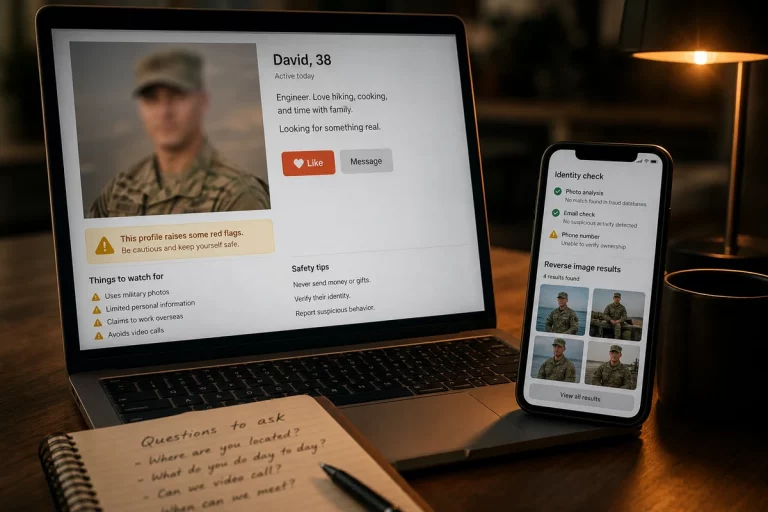
- How to evaluate identity signals without treating any single check as certainty.
- Which trust signals matter and how to weigh them together.
- How to spot inconsistencies, pressure, or behavior patterns that deserve caution.
- How to move from online conversation to a safer first meeting.
- Where GuyID tools fit into a quick pre-date screening workflow.
- When to slow down, ask for more context, or walk away.
Bottom line
Verification reduces uncertainty; it does not guarantee future behavior. Use a layered approach: confirm identity signals, compare profile consistency, ask for a short video call, keep early plans public, and slow down when someone pressures you to skip normal safety steps.
Key takeaways
- Identity verification improves confidence, not certainty.
- Patterns matter more than isolated incidents.
- Verify before meeting privately or sharing sensitive details.
- A short video call can reveal many inconsistencies.
- Pressure to skip reasonable safety steps is useful information.
Free Tools
Catfish Probability Detector
Check whether a dating profile has suspicious identity or photo signals.
Dating Bio Red Flag Detector
Review a bio for scam, pressure, or trust-warning language.
Dating Safety Checklist
Use free GuyID tools before moving from chat to a real date.
Next step
Create your GuyID trust profile
Share consent-based trust signals before a date without turning the conversation into an interrogation.
The trust gap in online dating isn’t a feeling — it’s a measurable chasm between the safety women need and the safety dating platforms actually provide.
This article examines the trust gap in online dating from every angle: the data that quantifies it, the structural forces that created it, the demographic differences in who bears the burden, the platform incentives that perpetuate it, and the emerging verification models that are finally beginning to close it. If you’ve ever felt that online dating demands more trust than it earns, you’re not imagining things — and the solution is closer than you think.
NavigateTable of Contents29 sections
⚡ Key Takeaways
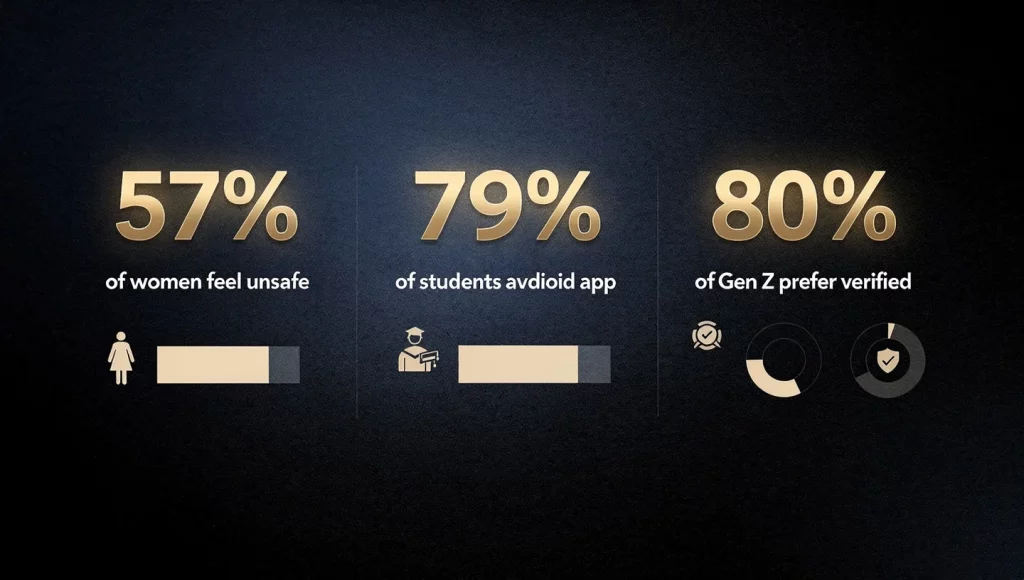
More than half of women using dating apps have concluded that the environment they’re navigating is fundamentally unsafe. This isn’t pessimism — it’s a data-driven assessment of the trust gap in online dating.
The gap exists because platforms verify photos, not identity
Dating app verification badges confirm that a selfie matches a profile photo. They do not confirm legal name, background, relationship status, or character. This structural weakness is the root cause of the trust gap.
The trust gap isn’t just reducing satisfaction — it’s driving potential users away entirely. The next generation of daters is rejecting the current model (IDscan.net, 2024).
The demand for verification is overwhelming (Bumble survey). Users want trust infrastructure. The platforms that provide it will win the next era of online dating.
Consent-based verification closes the gap
Platforms like GuyID are building the trust layer dating apps won’t — government ID verification + social vouching that’s voluntary, portable, and respects user agency.
The Data: Measuring the Trust Gap in Online Dating
The trust gap in online dating isn’t an abstract concept — it’s measurable, quantifiable, and growing. Every major study conducted in the past two years confirms the same finding: the majority of online daters don’t trust the environment they’re dating in. Understanding the scale of this gap is the first step toward understanding why it exists and how it can be closed.
The Trust Statistics
The numbers paint a consistent picture across every data source.
This is the most alarming statistic for dating platforms’ long-term viability — the next generation of potential users is actively choosing not to enter the market because the trust gap in online dating has become a barrier to adoption, not just a barrier to satisfaction.
These statistics show that the demand for trust infrastructure is overwhelming — users don’t just want safety, they actively reward it with their attention, their matches, and their dates. The market signal is clear: whoever closes the trust gap in online dating wins the next generation of users.
The Threat Statistics
The safety concerns driving the trust gap are not hypothetical. Organized criminal networks operate romance scams across borders.
The trust gap in online dating is the rational result of this data.
Why Women Bear the Disproportionate Burden of the Trust Gap in Online Dating
While the trust gap in online dating affects everyone, the burden is not equally distributed. Women navigate a fundamentally different threat landscape than men — and understanding this asymmetry is essential for designing solutions that actually work.
The Safety Calculus Women Perform
Every time a woman agrees to meet someone from a dating app, she performs a risk calculation that most men never have to consider. She evaluates: Is this person who they say they are? Will I be physically safe alone with them? Should I share my location with a friend? Do I drive myself or take an Uber so I can leave independently? Should I meet in a public place and refuse to go anywhere private? What if they become aggressive when I set a boundary?
This mental labor — constant, exhausting, and performed before every single date — is the lived experience of the trust gap in online dating. This safety calculus doesn’t exist in most men’s dating experience, which is why the trust gap is frequently underestimated by male users, male founders, and male-dominated platform leadership teams.
The Asymmetric Threat Profile
Women face a broader spectrum of threats on dating apps than men.
But for women, the trust gap in online dating encompasses a threat spectrum that goes far beyond financial fraud — it includes every dimension of personal safety that arises when meeting strangers from the internet.
The Emotional Tax
Beyond the cognitive safety calculus and the physical threat spectrum, women pay an emotional tax created by the trust gap in online dating. The constant vigilance required — screening profiles for red flags, maintaining skepticism during exciting early conversations, restraining emotional investment until verification is complete — directly conflicts with the openness and vulnerability that genuine connection requires.
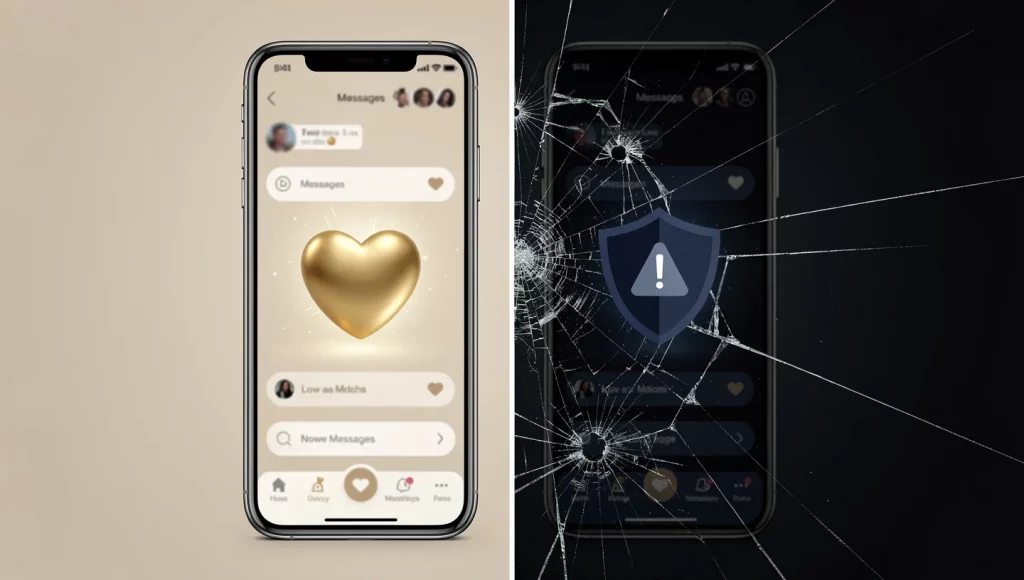
Women are told to be open to love while simultaneously being told to be suspicious of everyone. They’re expected to navigate the dating app experience with both an open heart and a raised shield — a contradiction that the trust gap in online dating forces but never resolves.
“The trust gap doesn’t just make dating harder — it makes it worse for everyone. Women who can’t trust become guarded. Men who are genuine can’t differentiate themselves from the organized scammers. The gap punishes authenticity and rewards performance. The only way to fix this is to make trust verifiable, not assumed.”
The Structural Causes: How Dating Apps Created the Trust Gap
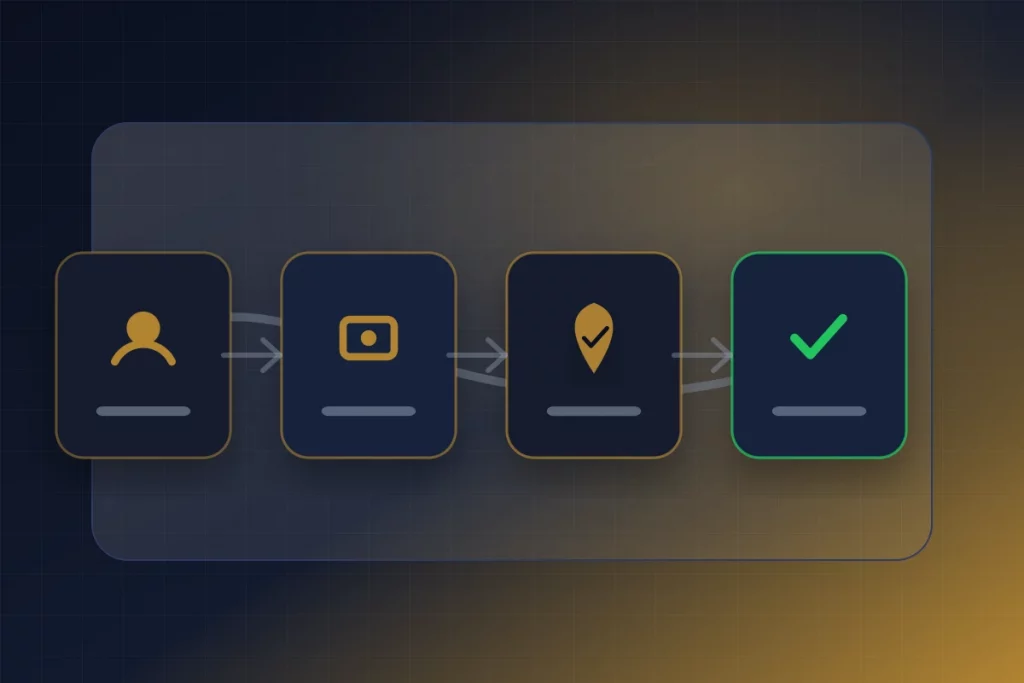
The trust gap in online dating wasn’t created by user behavior — it was created by platform design decisions that prioritize growth over safety. Understanding these structural causes explains why the gap exists, why platforms haven’t closed it, and why external solutions are necessary.
The Growth-Over-Safety Business Model
Dating apps are venture-backed technology companies valued on growth metrics: monthly active users, daily active users, matches per user, and revenue per user. Every friction point in the signup and matching process — including identity verification — reduces these metrics. Requiring government ID at signup would deter casual users, reduce new registrations, and slow the growth that investors demand. This creates a fundamental misalignment: the platform’s business incentive (minimize friction) directly conflicts with user safety needs (maximize verification).
This is why dating apps have settled on photo verification — the minimum viable safety feature that appears to address trust concerns without meaningfully reducing signup velocity. A photo verification step takes seconds and most users complete it. Government ID verification takes minutes and a significant percentage of users abandon the process. The platform chooses the option that retains more users, even though it provides dramatically less actual safety. The trust gap in online dating is, in part, a direct consequence of this optimization.
The Verification Theater Problem
Dating app verification badges create what security experts call “theater” — the appearance of safety without the substance. A blue checkmark on Tinder means a live selfie matched profile photos. It does not mean the person’s name is real, their age is accurate, their career claims are true, their relationship status is single, or their intentions are honest. But the badge communicates “verified” — a word that implies comprehensive validation when only superficial photo matching occurred.
This verification theater actively worsens the trust gap in online dating because it creates false confidence. Scammers who obtain verification badges (through liveness checks with AI-generated photos or by using real accomplices) receive disproportionate trust from targets who believe the badge means more than it does.
The Information Asymmetry
On a dating app, you know almost nothing about the person you’re matching with. You see photos (which may be AI-generated, stolen, or heavily filtered), a bio (which is self-reported with zero verification), and a name (which is self-declared). You don’t know their legal identity, their background, whether they’re actually single, where they actually live, or whether anyone in their real life would vouch for their character. Meanwhile, they learn about you through conversation — where you work, where you live, what you care about — creating an escalating information asymmetry that the trust gap in online dating describes.
This information asymmetry is why scammers target dating apps. The structural design of dating platforms gives scammers exactly the conditions they need: a target who knows nothing about them, combined with an emotional context (dating) that encourages trust-forward behavior. Every feature that makes dating apps convenient for legitimate users also makes them exploitable by criminal operators.
The Verification Illusion: Why Platform Badges Don’t Close the Trust Gap
Understanding exactly what dating app verification does and doesn’t prove is essential for seeing through the verification illusion that sustains the trust gap in online dating.
| What Users Think “Verified” Means | What “Verified” Actually Means |
|---|---|
| “This person’s identity has been confirmed” | A selfie matched uploaded photos — legal identity was never checked |
| “This person is safe to meet” | No background check, criminal history review, or character assessment was performed |
| “This person is who they claim to be” | Their name, age, career, education, and location are all self-reported with zero verification |
| “This person is single and available” | Relationship status is self-declared — no cross-reference exists |
| “I can trust this person more than unverified profiles” | Scammers with AI-generated photos can pass photo verification — the badge may increase risk by creating false confidence |
This gap between perceived and actual verification is a core mechanism of the trust gap in online dating. The platform presents a trust signal (“verified”) that users interpret broadly while the platform implements narrowly. The user extends trust they shouldn’t. The platform bears no liability for the gap between expectation and reality.
The solution requires verification that matches the scope of what users expect — confirming not just that a person exists (photo matching) but confirming who they are (government ID), whether they’re credible (social vouching), and whether they’ve demonstrated trustworthiness over time (reputation systems). This is the verification model that GuyID is building — and it’s the model that will eventually close the trust gap in online dating.
The Hidden Costs of the Trust Gap in Online Dating
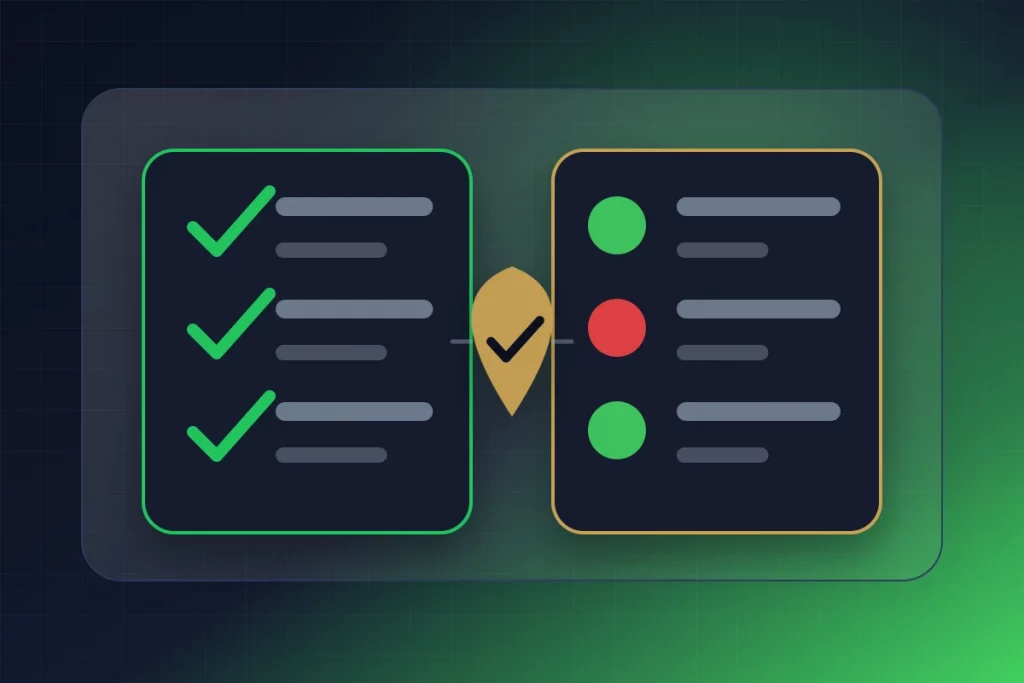
The trust gap in online dating creates costs that extend far beyond individual safety concerns. These hidden costs affect the dating ecosystem, the broader economy, and the social fabric of how people form relationships.
Cost 1: Market Contraction
The next generation of potential dating app users is rejecting the product because the trust gap makes it unappealing. For dating platforms valued on growth, this demographic rejection is an existential threat that current verification theater won’t resolve.
Cost 2: Genuine Users Can’t Differentiate
For genuine, well-intentioned men on dating apps, the trust gap in online dating creates an impossible differentiation problem. How does a real, honest man signal that he’s not one of the organized scammers or the countless catfish, married men, or manipulators sharing the platform? In the current system, he can’t — because the platform provides no mechanism for proving trustworthiness beyond the same photo verification that scammers also pass.
Men who proactively verify through platforms like GuyID — confirming their identity through government ID and social vouching — create exactly this differentiation. They signal: “I am who I say I am, and I respect your safety enough to prove it.” In an environment of universal distrust, verified identity becomes the most attractive feature a man can offer.
Cost 3: Emotional Toll and Dating Fatigue
The constant vigilance required by the trust gap in online dating produces dating fatigue — a documented phenomenon where users become emotionally exhausted from the cycle of hope, suspicion, verification effort, and frequent disappointment. Dating fatigue reduces the quality of genuine interactions because emotionally exhausted users are less open, less vulnerable, and less willing to invest in getting to know someone new. The trust gap doesn’t just prevent bad matches — it degrades good ones.
This money is extracted from Americans and transferred to international criminal networks, representing a direct economic drain that better trust infrastructure would substantially reduce.
How the Trust Gap Fuels Romance Scams
The trust gap in online dating and romance scam prevalence exist in a reinforcing cycle — each makes the other worse. Understanding this cycle explains why the problem has escalated rather than improved despite billions of dollars in dating app revenue.
The platforms have the resources to implement meaningful verification but lack the business incentive, because comprehensive verification would increase friction and reduce the growth metrics their valuations depend on. External verification platforms like GuyID break this cycle by providing the trust infrastructure dating apps won’t build — without requiring platform cooperation or systemic change from within.
For a detailed breakdown of the scam tactics enabled by this trust gap, see our guides on how to spot a romance scammer, pig butchering scams, AI romance scams, and deepfake dating scams.
Consent-Based Verification: The Model That Closes the Trust Gap in Online Dating
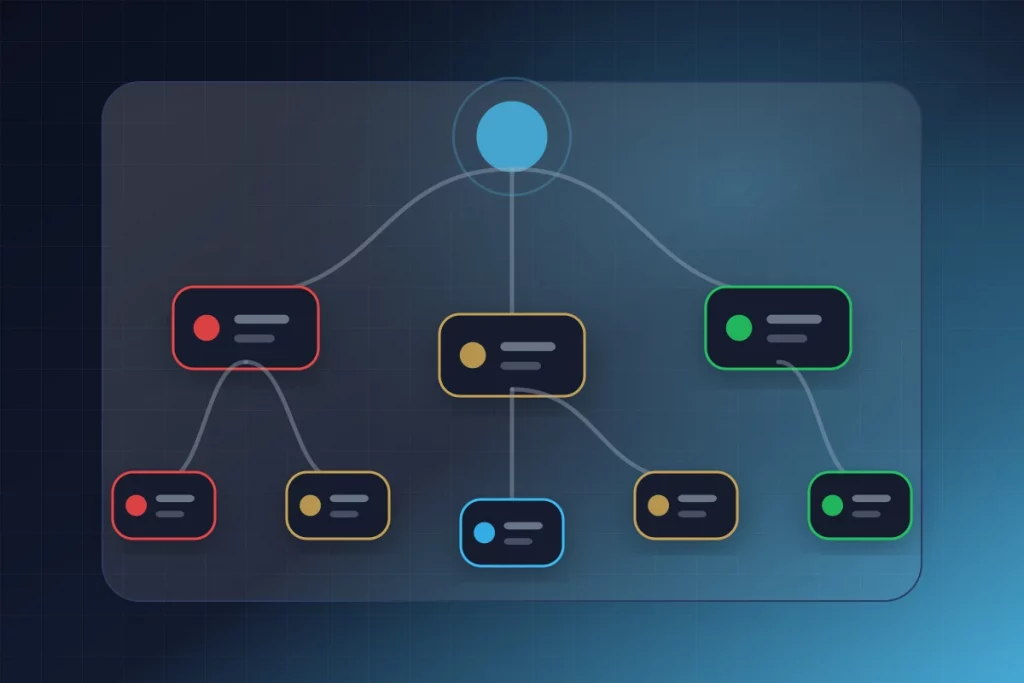
Closing the trust gap in online dating requires a verification model that satisfies three requirements simultaneously: it must confirm meaningful identity information (not just photo matching), it must respect user privacy and agency (not create surveillance), and it must work across all platforms (not lock users into a single app). This is the consent-based verification model — and it’s the approach GuyID was built to provide.
What Consent-Based Verification Means
Consent-based verification means that identity verification is voluntary, portable, and controlled by the individual. No one is forced to verify — but those who choose to verify signal trust and earn a visible differentiation advantage. The verification travels with you across platforms (Tinder, Bumble, Hinge, Instagram, WhatsApp) via a shareable link, not locked inside a single app. And the individual controls who sees their verification status and what level of detail is visible.
This model resolves the trust gap in online dating without requiring dating apps to change their business models. It’s additive, not disruptive — it layers trust on top of existing platforms rather than demanding that those platforms fundamentally restructure their signup and verification processes. Users who want verification get it. Users who don’t aren’t excluded.
How GuyID Implements Consent-Based Verification
GuyID provides the specific trust infrastructure that dating app verification badges fail to deliver:
- Government ID verification: Biometric matching against official government documents confirms legal identity — the person’s real name, real face, and real existence as a documented individual. This is what dating app photo verification doesn’t do.
- Social vouching: Real friends and colleagues confirm the person’s identity and vouch for their character. This social layer adds what no document can — evidence that other real humans know and trust this person. A scammer cannot produce genuine social vouches from real people who will stake their reputation on a fabricated identity.
- Trust Tiers: GuyID’s Trust Tiers system (GHOST → STARTER → BUILDER → TRUSTED → ELITE → LEGEND) provides a visual, progressive indicator of how much verification effort someone has invested. Each tier requires additional verification actions — creating a trust journey that rewards consistent demonstrated trustworthiness.
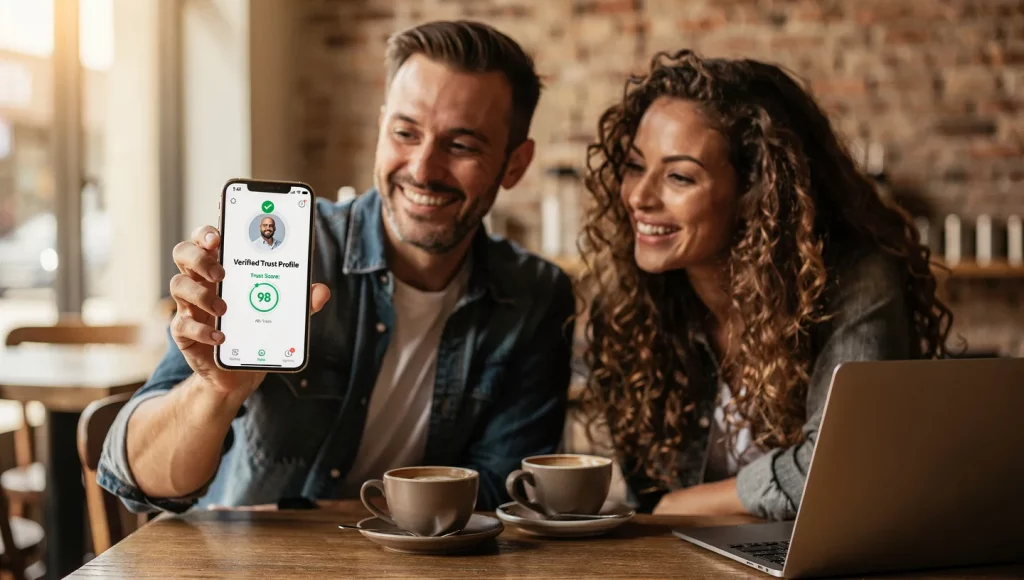
- Portable Date Mode link: The shareable verification link works across every platform. Whether you met on Tinder, Bumble, Instagram, or at a coffee shop, you can share your GuyID verification link and let the other person check your trust tier for free. This portability is what closes the trust gap in online dating — it makes verified trust available everywhere, not just within a single app.
- Free for women to check: Women can view anyone’s trust profile at no cost — removing any financial barrier to the safety information they need most.
What Men Can Do to Help Close the Trust Gap in Online Dating
The trust gap in online dating is not exclusively women’s problem to solve — men who want genuine connections have both the opportunity and the responsibility to help close it.
Get Verified on GuyID
The most impactful action any man can take is creating a verified GuyID Trust Profile. Government ID verification combined with social vouching from real friends and colleagues transforms you from “another unverified profile” into someone who has proactively demonstrated honesty, transparency, and respect for women’s safety concerns. In an environment of universal distrust, verified identity is the ultimate differentiator.
Share Your Date Mode Link Proactively
Don’t wait for her to ask if you’re real — offer your verified trust profile link early in the conversation. “Hey, I know online dating requires a lot of trust. Here’s my verified profile on GuyID — I did the ID verification and got vouched by friends.” This proactive transparency accomplishes several things: it immediately reduces her safety anxiety, it demonstrates that you take her concerns seriously, and it differentiates you from every other match who expects trust without earning it.
Respect the Safety Process
If a woman asks for a video call before meeting, agrees enthusiastically. If she wants to meet in a public place, suggests enthusiastically. If she wants to tell a friend where she’ll be, supports enthusiastically. If she asks you to verify your identity, does it willingly. Every safety step she requests is her managing the trust gap in online dating that exists because of the environment — not because of you specifically. Making her safety process easy and welcomed is how genuine men differentiate themselves from the ones who make women feel unsafe for having boundaries.
Build Your Trust Profile Over Time
GuyID’s Trust Tiers system rewards consistent trust-building behavior. Progress from GHOST (new, unverified) to STARTER, BUILDER, TRUSTED, ELITE, and eventually LEGEND by completing verification steps, earning vouches, and maintaining trust over time. The higher your tier, the stronger the trust signal you send to every potential match. In a dating market where the trust gap in online dating disadvantages everyone, building a verified trust history becomes a compound asset that improves every interaction.
Summary: The Trust Gap in Online Dating and the Path to Closing It
The trust gap in online dating is the defining challenge of modern digital romance.
The trust gap in online dating hurts everyone. Women bear the disproportionate burden through constant safety vigilance, emotional taxation, and disproportionate threat exposure. Men suffer because the gap makes it impossible to differentiate themselves from scammers and manipulators. The dating ecosystem suffers through market contraction, dating fatigue, and the erosion of the trust required for genuine connection.
But the trust gap in online dating is also closable — through consent-based verification that confirms real identity (not just photos), provides social credibility (not just self-reported claims), works across all platforms (not just within one app), and respects user agency (not mandated surveillance). This is what GuyID provides: government ID verification + social vouching + portable trust profiles + a progressive Trust Tiers system that rewards consistent trustworthiness.
The trust gap in online dating won’t close itself. But with the right tools, the right practices, and the right verification infrastructure, every individual can close it for themselves — starting today. Use GuyID’s free safety tools to verify matches. Ask for verified trust profiles. And if you’re a man — get verified, share your Date Mode link, and be part of the solution. The trust gap closes one verified profile at a time.
Close the Trust Gap for Yourself — Starting Now
GuyID provides the trust infrastructure that dating apps don’t: government ID verification, social vouching, portable trust profiles, and 60+ free safety tools. Women check for free. Men: get verified and become part of the solution.
Get Verified on GuyID
Try Free Safety Tools
Frequently Asked Questions
Why don’t dating apps fix the trust gap?
How can I close the trust gap for myself?
What is consent-based verification?
Does verification remove the need for dating boundaries?
Related Reading
- Breakups: Complete Guide
- Character Reference Letter Examples for Dating: 5 Templates (2026)
- 8 Online Dating Safety Tips That Actually Protect You (2026)
Evidence note
Pew Research Center found that 48% of Americans considered online dating at least somewhat safe while 49% considered it not too safe or not at all safe (Pew Research Center, 2023).
The FTC reported 64,003 romance-scam reports in 2023, with $1.14 billion in reported losses and a $2,000 median reported loss (Federal Trade Commission, 2024).