Free Tools
Catfish Probability Detector
Check whether a dating profile has suspicious identity or photo signals.
Dating Bio Red Flag Detector
Review a bio for scam, pressure, or trust-warning language.
Dating Safety Checklist
Use free GuyID tools before moving from chat to a real date.
Next step
Create your GuyID trust profile
Share consent-based trust signals before a date without turning the conversation into an interrogation.
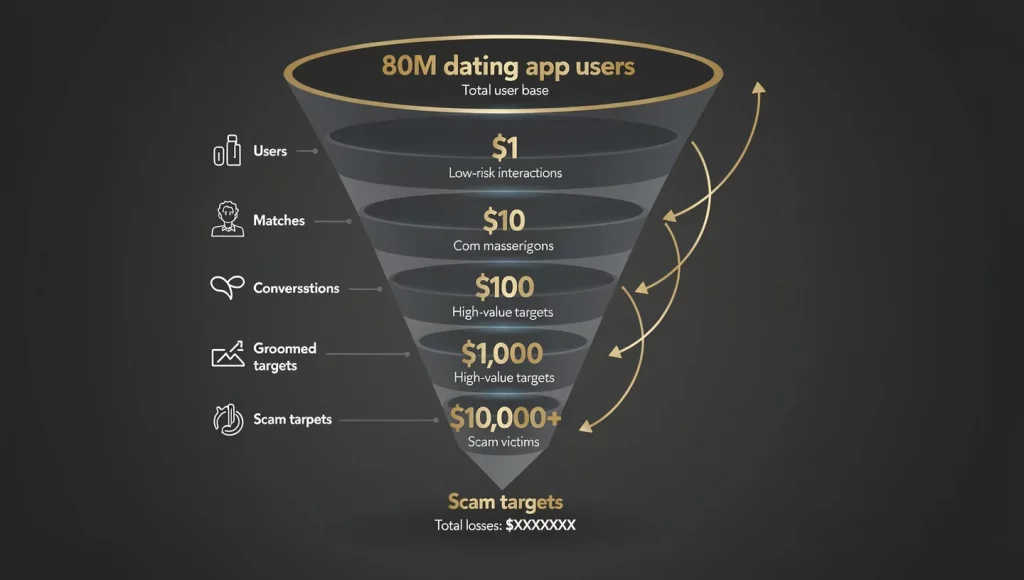
The Federal Trade Commission documents substantial reported losses from romance scams. The question of why do scammers target dating apps has a structural answer: these platforms concentrate people seeking connection and make private conversation easy before identity or intent has been independently established. Understanding that architecture of risk helps you choose proportionate safeguards instead of relying on platform features alone.
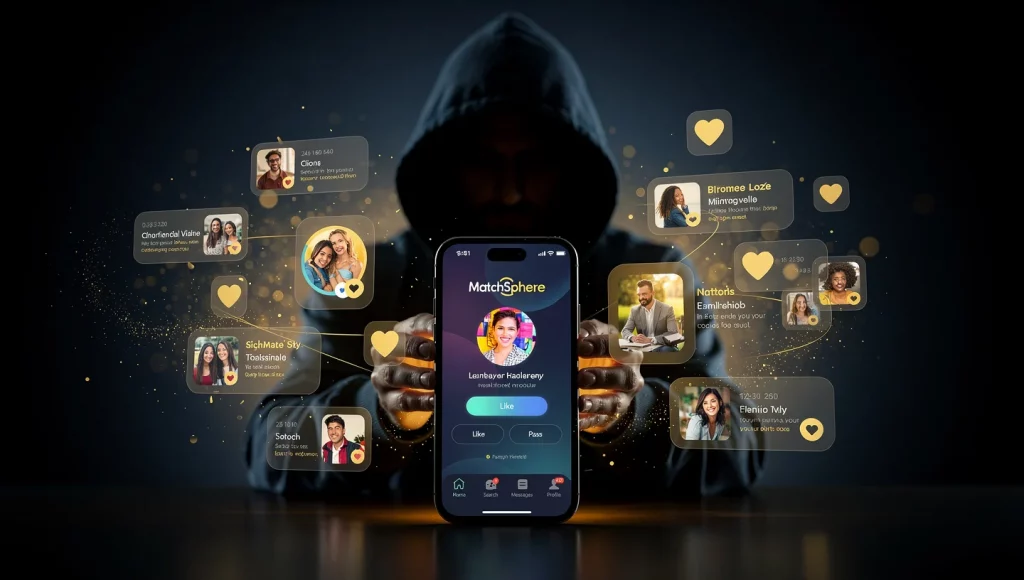
Romance scammers benefit from several conditions that dating apps place in one environment: strangers expect contact, conversations become private quickly, identity signals are limited, and emotional trust may develop before independent verification. This guide explains those structural, psychological, and economic reasons why scammers target dating apps — and what you can do about them.
NavigateTable of Contents32 sections
⚡ Key Takeaways
A concentrated audience actively seeking emotional connection
Dating apps concentrate people who are actively seeking connection, willing to trust strangers, and emotionally open — the exact psychological state scammers need. This is the primary reason why scammers target dating apps.
Weak verification creates easy, scalable entry
Most dating apps verify photos but not identity. Creating a convincing fake profile takes minutes.
Private messaging removes oversight
Once two users match, their conversations are private. Dating apps can’t monitor message content the way public social platforms flag suspicious posts. Scammers operate in an unmonitored channel.
The economics heavily favor scammers
Dating profiles can be created and reused with limited infrastructure, while automation can help an operator manage multiple conversations. This combination lowers operating friction without supporting a reliable universal profit estimate.
Third-party verification closes the gap
Platforms like GuyID provide the identity verification layer that dating apps don’t — government ID + social vouching that works across every platform via a portable trust profile.
The Scale of the Target: Why Scammers Go Where People Seek Connection
The most fundamental answer to why do scammers target dating apps is concentrated access. Dating platforms bring together people who are actively seeking emotional connection with strangers, which removes the first barrier a scammer faces on a general-purpose platform: finding someone willing to begin a personal conversation.
From a scammer’s perspective, dating apps also reduce acquisition effort. A match has already indicated openness to conversation, profiles provide material for personalized messages, and messaging can continue asynchronously. Automation can increase the number of conversations an operator attempts, but no reliable public dataset supports a universal response rate or profit estimate.
Compared with other scam channels, dating apps provide a built-in reason for personal contact. Phone scams require synchronous interaction, while cold email must first persuade a recipient to respond. Dating messages can be personalized from profile details and managed asynchronously.
Channel Comparison
| Channel | Initial contact context | Operator requirement | Dating-app distinction |
|---|---|---|---|
| Cold email | Unexpected message | Convince a recipient to respond | A dating match already expects personal contact |
| Phone scam | Synchronous interruption | Maintain a live script | Dating messages can be managed asynchronously |
| Social media message | Mixed social context | Establish a reason for contact | Dating profiles explicitly invite new conversations |
| Dating app | Relationship-seeking context | Create a plausible profile and dialogue | Emotional intent and private messaging are built in |
| Investment-romance scam | Relationship followed by financial solicitation | Sustain trust and introduce a financial story | Dating contact can become the entry point to another fraud |
Structural Vulnerabilities: Why Dating Apps Make Scamming Easy
Understanding why scammers target dating apps requires examining the structural features that make these platforms uniquely exploitable. These aren’t design flaws per se — they’re features that serve legitimate dating purposes but simultaneously create vulnerabilities that criminal operations exploit.
Low Barriers to Profile Creation
Creating a dating profile takes minutes. Most apps require only a phone number or email address, a few photos, and a short bio. There’s no identity verification at signup on the majority of platforms. A scammer can create a convincing fake profile in under five minutes using AI-generated photos and a generic bio. If the profile gets reported and removed, they create a new one in another five minutes.
This low barrier to entry is a core reason why scammers target dating apps. Compare it to creating a convincing fake LinkedIn profile (requires building a credible work history, connections, and endorsements over weeks) or a fake Instagram account (requires posting content consistently over months to look authentic). Dating profiles require almost nothing to appear legitimate.
Private, Unmonitored Communication Channels
Once two users match on a dating app, their conversations are private. Dating apps don’t — and in most jurisdictions legally can’t — read or monitor the content of private messages the way public social media platforms use AI to flag suspicious posts. This gives scammers a secure channel to execute their manipulation scripts without any platform oversight.
Additionally, scammers quickly move targets off the dating app to WhatsApp, Telegram, or text messages — further removing all platform visibility. Once the conversation leaves the app, the dating platform has zero ability to detect scam activity, intervene, or even notify the user. This structural blindspot is a major part of why scammers target dating apps as their initial entry point.
Built-In Emotional Context
Unlike any other digital platform, dating apps create an explicit emotional context. Users are there to form romantic connections. They’re predisposed to be open, vulnerable, hopeful, and trusting. A stranger messaging you on LinkedIn feels like a networking request. The same stranger messaging you on Tinder feels like a potential partner. The platform itself primes the emotional state that makes manipulation effective — something no other scam channel provides.
Cross-Platform Migration
Scammers use dating apps as entry points but quickly migrate to platforms with less oversight. “Let’s move to WhatsApp — it’s easier to chat there.” This transition serves multiple purposes: it removes the conversation from the dating app’s (limited) monitoring, creates a sense of relationship progression (“we’re past the app stage”), and makes it harder for the victim to report the scammer or access the original profile if they later realize they’ve been targeted.
This cross-platform migration pattern is central to why scammers target dating apps rather than running their entire operation on WhatsApp or Telegram directly. The dating app provides the context (romantic intent), the matching (target selection), and the initial credibility (a profile that looks like a real person seeking a real relationship). WhatsApp provides the operational environment where the scam plays out without oversight.
💡
The Platform Paradox
Dating apps face a fundamental business tension that explains why scammers target dating apps so successfully. Aggressive anti-scam measures like mandatory ID verification increase friction, which reduces signups and engagement — metrics that determine the platform’s revenue and valuation. Most platforms choose growth over security, implementing the minimum viable safety features while leaving the real burden of protection on users. This is unlikely to change as long as growth metrics drive investor valuations.
The Psychology Scammers Exploit: Why Dating App Users Are Vulnerable
Beyond the structural vulnerabilities, the deeper answer to why do scammers target dating apps lies in the psychological state of dating app users. People on dating apps are in a mental and emotional state that makes them uniquely susceptible to manipulation — not because they’re foolish, but because the act of dating requires the exact behaviors that scammers exploit.
Active Openness to Strangers
Dating apps are the only major digital platform where connecting with complete strangers is the entire purpose. On Facebook, you friend people you know. On LinkedIn, you connect with professional contacts. On dating apps, you swipe right on people you’ve never met, never spoken to, and know nothing about beyond a few photos and sentences. This fundamental openness to strangers — a necessary condition for dating to work at all — is precisely the vulnerability scammers exploit.
People on dating apps are not passive consumers — they are actively seeking connection. They may hope that the next match becomes meaningful. That openness can also make it easier to overlook inconsistencies and extend trust that would be unusual in another digital interaction.
Emotional Vulnerability and Loneliness
Many dating app users are navigating difficult emotional circumstances — recovering from breakups, experiencing loneliness, dealing with the frustration of unsuccessful dating, or facing the social pressure of being single. Scammers are trained to identify and exploit these vulnerabilities within the first few conversations. Questions like “When was your last relationship?” and “What are you looking for?” aren’t just conversation starters — they’re reconnaissance that helps the scammer calibrate their approach.
Romance scams affect adults across age groups. The relevant vulnerability is not age alone; it is the combination of emotional investment, isolation from independent feedback, and a request that shifts the relationship toward money, credentials, or secrecy.
Trust Architecture of Dating
Dating inherently requires giving strangers the benefit of the doubt. You swipe right based on photos and a short bio. You share personal details in early conversations — where you live, what you do for work, what you care about. You plan to meet someone you’ve never verified in a private or semi-private setting. Every step of the normal dating process involves extending trust with limited information, which is exactly what makes dating apps work — and exactly what makes them exploitable.
This trust architecture is the fundamental answer to why scammers target dating apps. No other digital platform creates this combination of emotional openness, personal information sharing, and willingness to trust unverified strangers. Email doesn’t create it. Social media doesn’t create it. Only dating apps systematically construct the exact psychological conditions that enable romance fraud.
Underreporting and Shame
Another factor that explains why scammers target dating apps is underreporting. Shame, fear of judgment, and the private nature of a romantic conversation can discourage a victim from telling friends, a platform, a financial institution, or law enforcement.
The shame of being deceived in a romantic context — combined with the stigma some people still associate with online dating — can delay reporting. That delay gives an operator more time to move funds, reuse accounts, and approach other targets.
The Economics of Dating App Fraud
To fully understand why scammers target dating apps, you need to understand the economics. Romance scams are not desperate acts by individuals — they’re organized criminal enterprises with sophisticated operational models, division of labor, and profit optimization strategies.
The Criminal Business Model
Large-scale romance scam operations can function like businesses. Different participants may create and maintain profiles, manage the emotional manipulation and financial extraction phases, or move proceeds through money-mule networks. AI systems can also support high-volume initial conversations.
The operating model explains why scammers target dating apps with persistence. One person can maintain several asynchronous conversations, reuse scripts and profile assets, and hand a responsive target to another operator. In pig-butchering operations, the relationship narrative may be paired with a controlled investment interface. Public evidence does not support a universal per-operator revenue estimate, so this guide does not assign one.
Near-Zero Operating Costs
The operating costs for dating app scams are remarkably low. Creating fake profiles is free. AI chatbots cost pennies per conversation. The dating apps themselves are free to use. The only significant operational cost is human labor for the critical manipulation phases — and even that is being automated. Compare this to other criminal enterprises (drug trafficking requires physical supply chains, cybercrime requires technical infrastructure) and the ROI of romance scams becomes obvious.
Minimal Risk of Prosecution
The vast majority of romance scam operations are based in countries with limited law enforcement cooperation — Nigeria, Ghana, Myanmar, Cambodia, and the Philippines being the most commonly identified origins. International jurisdiction makes prosecution extraordinarily difficult. The few victims who do report often wait weeks or months, by which time the scammer has deleted their profiles, changed phone numbers, and moved funds through multiple jurisdictions.
The combination of massive revenue, minimal costs, and near-zero prosecution risk is the complete economic answer to why scammers target dating apps. It is, dollar for dollar, the most profitable low-risk criminal enterprise available in 2026.
The economic attraction is the ability to reuse infrastructure and conduct conversations remotely while pushing a target toward payments or account access. Profitability varies by operation and should not be reduced to an unsupported universal estimate.
Why Dating App Verification Alone Cannot Stop Scammers
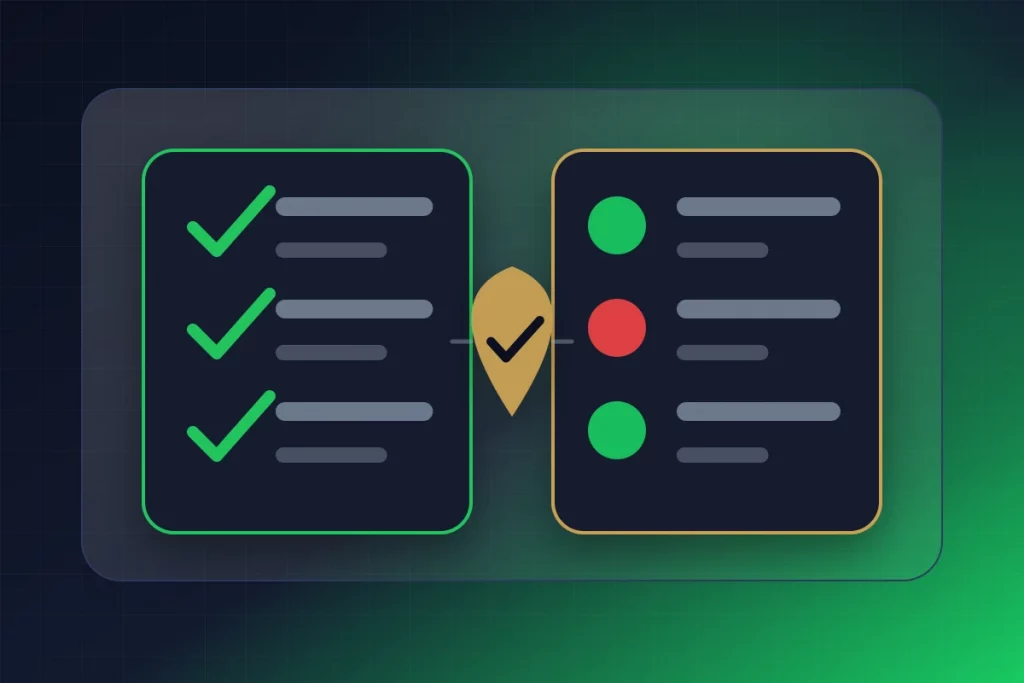
One major reason scammers continue to target dating apps successfully is that current platform verification measures address only a fraction of the identity problem. Understanding the gap between what dating app verification badges actually prove and what users believe they prove is critical for your safety.
| What the Verification Badge Proves | What the Badge Does NOT Prove |
|---|---|
| Your live selfie matches your profile photos | Your real name, legal identity, or age |
| You are a real human (not a static image) | Your criminal background or history |
| You have a working phone number | Your relationship status (single vs. married) |
| Your email address is valid | Your employment, education, or location claims |
| You exist as a real person taking a selfie | Whether you’re the same person who will show up on a date |
This verification gap is a major factor in why scammers target dating apps so effectively. A scammer using AI-generated photos that match a liveness check can potentially pass photo verification. They can verify a phone number purchased specifically for scamming. The blue checkmark creates false confidence in the victim — “they’re verified, so they must be real” — when the badge only confirms that a real human took a selfie that matches uploaded photos, not that the person is who they claim to be.
Verification badges influence how a profile is perceived, but their scope varies by platform. A photo-matching badge should not be interpreted as a background check or character assessment. An operator who gains control of a verified account may benefit from trust that exceeds what the badge technically confirms.
The Third-Party Verification Solution
This verification gap is exactly why third-party identity verification platforms like GuyID exist. GuyID provides what dating apps don’t: government ID verification (confirming legal identity through biometric matching against official documents) combined with social vouching (real friends and colleagues confirming the person’s identity and character). This multi-layered verification creates a trust profile that is portable across all dating platforms via a shareable “Date Mode” link.
When a match shares their verified GuyID Trust Profile, you know they’ve passed government ID verification, have real people vouching for them, and have opted into a system designed to make dating safer. Women can check trust profiles for free. In an environment where dating app badges prove almost nothing about real identity, this level of verification represents a fundamentally different approach to the problem of why scammers target dating apps — it makes the scam unworkable by confirming what dating apps don’t.
Platform-by-Platform Vulnerability Analysis: Where Scammers Strike Most
Not all dating apps are equally vulnerable, and understanding the platform-specific risk profiles helps explain why scammers target dating apps in different ways depending on the platform. Each app’s design decisions, user demographics, and verification features create distinct vulnerability patterns.
Plenty of Fish (POF) — Highest Scam Volume
POF’s vulnerability comes from its lower barrier to entry (less stringent verification at signup), its older user demographic (more likely to have savings and less familiarity with AI-generated content), and its free-to-use model that allows unlimited messaging without payment. If you use POF, applying maximum scrutiny to every interaction is essential — the statistical likelihood of encountering a scam profile is dramatically higher than on other platforms.
Tinder — Highest Malicious Activity Volume
Tinder’s swipe-based matching creates a high-volume environment where scammers can cast wide nets — a scam profile can be shown to hundreds of users daily. Common Tinder scam patterns include verification scams (fake links claiming “verify your account”), bot accounts that share links to external websites, and romance scammers who push for WhatsApp communication immediately after matching.
Bumble — Lower Risk but Not Immune
Bumble’s design choice that women must message first reduces (but doesn’t eliminate) scam volume. Female scam profiles still operate by matching and waiting for the victim to initiate (since the victim, as a woman, must message first — meaning the scammer creates a male target profile matching first, or creates a female profile in a woman-initiates environment). Bumble’s mandatory photo verification is more rigorous than most platforms, but it still only confirms photo matching, not identity.
Hinge — Longer Game Scams
Hinge’s limited daily likes and “designed to be deleted” philosophy creates a user base that’s more relationship-focused and willing to invest time. This makes Hinge users slightly less susceptible to quick scams but more vulnerable to long-con operations like pig butchering, where the scammer plays a patient, relationship-building game over weeks before introducing financial exploitation.
Facebook Dating — Unique Vulnerability
Facebook Dating’s integration with existing Facebook profiles provides more context than a standalone profile, but it also creates account-takeover risk. A hacked account can lend years of authentic-looking history to someone who does not own it. Treat account age as context, not proof of who currently controls the profile.
How to Protect Yourself on Dating Apps
Now that you understand why scammers target dating apps, here’s the comprehensive protection framework that addresses each vulnerability. The goal isn’t to make you paranoid — it’s to make verification a natural, routine part of your dating process, the same way you’d check reviews before choosing a restaurant.
Before Matching: Profile Verification
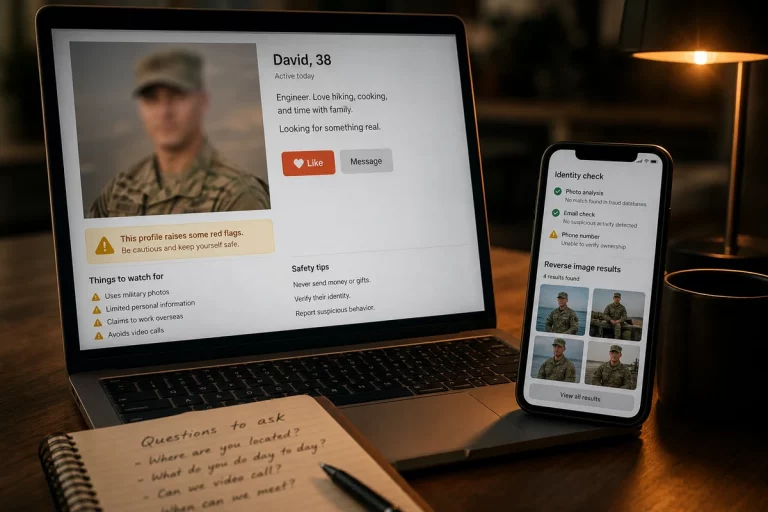
- Run a reverse image search on every profile photo. Start with GuyID’s free reverse image search tool, then compare results from Google Lens, TinEye, and Yandex. A photo tied to conflicting names is strong evidence that the profile is misrepresented. This takes 30 seconds per match and catches the majority of scam profiles.
- Check their digital footprint. Search their name on LinkedIn, Instagram, and Facebook. A real person has years of authentic digital history. A scammer has a thin, recently created presence — or no presence at all outside the dating app.
- Use GuyID’s catfish probability detector for an objective risk assessment based on multiple profile signals. When you’re attracted to someone, your judgment is compromised — let data-driven tools provide a second opinion.
After Matching: Conversation Verification
- Insist on a video call within the first week. No exceptions, no excuses. Video calls confirm the person matches their photos, is a real human, and can interact naturally. Anyone who consistently refuses video is hiding their identity.
- Test for real-world specificity. Ask about specific local places, recent weather, current events in their claimed city. AI chatbots give generic answers; real people give verifiable specifics.
- Watch for rapid escalation. Declarations of deep feelings within days, pressure to move off the dating app, and intense daily messaging are romance scam warning signs — not signs of genuine connection.
Before Meeting: Identity Verification
- Ask for a verified trust profile. GuyID lets people verify their identity through government ID and social vouching from real friends and colleagues. Asking a match to share their Date Mode link is a reasonable safety step. A genuine person will understand and respect the request — a scammer will make excuses or disappear.
- Share your plans with someone you trust. Tell a friend or family member who you’re meeting, where, and when. Share a photo of your match’s profile. This isn’t just safety — it’s also a check against emotional manipulation, because describing the situation to a third party often reveals red flags your own emotional investment obscures.
Always: Financial Protection
No story, no emergency, no investment opportunity justifies sending money to someone whose real-world identity you haven’t verified.
Legitimate financial advice comes from licensed professionals, not dating matches.
Summary: Why Scammers Target Dating Apps and What You Can Do About It
The reasons why scammers target dating apps form an interconnected system of structural, psychological, and economic advantages. A concentrated relationship-seeking audience, limited identity verification, and private messaging can create useful conditions for deception. The psychological architecture of dating — openness, trust, vulnerability, and hope — gives an operator material to manipulate.
Understanding why scammers target dating apps isn’t meant to discourage online dating — it’s meant to arm you with the awareness that transforms you from a potential target into someone scammers cannot exploit. The vulnerabilities are structural, but the defenses are behavioral. Run reverse image searches. Insist on video calls. Test for real-world specificity. Ask for verified identity. Never send money to unverified people. These practices take minutes but eliminate the vulnerabilities that make dating apps attractive to criminal operations.
Weak identity verification is one structural reason why scammers target dating apps. You can reduce uncertainty by asking a match to share consent-based identity signals through GuyID, while recognizing that verification does not predict intent or guarantee safety. Combine identity evidence with financial boundaries, platform reporting tools, and independent judgment.
The answer to why scammers target dating apps will remain the same as long as the current structural conditions exist. But your vulnerability to those scammers is entirely within your control. Use the tools available, make verification routine, and share this knowledge with anyone you know who dates online. The scammers succeed because most people don’t know what you now know.
The Verification Dating Apps Don’t Provide
Dating apps verify photos. GuyID verifies trust. Government ID + social vouching + a portable trust score that works across Tinder, Bumble, Hinge, and every platform. Women check for free.
Get Verified on GuyID
Try Free Safety Tools