Free Tools
Catfish Probability Detector
Check whether a dating profile has suspicious identity or photo signals.
Dating Bio Red Flag Detector
Review a bio for scam, pressure, or trust-warning language.
Dating Safety Checklist
Use free GuyID tools before moving from chat to a real date.
Next step
Create your GuyID trust profile
Share consent-based trust signals before a date without turning the conversation into an interrogation.
The FTC warns that romance scammers impersonate service members, steal military photos, and invent expenses for leave, food, medical treatment, or communications (FTC). If you have matched with someone claiming to be in the military, use the evidence-based checks in this guide before sharing money or sensitive information.
NavigateTable of Contents35 sections
What Is a Military Romance Scam?
A military romance scam is a type of romance scam where a fraudster creates a fake online dating profile using stolen photos and fabricated details of a military service member. The scammer builds an emotional connection with their target — often over weeks or months — before requesting money under the guise of military-related emergencies.
These scammers typically claim to be U.S. Army soldiers, Navy SEALs, or Marines deployed overseas. They target victims on dating apps like Tinder, Bumble, and Hinge, as well as on social media platforms like Facebook and Instagram. The scam follows a predictable pattern: love bombing, manufactured intimacy, fabricated crisis, and then the financial ask.
The FTC documents military impersonation as a recurring romance-scam pattern, but it does not publish a separate current median loss for this subtype (FTC). Treat deployment-based urgency as a reason to verify, not as evidence that a request is legitimate.
Key distinction: The U.S. Army says soldiers and their loved ones are not charged for leave, secure communications, military food, or covered medical care (U.S. Army). A request to pay one of those supposed military fees is a documented scam pattern.
Why Scammers Impersonate Military Personnel
Military impersonation is the most effective disguise in the romance scammer’s playbook, and the reasons are deeply psychological:
Instant trust and respect. Service members enjoy some of the highest trust ratings of any profession in America. Scammers exploit this institutional trust to bypass the natural skepticism people bring to online dating.
Built-in excuse for not meeting. “I’m deployed in Syria” or “I’m stationed at a classified base in Afghanistan” provides an airtight reason for never being available for video calls, phone conversations, or in-person meetings. This is the most critical element — it eliminates the verification step that would expose most catfishing attempts.
Emotional leverage. The combination of heroism, danger, and sacrifice creates intense emotional bonding. Victims often feel that questioning their “soldier” is disloyal or unpatriotic. The scammer weaponizes patriotism against the victim’s better judgment.
Plausible financial emergencies. Military deployment creates a believable context for unusual money requests: satellite phone cards, leave travel fees, military mail postage, customs fees for shipping personal items home. These sound legitimate to someone unfamiliar with how the military actually works.
Limited digital footprint seems normal. A deployed soldier having minimal social media activity, no recent photos with friends, or an inconsistent online history all seem reasonable. In reality, today’s military personnel are highly connected — they have smartphones, social media accounts, and regular communication with family.
11 Signs of a Military Romance Scam
Here are the eleven warning signs that the “soldier” you’re talking to online is actually a scammer operating from a fraud farm. If you spot even two or three of these, proceed with extreme caution.
1. They Contact You First on Social Media
Real soldiers don’t randomly message strangers on Facebook or Instagram with romantic intentions while deployed. If someone in military uniform sends you an unsolicited friend request or direct message with flattering comments about your photos, it’s almost certainly a scam. Military romance scammers mass-message dozens of potential targets daily, waiting to see who responds.
High Risk
2. They Claim to Be a High-Ranking Officer
Scammers love to claim they’re Generals, Colonels, or Special Forces operatives because these titles sound impressive and authoritative. In reality, a General has no reason to be on Tinder. High-ranking officers are also extremely unlikely to share operational details with strangers. If someone claims to be a decorated senior officer and they’re chatting you up on a dating app, it’s a fabrication.
High Risk
3. They Can Never Video Chat
Repeated refusal to communicate live is a significant warning sign, although legitimate service constraints and technical problems can occur. An impostor may repeatedly cite a broken camera, security restrictions, or poor internet. Do not treat one failed call as proof; evaluate the continuing pattern alongside money requests, inconsistent details, and avoidance of independent verification.
Critical Red Flag
4. Their Story Has Inconsistencies
Pay attention to the details. They say they’re Army but use Navy terminology. They claim to be in Afghanistan but Afghanistan deployment ended years ago. They say they’re a sergeant but describe officer-level responsibilities. They mention a base that doesn’t exist. Scammers often work multiple victims simultaneously and mix up their stories. Keep notes of what they tell you — inconsistencies reveal the deception.
Medium Risk
5. They Fall in Love Unusually Fast
A hallmark of every romance scam is accelerated emotional intimacy. They’ll say “I love you” within days. They’ll talk about marriage, moving in together, and building a life — all before you’ve even heard their voice on a phone call. This is love bombing, and it’s designed to create emotional dependency that overrides rational thinking. Real relationships — even intense ones — don’t reach “I want to spend my life with you” in a week of texting.
High Risk
6. They Ask for Money — For Any Reason
Money requests tied to supposed military fees are the clearest warning sign. Documented pretexts include leave papers, travel, satellite phones, shipping belongings, medical care, and investments. The U.S. Army states that soldiers and their loved ones are not charged for leave, secure communications, or military medical expenses (U.S. Army). Do not wire money based on a military story supplied by someone you know only online.
Confirmed Scam
7. They Want to Move Off the Dating App Quickly
Scammers want to get you off regulated dating platforms (where their profiles can be reported and removed) and onto unmonitored channels like WhatsApp, Google Chat, or Telegram. They’ll say “My deployment means I can’t access the app” or “I prefer to talk privately.” Moving to WhatsApp isn’t inherently suspicious, but doing so within the first few messages — combined with other red flags — is a warning sign you should take seriously.
Medium Risk
8. Their Photos Look Too Perfect or Too Generic
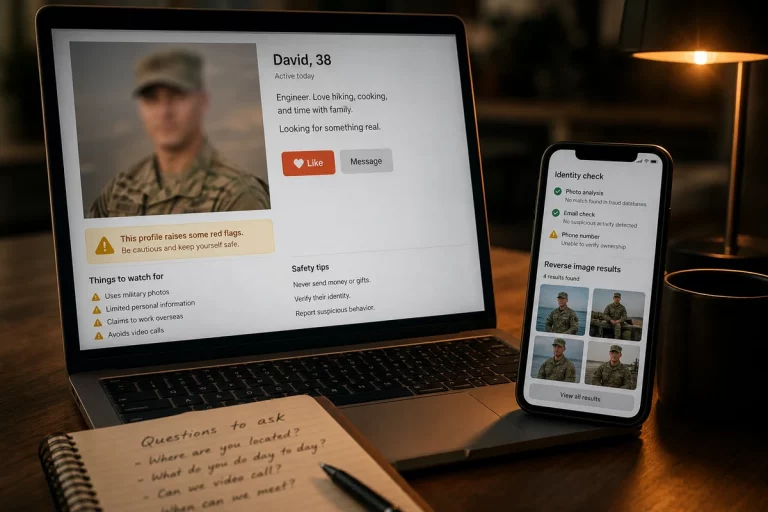
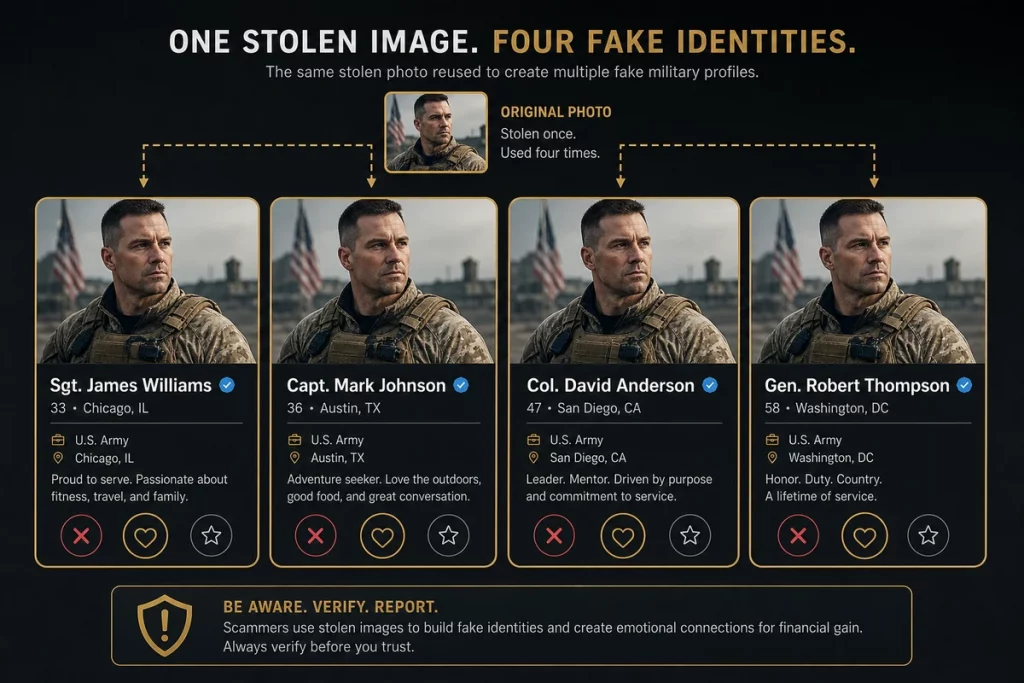
Military romance scammers steal photos from real service members’ social media accounts, military news articles, and stock photo sites. Look for: magazine-quality posed shots in uniform, photos that look like official military headshots, images with different backgrounds suggesting they were taken at different times by different people, and photos where the face is partially obscured. Use reverse image search on every photo they send you — if those images appear on other websites or profiles, you’ve caught a scammer.
High Risk
9. They Claim to Need Help with Customs or Shipping
A common military scam narrative: “I have a valuable package (gold bars, cash, personal items) that needs to be shipped home from my deployment, but I need someone stateside to pay the customs/shipping fees.” This is pure fiction. The military handles all logistics for personnel belongings. There are no customs fees that soldiers need civilians to pay. This is a pig butchering variant designed to extract escalating payments.
Confirmed Scam
10. They Want Gift Cards or Cryptocurrency
When the money ask comes, pay attention to the payment method. The FTC specifically warns about gift cards, cryptocurrency, wire transfers, and payment apps in online-love-interest scams (FTC). A request to pay through one of these methods is a strong reason to stop and report the interaction.
Confirmed Scam
11. They Get Angry or Guilt-Trip When Questioned
When you express doubt, a scammer will typically respond with emotional manipulation: “After everything I’ve sacrificed for this country, you don’t trust me?” or “I can’t believe you’d question my honor.” This is designed to make you feel guilty for protecting yourself. A real soldier would understand your caution. A scammer needs you to stop asking questions because questions lead to verification, and verification leads to exposure.
Medium Risk
Real Military Romance Scam Stories
Understanding how these scams play out in real life helps you recognize the patterns. Here are three documented cases that illustrate the devastating impact of military romance fraud.
Composite scenario: the “deployed surgeon.” An online contact claims to be a military doctor abroad, develops daily intimacy, and gradually introduces supposed communication, medical, travel, or investment expenses. This is a composite of patterns documented by the FTC and Army, not a claim about a specific victim.
Composite scenario: the “classified operator.” An online contact uses stolen tactical photos and claims secrecy prevents ordinary verification. A reverse image search links the pictures to another identity. The lesson is to evaluate the evidence without treating uniforms, documents, or claims of classified work as proof.
Composite scenario: the “leave fee.” An online contact asks for money for emergency leave papers. The recipient checks the photos, finds conflicting identities, stops contact, and reports the account. The Army confirms that soldiers and loved ones are not charged money so a soldier can take leave (U.S. Army).
Known Military Scammer Tactics & Lists
While no definitive “military scammer list” exists that you can search by name, there are several resources and common patterns to be aware of:
Stolen identity databases. The U.S. Army Criminal Investigation Division (CID) maintains a page documenting the most commonly impersonated military personnel. Real generals and senior officers whose photos are stolen most frequently include names that you can verify directly through official military channels.
Common fake names and ranks. Scammers frequently use names like “Sgt. James Williams,” “Captain Mark Johnson,” or “General David Anderson” — generic, common American names paired with impressive-sounding ranks. They almost never claim to be privates or low-ranking enlisted personnel because those ranks don’t carry the authority they need.
The deployment locations shift. In 2024-2025, the most common fake deployment claims were Syria, Afghanistan (even though major operations ended), Iraq, undisclosed locations in Africa, and peacekeeping missions in Eastern Europe. The key detail: they’ll claim their location is “classified” when asked for specifics, which conveniently prevents verification.
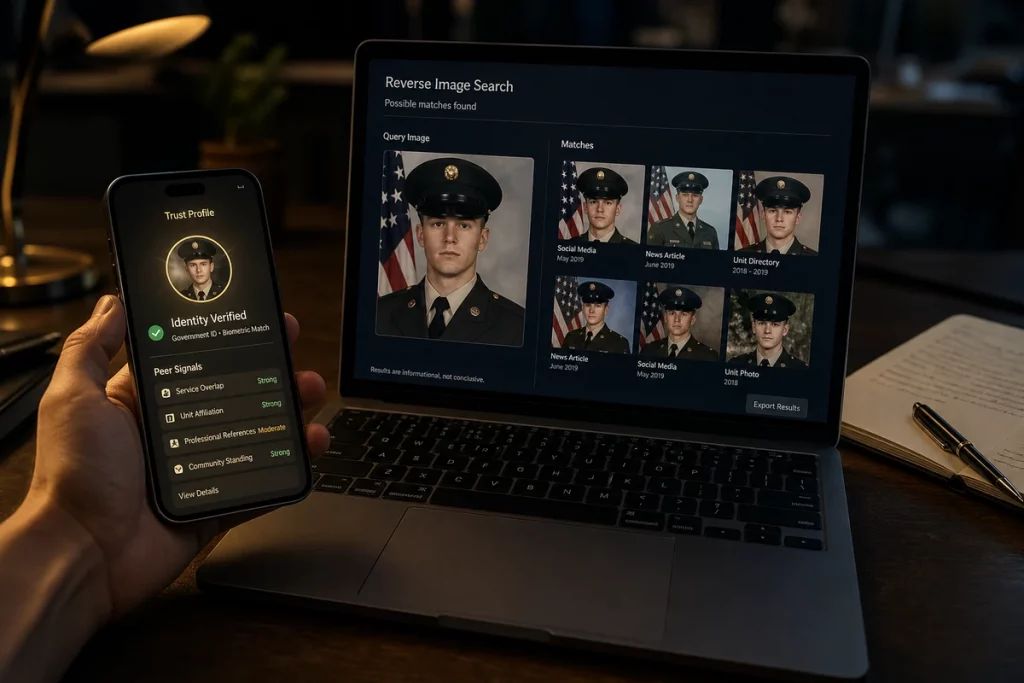
Recycled photos circulate widely. Many military scammer photos are reused across thousands of fake profiles worldwide. Running any photo they send through Google Reverse Image Search, TinEye, or Social Catfish will often reveal the same image on scam-warning websites.
Pro tip: The U.S. Army will verify whether someone is a real service member if you contact the Army Human Resources Command at (888) 276-9472. You can also check DFAS (Defense Finance and Accounting Service) records to verify active duty status.
How They Use Stolen Military Photos
Military romance scam pictures are the foundation of the entire deception. Here’s how scammers acquire and weaponize them:
Sources of stolen military photos:
| Source | How Scammers Use It | How to Check |
|---|---|---|
| Personal social media | Scrape photos from soldiers’ public Facebook/Instagram profiles | Reverse image search; check if the person warns about impersonation |
| Official military sites | Download official portraits and ceremony photos from .mil websites | Search the photo on Google; it will link back to the official source |
| News articles | Take photos from deployment coverage, award ceremonies, and memorial pages | Reverse image search will show the news source and real person’s name |
| Stock photo sites | Use generic “soldier” stock images that don’t match any real person | TinEye or Google Images will show the stock photo site |
| AI-generated images | Create entirely fake military photos using AI tools like Midjourney or DALL-E | Look for AI artifacts: irregular fingers, blurred insignia, inconsistent lighting. Use AI photo detection tools |
Red flags in military photos: Uniform insignia that don’t match the claimed branch or rank, medals or ribbons in incorrect positions, camouflage patterns from the wrong era, name tapes that are blurry or unreadable, and photos that look like they were cropped from a group shot. Real military personnel are precise about their uniforms — errors in presentation are a dead giveaway.
How to Verify a Military Person’s Identity
If you’ve met someone online who claims military service and you want to verify their identity before investing further, here are concrete steps:
Step 1: Reverse image search every photo. Use Google Images, TinEye, and reverse image search tools designed for dating to check every photo they’ve sent. If the images appear on other profiles, news sites, or scam-warning databases, you have your answer.
Step 2: Request a video call. This is the single most effective verification method. A real person will agree to a video call. A scammer physically cannot show you the face of the person they’re impersonating. If they refuse video after two requests with reasonable scheduling flexibility, end the conversation.
Step 3: Verify through official channels. Contact the Army CID, the specific branch’s public affairs office, or DFAS to verify active duty status. You’ll need the person’s full name and any unit information they’ve provided. Legitimate service members will not object to this step.
Step 4: Check military knowledge. Ask specific questions about military life: their MOS (Military Occupational Specialty), their unit’s chain of command, what basic training was like, or details about their base. Scammers working from scripts often get these details wrong. If they claim special forces but can’t describe selection, they’re fake.
Step 5: Ask them to verify through GuyID. If they’re genuine, they can complete GuyID’s government ID verification in under two minutes. Their Trust Profile provides third-party proof of identity that protects both parties. A real soldier with nothing to hide will welcome the opportunity to prove themselves. A scammer will refuse or deflect.
What to Do If You Suspect a Military Scam
If you’re currently in contact with someone you suspect may be a military romance scammer, here’s your action plan:
Stop all financial transactions immediately. If you’ve already sent money, contact your bank or financial institution right away. For wire transfers, call within 24 hours for the best chance of recovery. For gift cards, contact the issuing company with the card numbers. For cryptocurrency, contact the exchange platform.
Do not confront the scammer. Letting them know you’re suspicious may cause them to delete their accounts and cover their tracks, making it harder for law enforcement to investigate. Instead, quietly gather evidence: take screenshots of all conversations, save all photos they’ve sent, note all phone numbers and email addresses they’ve used, and record the dates and amounts of any money sent.
Cease contact. Block their number, email, and all social media accounts. This is not ghosting — it’s self-protection. Scammers are sophisticated manipulators who will deploy every emotional weapon to maintain the connection. Any continued communication exposes you to further manipulation.
Seek emotional support. Being scammed is not a reflection of intelligence — it’s a testament to your capacity for trust and love. These criminals are professionals who manipulate human psychology for a living. Consider speaking with a therapist or counselor, especially if the emotional investment was deep. The emotional impact of romance fraud can mirror the trauma of an actual breakup.
How to Report a Military Romance Scammer
Reporting matters. Every report helps law enforcement build cases against fraud networks and protect future victims.
Report to all of these agencies:
FBI’s Internet Crime Complaint Center (IC3)
File a complaint at ic3.gov. Include all evidence: screenshots, financial records, communication logs. The IC3 is the primary federal agency for internet-based fraud.
Federal Trade Commission (FTC)
Report at ReportFraud.ftc.gov. The FTC tracks romance scam patterns and coordinates with other agencies. Your report contributes to national fraud databases.
U.S. Army Criminal Investigation Division (CID)
If the scammer claimed to be Army, report to CID at cid.army.mil/report-a-crime.html. They specifically track military impersonation fraud.
The Dating Platform
Report the profile on the dating app or social media platform where you were contacted. Include evidence. Most platforms will remove the profile and ban the account. Learn more about how to report someone on a dating app.
For a complete step-by-step walkthrough of the reporting process, see our guide on how to report a scammer.
How to Protect Yourself Going Forward
Early verification and firm financial boundaries can reduce exposure. Here’s how to protect yourself from military romance scams — and other romance scams — moving forward:
Verify before you invest emotionally. Make video chat a non-negotiable requirement before developing feelings. If someone won’t show their face within two weeks of connecting, they have something to hide. This single rule eliminates the vast majority of romance scams.
Use screening tools proactively. Before investing time in a new match, run their photos through GuyID’s free screening tools and reverse image search. A two-minute check can save months of heartbreak and thousands of dollars.
Trust the verification, not the story. Stories can be fabricated. Emotions can be manufactured. But government-issued ID verification, social vouching from real friends, and a trust score built over time cannot be faked. Look for verifiable proof of identity, not compelling narratives.
Know the military basics. Active-duty U.S. military personnel have free healthcare (they never need you to pay medical bills), free food and housing while deployed, free internet and phone access on most bases, and their own travel arrangements handled by the military. If anyone claiming to be a soldier asks you to pay for any of these things, it is a scam without exception.
Share the Date Mode link. When someone asks to move from a dating app to direct communication, share your GuyID Date Mode link. It lets them see your verified Trust Profile while you protect your personal information. A genuine person will appreciate the safety measure. A scammer will disappear — which is exactly what you want.
Talk to someone you trust. Scammers thrive on secrecy. They’ll encourage you to keep the relationship private. Sharing your new online connection with a trusted friend or family member creates an external reality check that can catch red flags your emotions might miss.
How GuyID Helps
GuyID should appear when it is useful, not as a banner ad. A GuyID Trust Profile gives someone a portable way to share trust signals before a date, while identity verification and social vouching help turn vague profile claims into clearer next steps.
Useful next steps:
- Create a GuyID Trust Profile when you want a cleaner way to share verified trust signals.
- Use GuyID free tools and related guides when you need a checklist before meeting someone.
- Treat identity verification as confidence-building, not a guarantee.
- Use social vouching when you want context from people who already know the person.
- Sign up only when the extra trust layer helps the decision you are already trying to make.
Frequently Asked Questions
Can a real soldier ask me for money?
No. Active-duty U.S. military personnel have their basic needs — housing, food, healthcare, communication, and travel — covered by the military. There is no legitimate scenario where a deployed soldier needs a romantic interest to send money. If someone in uniform asks for money for any reason, it is a scam. Period.
How can I verify if someone is actually in the military?
Request a video call first — this eliminates most scammers. Then use reverse image search on their photos. You can also contact the Army Human Resources Command at (888) 276-9472, verify through DFAS records, or ask them to complete GuyID government ID verification which takes under two minutes.
What are the most common military scammer names?
Scammers use generic American names like James Williams, Mark Johnson, David Anderson, Michael Smith, and Robert Thompson. They pair these with impressive ranks like Sergeant Major, Captain, Colonel, or General. The name alone doesn’t confirm a scam, but combined with other red flags like refusing video calls and requesting money, the pattern becomes clear.
Why do military romance scammers target older women?
Scammers target older women because they’re statistically more likely to have savings and retirement funds, may be more emotionally vulnerable after divorce or losing a spouse. Tend to be less familiar with reverse image search and online verification tools, and the “mature soldier” narrative is more believable than a 25-year-old General. However, victims span all ages, genders, and backgrounds. Anyone can be targeted.
Can I get my money back from a military romance scam?
Recovery depends on the payment method, provider rules, and how quickly you act. Contact the financial provider immediately, then report to the FBI’s IC3 and the FTC. Gift-card and cryptocurrency transactions can be difficult to reverse, but you should still report them. Use our romance scam loss calculator to document your total exposure.
Are military romance scams only on dating apps?
No. Military romance scammers can operate across social networks, games, professional networks, and dating apps. The platform can affect reporting options, but the core warning pattern remains stolen or misleading identity evidence combined with emotional manipulation and money requests.
How do I know if military photos are stolen?
Run every photo through Google Reverse Image Search and TinEye. Also check for: uniform inconsistencies (wrong branch insignia, incorrect medal placement), AI-generated artifacts (extra fingers, blurred text on uniforms), and photos that look professionally shot or official. If the same photos appear on scam-warning websites, dating profile databases, or news articles about someone else, they’re stolen.
What should I do if someone used my military photos for a scam?
If you’re a real service member whose photos have been stolen, report the impersonation to your branch’s Criminal Investigation Division, file reports with the platforms where fake profiles appear. Set your social media accounts to private, and consider adding a watermark to any remaining public photos. The Army CID’s page at cid.army.mil has specific instructions for military personnel who’ve been impersonated.