Reader Briefing
Reader Briefing
Start here if you need a practical read on catfish probability detector: holistic fake profile risk score (free tool): who should use verification, what signals to check, and what to do before moving from online interest to an in-person plan.
Who this is for
- People meeting someone from a dating app or social platform.
- Readers preparing for a first in-person date.
- Anyone checking identity, profile consistency, and trust signals.
- People trying to avoid romance scams, fake profiles, or pressure tactics.
You’ll learn
- How to evaluate identity signals without treating any single check as certainty.
- Which trust signals matter and how to weigh them together.
- How to spot inconsistencies, pressure, or behavior patterns that deserve caution.
- How to move from online conversation to a safer first meeting.
- Where GuyID tools fit into a quick pre-date screening workflow.
- How to compare options using practical safety and trust criteria.
Bottom line
Verification reduces uncertainty; it does not guarantee future behavior. Use a layered approach: confirm identity signals, compare profile consistency, ask for a short video call, keep early plans public, and slow down when someone pressures you to skip normal safety steps.
Key takeaways
- Identity verification improves confidence, not certainty.
- Patterns matter more than isolated incidents.
- Verify before meeting privately or sharing sensitive details.
- A short video call can reveal many inconsistencies.
- Pressure to skip reasonable safety steps is useful information.
Free Tools
Catfish Probability Detector
Check whether a dating profile has suspicious identity or photo signals.
Dating Bio Red Flag Detector
Review a bio for scam, pressure, or trust-warning language.
Dating Safety Checklist
Use free GuyID tools before moving from chat to a real date.
Next step
Create your GuyID trust profile
Share consent-based trust signals before a date without turning the conversation into an interrogation.
NavigateTable of Contents15 sections
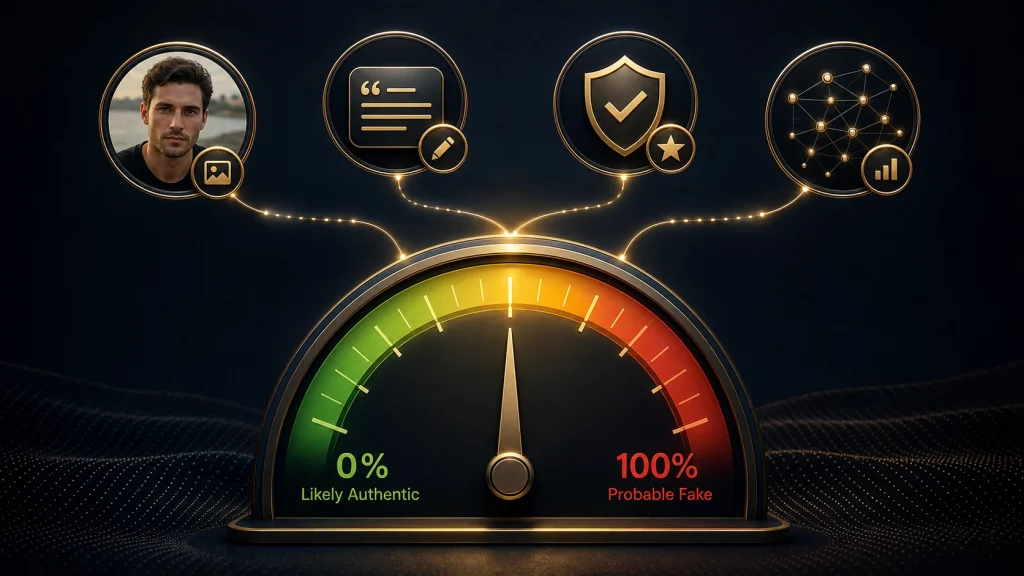
You’ve matched with someone. The photos look right. The bio seems fine. But you can’t shake the question: is this person real? A reverse image search checks one dimension — whether the photos are stolen. A bio red flag detector checks another — whether the text contains scam language. But the catfish probability detector evaluates the COMPLETE profile holistically — aggregating multiple risk signals across photos, bio, behavior patterns, and verification status to produce a single probability score that answers the question every dater asks: “What are the chances this profile is fake?” This guide explains what the detector evaluates, how to use it, what the probability score means, and the specific actions to take at each risk level.
Why Single-Signal Detection Isn’t Enough
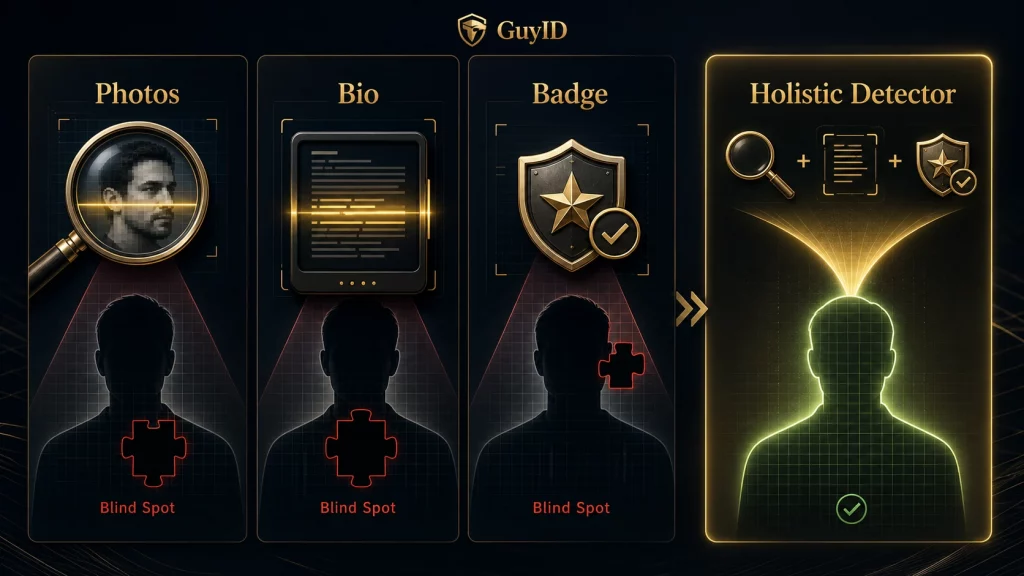
Most catfish detection focuses on one signal at a time: reverse image search checks whether photos are stolen. Bio analysis checks whether text contains scam patterns. Verification badges check whether a face matches photos. Each tool catches a specific type of fake — and misses every other type.
The Gaps in Single-Signal Approaches
| Tool | What It Catches | What It Misses |
|---|
| Bio red flag detector | Formulaic scam language | Well-written bios from sophisticated scam operations |
| Verification badge | Face doesn’t match photos | Deepfakes that pass selfie verification |
A catfish who uses AI-generated photos (evading reverse image search) with a well-written bio (evading bio analysis) and no verification badge (no badge to check) passes every single-signal tool. But the COMBINATION of signals — AI-perfect photos + no verification + specific behavioral patterns + profile inconsistencies — produces a distinctive pattern that holistic detection catches. The catfish probability detector evaluates the combination, not the individual signals.
Inline visual 1
What the Catfish Probability Detector Evaluates
The detector assesses multiple dimensions simultaneously, weighting each based on its correlation with confirmed catfish profiles.
Signal Categories
- Photo signals: Quality consistency (all professional vs mixed), variety (multiple settings vs one), social context (friends present vs solo-only), temporal diversity (different periods vs same-day batch). Photo authenticity indicators weighted collectively.
- Bio signals: Specificity level (named details vs generic categories), language patterns (scam-associated formulaic combinations), voice consistency (reads like one person vs templated), and red flag keywords (career-explains-unavailability, religious-piety-signaling, urgency language).
- Profile completeness signals: Filled vs empty fields, number of photos, bio length and depth, connected social media (when visible). Completeness correlates with legitimacy — fake profiles often skip optional fields.
- Verification signals: Presence or absence of app badges, GuyID Trust Profile link, verification signal tier. Higher verification = lower catfish probability. Absent verification = elevated baseline risk.
- Pattern combination signals: Combinations that individually seem neutral but together indicate fabrication. All-professional photos + generic bio + no verification + career-explains-unavailability = individually excusable, collectively concerning. The detector evaluates the combination that human assessment often misses.
How to Use the Catfish Probability Detector
Step 1: Open the Tool (5 seconds)
Visit guyid.com/tools/catfish-probability-detector. Free. No account. No sign-up.
Step 2: Input the Profile Information (30-45 seconds)
Enter the available information from the profile you’re evaluating: screenshot or description of photos, bio text (paste directly), verification status (badge present/absent), and any behavioral observations (video call accepted/refused, communication patterns). More data = more accurate assessment. Even partial input produces a useful estimate.
Step 3: Review the Probability Score (10 seconds)
Step 4: Act on the Assessment (varies)
Low probability: proceed with standard caution. Moderate: apply additional screening (image search + video call). High: investigate with the 5-layer method before any further investment. Very high: disengage and report.
Understanding Your Probability Score
| Probability | Risk Tier | What It Means | Recommended Action |
|---|---|---|---|
| No concerning patterns detected. Profile is consistent with a real person. | Proceed with standard safety practices. Request Trust Profile before meeting for full confirmation. | ||
| Some authenticity indicators present alongside some yellow flags. Could be a real person with a thin profile OR a moderately sophisticated fake. | Run reverse image search. Request video call. Ask dual-purpose questions. Request Trust Profile. Don’t meet without video call. | ||
| Pattern combinations consistent with known catfish profiles. Significant risk of engaging with a fake identity. | Apply full 5-layer investigation. Do NOT invest further emotional energy without video call confirmation AND identity verification. Consider disengaging. | ||
| Profile matches known catfish/scam templates. High confidence that this is not a genuine identity. | Disengage immediately. Report the profile. Block. Do not continue communication. If money was already sent: FBI IC3 + FTC. |
💡
The Moderate Zone Is Where Screening Matters Most Low probability (clearly real) and very high probability (clearly fake) are easy decisions. It transforms “I’m not sure” into a specific probability with specific recommended actions. In this zone: the additional screening steps the detector recommends (video call, reverse image search, Trust Profile request) resolve the ambiguity that the probability score identified.
What to Do at Each Risk Level
☐ Continue conversation with normal interest
☐ Apply dual-purpose questions (chemistry + screening simultaneously)
☐ Video call before meeting (standard practice for all matches)
☐ Check for GuyID Trust Profile before the date
☐ Follow first date safety protocol
☐ Reverse image search every photo (catches stolen images the detector flags as suspicious)
☐ Bio red flag detector (deeper text analysis)
☐ Video call within the first few days — non-negotiable at this level
☐ Ask about their social network and listen for specificity vs vagueness
☐ Request GuyID Trust Profile — their response is itself a data point
☐ Apply the complete 5-layer investigation method
☐ Do NOT invest further emotionally until identity is independently confirmed
☐ Do NOT move to WhatsApp/text without video call first
☐ Do NOT agree to meet in person under any circumstances without video + verification
☐ Prepare to disengage if investigation confirms fabrication signals
☐ Stop all communication
☐ Report the profile on the dating platform
☐ Block on all channels
☐ If money was sent: FBI IC3 + FTC + contact your bank
☐ See the complete catfish recovery guide if needed
What the Detector Catches That Other Tools Miss
Pattern Combinations
Individual signals that seem innocuous together form distinctive patterns. The detector identifies combinations like:
- All-professional photos + generic bio + no badge + recent account: Each element is individually common. Together: the signature of a mass-produced fake profile. Probability score: elevated.
- AI-quality photos + specific bio + no social photos + no verification: The bio quality suggests a real person. The photo quality + absent social proof + no verification suggest AI generation with human-written text. Probability score: moderate-high.
- Inconsistent photo quality + career-explains-unavailability bio + declined video call: Photos from different sources (potentially stolen from multiple people) + military/oil rig/overseas business claim + can’t appear on camera. The classic scam pattern. Probability score: high-very high.
Human assessment typically evaluates each signal independently — “The photos look fine. The bio is a bit generic but not alarming. No badge, but lots of people skip that.” The detector evaluates the COMBINATION — producing a holistic probability that accounts for how individual signals interact.
Baseline Comparisons
The detector compares the evaluated profile against a baseline of known authentic profiles and known fake profiles — identifying where the profile falls on the spectrum. This baseline comparison catches subtle patterns: a fake profile that’s individually “fine” in every category but consistently lands at the low-authenticity end of normal ranges across all categories — a pattern human assessment rarely detects but statistical comparison catches.
Limitations: What the Detector Can’t Assess
Transparency about limitations builds trust in the tool’s genuine assessments. The catfish probability detector can’t evaluate:
- Real-time behavior: The detector analyzes static profile information. Behavioral assessment (how someone communicates over time) requires the dual-purpose question strategy and the behavioral authenticity evaluation in the 4-step analysis framework.
- Character beyond identity: The detector assesses whether a person is REAL. It doesn’t assess whether a real person is TRUSTWORTHY. Character assessment requires social vouching and the behavioral observation that only human judgment provides.
- Every new scam variant: Scam techniques evolve. The detector’s pattern recognition is based on known patterns — novel approaches may not match existing templates. This is why the detector is part of a screening STACK, not a standalone solution.
These limitations are why the detector works best as part of the complete screening stack — not as a sole determination. The detector flags probability. The additional tools and verification confirm or deny the flag.
The Complete Screening Stack: Detector + Tools + Verification
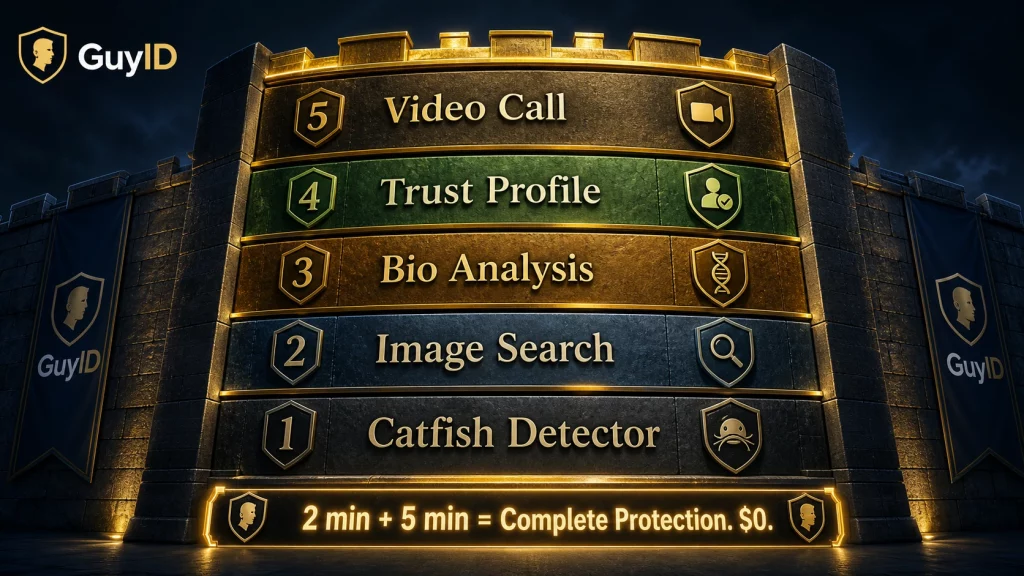
Maximum catfish protection layers the detector with complementary tools — each catching what the others miss.
| Layer | Tool | What It Catches | Time | Cost |
|---|---|---|---|---|
| 1 | Catfish Probability Detector | Holistic pattern combinations across all profile dimensions | 60 sec | Free |
| 2 | Reverse Image Search | Stolen photos matched to different identities | 10 sec | Free |
| 3 | Bio Red Flag Detector | Scam-associated language patterns in bio text | 10 sec | Free |
| 4 | GuyID Trust Profile Check | Identity not government-verified / no character vouches | 10 sec | Free (women) |
| 5 | Video Call | Person can’t appear as their claimed identity in real-time | 5 min | Free |
Total screening time: under 2 minutes for Layers 1-4 + 5 minutes for Layer 5. Total cost: $0. Coverage: comprehensive across every catfish method — stolen photos, AI-generated identities, scam language, unverified identities, and deepfakes.
Apply Layers 1-4 to every match (2 minutes). Apply Layer 5 before any in-person meeting (5 minutes). The complete stack catches what any individual tool misses — because each tool’s blind spot is another tool’s strength.
Inline visual 2
Summary: One Score. Every Signal. 60 Seconds.
The catfish probability detector does what individual tools can’t: it evaluates the complete profile holistically, weighs multiple signal categories simultaneously, and produces a single probability score that replaces “I’m not sure” with a concrete assessment and clear next steps.
Use it on every match. Not just the suspicious ones — because the sophisticated fakes are the ones that don’t trigger suspicion. Sixty seconds per match. Zero cost. A probability score that either confirms your instinct (“I thought that was fake — it is”) or challenges it (“That seemed fine but the pattern combination is concerning”). Either outcome protects you.
Then layer it with the complete screening stack: reverse image search (catches stolen photos), bio red flag detector (catches scam language), Trust Profile check (confirms verified identity), and video call before meeting (confirms real-time presence). Two minutes of screening + five minutes of video call = comprehensive catfish protection at zero cost. The tools exist. The time investment is trivial. The protection is comprehensive. Screen every match. Every time.