Reader Briefing
Reader Briefing
Start here if you need a practical read on how to spot a catfish: 10 signs the person isn’t real: who should use verification, what signals to check, and what to do before moving from online interest to an in-person plan.
Who this is for
- People meeting someone from a dating app or social platform.
- Readers preparing for a first in-person date.
- Anyone checking identity, profile consistency, and trust signals.
- People trying to avoid romance scams, fake profiles, or pressure tactics.
You’ll learn
- How to evaluate identity signals without treating any single check as certainty.
- Which trust signals matter and how to weigh them together.
- How to spot inconsistencies, pressure, or behavior patterns that deserve caution.
- How to move from online conversation to a safer first meeting.
- Where GuyID tools fit into a quick pre-date screening workflow.
- How to compare options using practical safety and trust criteria.
Bottom line
Verification reduces uncertainty; it does not guarantee future behavior. Use a layered approach: confirm identity signals, compare profile consistency, ask for a short video call, keep early plans public, and slow down when someone pressures you to skip normal safety steps.
Key takeaways
- Identity verification improves confidence, not certainty.
- Patterns matter more than isolated incidents.
- Verify before meeting privately or sharing sensitive details.
- A short video call can reveal many inconsistencies.
- Pressure to skip reasonable safety steps is useful information.
Free Tools
Catfish Probability Detector
Check whether a dating profile has suspicious identity or photo signals.
Dating Bio Red Flag Detector
Review a bio for scam, pressure, or trust-warning language.
Dating Safety Checklist
Use free GuyID tools before moving from chat to a real date.
Next step
Create your GuyID trust profile
Share consent-based trust signals before a date without turning the conversation into an interrogation.
**Their photos look like they belong on a magazine cover. The connection feels instant and intense. A catfish is a person who creates a fake online identity — typically using stolen photos, fabricated biographical details, and carefully constructed personas — to deceive others in dating or social contexts. Whether the motive is financial fraud, emotional manipulation, or simply the thrill of deception, the damage to the target is real: financial loss, emotional devastation, and eroded trust that affects every subsequent connection. This guide teaches you how to spot a catfish using the specific behavioral patterns, verification techniques, and red flags that expose fake identities before they cause real harm.
NavigateTable of Contents21 sections
What Is Catfishing and Why It’s Getting Harder to Detect
Catfishing is the act of creating a fake online persona to deceive someone — typically in a dating or romantic context. The term originated from the 2010 documentary “Catfish” and has since become the standard term for identity deception in online dating. According to the American Psychological Association’s research on online deception, catfishing has evolved significantly since the term was coined: early catfishing involved simply using someone else’s photos, while modern catfishing incorporates AI-generated faces, deepfake video technology, voice cloning, and sophisticated social engineering that makes the deception dramatically harder to detect than it was even five years ago.
Understanding how to spot a catfish in 2026 requires recognizing that the technology has changed but the BEHAVIORAL patterns haven’t. Regardless of how sophisticated the fake identity is, the catfish still can’t video call in real time (because they don’t look like their photos), still can’t meet in person (for the same reason), and still exhibits the communication patterns that every identity deception shares: too much too fast, inconsistencies that accumulate, and the specific avoidance behaviors that keep the deception from being exposed. Research from the National Library of Medicine on online dating fraud confirms that behavioral indicators remain more reliable than technological detection methods — because while AI can generate a convincing face, it can’t generate the consistent behavioral history that a real identity produces. Our romance scammer detection guide covers the broader fraud landscape; this guide focuses specifically on identity verification and the catfish-specific patterns that expose fake personas.
10 Signs You’re Being Catfished: How to Spot a Catfish

1. Photos Look Professional or Too Perfect
Real dating profile photos include a mix: some well-lit, some casual, some with friends, some in different settings across different time periods. Catfish profiles typically feature photos that are uniformly high-quality, often with consistent professional lighting, and frequently showing only one angle or expression. If every photo looks like it belongs in a portfolio, the photos may BE from a portfolio — stolen from a model, influencer, or someone else’s social media. Learning how to spot a catfish starts with learning to see photos critically: do they look like a real person’s casual collection, or like a curated set selected for maximum appeal?
2. They Refuse to Video Call — Repeatedly
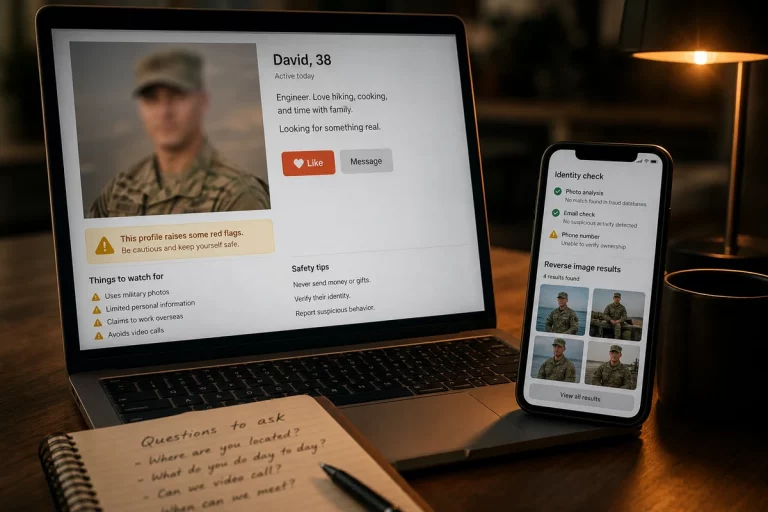
This is the single most reliable catfish indicator. A real person with a genuine interest in connecting has no reason to refuse a video call across weeks of daily messaging. The excuses are predictable: broken camera, poor internet, military security restrictions (see our military scammer list guide), “I’m too shy,” or indefinite postponement (“next week for sure”). A brief, real-time video call where you can see the person and ask them to wave or hold up a specific number of fingers eliminates catfishing instantly — which is precisely why catfish resist it with absolute consistency.
3. Their Story Has Inconsistencies
Fabricated identities accumulate contradictions because maintaining a complex false narrative over weeks or months requires perfect memory that most people — including professional scammers — don’t have. They mentioned they live in Boston last week and Chicago this week. Their job title changed between conversations. Their age on the app doesn’t match the age they mentioned in chat. Each individual inconsistency might be explainable; the PATTERN of inconsistencies is diagnostic. Knowing how to spot a catfish means tracking the details they share and noticing when the story doesn’t add up across conversations.
4. Emotional Intensity Arrives Immediately
“I’ve never felt this way before.” “You’re my soulmate.” “I think I’m falling in love with you.” These declarations within days or weeks of initial contact — before you’ve met, before a video call, before any real-world verification — are the love bombing that every catfish uses to create the emotional attachment that prevents critical evaluation. The attachment is the catfish’s most important product: once you’re emotionally invested, you’re far more likely to dismiss the red flags, rationalize the excuses, and continue the connection despite accumulating evidence that something isn’t right.
5. Limited Social Media Presence
Real people have social media histories that span years: old photos, tagged posts from friends, check-ins, evolving content that reflects a real life unfolding over time. Catfish profiles are typically newly created, have few followers (or followers that are also fake accounts), contain no tagged photos from other people, and show no history before the profile’s recent creation. If their Instagram was created three months ago and has 50 posts but no tagged photos from friends, no comments from people who clearly know them, and no content older than the dating profile — the social media was created to support the catfish identity, not to document a real life.
6. They Quickly Move Off the Dating App
“Let’s move to WhatsApp/Telegram/personal email — this app is glitchy.” Moving off the dating platform serves the catfish strategically: it removes the catfish from the platform’s fraud detection systems, prevents the target from reporting the profile until later, and moves the conversation to channels with fewer identity verification features. While moving to personal messaging is normal as connections develop, the urgency of the request — particularly within the first few exchanges — is a pattern that helps answer how to spot a catfish early. Our icebreaker guide recommends keeping initial conversations on-platform until identity verification has occurred.
7. They Have Excuses for Never Meeting
Work emergency. Family crisis. Travel complications. COVID concerns. Injury. Military deployment. Car trouble. Every planned meeting falls through for reasons that sound individually plausible but form a collectively unmistakable pattern: they will never meet you because they can’t — the person behind the screen doesn’t match the person in the photos. This pattern can persist for months because each excuse is accompanied by renewed emotional intensity (“I want to see you SO badly”) that refreshes the target’s hope and patience. The red flags guide identifies indefinite meeting avoidance as one of the most reliable indicators of fraudulent identity.
8. They Request Money
Not all catfish are financially motivated — but many are, and the financial request is the moment the catfish’s true purpose reveals itself. The request follows the emotional investment: once you care about them, the “emergency” appears (medical bills, travel funds, business crisis, legal trouble). Each request is framed as temporary (“I’ll pay you back as soon as…”) and escalates over time. If ANYONE you’ve never met in person asks for money — regardless of the emotional context — the request is a scam indicator. Our romance scammer guide covers the financial extraction patterns in comprehensive detail.
9. Their Photos Appear Elsewhere Online
The fastest technical method for how to spot a catfish: reverse image search their photos. Upload every profile photo to Google Images or TinEye. If the photos appear on other websites under different names — or on social media accounts belonging to someone else — the identity is stolen. This single step catches the vast majority of catfish because the entire deception depends on photos that don’t belong to the person using them. The search takes 30 seconds per photo and should be standard practice for EVERY match before meeting in person.
10. Your Gut Says Something’s Off
You can’t articulate exactly what’s wrong — but something doesn’t feel right. The connection is too perfect. The words are too polished. The intensity is too calibrated. The excuses are too convenient. Your subconscious pattern-recognition system processes threat signals faster than your conscious mind can articulate them, and the “gut feeling” that something is off is your brain’s threat detection flagging data that your analytical mind hasn’t processed yet. When your gut conflicts with the words on the screen, trust your gut — because the words may be fabricated while your neurological alarm system is reading behavioral patterns that text alone can’t fake. The dating anxiety guide distinguishes between anxiety (general nervousness about dating) and intuition (specific unease about a specific person) — and the distinction matters because anxiety deserves management while intuition deserves trust.
How to Verify Someone’s Identity and Confirm They’re Real
Step 1: Reverse image search every photo. Upload all profile photos to Google Images and TinEye. If the photos appear on other profiles, stock photo sites, or someone else’s social media — the identity is fake.
Step 2: Request a real-time video call. Not a pre-recorded video. Not a voice-only call. A live video call where you can see the person and interact in real time. Ask them to do something specific (wave, hold up three fingers, show you their view from the window) to confirm the video is live rather than pre-recorded or deepfaked. Repeated refusal after weeks of messaging is diagnostic — no genuine person who’s interested in you will refuse a 30-second video call for months on end.
Step 3: Cross-reference their claims. Google their name + city. Check LinkedIn for employment verification. Search the company they claim to work for and see if they’re listed. If they claim a specific education, check the institution. The more claims you can independently verify, the more confident you can be that the identity is real — and the more claims that DON’T verify, the more the catfish indicator accumulates.
Step 4: Use GuyID’s free screening tools. Government ID verification through GuyID confirms actual identity — not just photo matching but real government-document confirmation that the person is who they claim to be. Share your Date Mode link through GuyID and ask them to share theirs. A real person will verify willingly; a catfish will produce excuses. The refusal itself IS the verification — it tells you everything the video call would have confirmed.
AI-Generated Catfish: The New Threat for 2026
AI has dramatically changed the catfishing landscape. Tools that generate photorealistic human faces, clone voices from short audio samples, and produce convincing text conversations have made catfishing accessible to anyone with basic technical skills — and made the results harder to detect than ever before:
AI-generated faces. Services like ThisPersonDoesNotExist.com and advanced generative AI tools create faces that are virtually indistinguishable from real photos. These generated faces won’t appear in reverse image searches (because they’ve never existed elsewhere), which means the most reliable traditional catfish detection method fails against AI-generated identities. However, AI faces have tells: asymmetric earrings, distorted backgrounds, inconsistent lighting on the face versus the background, and subtle artifacts around hair edges and teeth. More importantly, AI can generate a single convincing photo but struggles to generate a CONSISTENT set of photos showing the same person in different settings, lighting conditions, and time periods — which is why requesting multiple casual photos (not just profile shots) remains an effective detection strategy.
Deepfake video. Real-time deepfake technology can now superimpose one person’s face onto another’s during video calls — potentially defeating the video-call verification that has been the gold standard for catfish detection. However, current deepfake technology shows artifacts during rapid movement, unusual lighting changes, and extreme angles — so requesting the person on a video call to turn their head quickly, move close to the camera, or change lighting conditions can expose deepfakes that static or controlled positioning would conceal. The National Domestic Violence Hotline has noted the emerging threat of deepfake-enabled catfishing in their technology-facilitated abuse advisories — recognizing that the technology is advancing faster than the public’s ability to detect it.
AI-generated conversation. Large language models can now produce convincing, personalized romantic conversation that maintains character consistency across extended exchanges. AI-powered catfish operations use these tools to run multiple simultaneous “relationships” — each producing the personalized, emotionally engaging communication that targets interpret as genuine human connection. Detection: AI conversation tends to be consistently articulate (real people have off days), reference details you’ve shared with unusual precision (AI has perfect recall of conversation history), and avoid the specific, personal anecdotes that real people share spontaneously. The genuine interest signs guide provides behavioral indicators that distinguish real human engagement from even the most sophisticated AI-generated conversation.
What to Do If You’ve Been Catfished
Stop all contact immediately. Block across all platforms. Don’t respond to follow-up messages regardless of emotional appeals. The catfish may attempt to re-engage using guilt, new fake identities, or emotional manipulation — every response extends the deception.
Document everything. Screenshot all conversations, profile information, photos, and any financial transaction records. This documentation serves as evidence for law enforcement and platform reporting, and it provides the objective record that prevents the catfish from revising the narrative if they attempt to re-engage.
Report to the platform and authorities. Report the catfish profile to the dating app. File a report with the FTC (reportfraud.ftc.gov) and FBI IC3 (ic3.gov) if financial fraud occurred. Even if your individual losses seem small, reporting contributes to the pattern data that helps law enforcement identify and shut down catfish operations that are targeting others simultaneously.
Don’t blame yourself. Catfishing is a form of fraud — not evidence of your gullibility. Modern catfish operations are sophisticated, psychologically informed, and specifically designed to exploit the human desire for connection. The shame victims feel is what prevents reporting and keeps them isolated — which is exactly the outcome the catfish benefits from. The breakup recovery guide provides the emotional processing framework that applies to catfish aftermath because the grief is real even though the person was fake: you’re grieving the possibility that the connection represented, and that grief deserves acknowledgment rather than dismissal.
Protect yourself going forward. Use GuyID’s free screening tools for every future connection. Reverse image search every profile photo. Insist on video calls before emotional investment. Apply the red flags framework and the green flags framework to every new connection — because the awareness of how to spot a catfish that this experience has given you is protective knowledge that makes you harder to deceive and better equipped to find genuine connection.

How GuyID Helps
GuyID should appear when it is useful, not as a banner ad. A GuyID Trust Profile gives someone a portable way to share trust signals before a date, while identity verification and social vouching help turn vague profile claims into clearer next steps.
Useful next steps:
- Create a GuyID Trust Profile when you want a cleaner way to share verified trust signals.
- Use GuyID free tools and related guides when you need a checklist before meeting someone.
- Treat identity verification as confidence-building, not a guarantee.
- Use social vouching when you want context from people who already know the person.
- Sign up only when the extra trust layer helps the decision you are already trying to make.
Frequently Asked Questions
How do you spot a catfish on dating apps?
The fastest detection method: reverse image search their photos and request a real-time video call. A genuine person passes both instantly; a catfish fails both consistently.
Can AI create catfish profiles that are undetectable?
AI-generated faces can now bypass reverse image search (because the face has never existed elsewhere), and AI conversation tools can produce convincing personalized messaging. However, AI still can’t generate a CONSISTENT set of photos showing the same person across different real-world settings and time periods, can’t produce a convincing real-time video call (deepfakes still show artifacts during movement), and can’t replicate the spontaneous, imperfect communication style of a real person. Government ID verification through GuyID remains the most reliable defense because it verifies the actual PERSON, not just the photos or conversation.
What should I do if I think I’m being catfished?
Verify before confronting: reverse image search their photos, request a real-time video call, cross-reference their claims through Google and social media, and ask them to verify through GuyID. If the verification fails (photos appear elsewhere, video call is refused, claims don’t check out, GuyID verification is declined), cease contact, document everything, report to the dating platform and relevant authorities, and process the experience with the understanding that being catfished reflects the scammer’s deception — not your judgment.
Is catfishing illegal?
Catfishing itself (creating a fake identity) exists in a legal gray area in many jurisdictions. However, the activities that typically accompany catfishing ARE illegal: financial fraud (wire fraud, theft by deception), identity theft (using a real person’s stolen photos and name), and harassment. If the catfishing involved any financial transactions, it’s prosecutable as fraud. Report to the FTC and FBI IC3 regardless of whether your specific jurisdiction has catfishing-specific legislation, because the fraud charges that accompany most catfishing operations are prosecutable everywhere.