Reader Briefing
Reader Briefing
Start here if you need a practical read on is grindr safe? lgbtq+ safety review: who should use verification, what signals to check, and what to do before moving from online interest to an in-person plan.
Who this is for
- People meeting someone from a dating app or social platform.
- Readers preparing for a first in-person date.
- Anyone checking identity, profile consistency, and trust signals.
- People trying to avoid romance scams, fake profiles, or pressure tactics.
You’ll learn
- How to evaluate identity signals without treating any single check as certainty.
- Which trust signals matter and how to weigh them together.
- How to spot inconsistencies, pressure, or behavior patterns that deserve caution.
- How to move from online conversation to a safer first meeting.
- Where GuyID tools fit into a quick pre-date screening workflow.
- How to compare options using practical safety and trust criteria.
Bottom line
Verification reduces uncertainty; it does not guarantee future behavior. Use a layered approach: confirm identity signals, compare profile consistency, ask for a short video call, keep early plans public, and slow down when someone pressures you to skip normal safety steps.
Key takeaways
- Identity verification improves confidence, not certainty.
- Patterns matter more than isolated incidents.
- Verify before meeting privately or sharing sensitive details.
- A short video call can reveal many inconsistencies.
- Pressure to skip reasonable safety steps is useful information.
Free Tools
Catfish Probability Detector
Check whether a dating profile has suspicious identity or photo signals.
Dating Bio Red Flag Detector
Review a bio for scam, pressure, or trust-warning language.
Dating Safety Checklist
Use free GuyID tools before moving from chat to a real date.
Next step
Create your GuyID trust profile
Share consent-based trust signals before a date without turning the conversation into an interrogation.
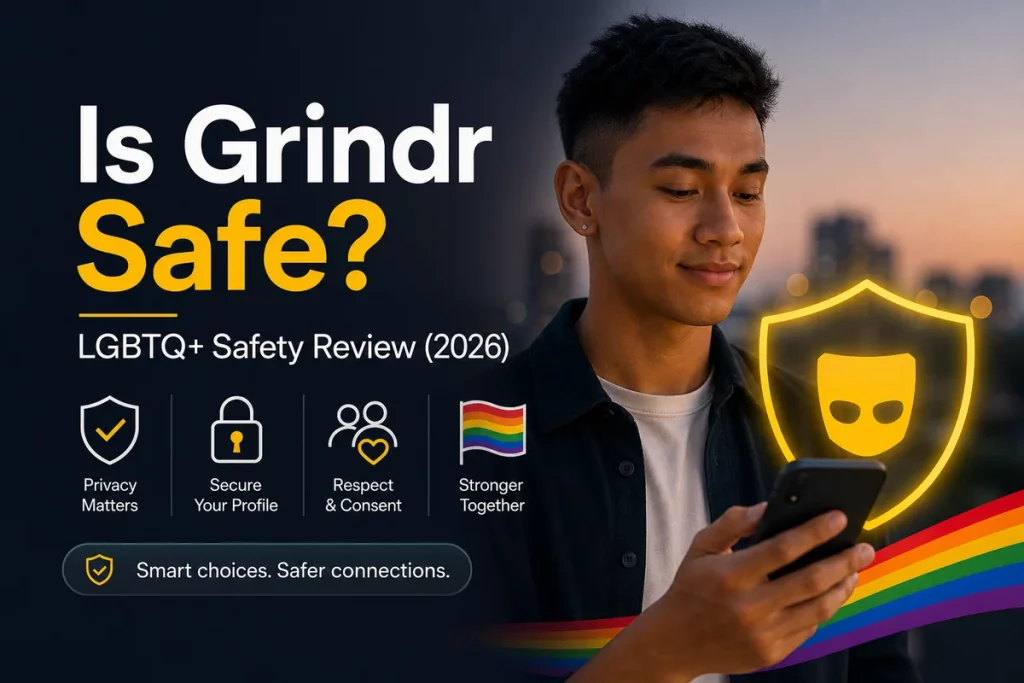
The platform has made meaningful improvements including identity verification, anti-discrimination features, HIV status sharing, and country-specific safety warnings for hostile regions. But fundamental risks remain — from location privacy vulnerabilities that can expose users to extortion schemes that specifically exploit LGBTQ+ users’ fear of being outed. This comprehensive review covers every dimension of Grindr safety: what the platform protects, what it doesn’t, LGBTQ+-specific risks that don’t exist on mainstream apps, and the practical steps that bridge the safety gap.
NavigateTable of Contents17 sections
Grindr’s Safety Features in 2026
Answering “is Grindr safe” requires understanding the protections the platform currently offers — and their limitations:
Identity verification. Grindr offers selfie-based photo verification similar to Tinder and Bumble. Verified users receive a badge confirming their photos match their real appearance. This eliminates basic catfishing where someone uses completely different photos, but — like all dating app verification — it confirms appearance without verifying names, ages, criminal records, or relationship status.
Block and report system. Users can block profiles and report inappropriate behavior, harassment, discrimination, scam attempts, and underage use. Grindr’s moderation team reviews reports and can ban accounts. The system includes specific reporting categories for LGBTQ+-targeted hate speech and discrimination — a feature mainstream apps don’t need. However, the system is reactive by nature: it addresses problems after they occur rather than preventing them from starting.
Discreet app icon. Grindr offers the option to disguise the app icon on your phone — displaying it as a generic utility icon rather than the recognizable Grindr logo. This is critically important for users in environments where being identified as LGBTQ+ could be dangerous, including workplaces, family situations, and countries where homosexuality is criminalized. This doesn’t affect in-app safety but addresses the broader personal safety concern of identity exposure.
Health-information features. Grindr lets users choose whether to share certain sexual-health information in their profile and publishes related resources. These fields are self-reported and are not medical verification. Review Grindr’s current safety guidance, because available features and partnerships can change.
LGBTQ+ safety resources and country warnings. Grindr provides in-app safety guides, links to LGBTQ+ legal and support organizations, and country-specific warnings for regions where homosexuality is criminalized. In countries with active anti-LGBTQ+ laws and enforcement, Grindr displays prominent safety advisories upon opening the app and reduces location precision to protect users from being identified. This is a safety feature no mainstream dating app needs or offers.
“Unsend” message feature. Grindr allows users to unsend messages — useful for retracting information shared prematurely or accidentally. While this doesn’t prevent screenshots, it reduces the persistent availability of sensitive content in chat history.
Is Grindr Safe? The Real Risks
Despite these protections, significant risks make the “is Grindr safe” question complicated. Many of these risks exist on all dating apps, but several are amplified or unique on Grindr:
Catfishing and fake profiles. A profile can use stolen photos or a fabricated identity for manipulation, fraud, or other harm. Before meeting, consider a reverse image search, check for fake profile red flags, and use a video call or another consent-based verification step.
Romance scams. The same romance scam tactics used on mainstream dating apps operate on Grindr — building emotional connections before requesting money, cryptocurrency investments, gift cards, or personal financial information. LGBTQ+ users face an additional vulnerability: scammers may exploit the smaller dating pool in certain areas to create a sense of scarcity (“You’re the only person near me I’ve connected with”), accelerating emotional attachment and reducing the victim’s willingness to scrutinize red flags.
Extortion and blackmail (outing threats). This is a uniquely elevated risk on LGBTQ+ platforms. Scammers obtain intimate photos or screenshots of conversations, then threaten to send them to the victim’s employer, family, friends, or social media connections — specifically targeting users who aren’t publicly out about their sexual orientation. The threat of being outed creates leverage that doesn’t exist on mainstream dating apps. The FBI’s Internet Crime Complaint Center has specifically flagged Grindr extortion as a growing crime category. Victims are advised never to pay — payment typically escalates demands.
Physical safety risks. Meeting strangers from Grindr carries physical safety risks — from robbery to assault to murder. The app’s culture of relatively quick meetups, often at private residences rather than public locations, increases exposure compared to apps where first meetings typically occur in restaurants or coffee shops. Cases of violent crimes connected to Grindr meetups — including “lure-to-rob” schemes and anti-LGBTQ+ hate crimes — have been documented in multiple countries and jurisdictions. Pre-meeting verification isn’t optional on Grindr; it’s essential.
Data privacy concerns. Grindr has faced significant criticism and regulatory action over data sharing practices. While the company has since overhauled its data practices and consent mechanisms, the incident underscores a critical question: is Grindr safe with your data? Users should minimize the personal and health information they share on the platform and review privacy settings carefully.
Underage users. Despite age requirements and verification attempts, underage users do access Grindr. This creates legal risk for adult users who may unknowingly interact with minors. The platform’s age verification relies on self-reporting — the same limitation that exists across all dating apps. If you suspect someone is underage, report immediately and cease all contact.
LGBTQ+-Specific Safety Concerns
The question “is Grindr safe” has dimensions that don’t exist for mainstream dating apps — risks that arise specifically because the platform serves a community that still faces discrimination, criminalization, and violence in many parts of the world:
Outing risks. For users who aren’t publicly out about their sexual orientation, any dating app activity carries identity exposure risk. Grindr-specific outing vectors include: screenshots shared without consent (profile photos, conversations, location data), discovery by people who know the user (coworkers, family members, acquaintances who are also on Grindr), extortion schemes that threaten to disclose orientation, and data breaches that could expose user lists. The discreet app icon helps prevent casual phone discovery, but can’t address these broader exposure pathways.
Safety in hostile regions. In the 64+ countries where homosexuality is criminalized — including several where it carries the death penalty — Grindr use can be genuinely life-threatening. Law enforcement in some countries have used dating apps to identify, entrap, and arrest LGBTQ+ individuals. In Egypt, for example, police have created fake Grindr profiles to lure gay men to meetings where they’re arrested. Grindr’s country-specific warnings address this risk at an advisory level, but users in hostile regions face dangers that no app-level safety feature can fully mitigate. The Human Rights Watch and the International Lesbian, Gay, Bisexual, Trans and Intersex Association provide country-specific safety assessments.
Targeted hate crimes. Grindr has been used as a tool to lure LGBTQ+ individuals into situations where they’re robbed, assaulted, or killed. These “catfish-to-assault” scenarios represent one of the most serious physical safety risks — and they’re motivated by anti-LGBTQ+ animus rather than the typical criminal opportunity that exists on all dating platforms. This risk is qualitatively different from the general dating app safety concerns because the violence is targeted at identity, not just opportunity.
Community-specific manipulation patterns. Scammers on Grindr may exploit LGBTQ+-specific vulnerabilities in ways that mainstream dating scammers don’t: creating rapid emotional bonds by claiming shared experiences of discrimination or coming out struggles, targeting users in areas with small queer communities where connection feels scarce, exploiting internalized shame about sexual orientation, and leveraging closeted status as implicit blackmail pressure. Understanding these specific manipulation patterns helps recognize them before they cause harm.
“Chemsex” and substance-related risks. Grindr has a well-documented association with “chemsex” — sexual activity combined with drug use, particularly methamphetamine and GHB. While this is a harm reduction issue rather than a platform safety issue per se, the intersection of substance use and meeting strangers creates compounded risk. Grindr has partnered with harm reduction organizations to provide in-app resources, but the platform cannot regulate off-platform behavior.
The Location Privacy Problem
Location privacy is the single biggest technical safety concern on Grindr — and it deserves detailed explanation because the risk is more serious than most users understand:
How Grindr location works. Grindr’s core functionality is proximity-based — showing how far away other users are (e.g., “500 feet away,” “0.3 miles”). This distance data is what makes the app useful for its purpose but also what creates the vulnerability.
The trilateration risk. A technique called trilateration allows someone to determine your exact location by checking your distance from three different known positions. If someone moves to three different locations and records your distance from each, basic geometry reveals your precise coordinates. Security researchers have demonstrated this attack multiple times — in some cases pinpointing a user’s location to within 100 meters.
Grindr’s mitigations. The platform has implemented “distance fuzzing” — rounding distance displays to reduce precision. At very close range, Grindr may display “nearby” rather than an exact distance. These mitigations reduce precision but don’t eliminate the vulnerability entirely, particularly for determined adversaries with technical knowledge.
What you can do. Disable the “Show Distance” feature in Grindr settings. Use a VPN to obscure your IP-based location. Be aware that even with distance disabled, your approximate location is inherent to the proximity-based matching system. In sensitive environments, consider whether Grindr’s location model is compatible with your safety needs.
Grindr vs. Other LGBTQ+ Apps
Is Grindr safe compared to alternatives? Here’s how safety features compare across LGBTQ+ dating platforms:
| Feature | Grindr | Scruff | Jack’d | Taimi |
|---|---|---|---|---|
| Photo verification | Yes | No | Yes | Yes |
| User base size | 13M+ MAU | ~3M MAU | ~5M MAU | ~10M MAU |
| Country safety warnings | Yes | Yes (travel alerts) | Limited | Yes |
| HIV/health features | Yes (comprehensive) | Yes | Limited | Yes |
| Discreet icon option | Yes | Yes | No | No |
| Distance hiding | Yes (toggleable) | Yes | Yes | Yes |
| Identity verification | No (photo only) | No | No | No |
Grindr has the largest user base and most comprehensive safety feature set among LGBTQ+ dating apps. Scruff offers similar features with a smaller, somewhat older user base and a reputation for slightly better community standards. Taimi positions itself as a broader LGBTQ+ social network with dating functionality. None of these platforms verify real identity — the same gap that exists across all dating apps. For identity verification that works across any platform, GuyID’s government ID verification provides the layer no app currently offers.
8 Steps to Stay Safe on Grindr
Making Grindr safer requires the same verification habits recommended for all dating apps, plus LGBTQ+-specific protections that address the unique risks outlined above:
Step 1: Verify their photos (2 min). Screenshot their profile photos and run a reverse image search through Google Images, TinEye, and GuyID’s free screening tools. This catches stolen photos and recycled fake profiles. Check for fake profile red flags including very few photos, professionally lit shots, and no casual/candid images.
Step 2: Video call before meeting (5 min). A 5-minute FaceTime or video chat confirms the person matches their photos and can interact naturally in real time. This single step eliminates most catfish, prevents lure-to-assault scenarios, and provides a basic safety checkpoint before any physical meeting. If they refuse video after two polite requests, do not meet in person — regardless of how compelling their conversation has been.
Step 3: Meet in public first (even for private meetups). This is the most important behavioral change for Grindr safety. Even when the goal is a private encounter, meeting briefly in a public location first — a coffee shop, a bar, a park — provides a crucial safety checkpoint. You can verify they match their profile, assess your comfort level, confirm they’re not intoxicated or aggressive, and share your location with a trusted friend before going anywhere private.
Step 4: Protect your location. Disable “Show Distance” in Grindr settings. Use a VPN when the app is active. Never share your exact home address until you’ve verified the other person’s identity through multiple methods. Be aware that even with precautions, Grindr’s proximity model reveals your general area — consider whether this is acceptable for your personal safety situation.
Step 5: Guard against extortion. Be extremely cautious about sharing intimate photos or videos with unverified users. If you do share intimate content, avoid including your face or other identifying features (tattoos, distinctive room backgrounds, visible personal items). If threatened with extortion: do NOT pay, screenshot all threatening messages for evidence, report to Grindr immediately, file a report with the FBI’s IC3 and local police.
Step 6: Verify identity through GuyID (2 min). Share your Date Mode link and ask matches to verify through GuyID. Government ID verification confirms real legal identity — the protection that Grindr’s photo verification doesn’t provide. This is especially important for meetups at private locations where public visibility isn’t available as a safety net. The Trust Score provides a portable credibility metric that works across platforms.
Step 7: Tell someone your plans. Share your location and plans with a trusted friend before any Grindr meetup. Establish check-in times (“I’ll text you by 10 PM — if you don’t hear from me, call”). Use real-time location sharing on your phone. This is a non-negotiable safety step for meeting anyone from any dating app — but it’s especially critical on Grindr where meetups frequently occur at private locations. See our complete first date safety guide.
Step 8: Know the specific risks in your area. If you’re in a region with anti-LGBTQ+ laws or sentiment, take additional precautions: use a VPN, minimize identifying information in your profile, be cautious about sharing your real name or workplace, and research local laws before engaging. The Human Rights Watch and ILGA provide country-specific LGBTQ+ safety assessments that complement Grindr’s in-app warnings.
How GuyID Helps
GuyID should appear when it is useful, not as a banner ad. A GuyID Trust Profile gives someone a portable way to share trust signals before a date, while identity verification and social vouching help turn vague profile claims into clearer next steps.
Useful next steps:
- Create a GuyID Trust Profile when you want a cleaner way to share verified trust signals.
- Use GuyID free tools and related guides when you need a checklist before meeting someone.
- Treat identity verification as confidence-building, not a guarantee.
- Use social vouching when you want context from people who already know the person.
- Sign up only when the extra trust layer helps the decision you are already trying to make.
Frequently Asked Questions
Is Grindr safe to use in 2026?
Grindr provides safety resources and reporting controls, but those features do not establish a user’s complete identity, history, or intentions. Review location-sharing settings, limit identifying details, keep early conversations on-platform, and plan in-person meetings with independent safety precautions.
Can someone find my exact location on Grindr?
Grindr shows approximate distance, which can be used to estimate location through trilateration — checking distance from multiple positions. Grindr has implemented distance fuzzing to reduce precision, but researchers have demonstrated location can still be narrowed significantly. Disable “Show Distance” in settings and consider using a VPN. In hostile regions, the location risk may make Grindr use inadvisable.
How do I avoid scams on Grindr?
Reverse image search their photos, video call before meeting, never send money to someone you haven’t met in person, and be wary of profiles that escalate emotional intensity quickly. For Grindr specifically: be extremely cautious about sharing intimate content with unverified users, and watch for romance scam tactics including manufactured urgency and claims of military deployment.
What should I do if someone threatens to out me using Grindr?
Do NOT pay — paying leads to escalating demands in virtually every documented case. Screenshot all threatening messages immediately. Report the user to Grindr. File a report with the FBI’s IC3 and local police — extortion is a federal crime regardless of the content being leveraged. Contact an LGBTQ+ legal organization like Lambda Legal for situation-specific guidance. Block the user only AFTER preserving all evidence.
Is Grindr safe in countries where being gay is illegal?
The risk is significantly elevated and potentially life-threatening. Law enforcement in some countries actively use dating apps to identify and arrest LGBTQ+ individuals. If using Grindr in a hostile region: disable distance display, use a VPN, avoid sharing identifying information, never share your real name or workplace, and research local laws before any engagement. Take Grindr’s in-app country warnings seriously. The Human Rights Watch provides country-specific LGBTQ+ safety assessments.
Does Grindr share my data with third parties?
The company has since updated its data practices and consent mechanisms. Review Grindr’s current privacy policy, minimize personal and health information shared on the platform, and be aware that any data you share could potentially be exposed through future breaches or policy changes.
How do I verify someone’s identity from Grindr?
Use the same verification protocol as other dating apps: (1) reverse image search their photos, (2) video call before meeting in person, (3) cross-reference on social media if they share their name. (4) Verify phone number with free lookup tools, (5) ask them to verify through GuyID for government ID confirmation. These steps take 15 minutes combined and provide significantly more identity assurance than Grindr’s built-in photo verification alone.
Is Grindr safer than Scruff or other LGBTQ+ apps?
Grindr has the largest user base and most comprehensive safety feature set among LGBTQ+ dating apps, including photo verification, country warnings, and health features. Scruff offers similar safety tools with a smaller, generally older user base. Taimi positions itself as a broader LGBTQ+ social platform. No LGBTQ+ dating app verifies real identity. The safety level depends more on personal verification habits than on the specific app — use the 8-step protocol above regardless of which platform you’re on.