Reader Briefing
Reader Briefing
Start here if you need a practical read on red flags in a relationship for guys: 12 signs: who should use verification, what signals to check, and what to do before moving from online interest to an in-person plan.
Who this is for
- People meeting someone from a dating app or social platform.
- Readers preparing for a first in-person date.
- Anyone checking identity, profile consistency, and trust signals.
- People trying to avoid romance scams, fake profiles, or pressure tactics.
You’ll learn
- How to evaluate identity signals without treating any single check as certainty.
- Which trust signals matter and how to weigh them together.
- How to spot inconsistencies, pressure, or behavior patterns that deserve caution.
- How to move from online conversation to a safer first meeting.
- Where GuyID tools fit into a quick pre-date screening workflow.
- When to slow down, ask for more context, or walk away.
Bottom line
Verification reduces uncertainty; it does not guarantee future behavior. Use a layered approach: confirm identity signals, compare profile consistency, ask for a short video call, keep early plans public, and slow down when someone pressures you to skip normal safety steps.
Key takeaways
- Identity verification improves confidence, not certainty.
- Patterns matter more than isolated incidents.
- Verify before meeting privately or sharing sensitive details.
- A short video call can reveal many inconsistencies.
- Pressure to skip reasonable safety steps is useful information.
Free Tools
Catfish Probability Detector
Check whether a dating profile has suspicious identity or photo signals.
Dating Bio Red Flag Detector
Review a bio for scam, pressure, or trust-warning language.
Dating Safety Checklist
Use free GuyID tools before moving from chat to a real date.
Next step
Create your GuyID trust profile
Share consent-based trust signals before a date without turning the conversation into an interrogation.
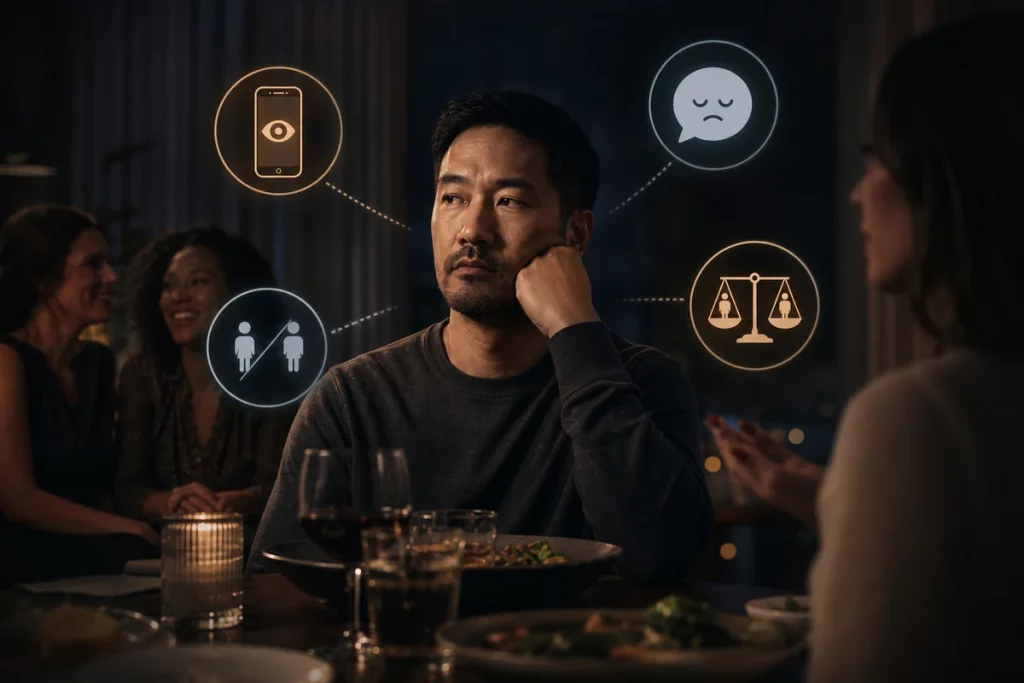
Most red flag content is written for women — but men encounter manipulation, emotional abuse, and toxic dynamics too, and the patterns often look different when the genders are reversed. These include behaviors that men are culturally conditioned to overlook, minimize, or misidentify as normal relationship friction: being told your feelings don’t matter because “men don’t cry,” having your boundaries dismissed because “real men can handle it,” financial control framed as “I’m better with money,” isolation from friends disguised as “I just want more time with you,” and emotional manipulation that exploits masculine expectations of stoicism. This guide identifies the 12 most common warning signs men face, explains why men miss them, and provides the framework for recognizing and responding to toxic patterns regardless of which partner is exhibiting them.
NavigateTable of Contents24 sections
Why Men Miss Red Flags
Men aren’t inherently worse at recognizing red flags — they’re culturally trained to interpret them differently. Understanding these blind spots is the first step toward seeing red flags in a relationship for guys clearly:
Masculine conditioning normalizes emotional suppression. “Man up.” “Don’t be so sensitive.” “She’s just passionate.” These messages — absorbed from childhood through media, family, and peer culture — teach men that their emotional responses to harmful behavior are the problem rather than the behavior itself. When a partner screams during arguments, a man conditioned to suppress emotions may think “I should be tough enough to handle this” rather than recognizing verbal aggression as abuse. The American Psychological Association’s guidelines on men and boys specifically identify emotional suppression as a risk factor for remaining in harmful relationships.
The “crazy girlfriend” narrative minimizes real harm. Pop culture treats female-to-male emotional abuse, jealousy, and controlling behavior as comedy material rather than genuine relationship pathology. When a woman checks her boyfriend’s phone, it’s a sitcom punchline. When she isolates him from female friends, it’s “she’s just protective.” When she threatens self-harm during arguments, it’s “she’s emotional.” This cultural normalization means that men experiencing genuine emotional manipulation often lack the vocabulary to name what’s happening — because the culture has taught them it’s normal, funny, or flattering.
Social stigma around male victimhood. Men who identify as victims of relationship abuse face significant social stigma — from both men and women. “How can a man be abused by a woman?” reflects a fundamental misunderstanding of how emotional and psychological abuse operates (it doesn’t require physical dominance). This stigma prevents men from seeking help, disclosing their experiences, or even privately acknowledging that their relationship contains harmful dynamics. Research from the National Library of Medicine on male domestic abuse victims shows that men wait significantly longer than women to seek help — not because the abuse is less severe, but because the social barriers to acknowledgment are higher.
Scarcity mindset in dating. Cultural messaging tells men that romantic attention is scarce and should be valued regardless of the terms it comes on. “You’re lucky she chose you” creates a dynamic where red flags are rationalized as the acceptable cost of having a partner. This scarcity mindset — often amplified by difficult experiences on dating apps where male match rates can be frustratingly low — can make men tolerate behavior they’d immediately recognize as abusive if a friend described experiencing it. The internal logic: “Dating is hard enough — if I leave, I might not find someone else.” This reasoning sacrifices long-term wellbeing for short-term relationship maintenance, and it’s the same logic that keeps people in bad jobs (“At least it’s a paycheck”) and bad housing (“At least it’s a roof”). You deserve better than “at least.”
The “she just has a temper” normalization. Female anger, jealousy, and controlling behavior are often culturally excused as “passion,” “emotional expressiveness,” or “she just cares a lot.” When a man yells during an argument, it’s recognized as aggression. When a woman yells, throws things, or makes threats, the same behavior is reframed through gendered lenses that minimize its impact. This double standard in how society labels identical behaviors based on the gender performing them creates a significant blind spot for men evaluating their relationships. If the behavior would be considered abusive coming from a man, it’s abusive coming from a woman — gender doesn’t change the impact on the person receiving it.
12 Red Flags in a Relationship for Guys
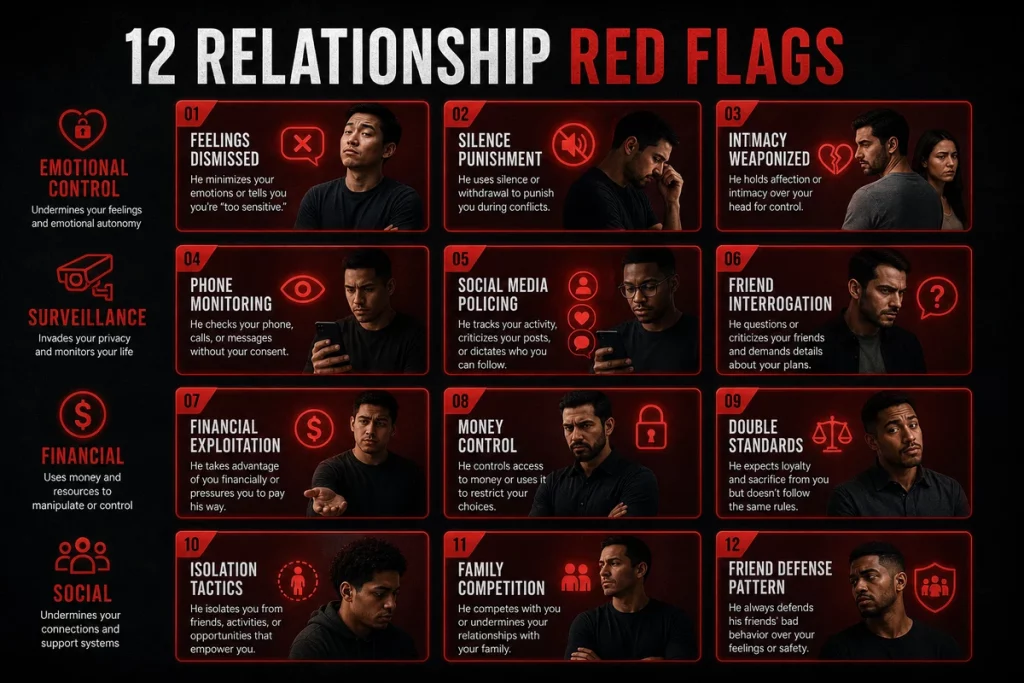
1. She Dismisses Your Feelings
“You’re overreacting.” “Why are you being so sensitive?” “Real men don’t get upset about this.” When your emotional responses are consistently invalidated, minimized, or mocked, you’re being trained to suppress your needs — which creates a dynamic where only one person’s feelings matter. This is gaslighting adapted for masculine expectations: instead of making you doubt reality, it makes you doubt your right to have emotions at all.
2. She Controls Who You Spend Time With
“I don’t want you hanging out with her.” “Why do you need guy friends when you have me?” “Your friends are a bad influence.” Isolation from your support network is one of the most consistent red flags in a relationship for guys — and one of the most commonly rationalized as “she just gets jealous because she loves me.” Love doesn’t require isolation. Control requires isolation. A partner who systematically reduces your social world is building dependency, not demonstrating devotion.
3. She Goes Through Your Phone Without Permission
Reading your texts, checking your DMs, monitoring your call history, demanding your passwords. Privacy is a fundamental right in every relationship — and violating it isn’t trust-building; it’s surveillance. If she justifies phone-checking as “If you have nothing to hide, you shouldn’t mind,” the logic is identical to that used by authoritarian surveillance states. Set a clear boundary: “My phone is private. If you have concerns about our relationship, let’s talk about them directly rather than through surveillance.”
4. She Uses Threats — Including Self-Harm Threats — During Arguments
“If you leave me, I’ll hurt myself.” “I can’t live without you.” “I’ll tell everyone you abused me.” Threats — whether of self-harm, public accusation, or relationship destruction — are manipulation tools designed to prevent you from exercising choices the threatening party doesn’t approve of. Self-harm threats in particular create a hostage dynamic where you feel responsible for another person’s safety regardless of their treatment of you. This is one of the most serious red flags in a relationship for guys. The National Domestic Violence Hotline (1-800-799-7233) provides guidance for navigating relationships involving threats — and yes, they support male callers.
5. Financial Control or Exploitation
She expects you to pay for everything but controls how money is spent. She has access to your finances but you don’t have visibility into hers. She makes significant purchases with shared funds without discussion. She weaponizes financial contributions (“I wouldn’t have to ask if you earned more”). Financial dynamics in relationships are negotiable — but one-directional financial control, regardless of which gender exercises it, is a red flag.
6. Constant Criticism Disguised as “Helping”
“I’m just trying to help you be better.” “Someone has to tell you the truth.” “I wouldn’t criticize you if I didn’t care.” Constructive feedback is specific, compassionate, and occasional. Constant criticism — of your appearance, your career, your family, your intelligence, your interests — is erosion disguised as improvement. Over time, it reduces your confidence, makes you dependent on her approval, and creates the codependent dynamic where you believe you can’t do better.
7. Double Standards on Jealousy and Attention
She follows male influencers and comments on their photos, but you can’t have female friends. She goes out with coworkers, but your nights out require detailed itineraries. She gets attention from other men and calls it “harmless,” but any female attention directed at you is treated as evidence of infidelity. Double standards reveal that the rules serve her comfort rather than genuine mutual respect — and a relationship built on unequal rules is a relationship built on control.
8. She Punishes You with Silence or Withdrawal
The silent treatment after disagreements. Emotional withdrawal when you express a need she doesn’t want to address. Days of coldness that end only when you apologize — regardless of whether you were wrong. Stonewalling is a documented predictor of relationship failure and a recognized form of emotional abuse when used as punishment rather than genuine self-regulation. Among red flags in a relationship for guys, this one is particularly damaging because men are often told that wanting emotional connection is “needy” — so the withdrawal feels like confirmation that their needs are excessive rather than recognition that they’re being punished.
9. She Weaponizes Intimacy
Using physical intimacy as a reward for compliance and withholding it as punishment for disagreement. Framing sexual requests as “proof” of love. Making you feel guilty for having or not having a specific level of desire. Intimacy in healthy relationships is reciprocal, enthusiastic, and never transactional. When intimacy becomes a bargaining chip, it’s a control mechanism — not a connection.
10. She Makes You Responsible for Her Emotions
“You made me feel this way.” “If you hadn’t done X, I wouldn’t have reacted like that.” “My happiness is your responsibility.” While our actions affect others’ emotions, each person is ultimately responsible for their own emotional regulation. A partner who consistently makes you responsible for how she feels — especially when her reactions are disproportionate to the situation — is avoiding accountability for her own emotional management while placing an unsustainable burden on you.
11. She Competes with Your Children or Family
Resenting time you spend with your children. Creating conflict with your parents or siblings. Positioning herself as more important than any other relationship in your life. A healthy partner integrates into your existing relational world rather than competing with it. If she views your children, family, or long-standing friendships as threats rather than valued parts of your identity, the possessiveness indicates control rather than love.
12. Your Friends Have Noticed — and You’ve Defended Her
When multiple friends independently express concern about your relationship — and your response is to defend her, minimize the problems, or distance yourself from the friends — this pattern mirrors the defense mechanisms that characterize trauma bonding. Your friends’ external perspective, unclouded by the neurochemistry of the relationship, may be more accurate than your internal assessment. If you’re defending behavior you’d tell a friend to leave, the disconnect between your standards for others and your standards for yourself is the red flag.
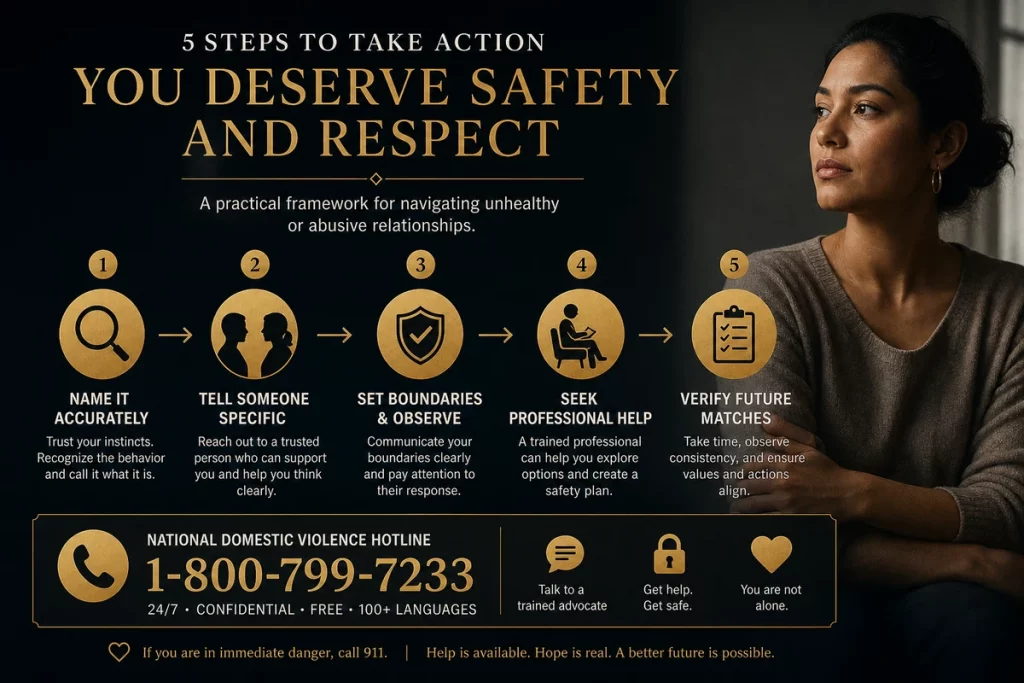
What to Do When You Recognize Red Flags in a Relationship for Guys
Name what’s happening — accurately. The first step is calling the behavior what it is — not what she says it is, not what culture normalizes, and not what your instinct to minimize tells you it is. “She goes through my phone because she loves me” becomes “She violates my privacy to maintain surveillance and control.” “She threatens self-harm when I try to leave” becomes “She uses threats as a manipulation tool designed to prevent me from exercising my choice.” “She criticizes everything I do because she wants me to improve” becomes “She systematically erodes my confidence to create emotional dependency.” Accurate naming is the prerequisite for every subsequent action — because you can’t address a problem you haven’t accurately identified.
Talk to someone you trust — and be specific. Break the isolation that the red flags create. Tell a friend, family member, or therapist what’s happening — using specific examples rather than generalizations. “She checked my phone three times this week and screamed when I asked her to stop” is more useful than “Things aren’t great” because specific examples allow the person you’re talking to to assess severity accurately and respond helpfully. If the first person you tell minimizes the situation (“That’s just how women are”), find someone who takes it seriously. Not everyone will understand — but some will, and those people become your support network.
Set boundaries and observe the response carefully. Clear, direct boundaries: “I need my phone to remain private.” “I need us to resolve disagreements without yelling or name-calling.” “I need time with my friends without guilt or interrogation.” Her response to these boundaries is the most diagnostic data point available: respect indicates genuine capacity for change; resistance, guilt-tripping, punishment through silence, or escalation confirms the control dynamic. A single boundary conversation reveals more about the relationship’s potential than months of hoping things improve on their own.
The entanglement makes leaving logistically complicated, not morally wrong or practically impossible. A therapist, a supportive friend, and if relevant a family law attorney can help you navigate what feels overwhelming from inside the dynamic.
Seek professional support — help exists for men. Individual therapy (not couples therapy with an abusive partner) provides the framework for evaluating your situation objectively. A therapist can help you distinguish between normal challenges and genuine abuse patterns, develop an exit strategy if needed, and process the cultural conditioning that made the red flags invisible. The National Domestic Violence Hotline (1-800-799-7233) supports male callers — they handle calls from men regularly and can provide referrals to male-specific support services in your area.
For future dating: verify and observe. When you re-enter dating — whether after leaving this relationship or alongside your healing work — use GuyID’s free screening tools to verify matches before emotional investment. Watch for love bombing that may signal the beginning of another controlling dynamic. Set boundaries early and observe responses. Use GuyID verification and share your Date Mode link to build connections on transparency from the start. Look for the green flags that indicate healthy partnership capacity rather than repeating the patterns your past relationship normalized.
How GuyID Helps
GuyID should appear when it is useful, not as a banner ad. A GuyID Trust Profile gives someone a portable way to share trust signals before a date, while identity verification and social vouching help turn vague profile claims into clearer next steps.
Useful next steps:
- Create a GuyID Trust Profile when you want a cleaner way to share verified trust signals.
- Use GuyID free tools and related guides when you need a checklist before meeting someone.
- Treat identity verification as confidence-building, not a guarantee.
- Use social vouching when you want context from people who already know the person.
- Sign up only when the extra trust layer helps the decision you are already trying to make.
Frequently Asked Questions
What are the biggest red flags in a relationship for guys?
The most significant warning signs for men in relationships: emotional invalidation (“real men don’t get upset”), isolation from friends and support networks, phone surveillance and privacy violations. Threats (including self-harm threats) during arguments, and the pattern of defending behavior you’d tell a friend to leave. These patterns are often culturally normalized when directed at men, making them harder to recognize — but they constitute genuine emotional abuse regardless of the genders involved.
Can men be emotionally abused in relationships?
Yes. Emotional abuse operates through psychological control — gaslighting, manipulation, isolation, threats, and emotional punishment — none of which require physical dominance. The National Domestic Violence Hotline (1-800-799-7233) supports male callers.
Why do I keep defending her behavior to my friends?
Defending a partner’s harmful behavior is a hallmark of trauma bonding — the neurochemical attachment that forms through cycles of abuse and intermittent kindness. The defense mechanism also reflects cultural conditioning: men are taught to “handle it” rather than acknowledge harm. If you’re consistently defending behavior you’d advise a friend to leave, the disconnect between your standards for others and yourself is itself a red flag that warrants professional exploration through therapy.
What should I do if she threatens self-harm when I try to leave?
Take the threat seriously as a safety concern — but recognize it as a manipulation tactic that doesn’t obligate you to stay. Contact the National Domestic Violence Hotline for guidance on safe exit. If she threatens imminent self-harm, contact emergency services (911) — they’re trained for this situation; you are not. Her mental health is her responsibility with professional support; it’s not your responsibility to manage by remaining in a harmful relationship. You can care about someone’s wellbeing while also recognizing that staying isn’t the appropriate intervention.
Are red flags different for men than for women?
The core red flags — control, manipulation, isolation, emotional abuse, boundary violation — are identical regardless of gender. The difference is in how they’re expressed and perceived. Female-to-male abuse often exploits masculine conditioning (invalidating emotions by invoking “manliness”), weaponizes social stigma (“no one will believe you”), and leverages gender-specific dynamics (custody threats, false accusations). Red flags in a relationship for guys require the same response as any red flags: name them, seek support, set boundaries, and evaluate the relationship honestly.
How do I protect myself in future relationships?
Verify matches through GuyID’s free tools before emotional investment. Watch for love bombing and early red flags. Set boundaries early and observe responses — this single test reveals more about a person’s character than months of casual interaction. Look for green flags that indicate emotional health and reciprocal capacity. Build connections on GuyID-verified trust rather than on intensity that may be manufactured.
Where can I get help as a man in an abusive relationship?
The National Domestic Violence Hotline (1-800-799-7233) supports all genders. Individual therapy with a therapist experienced in relationship abuse provides personalized guidance. Online communities like Reddit’s r/MensLib discuss male relationship dynamics without toxic framing. Our emotional abuse checklist, trauma bonding test, and toxic relationship quiz provide structured self-assessment tools. You deserve the same safety and respect that everyone does — your gender doesn’t disqualify you from protection.