Free Tools
Catfish Probability Detector
Check whether a dating profile has suspicious identity or photo signals.
Dating Bio Red Flag Detector
Review a bio for scam, pressure, or trust-warning language.
Dating Safety Checklist
Use free GuyID tools before moving from chat to a real date.
Next step
Create your GuyID trust profile
Share consent-based trust signals before a date without turning the conversation into an interrogation.
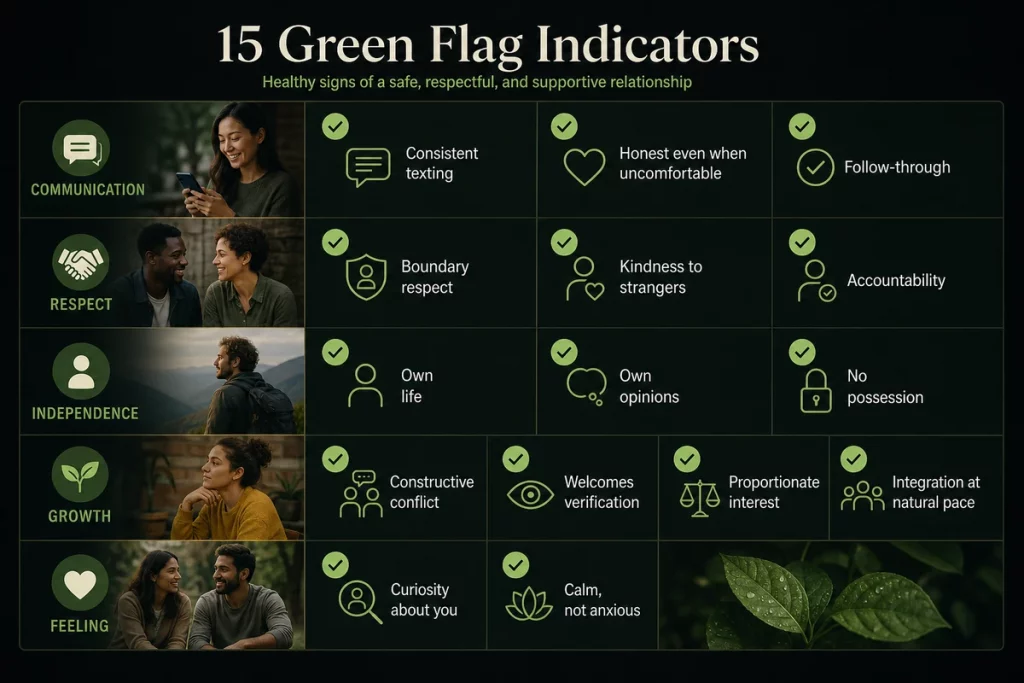
You’ve learned the red flags — now it’s time to learn what you should actively be looking FOR, not just what you should be running from or screening against. Green flags in dating are the positive behavioral indicators that a person is emotionally healthy, relationally capable, genuinely interested, and capable of building a sustainable, respectful relationship. While the internet is saturated with red flag content (including our own comprehensive red flags guide), the green flag conversation is equally important — because knowing what healthy looks like prevents two common mistakes: rejecting good people because they don’t produce the familiar anxiety that love bombing or avoidant dynamics create, and staying in mediocre connections because nothing is technically “wrong” even though nothing is genuinely right. This guide identifies 15 specific green flags in dating that predict healthy, lasting relationships — backed by relationship science and the patterns that therapists consistently see in their happiest couples.
NavigateTable of Contents29 sections
Why Green Flags in Dating Matter More Than Red Flags
Red flag awareness is essential — but it produces a detection mindset rather than a selection mindset. You know what to avoid, but do you know what to choose? Research from the American Psychological Association on relationship formation shows that people who can articulate what they’re looking for (positive selection criteria) form more satisfying relationships than people who can only articulate what they’re avoiding (negative filtering criteria). Both matter — but green flag literacy is the piece most often missing from modern dating education, which focuses almost exclusively on warning signs.
The imbalance is understandable: red flags have immediate, dramatic consequences (scams, abuse, manipulation), so they generate more content, more clicks, and more urgency. But the absence of red flags doesn’t equal the presence of a good relationship. A connection can be completely free of every documented red flag and still be mediocre, unfulfilling, or simply wrong for you — because “nothing is technically wrong” is a very different assessment than “this person actively brings qualities I value.” Green flags in dating shift the evaluation from “is this person safe?” (the minimum) to “is this person someone I’d choose even if I had unlimited options?” (the standard that produces genuine satisfaction).
Green flags in dating also solve a specific problem for people recovering from toxic relationships: the “boring = healthy” confusion. After experiencing the neurochemical intensity of love bombing, trauma bonding, or breadcrumbing, a genuinely healthy partner can feel “boring” because they don’t trigger the hypervigilant monitoring system. Green flag awareness recalibrates your emotional compass: what feels calm isn’t boring — it’s what safety actually feels like. And recognizing that safety in real-time, while it’s happening, prevents you from walking away from the healthiest connection you’ve ever had because it didn’t produce the adrenaline you’d confused with love.
15 Green Flags in Dating
1. Consistent Communication Without Games
They text at a steady, natural frequency. They don’t manufacture anxiety through strategic silence or overwhelm through constant messaging. Their communication reflects genuine interest expressed at a sustainable pace — not breadcrumbing (too little) or love bombing (too much). Consistency is the single most reliable green flag because it’s the hardest to fake over time. Anyone can perform intense interest for two weeks. Consistent, proportionate interest over months reveals genuine character.
2. They Respect Your Boundaries Without Guilt-Tripping
“I can’t hang out this weekend.” “No problem — next week?” That’s it. No guilt. No “But I cleared my whole schedule.” No pouting or silent treatment. A person who respects your boundaries without making you feel bad about having them demonstrates the emotional maturity that healthy relationships require. This green flag is particularly important for people with anxious attachment — because anxious daters often mistake boundary-pushing intensity for devotion.
3. They Ask Questions and Remember the Answers
They remember that your sister’s name is Sarah, that you’re nervous about the presentation on Thursday, and that you don’t like cilantro. This isn’t superhuman memory — it’s genuine interest expressed through attention. When someone listens closely enough to reference previous conversations naturally, they’re demonstrating that you matter to them as a specific person, not as a generic dating partner filling a role.
4. They Have Their Own Life and Encourage Yours
They have friends, hobbies, goals, and a routine that exists independently of you — and they support yours. They don’t compete with your friendships, guilt you for having plans, or require your constant presence to feel secure. This maintained independence isn’t emotional coldness or disinterest; it’s the foundation of a relationship between two complete people rather than two half-people trying to become whole through each other. The National Library of Medicine research on relationship longevity consistently identifies maintained individual identity as a predictor of long-term satisfaction.
5. They’re Honest Even When It’s Uncomfortable
“I should be upfront — I’m also seeing one other person right now.” “I have to tell you, I’m not sure I’m ready for something serious yet.” Honesty that risks your disappointment demonstrates courage, respect, and the kind of integrity that manipulators — who tell you whatever maintains your investment — can’t replicate. The willingness to be uncomfortable in service of truth is one of the most powerful green flags in dating because it reveals character under pressure.
6. They Take Accountability Without Excessive Self-Flagellation
Clean accountability — acknowledging the mistake, apologizing genuinely, and adjusting behavior going forward — is rare and extremely valuable. It signals emotional regulation, self-awareness, and the capacity for growth that relationships require.
7. They Introduce You to Their Life at a Comfortable Pace
Healthy integration usually happens neither immediately nor after indefinite delay. Over weeks and months, they naturally integrate you: meeting friends, mentioning you to family, and including you in social activities. This gradual integration can reflect confidence in the connection. See our committed relationship vs dating guide for how integration can signal the transition from casual to committed.
8. They Handle Conflict Constructively
Disagreements happen — and how someone handles them reveals significantly more about their character than how they handle the good times. They don’t stonewall, name-call, threaten, or use the gaslighting tactics that characterize unhealthy conflict patterns.
9. They’re Kind to People Who Can’t Do Anything for Them
How they treat servers, drivers, customer service workers, and strangers offers useful evidence about their default behavior. Consistent kindness to people with no power to benefit them is a meaningful character indicator because sustained behavior across contexts is harder to perform strategically. Charm toward you combined with rudeness toward service workers deserves closer attention.
10. They Follow Through on What They Say
“I’ll call you tomorrow” — and they do. “Let’s go to that restaurant this weekend” — and it happens. Words backed by action, consistently, over time. This is the behavioral manifestation of reliability — and it’s the foundation of trust. In a dating landscape where plans evaporate and promises are decorative, a person who does what they say they’ll do is a genuinely rare, valuable, and deeply reassuring find.
11. They Express Interest Proportionate to the Timeline
After two dates: “I’m really enjoying getting to know you.” After two months: “I’d like us to be exclusive.” The intensity matches the investment — not rushing ahead (love bombing) or lagging behind (avoidant distancing). This proportionate expression of interest is the behavioral opposite of the disproportionate intensity that love bombing red flags produce.
12. They Welcome Verification and Transparency
When you suggest a video call before meeting, they say “Great idea.” When you mention GuyID verification, they’re interested rather than defensive. When you want to take things at a measured pace, they respect it. People with nothing to hide welcome transparency — and a positive response to verification requests is a green flag that simultaneously confirms identity and reveals character. Use GuyID’s free screening tools and share your Date Mode link — the response is diagnostic.
13. They Have Healthy Relationships with Friends and Family
Close, maintained friendships and respectful family relationships (even if complicated) indicate the capacity for sustained, healthy connection. A person with zero close friendships may struggle with the relational skills that partnership requires. A person who speaks about all their exes with contempt may eventually speak about you the same way. The pattern of their OTHER relationships predicts the pattern of yours.
14. They’re Curious About You Rather Than Performing for You
They ask genuine questions. They want to know your opinions, your experiences, your perspective — not just to appear interested, but because they’re genuinely curious about who you are as a person. This genuine curiosity manifests in observable ways: remembering specific details, following up on things you’ve mentioned, asking “why” questions that dig deeper than surface-level, and demonstrating consistent interest in your inner world rather than just your carefully curated external presentation.
15. You Feel Calm, Not Anxious
The most important green flag is internal: how do you FEEL in their presence and between interactions? Green flag connections produce predominantly calm, secure, comfortable feelings. You’re not checking your phone obsessively. You’re not analyzing every text. You’re not wondering “do they still like me?” The absence of anxiety isn’t the absence of excitement — it’s the presence of safety. For people accustomed to anxious, high-intensity dynamics, this calm may initially feel unfamiliar. Sit with it. What you’re experiencing is what healthy love actually feels like.
Green Flags vs. Love Bombing: The Critical Distinction
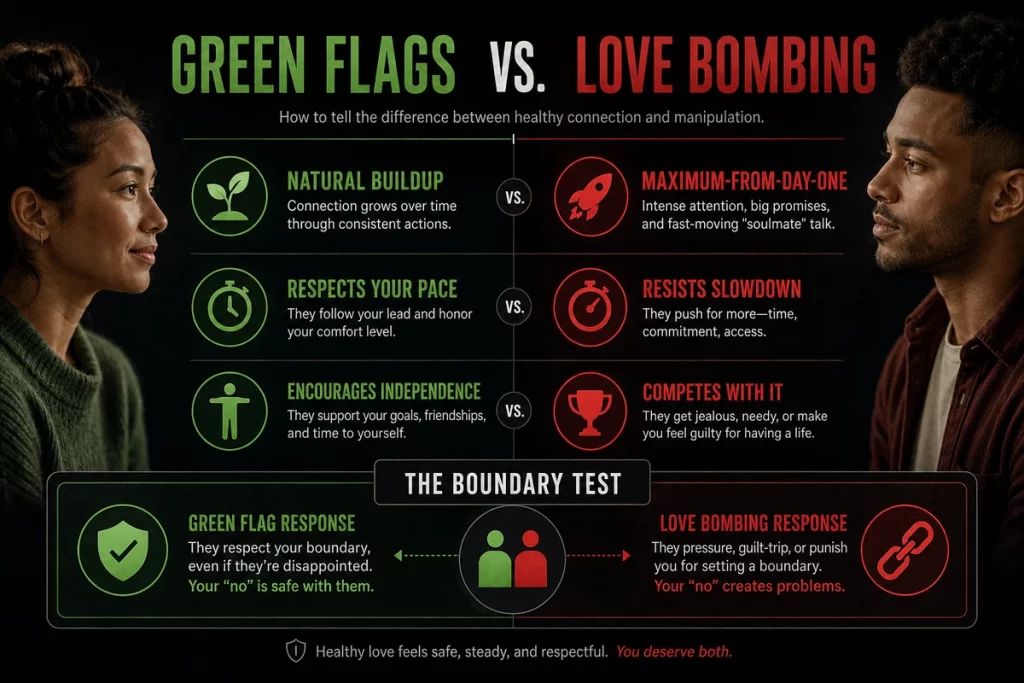
Some green flags in dating — enthusiasm, generosity, future planning — overlap with love bombing behaviors. The distinction:
| Green Flag | Love Bombing |
|---|---|
| Interest builds naturally over time | Maximum intensity from day one |
| Respects your pace when you communicate it | Resists, guilt-trips, or escalates when you slow down |
| Encourages your independence | Competes with your other relationships and commitments |
| Has their own opinions that sometimes differ from yours | Mirrors everything — suspiciously perfect compatibility |
| Actions consistently match words over months | Words escalate rapidly while actions may not follow |
| You feel calm and secure | You feel exhilarated but anxious |
| Welcomes verification | May resist accountability measures |
The single most reliable differentiator: set a boundary and observe the response. A green flag partner respects it. A love bomber resists it. This test works every time because genuine interest can accommodate your pace while manipulative interest requires your compliance. Apply the 7 love bombing tests to any connection that feels intensely positive — because the best outcome is confirming that the intensity is genuine rather than discovering it’s manufactured after emotional investment makes clear thinking harder.
How to Cultivate Green Flags in Yourself
Attracting green flag partners requires being one yourself — and the good news is that every green flag in dating can be developed through intentional practice:
Communicate consistently. Respond within reasonable timeframes. Follow through on plans. Express interest proportionately. Be the kind of communicator you’d want to date — not playing games, not manufacturing scarcity, not testing the other person’s investment through strategic silence. The National Domestic Violence Hotline identifies consistent, honest communication as the foundation of all healthy relationship dynamics — it’s the behavioral infrastructure that everything else builds on.
Develop emotional regulation. The ability to experience intense emotions without acting destructively on them is the foundation of healthy relationships. Therapy, mindfulness, and self-awareness practices build the emotional regulation capacity that green flag partners demonstrate naturally. If your conflict style involves yelling, stonewalling, name-calling, or punishment — these are specific areas for growth that therapy specifically and effectively addresses. Emotional regulation isn’t about suppressing feelings; it’s about choosing how you respond to them rather than letting them choose for you.
Maintain your independent identity. Hobbies, friendships, goals, and routines that exist independently of any romantic relationship make you a more interesting, more emotionally stable, and more attractive partner. Codependent patterns — where your identity collapses into the relationship until you can’t distinguish your needs from your partner’s — produce the suffocating dynamics that healthy, emotionally aware people instinctively avoid. A full life makes you attractive because it demonstrates that you’re choosing to share your life with someone rather than needing someone to give your life meaning.
Do your own inner work. Process your past relationships, understand your attachment style, identify the patterns that have led to unhealthy dynamics in the past, and address them through therapy, self-help resources, or both. The most common reason people can’t recognize green flags in dating is that their own unresolved patterns make healthy behavior feel threatening, boring, or insufficient. A person who has done their inner work attracts people who have done theirs — creating the foundation for a genuinely healthy dynamic rather than two unhealed people unconsciously recreating their childhood wounds.
Welcome transparency and accountability. Build your GuyID Trust Profile, verify your identity willingly, and embrace the accountability that genuine connection requires. Being the person who suggests verification rather than the person who resists it immediately distinguishes you from the vast majority of dating profiles — and attracts partners who share your value for honesty, transparency, and building connections on confirmed identity rather than manufactured personas. Green flags in dating start with being genuinely, verifiably yourself.
How GuyID Helps
GuyID should appear when it is useful, not as a banner ad. A GuyID Trust Profile gives someone a portable way to share trust signals before a date, while identity verification and social vouching help turn vague profile claims into clearer next steps.
Useful next steps:
- Create a GuyID Trust Profile when you want a cleaner way to share verified trust signals.
- Use GuyID free tools and related guides when you need a checklist before meeting someone.
- Treat identity verification as confidence-building, not a guarantee.
- Use social vouching when you want context from people who already know the person.
- Sign up only when the extra trust layer helps the decision you are already trying to make.
Frequently Asked Questions
What are green flags in dating?
Green flags in dating are positive behavioral indicators that a person is emotionally healthy, genuinely interested, and capable of building a respectful, sustainable relationship. They include: consistent communication, boundary respect, follow-through on commitments, proportionate interest, emotional regulation, maintained independence, constructive conflict handling, and the overall feeling of calm security in their presence. Green flags predict relationship quality the way red flags predict relationship problems — both deserve equal attention in your dating education and practice.
How do I tell the difference between green flags and love bombing?
Set a boundary. A green flag partner respects it gracefully. A love bomber resists, guilt-trips, or escalates. Additional distinctions: green flags build naturally over time while love bombing peaks immediately; green flag partners encourage your independence while love bombers compete with it; green flags produce calm while love bombing produces anxious exhilaration. See the love bombing test for the complete 7-test framework.
Why do green flags feel boring after toxic relationships?
Because your nervous system was calibrated by toxic dynamics to equate intensity with love and anxiety with attraction. A healthy partner’s consistent, calm presence doesn’t trigger the hypervigilant monitoring system that trauma bonding or love bombing trained — so the absence of activation feels like absence of connection. It’s not boredom; it’s safety. Staying through the initial “boring” phase and noticing whether genuine appreciation develops is one of the most important skills in post-toxic dating recovery.
What’s the most important green flag in dating?
Consistency — because it’s the hardest to fake over time. Anyone can perform impressive behavior for a few dates. Consistent communication, consistent follow-through, consistent kindness, consistent boundary respect, and consistent character across months reveal who someone genuinely is rather than who they’re performing as during the impression-management phase of early dating.
Can someone show green flags and still be wrong for me?
Yes. Green flags in dating indicate emotional health and relationship capability — but compatibility requires more than mutual health. Value alignment, lifestyle compatibility, physical attraction, timing, and life-goal convergence all matter alongside green flags. A person can be emotionally healthy, communicatively excellent, and genuinely kind — and still not be right for you specifically. Green flags tell you the person is capable of a good relationship. Compatibility assessment tells you whether that good relationship would be with you.
How do I become a green flag partner myself?
Develop emotional regulation through therapy or mindfulness practices. Communicate consistently and honestly. Maintain your independent identity (hobbies, friendships, goals). Follow through on commitments. Handle conflict constructively. Welcome transparency — build your GuyID Trust Profile and embrace verification as a positive relationship practice rather than a suspicious one. The green flags you want to see in others should be present in yourself first.
Should I verify matches who show green flags?
Yes — verification and green flags aren’t contradictory; they’re complementary. A genuinely green flag person WELCOMES verification (green flag #12 on this list) because they have nothing to hide. Use GuyID’s free tools for reverse image search, catfish detection, and identity verification — and notice that a green flag match’s response to verification is itself a green flag. Verification doesn’t signal distrust; it signals that you value the connection enough to build it on confirmed rather than assumed identity.