
Reader Briefing
Reader Briefing
Start here if you need a practical read on anxious attachment style symptoms: 14 signs: who should use verification, what signals to check, and what to do before moving from online interest to an in-person plan.
Who this is for
- People meeting someone from a dating app or social platform.
- Readers preparing for a first in-person date.
- Anyone checking identity, profile consistency, and trust signals.
- People trying to avoid romance scams, fake profiles, or pressure tactics.
You’ll learn
- How to evaluate identity signals without treating any single check as certainty.
- Which trust signals matter and how to weigh them together.
- How to spot inconsistencies, pressure, or behavior patterns that deserve caution.
- How to move from online conversation to a safer first meeting.
- Where GuyID tools fit into a quick pre-date screening workflow.
- When to slow down, ask for more context, or walk away.
Bottom line
Verification reduces uncertainty; it does not guarantee future behavior. Use a layered approach: confirm identity signals, compare profile consistency, ask for a short video call, keep early plans public, and slow down when someone pressures you to skip normal safety steps.
Key takeaways
- Identity verification improves confidence, not certainty.
- Patterns matter more than isolated incidents.
- Verify before meeting privately or sharing sensitive details.
- A short video call can reveal many inconsistencies.
- Pressure to skip reasonable safety steps is useful information.
Free Tools
Catfish Probability Detector
Check whether a dating profile has suspicious identity or photo signals.
Dating Bio Red Flag Detector
Review a bio for scam, pressure, or trust-warning language.
Dating Safety Checklist
Use free GuyID tools before moving from chat to a real date.
Next step
Create your GuyID trust profile
Share consent-based trust signals before a date without turning the conversation into an interrogation.
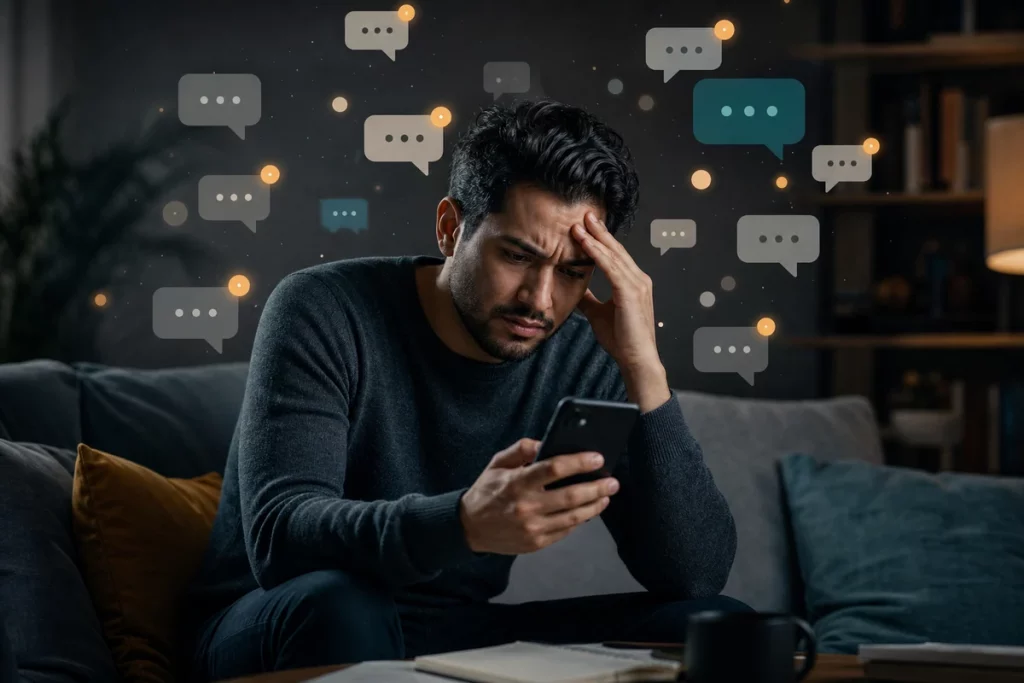
You check your phone constantly for their reply. A delayed response triggers a spiral of worst-case scenarios. You replay conversations looking for hidden meaning. You need reassurance that they still care — frequently, repeatedly, despite believing them each time. If this sounds familiar, you’re likely experiencing anxious attachment style symptoms — a deeply ingrained relational pattern that shapes how you bond, how you communicate, and how you experience love. This comprehensive guide identifies 14 specific symptoms, explains the science behind why anxious attachment develops, maps how it shows up in dating and relationships, and provides the evidence-based strategies that create lasting change.
NavigateTable of Contents35 sections
What Is Anxious Attachment Style?
Attachment theory — originally developed by psychologist John Bowlby and expanded by Mary Ainsworth — identifies four primary attachment styles that form in childhood and influence how adults experience romantic relationships: secure, anxious (also called anxious-preoccupied), avoidant (dismissive-avoidant), and fearful-avoidant (disorganized). Anxious attachment is characterized by a deep fear of abandonment, a heightened sensitivity to relationship threats, and a persistent need for reassurance and closeness.
Research from the National Library of Medicine estimates that approximately 20-25% of adults have an anxious attachment style. These individuals are not “clingy” or “needy” by choice — they’re operating from a nervous system that was wired in childhood to treat relationship uncertainty as a survival-level threat. The anxious attachment style symptoms described in this guide aren’t character flaws; they’re predictable responses from a nervous system that learned early that love is unreliable and must be constantly monitored to prevent its withdrawal.
Understanding your attachment style is transformative because it reframes lifelong patterns from “something wrong with me” to “a predictable response to my early environment that I can now consciously modify.” The American Psychological Association confirms that attachment styles, while deeply rooted, are not permanent — earned secure attachment through therapeutic work and healthy relationship experiences is well-documented and achievable.
14 Anxious Attachment Style Symptoms

Hypervigilance Symptoms (1-4)
1. Constant Monitoring of Communication Patterns
You track response times compulsively. “They usually reply in 20 minutes — it’s been 45.” You notice when their texting pattern changes, when they stop using emojis, when their messages get shorter. You check “last seen” timestamps on WhatsApp and “active now” indicators on Instagram. This surveillance isn’t about control — it’s about threat detection. Your nervous system uses communication patterns as data to predict whether the relationship is safe, and any deviation from the established pattern triggers an anxiety cascade.
2. Interpreting Ambiguity as Rejection
A neutral text becomes evidence of disinterest. “Sounds good” instead of “Sounds great!” means they’re pulling away. A cancelled plan — even with a legitimate reason — triggers abandonment panic. Among anxious attachment style symptoms, this negativity bias is one of the most distinctive: your brain defaulting to the worst possible interpretation of ambiguous social information. A securely attached person reads “Can’t make it tonight, sorry!” as a scheduling conflict. An anxiously attached person reads it as the beginning of the end.
3. Replaying Conversations for Hidden Meaning
After a phone call, date, or text exchange, you mentally replay it — analyzing tone, word choice, pauses, and implications. “What did they mean when they said ‘we’ll see’? Why did they hesitate before saying they had fun? Did they sound less enthusiastic than last time?” This post-interaction analysis is your nervous system’s attempt to extract certainty from inherently uncertain social data. It rarely produces useful insight and consistently produces anxiety.
4. Physical Anxiety When They’re Unavailable
When your partner or dating interest is unreachable — phone off, traveling, busy with work, out with friends — you experience physical symptoms: chest tightness, restlessness, inability to concentrate, stomach discomfort, or a buzzing nervous energy that won’t settle. These aren’t “overreactions” — they’re genuine stress responses from a nervous system that interprets unavailability as potential abandonment. The physical symptoms of anxious attachment style are as real as the physical symptoms of any anxiety condition.
Reassurance-Seeking Symptoms (5-8)
5. Needing Frequent Verbal Confirmation
“Do you still like me?” “Are we okay?” “You’re not going to leave, right?” “Do you think about me when we’re not together?” The need for explicit verbal reassurance — not just once, but repeatedly — is one of the most recognized anxious attachment style symptoms. Each reassurance provides temporary relief, but the relief fades quickly because the underlying belief (“love is unreliable and could be withdrawn at any moment”) remains unaddressed. The reassurance cycle is a symptom, not a solution.
6. Testing the Relationship
Creating situations that force your partner to demonstrate their commitment: picking a fight to see if they’ll stay, withdrawing to see if they’ll pursue, mentioning other romantic interest to gauge jealousy, or threatening to leave to see if they’ll fight for you. These “tests” are unconscious strategies for generating the reassurance that verbal confirmation doesn’t permanently provide. The problem: tests that succeed provide temporary relief, but tests that fail (because the partner doesn’t respond as hoped) create the very rejection scenario your nervous system fears most.
7. Difficulty Trusting Reassurance When Given
They tell you they love you. You believe them — for 20 minutes. Then the doubt returns. “Do they really mean it? How can I be sure? What if they change their mind?” This inability to internalize reassurance is a core anxious attachment symptom. It’s not that you don’t believe the words; it’s that your nervous system doesn’t store reassurance as permanent data. Each instance is treated as a momentary state rather than an established fact — requiring constant renewal to maintain its calming effect.
8. People-Pleasing to Maintain Connection
Suppressing your own opinions, preferences, and needs to align with your partner’s. Agreeing when you disagree. Accommodating when you’d rather not. Performing the version of yourself you believe they want rather than being authentically who you are. This people-pleasing isn’t about generosity — it’s about security. The anxious attachment logic: if I’m exactly what they want, they won’t leave. The cost: you lose yourself in the process of trying to keep them, and the relationship is built on a performance rather than genuine connection.
Emotional Reactivity Symptoms (9-11)
9. Intense Emotional Responses to Minor Relationship Events
They didn’t text good morning and you’re devastated. They mentioned an attractive coworker and you’re consumed by jealousy. They want a night alone and you feel rejected to your core. The emotional response is disproportionate to the event because the event isn’t being processed at face value — it’s being filtered through the anxious attachment lens that amplifies every signal into a threat. Minor relationship fluctuations feel like earthquakes because your nervous system treats them as evidence that abandonment is approaching.
10. Difficulty Self-Soothing During Relationship Stress
When relationship anxiety activates, you can’t calm yourself down independently. You need to hear from them, see them, or receive reassurance before the anxiety subsides. The inability to self-regulate during relational stress is one of the anxious attachment style symptoms with the deepest roots — it reflects a childhood where emotional regulation was dependent on the caregiver’s response rather than developing internally. As an adult, your partner has inherited the role of external regulator.
11. Fear of Expressing Needs Leading to Resentment
You need more quality time but don’t ask because you fear being perceived as demanding. You want more affection but stay silent because you fear being “too much.” The unmet needs accumulate into resentment — which eventually erupts in ways that confuse your partner (“Where is this coming from?”) and confirm your fear that expressing needs damages relationships. This suppress-resent-explode cycle is among the most self-defeating anxious attachment style symptoms because it creates the very conflict you were trying to avoid.
Relationship Pattern Symptoms (12-14)
12. Attraction to Emotionally Unavailable Partners
A pattern across multiple relationships: you’re drawn to people who are distant, inconsistent, or emotionally unavailable. The hot-cold dynamic that secure people find exhausting feels like intense chemistry to the anxiously attached person — because the uncertainty activates the same hypervigilant monitoring system that was wired in childhood. Avoidant partners create the maximum anxiety-attachment activation, which is neurochemically intense and easily mistaken for passion. The anxious-avoidant pairing is the most common dysfunctional relationship pattern in attachment research.
13. Moving Too Fast in New Relationships
Falling hard immediately. Wanting exclusivity after a few dates. Fantasizing about the future before knowing the person. The urgency comes from the anxious attachment system’s need to resolve uncertainty as quickly as possible — the ambiguity of early dating is acutely uncomfortable because it leaves the question “are they going to stay?” unresolved. By accelerating the relationship, you’re attempting to skip the uncertainty phase and arrive at the security of commitment. The problem: genuine compatibility can only be evaluated at the pace of reality, not at the pace of your anxiety.
14. Losing Yourself in Relationships
Your hobbies fade. Your friendships diminish. Your goals take a backseat. Your identity becomes organized around the relationship — you think about them constantly, plan your life around their availability, and measure your day’s quality by the state of the relationship. This identity merger is the culmination of multiple anxious attachment style symptoms: the hypervigilance narrows your focus, the people-pleasing reshapes your behavior, and the fear of abandonment makes the relationship feel too important to risk by maintaining independence. The result is a version of you that exists primarily in relation to another person rather than as a complete individual.
Where Anxious Attachment Comes From
Anxious attachment develops in childhood when caregiving is inconsistent — present and attentive sometimes, absent or unresponsive other times. The child learns:
Love is available but unreliable. The caregiver sometimes meets needs and sometimes doesn’t — creating a child who can’t predict when comfort will be available. The adaptive response: constant monitoring. If you watch closely enough, maybe you can predict the pattern and time your needs to the caregiver’s available moments. This monitoring system persists into adulthood as the hypervigilance described in symptoms 1-4.
Expressing distress increases attention. When the child amplifies emotional signals — crying louder, being more dramatic, escalating — the inconsistent caregiver is more likely to respond. This teaches the child that emotional intensity is the tool for securing attachment. In adult relationships, this manifests as the emotional reactivity described in symptoms 9-11: amplified responses to minor events because the nervous system learned that subtle signals get ignored.
Your worth depends on others’ responses. Because the caregiver’s attention was inconsistent, the child never develops a stable internal sense of worth. Self-esteem becomes externally sourced — dependent on the caregiver’s (and later, the partner’s) moment-to-moment responsiveness. This creates the reassurance-seeking pattern in symptoms 5-8: your self-worth requires constant external validation because it was never internalized as a stable foundation.
Common childhood environments that produce anxious attachment: A parent who was sometimes nurturing and sometimes emotionally unavailable (due to depression, stress, their own attachment issues, or competing demands). A parent who was physically present but emotionally inconsistent. A household where the child learned to “earn” attention through performance, helpfulness, or emotional caretaking. Parental divorce or separation that created uncertainty about availability. Note: the parent doesn’t need to be abusive — inconsistency alone is sufficient to wire the anxious attachment system.
How Anxious Attachment Affects Dating
Anxious attachment style symptoms are most visible and most disruptive in the dating context — particularly in early-stage dating when uncertainty is highest:
The dating app experience is especially activating. Dating apps create maximum uncertainty: matches can disappear without explanation, conversations can stop mid-flow, and the abundance of options makes every connection feel replaceable. For anxiously attached people, the dating app environment is a constant trigger — every unread message, every slow reply, every match that doesn’t convert to a date activates the abandonment detection system. This is why learning to recognize dating app red flags from a grounded perspective (rather than an anxious one) is especially important.
Early dating is the hardest phase. The first weeks of a new connection — before exclusivity, before commitment, before “I love you” — are when anxious attachment symptoms peak because the relationship’s stability is genuinely uncertain. The challenge: anxious behaviors during this phase (excessive texting, premature exclusivity pressure, emotional intensity) can push away partners who might otherwise be compatible. Learning to tolerate early-dating uncertainty without acting on every anxious impulse is one of the most valuable skills for anxiously attached daters.
Verification reduces anxiety constructively. Rather than monitoring WhatsApp timestamps or analyzing text tone, channel verification needs into productive tools: reverse image search confirms photos are real, phone verification confirms identity consistency, and GuyID verification provides definitive identity confirmation. These actions address legitimate safety questions rather than anxiety-driven surveillance — and completing them can actually reduce anxious monitoring because you’ve addressed the factual uncertainty that contributes to (though doesn’t fully explain) the anxiety.
Anxious vs. Avoidant vs. Secure Attachment
| Dimension | Anxious | Avoidant | Secure |
|---|---|---|---|
| Core fear | Abandonment — “They’ll leave me” | Engulfment — “They’ll control me” | Neither — trusts the relationship’s stability |
| Response to conflict | Pursue — escalate to get attention | Withdraw — shut down to maintain space | Engage — address directly and collaboratively |
| Self-worth source | External — partner’s responsiveness | Internal — but defended, not flexible | Internal — stable and flexible |
| Need expression | Amplified or suppressed (both extremes) | Minimized — “I don’t need anyone” | Direct, proportionate, and clear |
| Response to partner’s distress | Over-involved — your pain becomes mine | Withdrawn — uncomfortable with emotion | Present — supportive without losing self |
| Relationship pace preference | Fast — urgency to resolve uncertainty | Slow — resists commitment and closeness | Natural — comfortable at any pace |
The anxious-avoidant trap: anxiously attached people are most intensely attracted to avoidant partners — because the avoidant’s emotional distance activates the anxious system at maximum intensity, which feels like passionate chemistry. The avoidant’s withdrawal triggers the anxious person’s pursuit, which triggers the avoidant’s further withdrawal, creating a self-reinforcing cycle that both partners experience as “intense connection.” Understanding this pattern is essential for breaking it — healthy relationships shouldn’t require constant activation of your threat-detection system to feel engaging.
How to Heal Anxious Attachment
Anxious attachment style symptoms are deeply rooted but absolutely changeable. “Earned secure attachment” — security developed through conscious work rather than childhood wiring — is well-documented in research:
Therapy is the most effective intervention. A therapist experienced in attachment theory — particularly one trained in Emotionally Focused Therapy (EFT) as developed by Dr. Sue Johnson — can help you identify the childhood origins of your pattern, develop internal self-regulation skills (so you can soothe your own anxiety rather than requiring your partner to do it), and gradually build the internal model of relationship security that inconsistent childhood caregiving didn’t provide. Effective modalities include attachment-focused therapy, EMDR for processing early relational trauma, and schema therapy for modifying core beliefs about relationships.
Name the pattern in real time. When anxiety activates — “They haven’t texted in two hours, something must be wrong” — practice labeling: “This is my anxious attachment activation. This is my nervous system, not reality. The most likely explanation is that they’re busy.” Naming the pattern creates a gap between the trigger and the response, allowing you to choose a different action than the one your anxiety is demanding (don’t send the double text, don’t check their social media, don’t start composing a confrontational message).
Develop self-soothing skills. Breathwork, grounding exercises, journaling, physical exercise, and meditation build internal regulation capacity. The goal isn’t to eliminate anxiety — that’s unrealistic — but to develop the ability to experience relationship anxiety without acting on it destructively. Each time you feel the pull to seek reassurance and instead self-soothe successfully, you’re literally rewiring the neural pathways that drive anxious attachment style symptoms.
Choose secure partners deliberately. Stop confusing anxious activation with chemistry. A partner who triggers your anxiety isn’t creating “passion” — they’re activating your wound. Seek partners who are consistently responsive, emotionally available, and comfortable with both closeness and independence. These partners may feel “boring” initially because they don’t trigger the hypervigilant monitoring system — but that calm is what secure attachment actually feels like. It’s not boring; it’s safe.
Build verification habits instead of monitoring habits. Replace anxious surveillance (checking their online status, analyzing their posting patterns, tracking their location) with productive verification: reverse image search, GuyID identity verification, video calls, and direct communication about where things stand. Verification answers legitimate questions; monitoring feeds anxiety without resolving it. Use GuyID’s free tools to address factual uncertainty, then practice sitting with the remaining emotional uncertainty through the self-soothing skills above.

How GuyID Helps
GuyID should appear when it is useful, not as a banner ad. A GuyID Trust Profile gives someone a portable way to share trust signals before a date, while identity verification and social vouching help turn vague profile claims into clearer next steps.
Useful next steps:
- Create a GuyID Trust Profile when you want a cleaner way to share verified trust signals.
- Use GuyID free tools and related guides when you need a checklist before meeting someone.
- Treat identity verification as confidence-building, not a guarantee.
- Use social vouching when you want context from people who already know the person.
- Sign up only when the extra trust layer helps the decision you are already trying to make.
Frequently Asked Questions
What are the most common anxious attachment style symptoms?
The most frequently reported symptoms are: constant monitoring of communication patterns, interpreting ambiguity as rejection, needing frequent verbal reassurance, difficulty self-soothing during relationship stress, people-pleasing to maintain connection. Attraction to emotionally unavailable partners, moving too fast in new relationships, and losing yourself in relationships. If you recognize five or more of the 14 symptoms above, anxious attachment is likely a significant factor in your relational experience.
Can anxious attachment style be changed?
Yes. “Earned secure attachment” — security developed through conscious therapeutic work and healthy relationship experiences — is well-documented in research. Attachment styles are deeply rooted but not permanent. With therapy, self-awareness, deliberate practice of self-soothing skills, and experience in relationships with secure partners, anxious attachment style symptoms decrease significantly over time. Change is gradual — measured in months and years, not days — but achievable.
Is anxious attachment style a mental health condition?
Anxious attachment style is not a diagnosis in the DSM-5 — it’s a relational pattern identified through attachment theory research. However, it frequently co-occurs with and contributes to anxiety disorders, depression, and relationship difficulties. A therapist can help you understand whether your anxious attachment style symptoms are best addressed through attachment-focused therapy, anxiety treatment, or a combination of both approaches.
Why am I always attracted to avoidant partners?
The avoidant partner’s emotional distance activates your anxious attachment system at maximum intensity — producing neurochemical responses that feel like intense attraction. The uncertainty, the pursuit-withdrawal dynamic, and the intermittent reinforcement of occasional closeness create the same dopamine patterns as love bombing or gambling. Secure partners may initially feel “boring” because they don’t trigger this activation — but that calm is what genuine security feels like. Recognizing this pattern is the first step toward choosing differently.
How does anxious attachment affect dating apps?
Dating apps create maximum uncertainty — matches disappear, conversations stop, and options feel replaceable. For anxiously attached people, this environment constantly triggers the abandonment detection system. Productive strategies include: limiting daily app time, using GuyID’s verification tools for factual certainty, practicing delayed responses (not checking instantly), and reminding yourself that a slow reply means they’re busy, not that they’ve lost interest. See our dating app red flags guide for distinguishing real red flags from anxiety-driven false alarms.
What’s the difference between anxious attachment and codependency?
They overlap significantly but aren’t identical. Anxious attachment is primarily about fear of abandonment and need for reassurance. Codependency is primarily about identity enmeshment and compulsive caretaking. A person can be anxiously attached without being codependent (they fear abandonment but maintain their own identity) or codependent without being anxiously attached (they lose themselves in caretaking but don’t necessarily fear abandonment). Many people experience both simultaneously.
Can two anxiously attached people have a good relationship?
It’s challenging but possible with mutual awareness and therapeutic support. Two anxiously attached people tend to provide the reassurance each other needs (a positive) but also trigger each other’s anxiety through their own anxious behaviors (a negative). The relationship may feel intensely bonded but emotionally volatile. If both partners are working on developing secure attachment through therapy, the mutual understanding of each other’s patterns can actually accelerate healing.
How do I know if my anxiety is attachment-related or something else?
Attachment-related anxiety is specifically triggered by relationship contexts — perceived threats to connection, partner unavailability, or uncertainty about the relationship’s status. If your anxiety is primarily or exclusively activated by relational situations (and you function relatively well in other life areas), anxious attachment is the likely framework. If anxiety is pervasive across all life domains, a generalized anxiety disorder may be the primary issue, with attachment patterns as a contributing factor. A therapist can help differentiate.