

Reader Briefing
Reader Briefing
Start here if you need a practical read on attachment style quiz pdf: discover your relationship pattern: who should use verification, what signals to check, and what to do before moving from online interest to an in-person plan.
Who this is for
- People meeting someone from a dating app or social platform.
- Readers preparing for a first in-person date.
- Anyone checking identity, profile consistency, and trust signals.
- People trying to avoid romance scams, fake profiles, or pressure tactics.
You’ll learn
- How to evaluate identity signals without treating any single check as certainty.
- Which trust signals matter and how to weigh them together.
- How to spot inconsistencies, pressure, or behavior patterns that deserve caution.
- How to move from online conversation to a safer first meeting.
- Where GuyID tools fit into a quick pre-date screening workflow.
- When to slow down, ask for more context, or walk away.
Bottom line
Verification reduces uncertainty; it does not guarantee future behavior. Use a layered approach: confirm identity signals, compare profile consistency, ask for a short video call, keep early plans public, and slow down when someone pressures you to skip normal safety steps.
Key takeaways
- Identity verification improves confidence, not certainty.
- Patterns matter more than isolated incidents.
- Verify before meeting privately or sharing sensitive details.
- A short video call can reveal many inconsistencies.
- Pressure to skip reasonable safety steps is useful information.
Free Tools
Catfish Probability Detector
Check whether a dating profile has suspicious identity or photo signals.
Dating Bio Red Flag Detector
Review a bio for scam, pressure, or trust-warning language.
Dating Safety Checklist
Use free GuyID tools before moving from chat to a real date.
Next step
Create your GuyID trust profile
Share consent-based trust signals before a date without turning the conversation into an interrogation.
You panic when your partner doesn’t text back within an hour. You pull away the moment someone gets too close. You don’t do any of these things and you can’t understand why other people do.** These aren’t random quirks — they’re attachment patterns that formed in childhood and now run your romantic relationships on autopilot. An attachment style quiz pdf gives you the structured assessment to identify which of the four attachment styles governs your behavior in relationships — and understanding your style is the first step toward choosing how you relate rather than reacting from unconscious programming. This guide provides the complete assessment, explains each attachment style with real-world dating examples, and shows you how to use your results to build healthier connections starting today.
NavigateTable of Contents18 sections
The 4 Attachment Styles: How Childhood Shapes Your Love Life
Attachment theory, developed by John Bowlby and expanded by Mary Ainsworth, identifies four primary attachment patterns that form in early childhood based on how caregivers responded to your needs — and then replay in your adult romantic relationships with remarkable consistency. According to the American Psychological Association’s research on attachment in adult relationships, approximately 50% of adults are securely attached, while the remaining 50% distribute across the three insecure styles — meaning half of the people on dating apps are operating from attachment patterns that produce predictable relationship difficulties. An attachment style quiz pdf helps you identify which pattern you carry so you can work WITH your wiring rather than being controlled BY it.
Secure Attachment (~50% of adults)
Comfortable with intimacy AND independence. Secure individuals trust that their partner cares about them without needing constant reassurance, tolerate temporary separation without anxiety spirals, communicate needs directly rather than through protest behaviors, and approach conflict as a problem to solve together rather than a threat to the relationship’s existence. In dating, securely attached people evaluate partners based on compatibility rather than anxiety — they can enjoy a connection without clinging to it and walk away from incompatible matches without catastrophizing. Secure attachment is the baseline this assessment measures against — the other three styles are variations that develop when early caregiving was inconsistent, unavailable, or frightening.
Anxious Attachment (~20% of adults)
Hyperactivated attachment system: intense need for closeness, reassurance, and confirmation that the relationship is secure. Anxiously attached individuals monitor partner behavior for signs of withdrawal, interpret neutral events (delayed texts, a distracted expression) as evidence of impending rejection, and invest heavily and early in connections — often before the other person has matched their intensity. The internal experience: a persistent low-grade fear that the person they love will leave, producing the clingy, reassurance-seeking behaviors that paradoxically push partners away. In dating, dating anxiety is amplified exponentially by anxious attachment because every ambiguous signal activates the abandonment fear system.
Avoidant Attachment (~25% of adults)
Deactivated attachment system: discomfort with emotional closeness, preference for independence over intimacy, and the tendency to withdraw when partners seek deeper connection. Avoidantly attached individuals value self-sufficiency, experience genuine discomfort when relationships become “too close,” and use distance-creating strategies (emotional withdrawal, excessive busyness, compartmentalization) to maintain comfortable separation. The internal experience: connection feels like a threat to autonomy, producing the “approach then retreat” pattern that confuses partners who interpret the withdrawal as rejection. In dating, avoidant individuals often attract anxious partners — creating the anxious-avoidant trap that produces the most painful relationship dynamic in attachment theory.
Both systems activated simultaneously: simultaneous desire for and fear of closeness. Disorganized attachment typically develops in response to caregivers who were both the source of comfort AND the source of fear — creating an impossible bind where the person the child needed to approach for safety was also the person they needed to avoid for safety. In adult relationships, this manifests as chaotic relationship patterns: intense connection followed by abrupt withdrawal, idealization followed by devaluation, and the persistent feeling of wanting closeness while being terrified of what closeness brings. This style has the strongest correlation with trauma bonding patterns because the simultaneous pull toward and away from intimate connection replicates the original childhood dynamic.
The Attachment Style Quiz PDF: 20-Question Assessment
Rate each statement from 1 (Strongly Disagree) to 5 (Strongly Agree). Answer based on your TYPICAL pattern in romantic relationships — not how you’d ideally like to be. Honesty produces useful results; self-flattery produces inaccurate ones. Research from the National Library of Medicine on self-report attachment assessments confirms that the accuracy of attachment style quiz pdf tools depends entirely on the respondent’s willingness to acknowledge uncomfortable truths about their relational behavior.
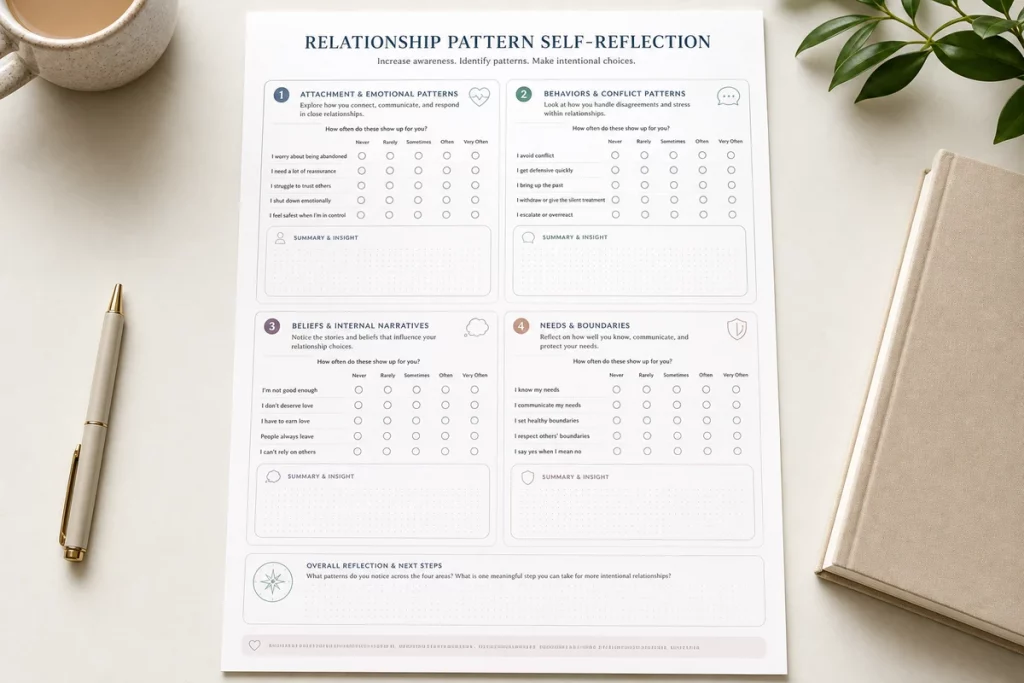
Section A: Secure Indicators (Questions 1-5)
1. I feel comfortable depending on romantic partners and having them depend on me.
2. I find it relatively easy to get close to others in romantic contexts.
3. I trust that my partner cares about me even when we’re apart or having a disagreement.
4. I can communicate my needs in a relationship without excessive anxiety about how they’ll be received.
5. I feel secure in my relationships most of the time and don’t need constant reassurance.
Section B: Anxious Indicators (Questions 6-10)
6. I worry that my partner doesn’t love me as much as I love them.
7. When my partner doesn’t respond to a message quickly, I assume something is wrong.
8. I need frequent reassurance that my partner is committed and not losing interest.
9. I tend to fall hard and fast, investing deeply before the other person matches my intensity.
10. I find myself monitoring my partner’s behavior for signs of withdrawal or decreased interest.
Section C: Avoidant Indicators (Questions 11-15)
11. I feel uncomfortable when romantic partners want to be very close emotionally.
12. I prefer maintaining significant independence even in committed relationships.
13. When a partner gets too emotionally intense, I feel the urge to pull away.
14. I find it difficult to fully trust or depend on romantic partners.
15. I sometimes feel “trapped” or “suffocated” by the emotional demands of relationships.
Section D: Disorganized Indicators (Questions 16-20)
16. I want closeness but also feel afraid of it — sometimes in the same moment.
17. My relationships tend to be intense and unpredictable, with extreme highs and lows.
18. I sometimes push away people I genuinely care about, then desperately want them back.
19. I find it hard to regulate my emotions in romantic contexts — small events trigger big reactions.
20. I’ve been told I send “mixed signals” in relationships and I can understand why.
Scoring Your Attachment Style Quiz PDF
Add your scores for each section:
Section A (Secure): ___ / 25 | Section B (Anxious): ___ / 25 | Section C (Avoidant): ___ / 25 | Section D (Disorganized): ___ / 25
| Highest Score | Your Primary Style | What It Means |
|---|---|---|
| Section A highest | Secure | Comfortable with intimacy and independence; trusts relationships naturally |
| Section B highest | Anxious | Hypervigilant about rejection; needs reassurance; invests intensely early |
| Section C highest | Avoidant | Uncomfortable with closeness; values independence; withdraws under pressure |
| Section D highest | Disorganized | Wants and fears closeness simultaneously; chaotic relational patterns |
Important nuances. Most people aren’t purely one style — you may score high in two sections, indicating a primary style with strong secondary tendencies. “Anxious-avoidant” (high B and C) is common and produces the most internally conflicted relationship experience: wanting closeness AND needing distance simultaneously. Your style may also vary by relationship context — you might be more avoidant with one partner type and more anxious with another, depending on their attachment style and the specific dynamic between you. This attachment style quiz pdf identifies your DOMINANT pattern; individual relationships may activate different aspects of your attachment architecture depending on the partner’s style and behavior.
Your style isn’t your destiny. Attachment styles are patterns, not prisons. They describe your DEFAULT — the automatic programming that runs when you’re not consciously choosing. With awareness (which this assessment provides), therapeutic support, and deliberate practice, insecure attachment patterns can shift toward security over time. The boundary-setting guide provides the communication framework that helps insecurely attached individuals express needs without the anxiety or withdrawal their pattern typically produces.
How Your Attachment Style Affects Your Dating Life
If you’re anxiously attached: You may be drawn to love bombing because the overwhelming attention activates your attachment system’s pleasure response — the very thing your nervous system craves. You may interpret the slow fade as confirmation of your deepest fear (abandonment) rather than as one person’s poor communication. You may tolerate breadcrumbing because intermittent attention is better than no attention when your attachment system is screaming for connection. The dating danger for anxious attachment: accepting too little from partners who can’t provide consistency because any connection feels better than the loneliness your nervous system classifies as life-threatening.
If you’re avoidantly attached: You may unconsciously choose partners who want more closeness than you can comfortably provide — then feel “suffocated” by their reasonable requests for connection, which confirms your belief that relationships are constraining. You may use ghosting as an exit strategy because the confrontation required by honest communication triggers your discomfort with emotional intensity. You may sabotage promising connections by finding “deal-breaking” flaws that justify withdrawal when the relationship reaches a depth threshold your avoidant wiring can’t tolerate. The dating danger for avoidant attachment: serially ending connections just as they develop real potential because your nervous system interprets deepening intimacy as threat rather than reward.
If you’re disorganized: Your dating experience is likely the most confusing — intense attraction followed by overwhelming fear, desperate pursuit followed by abrupt withdrawal, idealization followed by devaluation — all of which may cycle within a single relationship or even a single week. You may attract narcissistic partners because their idealization phase activates your craving for closeness while their devaluation phase activates your fear of it — replicating the original childhood dynamic of needing and fearing the same person. The dating danger for disorganized attachment: gravitating toward chaos because it feels familiar, and interpreting the emotional rollercoaster as “passion” rather than recognizing it as a trauma response pattern.
If you’re securely attached: You evaluate partners based on actual compatibility rather than attachment desperation. You can enjoy dating without it consuming your identity, tolerate uncertainty without catastrophizing, and walk away from connections that don’t serve you without the guilt or panic that insecure attachment produces. The dating advantage for secure attachment: you attract other securely attached individuals because security recognizes and gravitates toward security — creating a positive selection effect that insecure styles don’t access. You also have the emotional bandwidth to be a corrective experience for insecurely attached partners who are doing their own attachment work — though being someone’s therapist isn’t your job, and the red flags guide helps you distinguish between a partner with insecure attachment who’s actively working on it (worth investing in) and a partner who uses their attachment style as an excuse for harmful behavior (not your project to fix). Use GuyID’s free screening tools to verify matches and share your Date Mode link through GuyID as the practical expression of the transparency that secure attachment naturally produces.
Can You Change Your Attachment Style?
Yes — through a process researchers call “earned security.” The path from insecure to secure attachment involves three mechanisms that work in combination over months to years:
Therapeutic processing of attachment origins. Understanding WHERE your attachment style came from — which childhood experiences installed the pattern, which relational templates you absorbed, which beliefs about relationships you formed before you were old enough to evaluate them critically — creates the cognitive framework that allows you to see the pattern AS a pattern rather than experiencing it as reality. The National Domestic Violence Hotline provides referrals to attachment-informed therapists for individuals whose attachment patterns connect to childhood abuse or neglect experiences.
Corrective relationship experiences. Relationships with securely attached individuals provide the lived experience of what secure relating feels like — consistency, reliability, emotional availability, and the absence of the chaos or distance that insecure patterns produce. Each positive relational experience provides counter-evidence to the beliefs that sustain insecure attachment: “people leave” (anxious), “closeness is dangerous” (avoidant), or “love hurts” (disorganized). Over time, accumulated corrective experiences gradually rewire the attachment system toward security — though the process requires patience from both partners and typically benefits from therapeutic support.
Deliberate practice of secure behaviors. Acting FROM security even when your nervous system signals insecurity gradually teaches the attachment system that secure behavior produces better outcomes than insecure reactivity. For anxious attachment: resisting the urge to send the 4th unanswered text and instead tolerating the uncertainty — noticing that the relationship survived the gap and your partner eventually responded without the additional prompting your anxiety demanded. For avoidant attachment: staying in a difficult conversation rather than withdrawing, and noticing that the intimacy didn’t produce the catastrophe your system predicted — that closeness was uncomfortable but not dangerous. For disorganized attachment: maintaining behavioral consistency even when emotional chaos is present — following through on commitments, responding to partners predictably, and separating emotional experience from behavioral response. Each repetition of secure behavior — especially when it produces a positive outcome — strengthens the neural pathways that make security the default rather than the exception.
Self-compassion throughout the process. Changing attachment patterns means repeatedly confronting the most vulnerable parts of your psychology — the childhood needs that weren’t met, the relational templates that were installed without your consent, and the protective strategies that served you then but harm you now. This confrontation requires self-compassion rather than self-criticism: the insecure pattern developed because it was the best adaptation available to a child in a specific environment. Criticizing yourself for having an insecure attachment style is like criticizing a child for developing the only coping strategy their situation allowed. The adult work isn’t to punish the pattern but to gradually replace it with something that serves your current reality — which is fundamentally different from the childhood reality where the pattern was formed.
For new connections: Use this attachment style quiz pdf as a self-awareness tool before entering the dating market — because understanding your pattern BEFORE it activates in a new relationship gives you the observer perspective that prevents automatic pilot from taking over. When you notice your anxious attachment activating (“they haven’t texted back — they must be losing interest”), you can label it: “That’s my attachment system, not reality. I’ll wait and see what actually happens.” When your avoidant system signals “this is getting too close, find an exit” — you can recognize the pattern and stay present instead of retreating. This metacognitive capacity — watching your attachment system operate rather than being operated BY it — is the practical superpower this assessment provides. Watch for the green flags of secure attachment in potential partners: consistency, emotional availability, respect for boundaries, and comfort with both intimacy and independence. Verify identity through GuyID’s free screening tools — because the security of knowing WHO you’re connecting with reduces one major source of attachment activation, freeing cognitive resources for the more important evaluation of whether this person’s attachment style is compatible with building something healthy alongside yours.

How GuyID Helps
GuyID should appear when it is useful, not as a banner ad. A GuyID Trust Profile gives someone a portable way to share trust signals before a date, while identity verification and social vouching help turn vague profile claims into clearer next steps.
Useful next steps:
- Create a GuyID Trust Profile when you want a cleaner way to share verified trust signals.
- Use GuyID free tools and related guides when you need a checklist before meeting someone.
- Treat identity verification as confidence-building, not a guarantee.
- Use social vouching when you want context from people who already know the person.
- Sign up only when the extra trust layer helps the decision you are already trying to make.
Frequently Asked Questions
What is an attachment style quiz pdf?
An attachment style quiz pdf is a downloadable or printable self-assessment that identifies your primary attachment pattern — secure, anxious, avoidant, or disorganized — based on your typical behaviors and emotional responses in romantic relationships. The assessment evaluates how you handle closeness, separation, conflict, and uncertainty in intimate contexts, producing a profile that explains many of the automatic relationship patterns you’ve observed in yourself but may not have understood.
Can your attachment style change?
Yes — through a process called “earned security” that combines therapeutic processing of attachment origins, corrective relationship experiences with securely attached partners, and deliberate practice of secure behaviors even when your nervous system signals otherwise. The process typically takes months to years and benefits significantly from professional support. Change is gradual rather than dramatic — you’ll notice insecure patterns activating less frequently and with less intensity over time rather than experiencing a single transformative shift.
What’s the worst attachment style combination for dating?
Anxious-avoidant pairings produce the most painful dynamic: the anxious partner pursues closeness, the avoidant partner retreats, the pursuit intensifies, the retreat intensifies — creating an escalating cycle where both people’s attachment systems are maximally activated in the worst possible direction. Neither person gets what they need, and the dynamic often produces the trauma bond that makes the relationship addictive despite being unsatisfying. Both styles can form healthy relationships — but not typically with each other unless both are doing significant attachment work.
How accurate are online attachment style quizzes?
Self-report attachment assessments are reasonably accurate for identifying dominant patterns — research validates them against clinical assessment with moderate-to-strong correlation. Their main limitation: they depend on honest self-reporting, and people with avoidant attachment in particular tend to underreport their avoidance (because the avoidant style includes minimizing attachment needs). For the most accurate results, answer based on what your PARTNERS would say about your behavior, not just your internal experience. Professional assessment through a therapist provides the most comprehensive evaluation.