

Reader Briefing
Reader Briefing
Start here if you need a practical read on love language quiz printable: discover how you give and receive love: who should use verification, what signals to check, and what to do before moving from online interest to an in-person plan.
Who this is for
- Readers preparing for a first in-person date.
- Anyone checking identity, profile consistency, and trust signals.
- Online daters improving conversations, profiles, or match screening.
You’ll learn
- How to evaluate identity signals without treating any single check as certainty.
- Which trust signals matter and how to weigh them together.
- How to move from online conversation to a safer first meeting.
- Where GuyID tools fit into a quick pre-date screening workflow.
- How to compare options using practical safety and trust criteria.
- When to slow down, ask for more context, or walk away.
Bottom line
Verification reduces uncertainty; it does not guarantee future behavior. Use a layered approach: confirm identity signals, compare profile consistency, ask for a short video call, keep early plans public, and slow down when someone pressures you to skip normal safety steps.
Key takeaways
- Identity verification improves confidence, not certainty.
- Verify before meeting privately or sharing sensitive details.
- A short video call can reveal many inconsistencies.
- Pressure to skip reasonable safety steps is useful information.
- Use GuyID tools to turn vague concerns into specific checks.
Free Tools
Catfish Probability Detector
Check whether a dating profile has suspicious identity or photo signals.
Dating Bio Red Flag Detector
Review a bio for scam, pressure, or trust-warning language.
Dating Safety Checklist
Use free GuyID tools before moving from chat to a real date.
Next step
Create your GuyID trust profile
Share consent-based trust signals before a date without turning the conversation into an interrogation.
You keep buying thoughtful gifts. They keep saying “I just wish you’d spend more time with me.” The disconnect isn’t about love — it’s about language. A love language quiz printable helps you identify which of the five love languages you speak fluently and which ones your partner needs to hear — because the gap between how you GIVE love and how your partner RECEIVES it is the source of more relationship friction than most couples realize. This guide provides a complete printable assessment, explains each love language with real-world examples, covers the nuances that generic love language tests miss (including neurodivergent considerations), and shows you how to use your results to actually improve your relationship rather than just collecting self-knowledge you never apply.
NavigateTable of Contents16 sections
The 5 Love Languages: What They Mean in Practice
Gary Chapman’s love language framework identifies five primary ways people express and experience love. According to the American Psychological Association’s research on relationship satisfaction, couples who understand and speak each other’s love language report significantly higher satisfaction than those who default to their own language regardless of their partner’s preferences. Research from the National Library of Medicine on attachment and love expression further confirms that love language mismatches predict relationship distress independently of overall relationship quality — meaning even genuinely loving couples experience dissatisfaction when they consistently express love in channels their partner doesn’t receive. Understanding your love language — and your partner’s — through a love language quiz printable assessment transforms vague relationship frustration into specific, actionable insight.
Words of Affirmation
Love expressed through verbal acknowledgment: compliments, appreciation, encouragement, “I love you,” “I’m proud of you,” “Thank you for doing that.” For people who speak this language, HEARING love matters more than seeing it demonstrated through actions. The absence of verbal affirmation produces the feeling of being unloved even when the partner IS expressing love through other channels. Conversely, criticism and harsh words are disproportionately damaging to words-of-affirmation speakers because the very channel through which they receive love is the channel through which the hurt arrives.
Quality Time
Love expressed through undivided attention — not just being in the same room but being genuinely PRESENT: phones away, eyes engaged, conversation flowing, shared experience happening. For quality time speakers, a partner who’s physically present but mentally elsewhere (scrolling, distracted, multitasking) isn’t providing quality time — they’re providing quantity time, which doesn’t register as love. The key distinguisher: quality time is about ATTENTION, not duration. Twenty focused minutes of genuine engagement outweighs three hours of parallel phone-scrolling on the couch.
Acts of Service
Love expressed through helpful actions: cooking dinner, running errands, handling logistics, fixing something, taking a task off your partner’s plate. For acts-of-service speakers, words are nice but DOING communicates love more reliably than saying it. “I love you” means less than “I noticed you were stressed so I did the grocery shopping.” The inverse: laziness, broken promises, and creating more work for the partner are disproportionately hurtful because they communicate disregard through the very channel the partner uses to receive love. Our transactional relationships guide covers the important distinction between acts of service given freely and acts tracked as leverage.
Physical Touch
Love expressed through physical contact: holding hands, hugging, cuddling, a hand on the shoulder, a touch on the arm during conversation, physical closeness in general. For physical touch speakers, the body communicates what words can’t — and the absence of physical affection produces a specific kind of loneliness that verbal reassurance can’t address. Physical touch as a love language isn’t primarily about sexual contact (though it includes it) — it’s about the everyday physical connections that communicate “I’m here, I care, you’re not alone” through the body rather than through words.
Receiving Gifts
Love expressed through thoughtful presents — not materialism but the symbolic significance of someone thinking about you, choosing something meaningful, and offering a tangible representation of their care. Forgetting special occasions, giving generic gifts, or dismissing the importance of gift-giving (“it’s just stuff”) wounds gift-language speakers because it communicates “I don’t think about you when you’re not in front of me” — the opposite of what their love language needs to hear.
The Love Language Quiz Printable: 25-Question Assessment
For each pair of statements, choose the one that resonates more strongly — even if both apply. There are no right answers; the goal is to identify your PRIMARY love language (the one that matters most) and your secondary language. This love language quiz printable can be taken individually or with a partner for comparison — and the comparison is where the real value lives, because understanding the GAP between your languages is more actionable than understanding your own language in isolation.
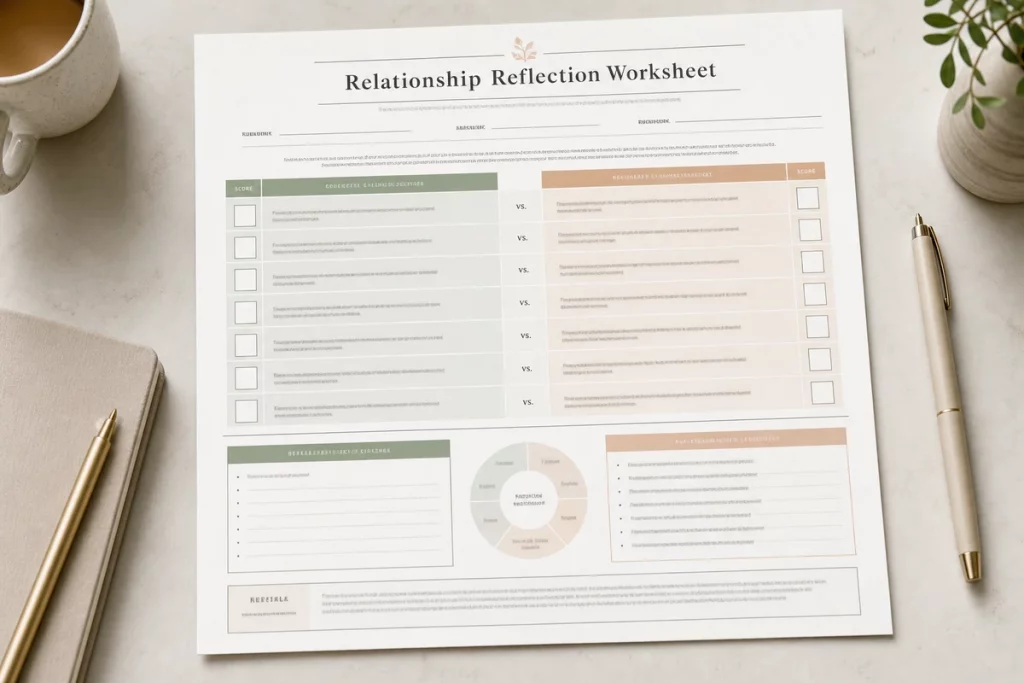
Instructions: For each pair (1-25), circle A or B. Count your totals for each letter at the end.
| # | Option A | Option B |
|---|---|---|
| 1 | I feel most loved when my partner tells me they appreciate me (W) | I feel most loved when my partner plans uninterrupted time together (Q) |
| 2 | A thoughtful gift means more to me than a helpful gesture (G) | Having my partner handle a stressful task means more than a gift (S) |
| 3 | I value a long hug after a hard day (T) | I value hearing “I’m proud of you” after a hard day (W) |
| 4 | I’d rather go on a date than receive a present (Q) | I’d rather receive a meaningful present than go out (G) |
| 5 | When my partner does chores without being asked, I feel loved (S) | When my partner holds my hand in public, I feel loved (T) |
| 6 | Verbal compliments make my day (W) | Spending the evening together makes my day (Q) |
| 7 | I notice when my partner brings me something small and thoughtful (G) | I notice when my partner takes something off my to-do list (S) |
| 8 | Physical affection makes me feel secure (T) | Words of encouragement make me feel secure (W) |
| 9 | Going for a walk together matters more than exchanging gifts (Q) | A surprise gift matters more than a planned outing (G) |
| 10 | I feel closest to my partner when they help with something I’m struggling with (S) | I feel closest during physical closeness like cuddling (T) |
| 11 | Hearing “I love you” regularly matters to me (W) | Dedicated one-on-one time matters more to me (Q) |
| 12 | A gift that shows they were thinking of me is very meaningful (G) | Coming home to a clean house when I didn’t expect it is very meaningful (S) |
| 13 | A back rub after a long day means love to me (T) | A handwritten note means love to me (W) |
| 14 | I’d prefer a weekend getaway together (Q) | I’d prefer my partner buying something I’ve been wanting (G) |
| 15 | My partner cooking my favorite meal says “I love you” (S) | My partner reaching for my hand says “I love you” (T) |
| 16 | I feel disconnected when we don’t talk enough (W) | I feel disconnected when we don’t spend enough time together (Q) |
| 17 | Receiving a sentimental gift makes me emotional (G) | My partner anticipating what I need and doing it makes me emotional (S) |
| 18 | I need regular physical affection to feel connected (T) | I need regular verbal affirmation to feel connected (W) |
| 19 | An experience shared together is the best gift (Q) | A carefully chosen object is the best gift (G) |
| 20 | I feel loved when my partner takes care of details I hate handling (S) | I feel loved when my partner is physically affectionate throughout the day (T) |
| 21 | Encouragement during a difficult time means everything (W) | Having my partner sit with me during a difficult time means everything (Q) |
| 22 | Receiving flowers or a small token of affection brightens my day (G) | My partner driving when I’m tired so I can rest brightens my day (S) |
| 23 | A spontaneous hug from my partner makes me happy (T) | A spontaneous compliment from my partner makes me happy (W) |
| 24 | I cherish experiences more than things (Q) | I cherish the thought behind a meaningful gift (G) |
| 25 | When my partner proactively helps, I know they care (S) | When my partner reaches for me physically, I know they care (T) |
Scoring Your Love Language Quiz Printable
Count your selections: W (Words of Affirmation) = ___ | Q (Quality Time) = ___ | G (Gifts) = ___ | S (Acts of Service) = ___ | T (Physical Touch) = ___
Your highest score is your PRIMARY love language — the one that most powerfully communicates love TO you. Your second-highest is your secondary language. Most people have one dominant language and one strong secondary, with the remaining three serving supporting roles.
What your score means for your relationship. Research from the National Library of Medicine on love language compatibility confirms that the most common source of love-language friction isn’t that partners don’t love each other — it’s that they express love in THEIR language rather than their PARTNER’S language. A person whose primary language is Acts of Service may show love by doing everything for their partner — while their partner, whose primary language is Words of Affirmation, feels unloved because they never HEAR “I love you” despite seeing it demonstrated through action constantly. The love language quiz printable reveals this gap so both people can bridge it deliberately rather than struggling with it unconsciously.
Share your results with your partner. The real value of a love language quiz printable emerges in comparison: “My primary language is Quality Time; yours is Physical Touch. That means I feel most loved when you give me undivided attention, and you feel most loved when I’m physically affectionate. Let’s make sure we’re speaking EACH OTHER’S language rather than just our own.” This specific, practical conversation — which the quiz makes possible — produces more relationship improvement per minute than most therapy sessions because it provides immediately actionable information about exactly how to make your partner feel loved.
Love Languages and Neurodivergence: What Standard Tests Miss
Standard love language assessments — including the one above — are calibrated for neurotypical relationship dynamics. For neurodivergent individuals (ADHD, autism spectrum, sensory processing differences), the love language framework requires adaptation because the standard categories may not accurately capture how love is experienced through a neurodivergent nervous system:
Physical touch and sensory sensitivity. A neurodivergent person may deeply value physical connection conceptually while finding certain types of touch overwhelming due to sensory processing differences. The standard love language quiz printable might score them low on Physical Touch because they answered “no” to questions about cuddling or handholding — when the reality is that they DO need physical connection but in SPECIFIC forms (firm pressure, specific locations, predictable timing) rather than the spontaneous, varied touch the standard questions describe. A neurodivergent love language test would ask about PREFERRED forms of touch rather than touch in general.
Quality time and attention regulation. For people with ADHD, “undivided attention” may look different than neurotypical expectations — they may be fully engaged while simultaneously fidgeting, looking away, or doing something with their hands. A partner who interprets these behaviors as inattention may feel their Quality Time needs aren’t being met, when the neurodivergent partner IS fully present through their own attentional architecture. A proper neurodivergent love language test would account for the fact that attention expression varies by neurology — and that focused engagement doesn’t always look like still, quiet, eye-contact-heavy presence.
Acts of service and executive function. Neurodivergent individuals with executive function challenges may deeply VALUE acts of service — both giving and receiving — while struggling to consistently PERFORM them due to the planning, initiation, and completion demands that executive function difficulties create. This doesn’t mean they don’t care; it means the channel through which they want to express love has a neurological bottleneck that intention alone can’t bypass. Understanding this distinction prevents the misinterpretation of executive function struggles as relational neglect — which is the mistake that causes the most friction in neurodivergent partnerships around the Acts of Service language.
Verbal processing and Words of Affirmation. Some neurodivergent individuals process language differently — literal interpretation of figurative expressions, difficulty reading tone or subtext, or challenges with spontaneous verbal expression. A partner who needs Words of Affirmation may not receive the verbal love their neurodivergent partner IS expressing because it arrives in unexpected forms: a detailed analysis of why your cooking is excellent (analytical appreciation) rather than a simple “dinner was great” (conventional compliment). Learning to recognize affirmation in its neurodivergent form — rather than insisting it match neurotypical templates — is essential for cross-neurotype partnerships. Our boundary-setting guide covers the communication framework that helps partners with different processing styles establish shared language for expressing needs.
How to Actually Use Your Love Language Quiz Printable Results
Speak their language daily — not just during conflict. The most common mistake is pulling out love language knowledge during arguments (“I already DO things for you!”) rather than applying it during ordinary moments. The goal: integrate your partner’s primary love language into daily life so consistently that it becomes automatic. If their language is Quality Time, put the phone away during dinner every night — not as a grand gesture but as a daily practice. If their language is Words of Affirmation, say one specific appreciative thing every day — not generic “I love you” but specific “I noticed how you handled that situation with your coworker and I thought it was really impressive.”
Ask for what you need in YOUR language. Knowing your own love language through the assessment gives you the vocabulary to request what you need: “I need to hear that you appreciate what I’m doing” (Words of Affirmation) or “Can we spend this evening without screens?” (Quality Time) or “A hug would really help right now” (Physical Touch). Specific requests based on love language knowledge are infinitely more effective than vague dissatisfaction (“I don’t feel loved”) because they give your partner ACTIONABLE direction rather than a problem without a solution. The green flags guide identifies responsive communication as a hallmark of healthy partnership — and love language-informed requests make responsive communication possible.
Don’t weaponize love languages. “Your love language is Acts of Service so you should be doing more around the house” is weaponization — using the framework as leverage rather than as understanding. Love languages describe how someone RECEIVES love, not what they OWE. The framework works when both people use it to give more effectively — not when one person uses it to demand more from the other. If love language conversations consistently produce conflict rather than connection, the issue may be deeper than communication style — the manipulation tactics guide covers how genuinely useful frameworks can be co-opted as control tools.
Reassess periodically. Love languages can shift over life stages — a new parent may temporarily prioritize Acts of Service (because they’re exhausted and help IS love) even if their baseline language is Quality Time. Someone recovering from a difficult breakup may temporarily need more Words of Affirmation than usual. Retake this love language quiz printable annually or during major life transitions to check whether your primary language has shifted — and communicate the shift to your partner rather than expecting them to intuit it.
For new relationships: Love language awareness is a green flag to watch for in potential partners — someone who asks “how do you like to be shown love?” early in a relationship is demonstrating the emotional intelligence and partner-focus that predicts long-term satisfaction. Verify identity through GuyID’s free screening tools before investing emotionally, share your Date Mode link through GuyID, and use the genuine interest signs guide to identify partners who demonstrate care through action rather than just words — because the best partners aren’t the ones who score perfectly on a love language quiz; they’re the ones who learn your language and speak it consistently.

How GuyID Helps
GuyID should appear when it is useful, not as a banner ad. A GuyID Trust Profile gives someone a portable way to share trust signals before a date, while identity verification and social vouching help turn vague profile claims into clearer next steps.
Useful next steps:
- Create a GuyID Trust Profile when you want a cleaner way to share verified trust signals.
- Use GuyID free tools and related guides when you need a checklist before meeting someone.
- Treat identity verification as confidence-building, not a guarantee.
- Use social vouching when you want context from people who already know the person.
- Sign up only when the extra trust layer helps the decision you are already trying to make.
Frequently Asked Questions
What is a love language quiz printable?
A love language quiz printable is a paper-based or downloadable assessment that helps you identify your primary love language — the way you most naturally give and receive love. Based on Gary Chapman’s framework, it evaluates five categories: Words of Affirmation, Quality Time, Acts of Service, Physical Touch, and Receiving Gifts. The printable format allows couples to take the assessment together, compare results side by side, and have the practical conversation about how to better meet each other’s needs.
Can your love language change over time?
Yes — love languages can shift based on life circumstances, relationship stage, and personal growth. New parents often temporarily prioritize Acts of Service. People recovering from emotionally neglectful relationships may need extra Words of Affirmation. Stress, grief, and major transitions can all shift which language feels most needed. Retaking the assessment annually or during life transitions helps you and your partner stay current with each other’s evolving needs.
Is there a love language test for neurodivergent people?
Standard love language tests don’t account for neurodivergent processing differences — but the framework still applies with adaptation. The key adjustments: recognize that Physical Touch preferences may be specific rather than general (sensory sensitivity), that Quality Time attention may look different (ADHD fidgeting doesn’t mean disengagement), that Acts of Service challenges may reflect executive function rather than caring, and that Words of Affirmation may arrive in analytical rather than emotional form. Take the standard quiz and then discuss results through a neurodivergent lens with your partner.
What if my partner and I have different love languages?
Different love languages are normal and manageable — the friction comes from not KNOWING about the difference, not from the difference itself. Once both people understand each other’s primary language, the solution is straightforward: each person deliberately speaks their PARTNER’S language rather than defaulting to their own. It feels unnatural at first (like speaking a foreign language), but with practice it becomes second nature. The conversation this quiz enables — “here’s what I need, here’s what you need, let’s make sure we’re both getting it” — is one of the highest-value relationship conversations you can have.