

Reader Briefing
Reader Briefing
Start here if you need a practical read on emotionally abusive test: 25 questions that reveal the truth: who should use verification, what signals to check, and what to do before moving from online interest to an in-person plan.
Who this is for
- Readers preparing for a first in-person date.
- Anyone checking identity, profile consistency, and trust signals.
- People trying to avoid romance scams, fake profiles, or pressure tactics.
- Online daters improving conversations, profiles, or match screening.
You’ll learn
- How to evaluate identity signals without treating any single check as certainty.
- Which trust signals matter and how to weigh them together.
- How to spot inconsistencies, pressure, or behavior patterns that deserve caution.
- How to move from online conversation to a safer first meeting.
- Where GuyID tools fit into a quick pre-date screening workflow.
- When to slow down, ask for more context, or walk away.
Bottom line
Verification reduces uncertainty; it does not guarantee future behavior. Use a layered approach: confirm identity signals, compare profile consistency, ask for a short video call, keep early plans public, and slow down when someone pressures you to skip normal safety steps.
Key takeaways
- Identity verification improves confidence, not certainty.
- Patterns matter more than isolated incidents.
- Verify before meeting privately or sharing sensitive details.
- A short video call can reveal many inconsistencies.
- Pressure to skip reasonable safety steps is useful information.
Free Tools
Catfish Probability Detector
Check whether a dating profile has suspicious identity or photo signals.
Dating Bio Red Flag Detector
Review a bio for scam, pressure, or trust-warning language.
Dating Safety Checklist
Use free GuyID tools before moving from chat to a real date.
Next step
Create your GuyID trust profile
Share consent-based trust signals before a date without turning the conversation into an interrogation.
You’ve Googled “am I being emotionally abused?” at 2 AM — and the fact that you’re asking the question is itself significant data. People in healthy relationships don’t search for an emotionally abusive test. The uncertainty you’re feeling — the confusion about whether your experience is “bad enough” to count, the self-doubt about whether you’re overreacting, the lingering question of whether this is normal — is itself one of the most common effects of emotional abuse: the erosion of your ability to trust your own perception. This emotionally abusive test provides 25 clinically-informed questions across five dimensions of emotional abuse, weighted scoring that reflects actual severity, and clear guidance on what your score means and what to do about it.
NavigateTable of Contents42 sections
Before You Take This Emotionally Abusive Test
This assessment is not a clinical diagnosis — it’s an awareness tool designed to help you evaluate patterns in your relationship using the same behavioral indicators that therapists and researchers use to identify emotional abuse. According to the National Domestic Violence Hotline, emotional abuse includes any pattern of behavior that controls, isolates, intimidates, demeans, or manipulates another person — and it occurs across all demographics, gender combinations, and relationship types.
As you answer each question, think about PATTERNS — not isolated incidents. Everyone has bad days. Everyone says something hurtful occasionally. What distinguishes emotional abuse from normal relationship friction is the pattern: repeated behavior that produces the same harmful effect over time, regardless of whether the individual incidents seem “small” in isolation. Our psychological abuse quiz provides a complementary assessment focused on cognitive and identity-level abuse patterns.
If at any point during this emotionally abusive test you feel unsafe, overwhelmed, or in crisis, the National Domestic Violence Hotline is available 24/7 at 1-800-799-7233. You deserve support regardless of where your score falls — and asking the question is the courageous first step toward clarity.
The 25-Question Emotionally Abusive Test
Rate each statement: 0 = Never, 1 = Rarely, 2 = Sometimes, 3 = Often, 4 = Almost Always
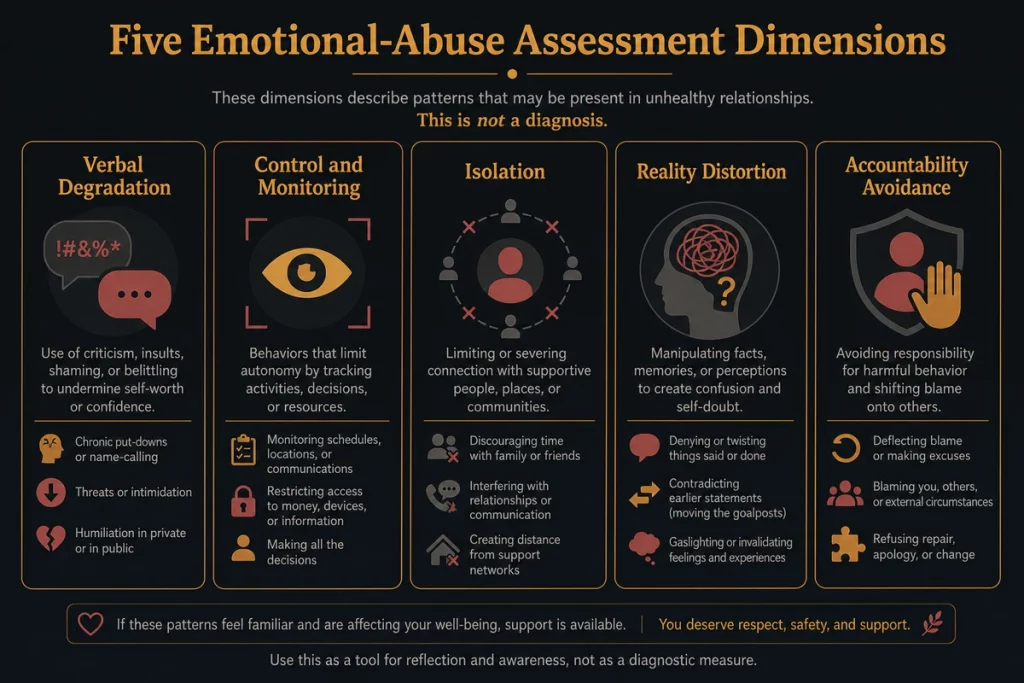
Category 1: Verbal and Emotional Degradation (Questions 1-5)
Q1. Name-Calling and Insults
My partner calls me names, uses insults, or makes degrading comments about my intelligence, appearance, or character — sometimes disguised as “jokes” or “honesty.” This includes comments like “you’re so stupid,” “no one else would put up with you,” or “I’m just being honest — you need to hear this.”
Q2. Public Humiliation
My partner embarrasses me in front of others — making fun of me, telling embarrassing stories I’ve asked them not to share, correcting me in social situations, or making me the target of group humor that feels more cruel than playful.
Q3. Constant Criticism
My partner criticizes me regularly — my appearance, my cooking, my parenting, my work, my decisions, my friends. The criticism isn’t constructive feedback offered with care; it’s a persistent pattern of finding fault that makes me feel like nothing I do is ever good enough.
Q4. Yelling, Threatening, or Intimidating
My partner raises their voice during arguments to intimidate rather than communicate, threatens consequences (leaving, infidelity, financial withdrawal, custody action) when they don’t get their way, or uses physical size, proximity, or posture to create fear during disagreements.
Q5. Dismissing My Feelings
When I express that something bothers me, my partner responds with “you’re too sensitive,” “you’re overreacting,” “that’s ridiculous,” or “I can’t say anything without you getting upset.” My emotional responses are consistently treated as the problem rather than the behavior that triggered them.
Category 2: Control and Monitoring (Questions 6-10)
Q6. Financial Control
My partner controls our finances — limiting my access to money, requiring me to justify purchases, monitoring my spending, or using financial power as leverage in arguments. This includes both overt control (restricting access to accounts) and covert control (creating guilt about spending).
Q7. Location and Communication Monitoring
My partner tracks my location, checks my phone, reads my messages, monitors my social media activity, demands to know where I am at all times, or becomes suspicious or angry when I’m unreachable for brief periods. The monitoring is framed as “care” or “concern” but produces the feeling of surveillance.
Q8. Decision Control
My partner makes decisions for both of us without my input — where we eat, how we spend weekends, which social events we attend, how our home is organized, or larger life decisions like career moves or family planning. When I express a different preference, it’s overridden or dismissed.
Q9. Appearance Control
My partner dictates or strongly influences what I wear, how I style my hair, whether I wear makeup, or how I present myself physically. Comments are framed as preferences (“I like you better in…”) but carry consequences when ignored (withdrawal of affection, criticism, or anger).
Q10. Permission Requirements
I feel I need my partner’s “permission” to see friends, visit family, pursue hobbies, spend money, or make personal decisions — even though they haven’t explicitly forbidden these things. The need for permission is enforced through emotional consequences (sulking, guilt-tripping, silent treatment) rather than overt prohibition.
Category 3: Isolation (Questions 11-15)
Q11. Friend and Family Interference
My partner criticizes my friends, creates conflict during family visits, or discourages my social connections — directly (“your friends are a bad influence”) or indirectly (scheduling conflicts, sulking when I make plans, creating crises when I try to socialize).
Q12. Competing With My Support System
My partner positions themselves as the only person who truly understands me, discourages me from seeking outside perspectives (especially therapy), or becomes jealous of close platonic relationships — framing isolation as exclusivity and control as devotion.
Q13. Monopolizing My Time
My partner expects me to spend all or most of my free time with them — becoming upset, hurt, or punitive when I choose independent activities. Over time, my social life has contracted significantly since the relationship began — not because I chose to prioritize differently but because the emotional cost of maintaining outside relationships became too high.
Q14. Information Control
My partner controls the narrative about our relationship to others — telling friends and family a version of events that makes me look unstable, unreasonable, or difficult while positioning themselves as the patient, long-suffering partner. I’ve discovered that people in our social circle have a very different impression of our dynamic than what I experience.
Q15. Creating Dependency
Through various mechanisms (financial control, undermining my confidence, discouraging my career, creating situations where I need them), my partner has created a dynamic where leaving feels practically impossible — not because I don’t want to leave but because the barriers to leaving seem insurmountable.
Category 4: Reality Distortion (Questions 16-20)
Q16. Gaslighting
My partner denies things I know happened (“I never said that”), reinterprets events to contradict my memory (“that’s not what happened — you’re remembering it wrong”), or insists my perception of reality is flawed (“you’re imagining things”). Over time, I’ve begun doubting my own memory and judgment.
Q17. Moving the Goalposts
When I meet one expectation, my partner frequently shifts to a new one, leaving approval feeling out of reach. Consider whether requests are specific and mutually discussed or whether changing standards are used to keep you seeking approval.
Q18. Projection
My partner accuses me of behaviors THEY engage in: accusing me of cheating when they’re the unfaithful one, accusing me of being controlling when they’re the one who monitors, accusing me of being emotionally abusive when they’re the one who degrades. The accusations make me defend myself instead of addressing their behavior.
Q19. Rewriting History
My partner retroactively changes the meaning or context of past events, agreements, or conversations to serve their current narrative. “I never agreed to that,” “that’s not what I meant,” and “you’re taking it out of context” are used to invalidate commitments they made and experiences I clearly remember.
Q20. Minimizing Their Impact
“It wasn’t that bad.” “You’re blowing this out of proportion.” “Other people have it way worse.” My partner consistently minimizes the impact of their behavior — implying that my distress is disproportionate rather than acknowledging that their behavior caused genuine harm.
Category 5: Accountability Avoidance (Questions 21-25)
Q21. Deflection
When I raise a concern about their behavior, the conversation immediately pivots to MY behavior: “What about when YOU did…?” “You’re not perfect either.” The original concern is never addressed because the deflection ensures the focus shifts from their accountability to my defensive posture.
Q22. Blame Shifting
“I wouldn’t have yelled if you hadn’t…” “You made me do that.” “If you would just…” My partner positions their harmful behavior as my responsibility — caused by my actions, justified by my failures, and eliminable only if I change first. Their behavior is never their own to account for.
Q23. Performative Apologies
My partner apologizes when caught — but the apology doesn’t include acknowledgment of specific harm, understanding of impact, or behavioral change. “I’m sorry you feel that way” (non-apology that makes my feelings the problem). “I’m sorry, but…” (apology immediately followed by justification). The words exist; the accountability doesn’t.
Q24. Stonewalling as Punishment
My partner uses silence, emotional withdrawal, or physical absence as punishment when I don’t comply with their wishes. The silent treatment isn’t them needing space (which they’d communicate); it’s them creating distress through calculated disconnection designed to make me anxious enough to capitulate.
Q25. The Cycle Repeats
We’ve had the same arguments about the same behaviors multiple times. My partner apologizes, things improve briefly, then the harmful behavior returns — often gradually enough that I don’t notice the return until it’s fully reestablished. The love bombing phase after conflict creates enough hope to prevent me from leaving, but the improvement never sustains.
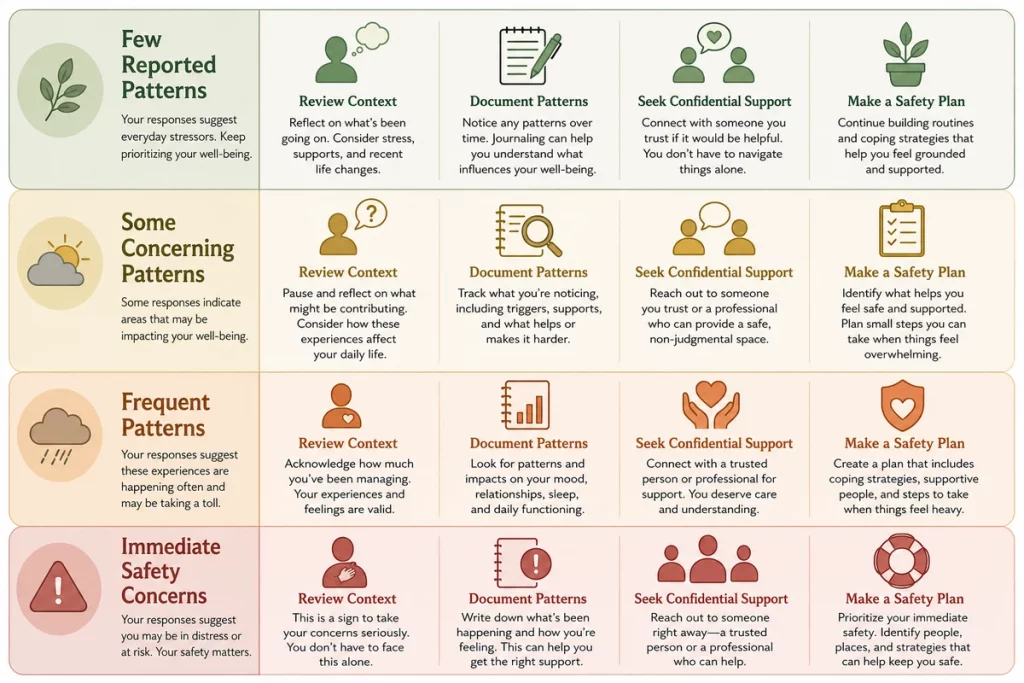
Scoring Your Emotionally Abusive Test
| Score Range | Assessment | Recommended Action |
|---|---|---|
| 0-15 | Healthy Range — Normal relationship friction without abusive patterns | Continue maintaining green flags and healthy communication |
| 16-35 | Concerning Patterns — Some indicators of unhealthy dynamics that warrant attention | Address concerns through direct communication; consider couples therapy |
| 36-60 | Significant Emotional Abuse Indicators — Multiple patterns suggest systematic emotional harm | Individual therapy recommended; couples therapy only if safe; boundary assessment essential |
| 61-100 | Severe Emotional Abuse — Pervasive patterns across multiple categories | Safety planning recommended; contact the National Domestic Violence Hotline at 1-800-799-7233 |
Important context about scoring: Even a moderate score (16-35) deserves attention if the points cluster in a single category. A score of 20 distributed across all five categories represents mild friction in multiple areas; a score of 20 concentrated in Category 4 (Reality Distortion) represents systematic gaslighting that’s actively eroding your grip on reality — a far more serious concern despite the identical numerical score. The category distribution matters as much as the total.
Why Emotional Abuse Is So Hard to Identify
No visible evidence. Unlike physical abuse, emotional abuse leaves no bruises, no marks, and no evidence that others can observe. the damage is entirely internal — to self-esteem, self-trust, identity, and psychological safety — making it invisible to everyone except the person experiencing it and (sometimes) close observers who know what to look for.
The gradual erosion effect. Emotional abuse rarely begins with obvious cruelty. It typically starts with subtle patterns — mild criticism framed as helpfulness, gentle boundary-pushing framed as enthusiasm, slight control framed as care — that intensify so gradually the target doesn’t recognize the escalation until the cumulative damage is severe. The metaphor of a frog in slowly heating water, while overused, accurately describes the trajectory: each individual increase is imperceptible, but the cumulative temperature becomes lethal. The narcissistic abuse signs guide describes this gradual escalation in clinical detail.
The abuser’s intermittent reinforcement. Emotional abusers aren’t consistently cruel — they alternate between cruelty and warmth in a pattern that produces the trauma bond that keeps targets attached. The good days create hope that the relationship CAN be consistently good; the bad days create the anxiety that maintains hypervigilance. This intermittent pattern is more psychologically addictive than consistent cruelty — which is why leaving an emotionally abusive relationship is often harder than leaving a consistently hostile one.
Self-doubt is a feature, not a side effect. Emotional abuse systematically erodes the target’s trust in their own perception — which means the person best positioned to identify the abuse (the person experiencing it) has been specifically conditioned to doubt their own assessment. “Am I overreacting?” “Maybe it’s not that bad.” “Other relationships have problems too.” These doubts aren’t evidence that the abuse isn’t real — they’re evidence that the abuse is working exactly as designed. The very fact that you’re searching for an emotionally abusive quiz or looking up “am I being emotionally abused” suggests that something has eroded your confidence in your own judgment enough that you need external validation of your experience — and that erosion IS the abuse operating at its most fundamental level. The stonewalling abuse assessment provides additional framework for evaluating specific behaviors that straddle the line between unhealthy communication and deliberate emotional harm.
What to Do With Your Results
Healthy range (0-15): Continue investing in the green flags that characterize healthy partnerships. The fact that you took this emotionally abusive test suggests awareness of what healthy relationships require — channel that awareness into positive maintenance rather than hypervigilant monitoring.
Concerning patterns (16-35): Address the specific behaviors identified through direct conversation with your partner. Use “I feel [emotion] when [behavior happens]” framing rather than accusatory language. If direct conversation produces deflection, blame-shifting, or minimization rather than genuine engagement, that response IS the data — and couples therapy (with a therapist trained in abuse dynamics) provides the structured environment where accountability becomes harder to avoid.
Significant indicators (36-60): Individual therapy FIRST — before couples therapy, before confrontation, before major decisions. You need a professional ally who helps you rebuild the self-trust that the emotional abuse has eroded before you navigate the complex decisions that follow identification. Couples therapy is only appropriate when both people are genuinely committed to change AND the power dynamic allows both people to speak honestly without fear of punishment for what they say in session.
Severe indicators (61-100): Safety planning is the priority. Contact the National Domestic Violence Hotline (1-800-799-7233) for confidential guidance. A safety plan doesn’t require immediate action — it creates a framework for leaving safely when you’re ready. Individual therapy with a trauma-informed practitioner provides the support your nervous system needs to process what you’ve experienced and plan your next steps from a position of clarity rather than crisis.
For people evaluating new connections: Use the patterns from this emotionally abusive test as an early-warning framework when dating. The behaviors described don’t appear at full intensity on date one — they appear in subtle, easy-to-dismiss forms that escalate over months. Verify identity through GuyID’s free screening tools before committing emotionally, share your Date Mode link through GuyID to establish transparency, and use the red flag quiz alongside this assessment to build a comprehensive evaluation framework. The red flags guide provides the early-stage detection toolkit that prevents emotional abuse from establishing itself in the first place.
How GuyID Helps
GuyID should appear when it is useful, not as a banner ad. A GuyID Trust Profile gives someone a portable way to share trust signals before a date, while identity verification and social vouching help turn vague profile claims into clearer next steps.
Useful next steps:
- Create a GuyID Trust Profile when you want a cleaner way to share verified trust signals.
- Use GuyID free tools and related guides when you need a checklist before meeting someone.
- Treat identity verification as confidence-building, not a guarantee.
- Use social vouching when you want context from people who already know the person.
- Sign up only when the extra trust layer helps the decision you are already trying to make.
Frequently Asked Questions
What is an emotionally abusive test?
An emotionally abusive test is a self-assessment tool that evaluates patterns in your relationship against established indicators of emotional abuse — including verbal degradation, control and monitoring, isolation tactics, reality distortion (gaslighting), and accountability avoidance. It’s not a clinical diagnosis but an awareness tool that helps you evaluate whether the behaviors you’re experiencing constitute a pattern of emotional harm. This particular test uses 25 questions across five categories with weighted severity scoring.
How do I know if I’m being emotionally abused?
Key indicators: you consistently feel confused about whether your perception of events is accurate. You walk on eggshells to avoid triggering your partner’s anger or withdrawal. You’ve become isolated from friends and family. You doubt yourself more than you used to. Your partner’s behavior follows a cycle of harm → apology → improvement → return to harm. If these patterns resonate, the emotionally abusive test above provides structured evaluation. The psychological abuse quiz offers an additional complementary assessment.
Can emotional abuse happen without the abuser knowing they’re doing it?
Yes — some emotionally abusive patterns are learned from childhood or previous relationships and enacted unconsciously. However, the lack of conscious intent doesn’t reduce the impact on the person experiencing it. Pain is pain regardless of whether the person causing it recognizes what they’re doing. What matters for your wellbeing isn’t their awareness but the pattern’s persistence: if the behavior continues after you’ve communicated its impact, the continuation IS the problem — whether it’s conscious or not.
What should I do if my score is high on this test?
For scores 36+: seek individual therapy with a therapist experienced in relationship abuse dynamics. For scores 61+: contact the National Domestic Violence Hotline (1-800-799-7233) for confidential safety planning guidance. In all cases: confide in a trusted friend or family member so you’re not processing this alone. You don’t need to make any immediate decisions — but having professional support and a personal support system creates the foundation for whatever decisions you eventually make.