

Free Tools
Catfish Probability Detector
Check whether a dating profile has suspicious identity or photo signals.
Dating Bio Red Flag Detector
Review a bio for scam, pressure, or trust-warning language.
Dating Safety Checklist
Use free GuyID tools before moving from chat to a real date.
Next step
Create your GuyID trust profile
Share consent-based trust signals before a date without turning the conversation into an interrogation.
Your Tinder match suddenly disappeared. Their profile is gone, your conversation vanished, and you’re left wondering: did they delete their account, unmatch you, or get banned? Understanding what happens with a tinder deleted account — from both sides — helps you interpret disappearing matches, make informed decisions about your own account, and protect your data when you decide to leave the platform. This guide covers everything: what Tinder actually deletes when you delete your account, the difference between deleting and unmatching, how to tell which one happened, data retention policies, and what to do when a match disappears without explanation.
NavigateTable of Contents17 sections
What Happens When Someone Deletes Their Tinder Account
When a user deletes their Tinder account (not just the app — the actual account through the in-app settings process), several important things happen simultaneously to their profile, matches, data, and billing:
Their profile disappears from all matches. Every person they were matched with loses the match. The conversation vanishes from your match list. There’s no notification — the match simply disappears as if it never existed. This is identical to what you see when someone unmatches you, which is why distinguishing between a tinder deleted account and an unmatch is difficult from the receiving end.
Their profile is removed from the swipe deck. Their profile no longer appears for anyone swiping. Any “likes” they’d sent that hadn’t yet been seen by the recipient are permanently removed. Any “likes” they’d received but hadn’t yet acted on are cancelled. The profile effectively ceases to exist within the active Tinder ecosystem. If they had Tinder Gold or Platinum and could see who liked them, that data is also removed — people who had liked their profile will no longer see a pending like from them.
Their subscription is NOT automatically cancelled. This is one of the most important and least understood aspects of a tinder deleted account situation — and the source of countless consumer complaints and frustrated support tickets. Deleting your Tinder account does NOT cancel your Tinder Plus, Tinder Gold, or Tinder Platinum subscription. The subscription is managed through Apple’s App Store or Google Play, not through Tinder itself — and it continues billing on its regular cycle until you manually cancel it through those platforms separately.
Review the current privacy terms. Before deleting an account, read Tinder’s current privacy policy and save any information you need. Do not rely on a fixed retention timeline from a third-party guide because platform terms can change.
Tinder Deleted Account vs. Unmatched: How to Tell
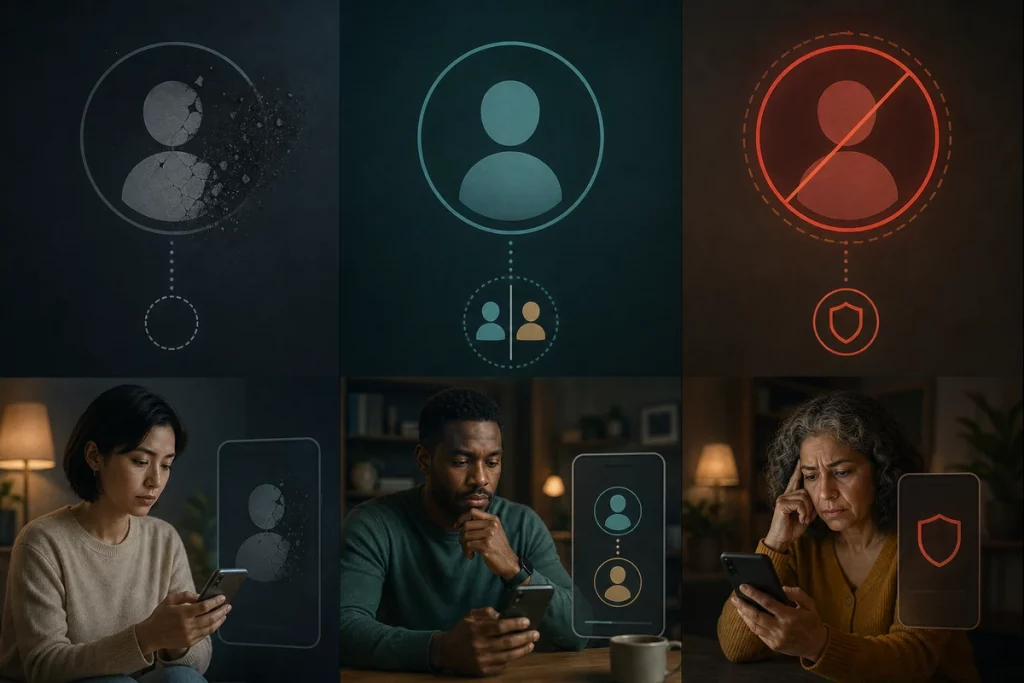
From your perspective as a matched user, a tinder deleted account and an unmatch look identical — the match disappears from your list and the conversation is gone. But there are ways to investigate which one occurred:
Method 1: Search for their profile. If you remember their name, age, and approximate distance, ask a friend to search for their profile on Tinder. If the profile still exists and is active, they unmatched you specifically — their account is fine; they just removed the connection with you. If the profile is genuinely gone from the platform entirely, they either deleted their entire account, changed their settings significantly (age range, distance, visibility), or were banned by Tinder for policy violations. This method isn’t foolproof — they may have changed settings that make them invisible to your search parameters — but it provides the most direct evidence available.
Method 2: Check other platforms. If you exchanged social media information before the disappearance, check whether their other profiles are still active. A person who deleted Tinder but remains active on Instagram, Facebook, or other platforms likely deleted the app specifically (potentially because they entered a relationship or decided to take a break) rather than disappearing from all platforms (which might suggest a broader issue). Use reverse image search on any photos you saved from the conversation to find their presence elsewhere online.
Method 3: Check your other communication channels. If you’d moved the conversation off Tinder (to WhatsApp, text, Instagram DMs), check whether you’re blocked on those platforms too. A tinder deleted account typically wouldn’t involve blocking you on unrelated platforms — that suggests an unmatch rather than an account deletion. If you’re blocked everywhere, the person is deliberately cutting contact; if only Tinder is gone but other channels remain open, an account deletion is more likely.
The honest truth: In most cases, you won’t be able to determine definitively whether someone deleted their account or unmatched you — and the distinction matters less than the outcome. Either way, the connection is gone. The more productive question isn’t “why did they disappear” but “how do I protect myself from the emotional impact of disappearing matches?” — which verification and communication habits address directly.
What Happens to Your Data After a Tinder Deleted Account
When you delete your own Tinder account, your data doesn’t vanish instantly. Understanding the data lifecycle matters for privacy-conscious users:
Immediate deletion (what disappears right away): Your profile is removed from other users’ view. Your matches and conversations are cleared. Your swiping history and like history becomes invisible to all other users on the platform. Your profile photos are removed from the active, user-facing platform display.
Retained data (what Tinder keeps temporarily): According to Tinder’s privacy policy and the FTC’s data retention guidelines, Tinder may retain: account registration data, purchase history and subscription records, reported content (if your profile was reported by other users), IP logs and device identifiers, and anonymized behavioral data. Most personally identifiable data is scheduled for deletion within approximately 3 months of account deletion, but financial transaction records and safety-related data may be retained longer for legal compliance.
Data you gave Tinder that persists elsewhere: Photos uploaded to Tinder may have been scraped by third-party sites, cached by search engines, or screenshot by matches before you deleted the account. Your phone number and email used for registration remain in Tinder’s system during the retention period. If you connected Facebook or Instagram to your account, the connection permissions may persist even after Tinder account deletion — carefully review your Facebook connected apps settings and Instagram third-party authorizations to revoke access manually.
GDPR and privacy rights. If you’re in a jurisdiction covered by GDPR (EU/EEA), the General Data Protection Regulation gives you the right to request complete data deletion — beyond what standard account deletion provides. You can submit a data subject access request (DSAR) through Tinder’s privacy settings to obtain a copy of all data they hold about you, and a deletion request to ensure comprehensive removal. Canadian users have similar rights under PIPEDA, though the enforcement mechanisms differ.
How to Properly Delete Your Tinder Account
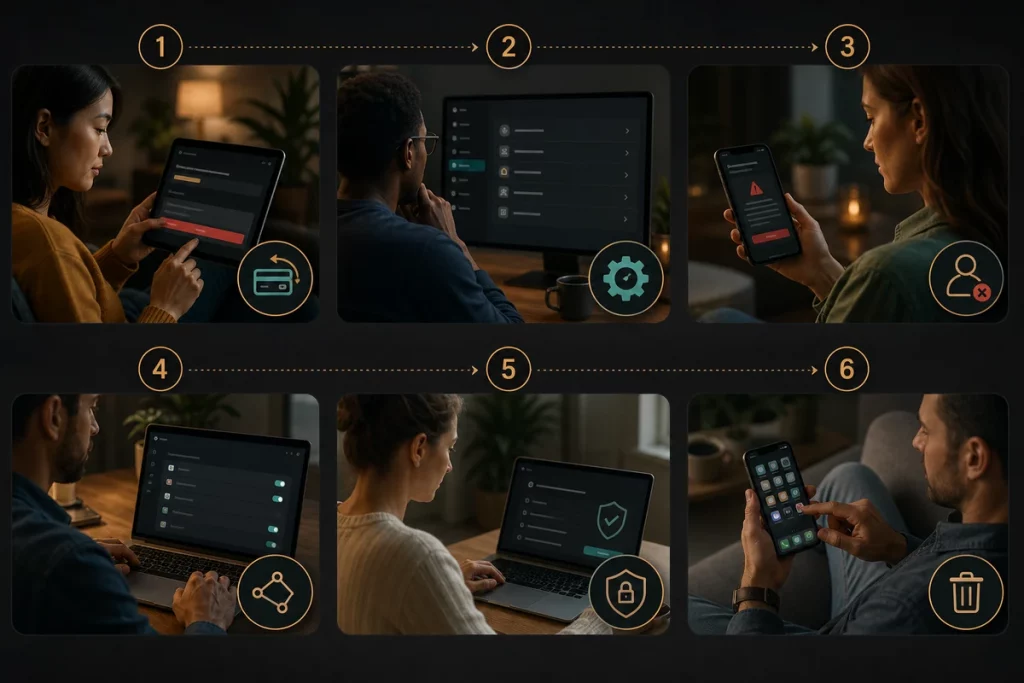
Many people think deleting the app deletes their account — it doesn’t. Here’s the complete tinder deleted account process that actually removes your profile:
Step 1: Cancel your subscription FIRST. Go to your phone’s subscription management (iPhone: Settings → Apple ID → Subscriptions; Android: Play Store → Subscriptions) and cancel any active Tinder subscription. If you delete your account before cancelling the subscription, the subscription continues charging. This is the most common mistake in the tinder deleted account process and the source of the most financial complaints.
Step 2: Open Tinder and go to Settings. Tap your profile icon → Settings → scroll to the bottom → “Delete Account.” This is critically different from “Log Out” — logging out preserves your account while deletion removes it.
Step 3: Confirm deletion. Tinder will present a screen asking why you are leaving the platform (optional feedback that helps Tinder understand churn patterns) and present a confirmation screen. Confirm deletion. Your profile is immediately removed from the active platform.
Step 4: Revoke connected permissions. If you connected Facebook, Instagram, or Spotify to Tinder, go to each platform’s settings and revoke Tinder’s access. Facebook: Settings → Apps and Websites → Remove Tinder. Instagram: Settings → Apps and Websites → Remove Tinder. This prevents Tinder from accessing data from those platforms even during the data retention period.
Step 5 (optional): Submit a GDPR/privacy deletion request. For comprehensive data removal, submit a request through Tinder’s privacy center or email their data protection team. This ensures data held in backup systems, analytics databases, and safety records is also queued for deletion — beyond what the standard account deletion process covers.
Step 6: Delete the app. Only after completing steps 1-4 should you delete the Tinder app itself from your phone. Deleting the app first creates a situation where your account remains active (and potentially visible to others) but you’ve lost the interface to manage or delete it.
Why People Delete Tinder Accounts
Understanding common reasons helps you interpret match disappearances with less anxiety:
They found a relationship. The single most common and most benign reason for account disappearance. Many people delete Tinder when a connection becomes exclusive — sometimes from the app itself, sometimes from another source. A match who disappears after a few good conversations may have simply committed to someone else. This isn’t about you; it’s about timing.
Dating fatigue. The swiping-texting-first-date cycle is exhausting, and many users delete their accounts temporarily to recover from dating burnout. These accounts often reappear weeks or months later when the user feels ready to re-engage. If your match mentioned feeling overwhelmed by dating before disappearing, this is the most likely explanation.
Privacy concerns. Some users delete after becoming uncomfortable with the amount of personal information Tinder holds — particularly after news stories about data breaches, data sharing with advertisers, or after receiving a people search result that includes their dating app activity. Privacy-motivated deletion has increased since awareness of data broker aggregation grew.
Account banned by Tinder. Tinder bans accounts for policy violations: inappropriate messages, harassment, underage use, scam activity, or multiple reports from other users. A banned account disappears identically to a tinder deleted account from the matched user’s perspective. If your match was exhibiting red flag behavior before disappearing, a ban may be the explanation — and if so, the disappearance actually protected you from further interaction with a problematic user.
Relationship status change. Some users create Tinder accounts while in relationships (without their partner’s knowledge) and delete them when the risk of discovery increases — a partner picks up their phone, a friend spots their profile, or guilt motivates removal. The sudden disappearance of someone who was only available at certain hours, never invited you to their home, and avoided connecting on social media may indicate they were never actually single — and deleted to avoid getting caught by their real partner. See our guide on how to find out if someone is married for verification methods that catch this pattern before the disappearance happens.
What to Do When a Match Disappears
Whether it’s a tinder deleted account, an unmatch, or a ban — the match is gone and you’re left with uncertainty. Here’s the productive response:
Don’t take it personally (easier said than done). Match disappearances happen to everyone. They’re a structural feature of dating apps, not a reflection of your worth. The person may have deleted for reasons completely unrelated to you — relationship commitment, dating fatigue, privacy concerns, or app frustration. For people with anxious attachment, a disappearing match triggers the abandonment detection system — name the response for what it is and resist the urge to spiral into self-blame.
Move conversations off-app sooner. The vulnerability of app-only connections is that a tinder deleted account wipes the conversation permanently. If a match is progressing well, exchange phone numbers or social media handles early enough that a platform deletion doesn’t sever the connection entirely. This doesn’t mean rushing off-app (which is its own red flag) — it means establishing a secondary communication channel once enough rapport exists to warrant it.
Verify earlier in the process. Use reverse image search and GuyID’s free screening tools before investing significant emotional energy in a match. Verifying early means that if the match disappears, you’ve lost less emotional investment. Ask promising matches to verify through GuyID and share your Date Mode link — verified matches who disappear are less likely to have been scammers, which narrows the likely explanation to benign reasons.
Don’t create a new account to investigate. Creating alternate accounts to search for someone who unmatched you crosses from curiosity into surveillance. Respect the boundary their disappearance communicates — whether it was an account deletion or an unmatch, the result is the same: the connection has ended. Redirect the energy toward matches who are actively engaging with you.
How GuyID Helps
GuyID should appear when it is useful, not as a banner ad. A GuyID Trust Profile gives someone a portable way to share trust signals before a date, while identity verification and social vouching help turn vague profile claims into clearer next steps.
Useful next steps:
- Create a GuyID Trust Profile when you want a cleaner way to share verified trust signals.
- Use GuyID free tools and related guides when you need a checklist before meeting someone.
- Treat identity verification as confidence-building, not a guarantee.
- Use social vouching when you want context from people who already know the person.
- Sign up only when the extra trust layer helps the decision you are already trying to make.
Frequently Asked Questions
Does deleting the Tinder app delete my account?
No. Deleting the app removes it from your phone but your account remains active — your profile continues appearing to other users and your subscription continues billing. To properly create a tinder deleted account, you must delete the account through the app’s Settings before removing the app, AND cancel any active subscription through your phone’s subscription management (not through Tinder itself).
Can I tell if someone deleted their Tinder or unmatched me?
Not definitively from within the app — both look identical (the match disappears). Methods to investigate: search for their profile using a friend’s account (if it still exists, they unmatched you specifically), check whether you’re blocked on other platforms (blocking everywhere suggests intentional cut-off; only Tinder disappearing suggests account deletion), or use reverse image search on saved photos to find other online presence.
Does Tinder keep my data after I delete my account?
Yes — temporarily. Tinder retains some account data for up to 3 months after deletion for legal, safety, and fraud prevention purposes. Financial transaction records may be kept longer. Anonymized behavioral data may be retained indefinitely. For comprehensive deletion, submit a GDPR or privacy data deletion request through Tinder’s privacy center in addition to the standard account deletion process.
Will I be charged after deleting my Tinder account?
If you don’t cancel your subscription before or after deleting your account, yes — the subscription continues billing through Apple or Google. A tinder deleted account does NOT automatically cancel paid subscriptions.
Can I recover a deleted Tinder account?
No. Once a Tinder account has been fully deleted through the proper process, it cannot be recovered or restored — all matches, conversations, and profile data are permanently removed from the active platform. You can create a new account using the same phone number or email, but you’ll start fresh with no matches, no conversation history, and no accumulated Elo score. This is why the deletion process includes confirmation steps — it’s irreversible.
Why would someone delete their Tinder right after matching with me?
Most likely: they were already considering deleting (dating fatigue, new relationship, privacy concerns) and your match happened to coincide with the deletion timing. Less commonly: they’re in a relationship and deleted to avoid discovery. Rarely: they specifically unmatched you (not deleted). The timing correlation feels personal but usually isn’t. For people with anxious attachment, this trigger can produce disproportionate distress — name it as your attachment system reacting to ambiguity rather than evidence about your worth.
How do I protect myself from disappearing matches?
Verify matches early using GuyID’s free tools — reverse image search, catfish detection, and identity verification — before significant emotional investment. Exchange contact information (phone number or social media) once enough rapport exists so the connection isn’t entirely platform-dependent. Share your Date Mode link for mutual verification. Maintain emotional investment proportional to the verification level — heavily invested in an unverified, app-only match is the highest-risk position.
Is a Tinder deleted account the same as being banned?
From the matched user’s perspective, they look identical — the match disappears. The difference: a deleted account was the user’s choice; a ban was Tinder’s enforcement action. Banned accounts can’t create new profiles with the same phone number, while deleted accounts can. If your match was exhibiting red flag behavior before disappearing (inappropriate messages, scam-like patterns), they may have been reported and banned rather than choosing to leave.