Reader Briefing
Reader Briefing
Start here if you need a practical read on tinder best opener: what to say first to get a response: who should use verification, what signals to check, and what to do before moving from online interest to an in-person plan.
Who this is for
- People meeting someone from a dating app or social platform.
- Readers preparing for a first in-person date.
- Anyone checking identity, profile consistency, and trust signals.
- People trying to avoid romance scams, fake profiles, or pressure tactics.
You’ll learn
- How to evaluate identity signals without treating any single check as certainty.
- Which trust signals matter and how to weigh them together.
- How to spot inconsistencies, pressure, or behavior patterns that deserve caution.
- How to move from online conversation to a safer first meeting.
- Where GuyID tools fit into a quick pre-date screening workflow.
- When to slow down, ask for more context, or walk away.
Bottom line
Verification reduces uncertainty; it does not guarantee future behavior. Use a layered approach: confirm identity signals, compare profile consistency, ask for a short video call, keep early plans public, and slow down when someone pressures you to skip normal safety steps.
Key takeaways
- Identity verification improves confidence, not certainty.
- Patterns matter more than isolated incidents.
- Verify before meeting privately or sharing sensitive details.
- A short video call can reveal many inconsistencies.
- Pressure to skip reasonable safety steps is useful information.
Free Tools
Catfish Probability Detector
Check whether a dating profile has suspicious identity or photo signals.
Dating Bio Red Flag Detector
Review a bio for scam, pressure, or trust-warning language.
Dating Safety Checklist
Use free GuyID tools before moving from chat to a real date.
Next step
Create your GuyID trust profile
Share consent-based trust signals before a date without turning the conversation into an interrogation.
**You matched. She’s interested enough to swipe right. This guide breaks down the psychology behind openers that convert, provides templates across different styles, and explains why the tinder best opener for YOU depends on your personality, your match’s profile, and what you’re actually looking for.
NavigateTable of Contents18 sections
Why Most Openers Fail: The Psychology Behind the Tinder Best Opener
Research on dating app messaging from the National Library of Medicine reveals that the average woman on dating apps receives 50-100 messages per week — and most first messages are so generic that they blend into an indistinguishable mass. “Hey,” “Hi beautiful,” “What’s up?” and their variants account for roughly half of all first messages sent by men on dating apps. The problem isn’t that these messages are offensive — it’s that they’re invisible. They communicate zero effort, zero engagement with the other person’s profile, and zero personality.
The tinder best opener succeeds by solving three problems simultaneously: it demonstrates that you actually looked at their profile (personalization), it makes responding easy and natural (low friction), and it reveals something about your personality (differentiation). When an opener achieves all three, it stands out not because it’s a clever trick but because it’s doing what most messages don’t — treating the other person as a specific individual rather than a interchangeable target.
According to the American Psychological Association’s research on first impressions, people form judgments about competence, warmth, and intent within milliseconds of encountering new information — and text-based first impressions are even more compressed because the reader has no vocal tone, facial expression, or body language to supplement the words. Your opener IS your first impression — it carries the full weight of communicating who you are, and it does so without any of the nonverbal support that in-person introductions provide. That’s why the tinder best opener is more like a headline than a conversation — it needs to capture attention and communicate value in under 10 words.
The 3-Part Tinder Best Opener Framework
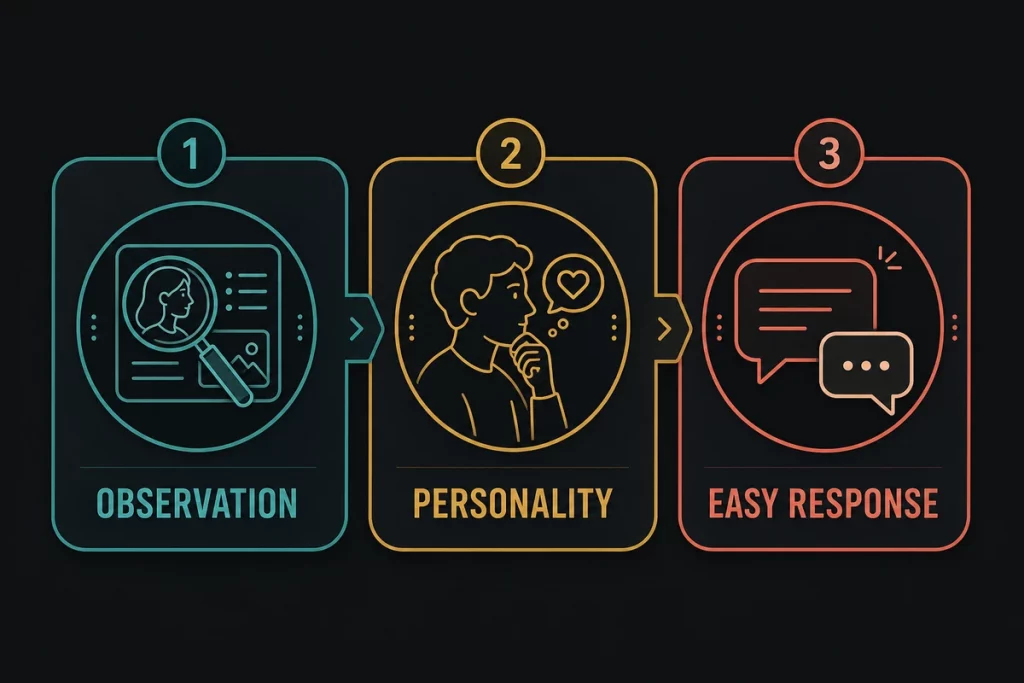
Part 1: The observation. Reference something specific from their profile — a photo location, a prompt answer, a bio detail, a pet, an activity. This demonstrates that you actually engaged with their profile rather than mass-messaging. “I notice you were at Glacier National Park” is better than “hey beautiful” because it proves you looked. The observation should be genuine — don’t fake interest in something you don’t care about, because the conversation that follows will expose the inauthenticity quickly.
Part 2: The personality reveal. Add something that shows your own personality — an opinion, a shared experience, humor, or a relevant personal detail. “I notice you were at Glacier National Park — I did the Grinnell Glacier trail last summer and it ruined all other hikes for me” reveals that you travel, hike, appreciate nature, and have enough enthusiasm to make a bold claim with humor. The personality reveal transforms a generic observation into a connection point — you’re not just acknowledging their profile; you’re creating shared territory.
Part 3: The easy response. End with something that makes responding easy — an open question, a light opinion to agree or disagree with, or an invitation that requires minimal commitment. “What was your favorite trail?” gives them a specific question. “Please tell me you did the Hidden Lake trail” creates playful energy with a low-stakes response. A clear conversational on-ramp gives an interested match something concrete to respond to, though many personal and situational factors still affect whether they reply.
The framework sounds simple — and it is. The difficulty isn’t understanding the structure; it’s executing it with authenticity rather than mechanical formula. The best openers feel natural and spontaneous even when they follow this structure, because the structure is invisible to the reader — they just experience a message from someone who seems genuinely interested, personally engaging, and worth talking to. Think of the framework as scaffolding: it supports the construction but gets removed before anyone sees the finished product. Your personality, humor, and genuine curiosity are the finished product — the framework just ensures they’re presented in a way that maximizes impact within the 5-second attention window that dating app messaging demands.
Tinder Best Opener Examples That Actually Work
Profile-Specific Openers
“Your dog has better posture than most humans I know. Is that a golden retriever mix? I have a lab who thinks he’s a lap dog despite being 80 pounds.” — Works because it’s specific (their dog photo), reveals personality (humor + dog owner), and invites easy response (breed question).
“That photo at the pottery wheel is great — how long have you been doing that? I tried a pottery class once and produced something my instructor diplomatically called ‘abstract.'” — Works because it references a specific hobby, shows genuine curiosity, and adds self-deprecating humor that’s inviting rather than pitying.
Prompt-Response Openers
“Your prompt says the way to your heart is through bad puns — challenge accepted. Why did the scarecrow win an award? Because he was outstanding in his field. I have worse ones if you’re interested.” — Works because it directly engages with their stated preferences, delivers on the engagement immediately, and offers continuation.
“You said your most controversial opinion is that pineapple belongs on pizza. I have a follow-up: does ranch dressing belong on pizza? Your answer determines whether this conversation continues.” — Works because it builds on their content, creates playful stakes, and gives them an easy, fun response opportunity.
Observation + Question Openers
“Three of your photos have incredible lighting — do you work in something creative, or do you just have a friend who’s secretly a professional photographer?” — Works because it compliments effort (not just appearance), shows observational intelligence, and asks a genuine question.
“I see you’ve been to Japan — I’m planning a trip for next year. One restaurant recommendation: go.” — Works because it’s specific, shows shared interest in travel, and the directive format is playful while being easy to respond to.
The Honest/Direct Opener
“Full transparency: I read your whole profile and now I have three follow-up questions, but I’ll start with one — what made you get into rock climbing?” — Works because it communicates genuine engagement (read the whole profile), sets a conversational tone (multiple questions signal sustained interest), and asks something specific that shows real curiosity.
“I’m going to skip the small talk — your prompt about childhood dreams made me genuinely curious. What was the dream, and how close did you get?” — Works because it signals emotional depth, references specific profile content, and asks an open-ended question that invites meaningful sharing rather than surface-level exchange.
The Playful Challenge Opener
“Your bio says you make the best tacos. That’s a bold claim. I’m going to need evidence — what’s your signature filling?” — Works because it engages with their stated identity, creates playful tension through the “challenge,” and invites them to talk about something they’re proud of (which people love doing).
“You say you can beat anyone at Mario Kart. I’m skeptical but intrigued. What’s your main character? Wrong answer and I’m unmatching immediately. (I’m kidding. Mostly.)” — Works because it’s playful, specific, creates low-stakes banter energy, and the parenthetical shows self-awareness about the joke’s intensity. The tinder best opener in the playful category succeeds when it creates a game-like dynamic where both people are having fun from message one.
The Worst Openers (and Why They Fail)
“Hey” / “Hi” / “What’s up” — These aren’t openers; they’re placeholders. They communicate “I want to talk to you but I’m not willing to invest any effort in how.” In a inbox of 50+ messages, these are invisible. Research confirms that single-word openers receive the lowest response rates of any message type across all dating platforms.
“You’re so beautiful” / “Wow, gorgeous” — Appearance compliments from strangers feel objectifying rather than flattering because the sender has no information about the person beyond photos. The subtext: “I swiped based on your looks and I have nothing else to say.” This opener also provides zero response path — what’s she supposed to say? “Thanks”? Dead end. Our green flags guide emphasizes that genuine interest manifests as curiosity about WHO someone is, not comments about how they look. The National Domestic Violence Hotline’s resources on healthy communication patterns confirm that respectful interest focuses on personality, values, and shared interests — not on evaluating someone’s physical appearance as a conversation opener.
“Do you come here often?” and other pickup lines — Pickup lines signal that you’re performing rather than connecting. They communicate inauthenticity because they’re obviously pre-scripted and interchangeable — the same line sent to every match. The tinder best opener is personal, not performative. A line that could be sent to anyone is a line that connects with no one. If you wouldn’t open a conversation with a friend-of-a-friend at a party using a scripted pickup line, don’t do it on an app — the social dynamics are identical even though the medium is different.
Sexual openers — Explicit or suggestive first messages produce almost zero response rates from people seeking genuine connections. They communicate that you view the match as a sexual opportunity rather than a person — which is the fastest route to being unmatched, reported, or blocked. Beyond being ineffective, overtly sexual openers contribute to the environment that makes dating apps feel unsafe for women — which is why platforms like GuyID exist to create trust-verified spaces where respectful communication is the baseline expectation.
The interview opener — “Where are you from? What do you do? What are you looking for?” Rapid-fire questions without offering anything about yourself create interrogation energy rather than conversational flow. Each question is generic enough to send to anyone, demonstrating zero profile engagement. The tinder best opener asks ONE specific, interesting question — not three generic ones that feel like a standardized intake form. If you want to know what she does for work, wrap it in context: “Your photos have serious creative energy — do you work in something design-related?” beats “What do you do?” every time because it shows you observed something specific before asking.
The negative opener — “I bet you won’t respond to this” or “Most people on here are boring but you seem different” or “I’m bad at these openers but here goes.” Self-deprecation, negging, and defeatism all communicate the same thing: low confidence wrapped in different packaging. The assumption of failure (“you won’t respond”), the backhanded compliment (“unlike most people”), and the preemptive excuse (“I’m bad at this”) all undermine the connection before it starts. Confidence — not arrogance, but the quiet assurance that you’re worth talking to — is what every effective opener communicates. Our red flags guide identifies negging as an early warning sign of manipulation patterns that escalate in relationships.
What to Do After the Opener Lands
The opener got a response — now what? The transition from opener to conversation determines whether the match converts to a date or fizzles into small talk that dies after 48 hours:
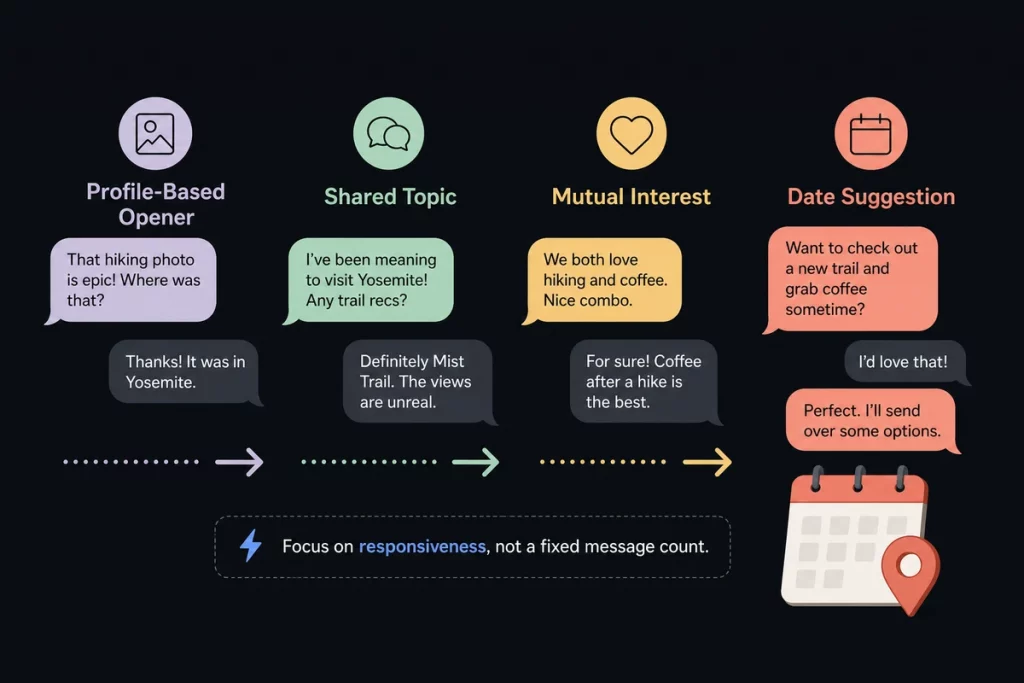
Build on what they share. If they answered your question about their favorite trail, don’t immediately pivot to a different topic — dig deeper into what they shared. “That trail sounds amazing — was that your first time in the park, or are you a regular?” demonstrates listening, sustained interest, and conversational depth. The genuine interest signals that apply in person apply in messaging too: people who build on what you share (rather than redirecting to themselves) communicate that they value your perspective.
Share proportionally. Notice the depth and length of their responses rather than rigidly matching every message. If they send brief replies while you repeatedly carry the conversation, the mismatch may signal different communication styles, limited availability, or uneven interest. Look for the broader pattern before labeling it breadcrumbing, and reduce your investment when reciprocity remains low.
Introduce light vulnerability gradually. The messaging phase between opener and date is where you transition from stranger to potential connection — and that transition requires gradually increasing authenticity. Early messages are witty and surface-level. By message 5-6, sharing something slightly more personal (“I’m actually nervous about this conversation going well — haven’t felt this kind of connection from a profile in a while”) signals emotional availability without overwhelming the conversation. The key word is “gradually” — too much vulnerability too fast reads as emotional dumping rather than authentic sharing. Our boundary-setting guide applies to digital communication as much as in-person interactions: share at the pace that feels right, and notice whether the other person reciprocates or retreats.
Suggest a date within 7-10 messages. Conversations that extend beyond 15-20 messages without a date suggestion typically lose momentum and die. The transition: “I’m really enjoying this conversation — would you be up for continuing it over coffee this week?” is direct, warm, and low-pressure. Waiting too long signals hesitation; moving too fast signals love bombing urgency. The 7-10 message range (roughly 2-3 days of exchange) provides enough familiarity to justify the date without enough time for momentum to fade.
Handle non-responses with grace. If your opener doesn’t get a response, don’t send a follow-up that expresses frustration or guilt-trips the other person. “Guess you’re not interested” or “Your loss” are the surest way to confirm that she made the right call by not responding. One follow-up is acceptable — something light like “No pressure, but I’d genuinely love to hear your take on [the thing you asked about]” — sent 3-4 days after the original. If the second message gets no response, move on. Ghosting at the opener stage isn’t personal — it reflects the volume dynamics of dating apps, not a judgment of your worth. The ghosting and dating guide provides the complete framework for handling non-responses with perspective rather than devastation.
Verify before meeting. Once a date is planned, share your Date Mode link through GuyID: “Before we meet — here’s my verified profile so you know I’m exactly who my pictures and bio say I am.” This gesture demonstrates transparency, builds trust, and differentiates you from every other match who hasn’t verified. Use GuyID’s free screening tools to verify your match as well — because the best opener in the world doesn’t protect you if the person behind the profile isn’t who they claim to be. Our reverse image search guide and romance scammer guide provide additional verification tools for the pre-date screening that protects both parties.
How GuyID Helps
GuyID should appear when it is useful, not as a banner ad. A GuyID Trust Profile gives someone a portable way to share trust signals before a date, while identity verification and social vouching help turn vague profile claims into clearer next steps.
Useful next steps:
- Create a GuyID Trust Profile when you want a cleaner way to share verified trust signals.
- Use GuyID free tools and related guides when you need a checklist before meeting someone.
- Treat identity verification as confidence-building, not a guarantee.
- Use social vouching when you want context from people who already know the person.
- Sign up only when the extra trust layer helps the decision you are already trying to make.
Frequently Asked Questions
What is the best first message on Tinder?
The tinder best opener references something specific from their profile, reveals your personality, and ends with an easy response path. Example: “[Observation about their profile] + [your relevant personality detail] + [specific question].” This formula works because it demonstrates genuine engagement, creates connection, and makes responding effortless. There’s no single best message — the best message is the one customized to the specific person you’re messaging.
Should I use the same opener for every match?
A reusable framework is fine, but customize the observation and question for each match. Repeated generic messages can feel impersonal, while a genuine profile detail shows that you paid attention. Personalization can improve relevance, but response decisions still depend on interest, timing, preferences, and many factors outside your control.
How long should a first message on Tinder be?
Two to three sentences (roughly 20-40 words). Long enough to demonstrate engagement and personality; short enough to be read without effort. Messages over 50 words feel like essays; messages under 5 words feel like low effort. The sweet spot communicates investment without overwhelming — like a good conversation starter at a party, not a monologue at a podium.
What if her profile is blank — no bio, minimal prompts?
Reference her photos specifically: a location, an activity, a pet, something in the background. “That sunset in your third photo is incredible — where was that taken?” works even without bio content because it demonstrates genuine attention. If the profile provides truly nothing to reference, a playful question works: “Your profile is mysterious — what’s one thing you’d want a match to know about you?” This acknowledges the blank profile without criticizing it while creating a response opportunity.
When should I send the first message after matching?
Within 24 hours. Matches that go unmessaged for more than a day lose momentum rapidly — the initial interest fades as both people continue swiping and new matches accumulate. The tinder best opener sent promptly demonstrates eagerness without desperation. Waiting days to appear “busy” or “not too eager” is a strategy from 2015 that no longer works — promptness signals genuine interest, which is attractive.