
Reader Briefing
Reader Briefing
Start here if you need a practical read on daters meaning: what it really means to be a dater in 2026: who should use verification, what signals to check, and what to do before moving from online interest to an in-person plan.
Who this is for
- People meeting someone from a dating app or social platform.
- Readers preparing for a first in-person date.
- Anyone checking identity, profile consistency, and trust signals.
- People trying to avoid romance scams, fake profiles, or pressure tactics.
You’ll learn
- How to evaluate identity signals without treating any single check as certainty.
- Which trust signals matter and how to weigh them together.
- How to spot inconsistencies, pressure, or behavior patterns that deserve caution.
- How to move from online conversation to a safer first meeting.
- Where GuyID tools fit into a quick pre-date screening workflow.
- How to compare options using practical safety and trust criteria.
Bottom line
Verification reduces uncertainty; it does not guarantee future behavior. Use a layered approach: confirm identity signals, compare profile consistency, ask for a short video call, keep early plans public, and slow down when someone pressures you to skip normal safety steps.
Key takeaways
- Identity verification improves confidence, not certainty.
- Patterns matter more than isolated incidents.
- Verify before meeting privately or sharing sensitive details.
- A short video call can reveal many inconsistencies.
- Pressure to skip reasonable safety steps is useful information.
Free Tools
Catfish Probability Detector
Check whether a dating profile has suspicious identity or photo signals.
Dating Bio Red Flag Detector
Review a bio for scam, pressure, or trust-warning language.
Dating Safety Checklist
Use free GuyID tools before moving from chat to a real date.
Next step
Create your GuyID trust profile
Share consent-based trust signals before a date without turning the conversation into an interrogation.
The word “dater” has evolved far beyond its dictionary definition — and understanding what daters meaning actually encompasses in 2026 reveals how dramatically the landscape of romantic pursuit has changed. A dater isn’t simply “a person who goes on dates.” In modern usage, daters meaning spans a spectrum from casual app users swiping between meetings to intentional relationship-seekers investing significant emotional and financial resources in finding partnership. The term carries different connotations depending on context: “serial dater” implies someone avoiding commitment, “intentional dater” suggests someone with clear standards, and “active dater” describes someone currently engaged in the dating process. This guide unpacks every dimension of daters meaning — the types, the psychology, the cultural shift, and what calling yourself a “dater” actually signals about your approach to connection in the modern world.
NavigateTable of Contents23 sections
The Full Definition: What Does Daters Meaning Actually Encompass?
At its most basic, daters meaning refers to people who are actively engaged in the dating process — meeting potential romantic partners through apps, in-person events, social connections, or any other channel. But the modern definition carries layers that the simple dictionary version doesn’t capture. According to the American Psychological Association’s research on relationship-seeking behavior, “dater” in contemporary usage implies active pursuit rather than passive availability — a person who has made the conscious decision to invest time, energy, and emotional resources in finding romantic connection.
The distinction matters because “being single” and “being a dater” are different states. A single person may not be actively seeking partnership — they may be focused on career, recovery, personal growth, or simply content without romantic pursuit. A dater, by definition, has entered the arena: they’ve created profiles, accepted setups, attended events, or otherwise signaled that they’re actively looking. Understanding daters meaning in this intentional sense helps explain why the term has developed such a rich vocabulary of subtypes — because HOW someone dates matters as much as WHETHER they date.
The word “dater” also carries a temporal dimension that “single” doesn’t. Being single is a status; being a dater is an activity. You can be single for years without being a dater for most of that time. You can be a dater for six months and then stop — returning to single-but-not-dating status. This activity-based understanding of daters meaning explains why people describe themselves as “taking a break from dating” rather than “taking a break from being single” — they’re pausing the active pursuit, not changing the underlying relationship status.
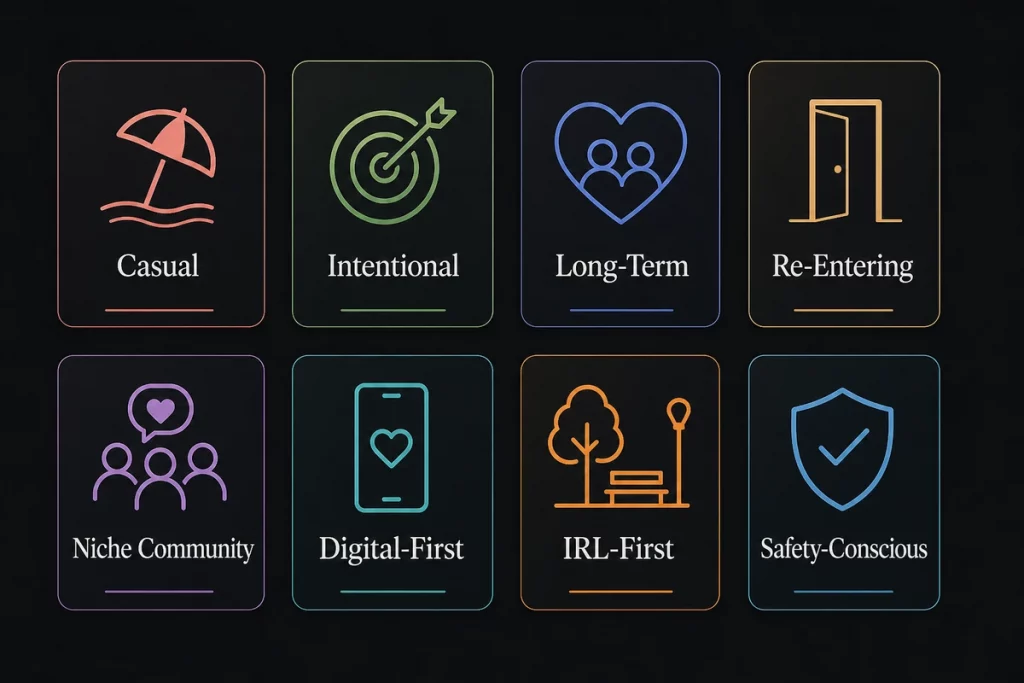
Types of Daters in 2026: The Full Spectrum
The Casual Dater
Dating without specific commitment goals — enjoying the process of meeting people, going on dates, and exploring connections without the pressure of “where is this going?” Casual daters maintain multiple low-investment connections simultaneously, prioritize fun over future-planning, and may or may not be open to something more serious if it develops organically. Understanding this category of daters meaning matters because casual dating is a legitimate approach — not a failure to commit. The key ethical requirement: transparency about intentions. Casual dating becomes problematic only when the casual dater allows others to believe the investment is deeper than it actually is.
The Intentional Dater
Dating with clear goals, defined standards, and deliberate evaluation criteria. Intentional daters know what they want (and what they won’t accept), approach each connection with purpose rather than impulse, and invest selectively rather than broadly. This type has grown significantly since 2020 as dating app fatigue pushed people toward quality over quantity. Intentional daters are the primary audience for green flag awareness, red flag recognition, and verification tools like GuyID — because intentional dating requires information to support deliberate evaluation.
The Serial Dater
Moving rapidly from one connection to the next — either through a series of short-term relationships or a pattern of dating many people simultaneously without deepening any single connection. In daters meaning vocabulary, “serial dater” carries a mild negative connotation: it implies avoidance of the vulnerability that genuine connection requires. But serial dating sometimes reflects a legitimate search process — trying many options to clarify what you actually want. The diagnostic question: is the pattern driven by exploration (healthy) or avoidance of intimacy (worth examining)? Our player warning signs guide helps distinguish between genuine exploration and the commitment-avoidant pattern that serial dating sometimes masks.
The Slow Dater
Deliberately pacing the dating process — taking weeks between dates with the same person, limiting app time to specific windows, and resisting the urgency that dating culture creates. Slow daters recognize that the swipe-match-message-date velocity of modern apps produces decision fatigue and shallow evaluation, so they intentionally decelerate. This approach is increasingly popular among people recovering from bad breakups or divorce who want to get it right rather than get it fast.
The Parallel Dater
Dating multiple people simultaneously before exclusivity is established — maintaining 2-5 active connections in various stages of development. Parallel dating is the default mode of app-based dating because the platform structure encourages it: you’re swiping and matching with new people even while developing conversations with existing matches. Ethically, parallel dating is acceptable when exclusivity hasn’t been discussed; it becomes breadcrumbing when one person is maintaining multiple connections specifically to avoid committing to any.
The Niche Dater
Dating within a specific community, demographic, or interest group — using niche platforms, attending community-specific events, or filtering mainstream apps by criteria that reflect lifestyle, values, or identity. Examples include widow dating, faith-based dating, expat dating, or profession-specific dating. Niche daters have concluded that general-audience platforms dilute their chances of finding compatible partners and prefer the higher compatibility rates (if lower total volume) of targeted communities.
The Digital-Only Dater
Someone who uses dating apps as their exclusive channel for meeting potential partners — no blind dates from friends, no meetups at bars, no singles events. Digital-only daters rely entirely on the app ecosystem for initial contact, using profiles, messaging, and video calls to evaluate potential before committing to an in-person meeting. This type represents the majority of daters under 40 and raises specific safety considerations around identity verification and scam prevention that in-person meeting channels don’t face.
The IRL Dater
Someone who deliberately avoids or minimizes dating apps in favor of meeting people through real-world channels: friends, events, community activities, classes, or serendipitous encounters. IRL daters often cite app fatigue, the desire for immediate chemistry assessment, or philosophical objections to the commodification of dating as their reasons. This type has grown since 2023 as the “anti-app” movement gained cultural momentum, with organized speed dating, singles mixers, and social clubs providing structured alternatives to digital platforms.
The Psychology of Being a Dater
Understanding daters meaning at the psychological level reveals why dating affects mental health, self-image, and emotional regulation in ways that other social activities don’t:
Identity vulnerability. Dating requires presenting yourself for evaluation — which activates the same psychological mechanisms as job interviews, auditions, and any other context where your worthiness is being assessed. Research from the National Library of Medicine on rejection sensitivity confirms that romantic evaluation activates stronger neurological responses than professional evaluation because the stakes feel more personal: you’re not being assessed for skills you can improve but for who you ARE as a person. This identity vulnerability explains why dating produces anxiety disproportionate to its actual risk — and why understanding daters meaning at the emotional level matters for anyone currently navigating the process.
Decision fatigue. Modern daters — particularly those on apps — make hundreds of micro-decisions daily: swipe left or right, respond or ignore, continue the conversation or let it die, suggest a date or wait longer. Each decision consumes cognitive resources, and the cumulative effect is the “dating fatigue” that the majority of active app users report. The paradox of choice compounds this: more options produce less satisfaction, not more, because each selection carries the awareness that you’re simultaneously rejecting the unchosen alternatives. This psychological load is a core part of daters meaning in the app era — being a dater in 2026 means being a constant decision-maker under conditions of extreme information overload and emotional exposure.
Hope-disappointment cycles. Every new match carries hope; every failed connection carries disappointment. Daters experience this cycle repeatedly — sometimes multiple times per week — which produces a rollercoaster emotional pattern that can mimic the intermittent reinforcement of trauma bonding in miniature. The match that responds enthusiastically then ghosts; the great first date with no second; the promising conversation that slow fades — each cycle teaches the dater’s nervous system that connection is unpredictable, which produces the protective cynicism that long-term daters often develop. This emotional dimension of daters meaning is rarely acknowledged but profoundly affects the quality of connections that eventually form.
Attachment activation. Dating activates the attachment system — the neurological infrastructure that governs how we bond, what we fear, and how we respond to connection and disconnection. For securely attached individuals, dating produces manageable anxiety. For anxiously attached individuals, dating can produce consuming preoccupation, rapid over-investment, and disproportionate distress when connections don’t develop. For avoidantly attached individuals, dating triggers the approach-avoid pattern that produces breadcrumbing behavior or commitment avoidance. Your attachment style fundamentally shapes your experience as a dater — and understanding that connection helps you navigate the process with more self-awareness and less reactive suffering.
Social comparison amplification. Dating — particularly app-based dating — places you in a context of constant social comparison. Every profile you view is implicitly compared to your own: are they more attractive, more successful, more interesting? Every match (or non-match) provides feedback about where you stand in the dating marketplace, and this constant evaluative feedback affects self-esteem in ways that other social contexts don’t replicate. Research on social comparison theory confirms that upward comparisons (viewing people who seem “better” than you) produce self-esteem decreases, while downward comparisons produce temporary boosts — and the random presentation of profiles on dating apps means you’re cycling through both comparison types dozens of times per session. This psychological dimension of daters meaning explains why many active daters report decreased self-confidence over time despite the process being designed to produce connection: the evaluation environment itself is corrosive to self-image when experienced in high volume.
The “dating persona” phenomenon. Many daters develop a curated version of themselves specifically for the dating context — a persona that emphasizes their most attractive qualities while minimizing perceived weaknesses. This dating persona isn’t necessarily deceptive (everyone puts their best foot forward in new social situations), but it creates an authenticity gap between who the dater presents and who they actually are. The gap produces anxiety (“will they still like me when they see the real version?”) and delays genuine connection (which requires authentic self-disclosure, not persona maintenance). The most successful daters are those who minimize the gap between persona and reality — which is why authentic dating bios that reflect genuine personality outperform curated ones that reflect an aspirational image.
How Dating Culture Has Changed the Meaning of “Dater”
The daters meaning that existed in 1990 bears almost no resemblance to the daters meaning that operates in 2026. Several cultural shifts have fundamentally transformed what it means to be a dater:
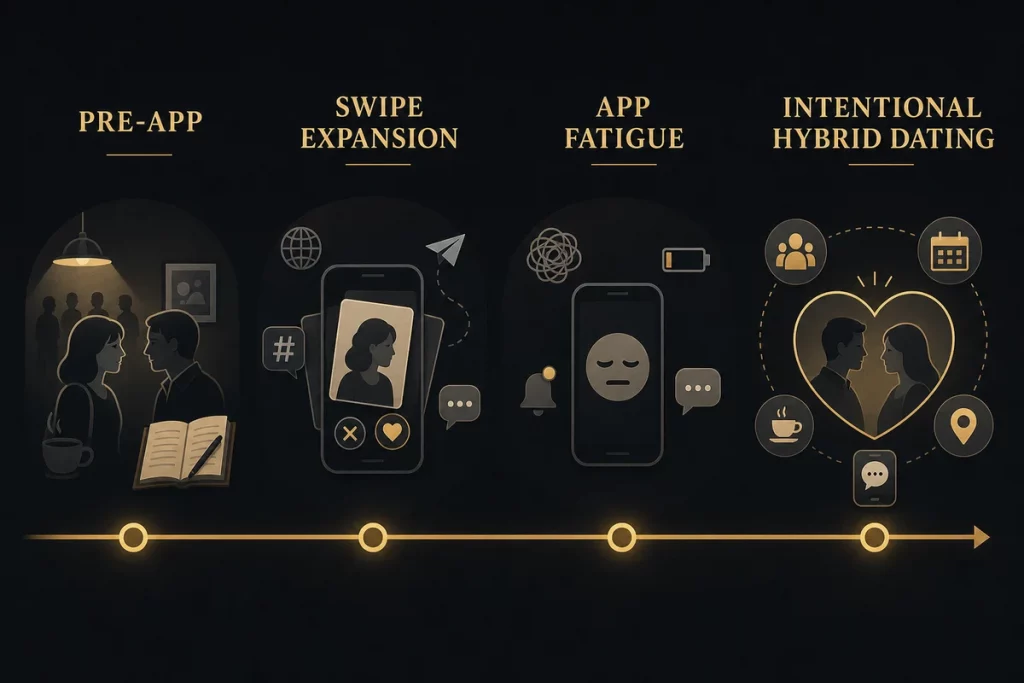
The app revolution (2012-present). Before dating apps, being a dater meant telling friends you were looking, going to social events, and accepting setups. The pool was limited to your immediate social geography. Dating apps exploded the pool to hundreds of thousands of potential matches — but also transformed dating from a social activity into a consumer activity, with all the paradox-of-choice, decision-fatigue, and commodification problems that consumer markets produce. Understanding daters meaning in the post-app era requires acknowledging that apps didn’t just change HOW people date — they changed what dating IS.
The pandemic acceleration (2020-2022). COVID-19 compressed a decade of dating evolution into two years: video dates became normalized, “what are your vaccination views?” became a compatibility screen, and the already-growing trend of intentional dating accelerated as people who’d spent months in isolation emerged with clearer priorities about what they wanted from partnership. The pandemic also widened geographic dating pools as remote work untethered people from location — making “long-distance dater” a more viable category than it had been pre-2020.
The safety consciousness shift (2022-present). The growing awareness of romance scams, narcissistic abuse patterns, love bombing, and gaslighting has transformed modern daters from naive optimists into informed evaluators. Today’s daters are more likely to Google a match before meeting, reverse image search profile photos, and use identity verification tools like GuyID. The safety-conscious dater represents a new category in daters meaning — someone who approaches dating with both openness to connection AND awareness of risk, using verification as a prerequisite rather than a paranoid afterthought.
The anti-app backlash (2024-present). The growing dissatisfaction with app-based dating has produced a counter-movement: organized singles events, social clubs, matchmaking services, and the revival of “friend-of-a-friend” introductions as a deliberate alternative to digital platforms. This backlash doesn’t reject technology entirely — many “anti-app” daters still use apps selectively — but it represents a cultural correction toward the in-person chemistry and social accountability that apps eliminated. The National Domestic Violence Hotline has noted that the accountability structures of community-based dating (where mutual friends provide natural background verification) provide safety protections that anonymous app-based dating doesn’t — adding a safety dimension to the anti-app cultural shift.
The Rise of Intentional Dating: Where Daters Meaning Is Heading
The dominant trend in modern dating culture is the shift from volume-based dating (meet as many people as possible) to intention-based dating (meet fewer people more deliberately). This shift has rewritten what daters meaning conveys:
Standards over settlement. Intentional daters define non-negotiables before entering the dating market — not preferences (tall, educated, funny) but standards (emotionally available, communicates honestly, respects boundaries). These standards function as filters that reduce the pool but dramatically increase the quality of connections that pass through. The intentional dater would rather have three excellent matches per month than thirty mediocre ones — a fundamental inversion of the quantity-maximizing logic that dating apps were built on.
Verification before investment. The intentional dater verifies before investing emotionally. Identity verification through GuyID, reverse image searches, and background checks aren’t paranoid behaviors for this dater type — they’re due diligence that protects the emotional investment they’re about to make. Sharing a Date Mode link through GuyID has become the intentional dater’s equivalent of exchanging business cards — a trust gesture that establishes transparency before the first meeting.
Process over outcome. The healthiest evolution in daters meaning is the shift from outcome-orientation (“I need to find my person”) to process-orientation (“I’m building the skills, self-knowledge, and connections that will make the right relationship possible when it arrives”). Process-oriented daters invest in therapy, self-awareness, communication skills, and personal growth alongside their dating activities — recognizing that the quality of the partner they attract is directly proportional to the quality of the person they’re becoming. This orientation produces less desperation, better boundaries, and healthier relationships when connections form — because the dater isn’t seeking someone to complete them but someone to complement an already-complete life.
Safety for Every Type of Dater
Regardless of where you fall on the daters meaning spectrum, certain safety principles apply universally:
Verify identity before meeting. Use GuyID’s free screening tools for government ID verification. Reverse image search profile photos. Google their name plus city. These steps take minutes and eliminate the most common forms of dating fraud. Share your own Date Mode link to demonstrate reciprocal transparency.
Meet in public first. Every dater type — casual, intentional, slow, parallel — should meet new connections in public settings for at least the first 2-3 encounters. Tell someone where you’re going and when you expect to return. Maintain transportation independence. These aren’t excessive precautions — they’re the baseline safety infrastructure that responsible daters build into their process automatically. The National Domestic Violence Hotline recommends these same protocols for anyone meeting a new person in a dating context, regardless of how the introduction occurred or how long you’ve been communicating beforehand.
Watch for patterns, not moments. A single red flag might be a bad day. A pattern of love bombing, gaslighting, manipulation, or inconsistency is data about who the person is. Our red flag quiz and green flags guide provide the structured evaluation frameworks that transform vague unease into actionable assessment — because every dater deserves the tools to evaluate connections accurately, not just hopefully.
How GuyID Helps
GuyID should appear when it is useful, not as a banner ad. A GuyID Trust Profile gives someone a portable way to share trust signals before a date, while identity verification and social vouching help turn vague profile claims into clearer next steps.
Useful next steps:
- Create a GuyID Trust Profile when you want a cleaner way to share verified trust signals.
- Use GuyID free tools and related guides when you need a checklist before meeting someone.
- Treat identity verification as confidence-building, not a guarantee.
- Use social vouching when you want context from people who already know the person.
- Sign up only when the extra trust layer helps the decision you are already trying to make.
Frequently Asked Questions
What does daters mean?
Daters meaning refers to people actively engaged in the dating process — meeting potential romantic partners through apps, events, or social connections. In modern usage, the term implies intentional pursuit of romantic connection (as opposed to passively being single), and encompasses a spectrum of approaches from casual dating to intentional relationship-seeking. The word carries different connotations depending on context: “serial dater” implies avoidance of commitment, “intentional dater” suggests clear standards, and “active dater” describes someone currently engaged in the search.
What are the different types of daters?
The main types include: casual daters (dating without specific commitment goals), intentional daters (clear standards and deliberate evaluation), serial daters (rapid movement between connections), slow daters (deliberately pacing the process). Parallel daters (multiple connections before exclusivity), niche daters (dating within specific communities), digital-only daters (exclusively app-based), and IRL daters (prioritizing in-person meeting channels). Most people shift between types depending on life stage, recent experiences, and relationship readiness.
Is being called a “dater” a good or bad thing?
Neutral — it simply describes someone actively and deliberately engaged in the dating process. The connotation depends on the modifier: “intentional dater” is positive, “serial dater” carries mild negative implications, “active dater” is purely descriptive. Being a dater means you’ve made the choice to pursue connection rather than waiting passively — which is a proactive, often courageous decision regardless of what type of dater you are.
How has the meaning of “dater” changed over time?
Before dating apps (pre-2012), “dater” simply meant someone who goes on dates — limited to their social geography and depending on friends, events, and chance encounters. The app revolution (2012+) transformed daters into consumer-like decision-makers navigating massive choice pools. The pandemic (2020-2022) accelerated the shift toward intentional dating. And the current era (2024+) has produced the safety-conscious, verification-oriented dater who combines openness to connection with awareness of risk. Understanding this evolution is central to understanding daters meaning in its current form.
How do I become a better dater?
Shift from volume to intention: define your non-negotiables, verify matches before emotional investment, pace yourself to prevent burnout, and invest in self-knowledge through therapy or reflection. Use GuyID’s free tools for identity verification, learn to recognize green flags and red flags, and approach dating as a process of mutual discovery rather than a performance to be judged. The best daters aren’t the ones who go on the most dates — they’re the ones who bring genuine self-awareness and honest communication to every connection.
What’s the difference between a dater and someone in a relationship?
A dater is someone actively engaged in the process of meeting and evaluating potential partners. A person in a relationship has found a specific partner and committed to developing that connection exclusively. The transition from “dater” to “in a relationship” typically involves a period of parallel dating that narrows to exclusive dating, then to official commitment. Understanding this progression is part of understanding daters meaning comprehensively. The term “dater” applies to the active search phase — once you’ve found your person and both agreed to exclusivity, you’re no longer a dater; you’re a partner.
Is it healthy to be a long-term dater?
Yes — as long as the extended dating period reflects genuine discernment rather than avoidance. Some people date for years before finding compatible partnership, and that timeline doesn’t indicate failure — it indicates standards. However, if long-term dating is producing chronic unhappiness, burnout, or cynicism, it’s worth examining whether the approach needs adjustment: are you selecting well? Are you available enough for genuine connection? Are unresolved patterns from past relationships affecting your evaluation? Our breakup recovery guide and dating after divorce tips address the specific barriers that can extend the dater phase beyond productive duration.