Reader Briefing
Reader Briefing
Start here if you need a practical read on is tinder safe? full safety review: who should use verification, what signals to check, and what to do before moving from online interest to an in-person plan.
Who this is for
- People meeting someone from a dating app or social platform.
- Readers preparing for a first in-person date.
- Anyone checking identity, profile consistency, and trust signals.
- People trying to avoid romance scams, fake profiles, or pressure tactics.
You’ll learn
- How to evaluate identity signals without treating any single check as certainty.
- Which trust signals matter and how to weigh them together.
- How to spot inconsistencies, pressure, or behavior patterns that deserve caution.
- How to move from online conversation to a safer first meeting.
- Where GuyID tools fit into a quick pre-date screening workflow.
- How to compare options using practical safety and trust criteria.
Bottom line
Verification reduces uncertainty; it does not guarantee future behavior. Use a layered approach: confirm identity signals, compare profile consistency, ask for a short video call, keep early plans public, and slow down when someone pressures you to skip normal safety steps.
Key takeaways
- Identity verification improves confidence, not certainty.
- Patterns matter more than isolated incidents.
- Verify before meeting privately or sharing sensitive details.
- A short video call can reveal many inconsistencies.
- Pressure to skip reasonable safety steps is useful information.
Free Tools
Catfish Probability Detector
Check whether a dating profile has suspicious identity or photo signals.
Dating Bio Red Flag Detector
Review a bio for scam, pressure, or trust-warning language.
Dating Safety Checklist
Use free GuyID tools before moving from chat to a real date.
Next step
Create your GuyID trust profile
Share consent-based trust signals before a date without turning the conversation into an interrogation.
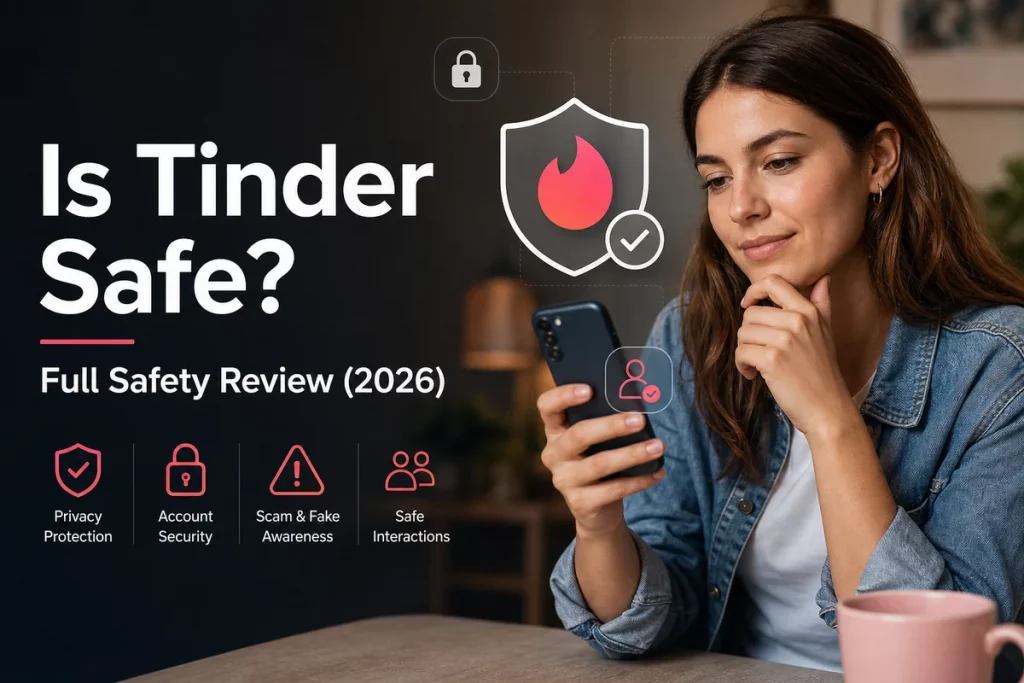
The honest answer is nuanced: Tinder has invested significantly in safety features including photo verification, AI message screening, and a partnership with Noonlight for emergency response. But fundamental gaps remain — the app verifies that you match your photos but doesn’t verify your name, age, criminal history, relationship status, or intentions. This comprehensive review breaks down exactly what Tinder does and doesn’t protect you from, the real risks backed by current data, how Tinder compares to Bumble and Hinge on safety, and the practical steps that close the verification gaps Tinder leaves open.
NavigateTable of Contents16 sections
What Tinder Does to Keep You Safe
Before answering “is Tinder safe,” it’s important to acknowledge the genuine safety infrastructure Tinder has built — because it is more extensive than most users realize:
Photo Verification. Tinder’s selfie verification system asks users to take a real-time selfie mimicking a specific pose, then uses AI to compare it against their profile photos. Verified users receive a blue checkmark. This eliminates the most basic catfishing where someone uses completely different images. The system has been updated multiple times since its 2020 launch and now uses video selfies for stronger matching. However, it only confirms appearance — not identity.
Automated message screening. In-app prompts may help users respond to potentially harmful interactions. Automated screening can miss context and does not guarantee that offensive messages or scams will be detected. Use current in-app report and block controls when needed.
Block and report functionality. Users can block and report profiles for various reasons including inappropriate behavior, scam suspicion, underage use, and offensive content. Reported profiles are reviewed by Tinder’s safety team, which operates 24/7. Repeat offenders face permanent bans, and severe violations (threats, exploitation) are escalated to law enforcement. Tinder also allows reporting after unmatching — so deleting the match doesn’t eliminate accountability.
Noonlight integration (U.S.). Tinder partners with Noonlight, a personal safety app that allows users to share their date details — location, time, who they’re meeting — with emergency dispatchers. The feature provides a panic button and automated safety check-ins before, during, and after dates. While it requires a separate app download, Noonlight integration represents Tinder’s most proactive safety feature for the physical meetup stage.
Background check partnership (Garbo). Tinder’s parent company Match Group has partnered with Garbo, a nonprofit background check platform, to enable users to run basic background checks on matches. The service searches for arrest records and sex offender registrations. However, adoption has been limited — the feature requires additional payment beyond the Tinder subscription and is only available in select markets.
Sex offender screening. Tinder screens user registrations against available sex offender registries. While coverage isn’t comprehensive (not all jurisdictions report to the databases Tinder accesses, and offenders can use fake names to circumvent the check), it provides a baseline filter that many competing dating apps don’t offer at all.
**Are You Sure? It’s a simple but effective friction point that discourages impulsive harmful behavior.
Is Tinder Safe? What It Doesn’t Protect You From
This is where the question “is Tinder safe” gets complicated. Despite the features above, significant verification gaps remain — and these gaps are where the real danger lives:
| Safety Gap | What It Means | Risk Level |
|---|---|---|
| No real name verification | Anyone can use any name — no government ID check required | High |
| No age verification | Age is self-reported with no documentation required | High |
| No criminal record check (standard) | Convicted offenders can create profiles using fake names | High |
| No relationship status check | Married users create profiles without any detection mechanism | Medium |
| No income/employment verification | Career and lifestyle claims are entirely unverified | Low-Medium |
| Photo verification ≠ identity | A verified photo proves face match — not who you actually are | High |
| No behavioral screening | Emotional abusers, narcissists, and manipulators pass all checks | High |
| No income verification | Financial claims (“I’m a surgeon,” “I own a company”) are unverified | Medium |
The critical insight: Tinder’s verification confirms appearance, not identity or safety. A person with a verified blue checkmark has proven they look like their photos. They have NOT proven: their real name, that they’re actually the age they claim, that they’re single, that they have no criminal history, that their career claims are real, or that they have good intentions. This verification gap is the primary reason the answer to “is Tinder safe” is conditional rather than absolute.
For a detailed analysis of what Tinder’s verification system actually proves (and doesn’t), see our guide on how Tinder verification works. For platform comparison, see safest dating apps 2026.
The Real Risks on Tinder (2026 Data)
Understanding the specific risks helps answer “is Tinder safe” with precision rather than speculation. Here are the documented threats, backed by current data:
Romance scams ($1.3B+ annually). The Federal Trade Commission reports over $1.3 billion lost to romance scams in 2025, with dating apps being the primary contact method. Tinder’s massive user base makes it a prime hunting ground for scammers who build emotional connections over weeks or months before requesting money — for “emergencies,” investment opportunities, or travel to meet you. The scam often begins with love bombing and rapid emotional escalation. See our guides on how to spot a romance scammer and how to report a scammer.
See our catfishing guide and fake profile red flags checklist.
Sexual assault and harassment. Research published by the National Library of Medicine has documented elevated rates of sexual assault and harassment associated with dating app meetings compared to traditional meeting methods. The risk is highest on first in-person meetings when identity hasn’t been independently verified — which is why pre-meeting verification is so critical.
Sextortion and blackmail. Scammers obtain intimate photos through Tinder conversations — often through initial rapport-building that feels genuine and mutual — then threaten to distribute them to the victim’s contacts, employer, or social media unless payment is made. This is one of the fastest-growing Tinder-related crimes, with the FBI’s Internet Crime Complaint Center reporting dramatic increases year over year. Victims include both men and women across all age groups. See our guide on online dating dangers.
Stalking and location exposure. Tinder shows approximate distance to matches, which sophisticated actors can exploit through triangulation — checking distance from multiple locations to narrow down where someone lives or works. While Tinder has implemented some protections (distance fuzzing, hiding exact distance at very close range), location-sharing remains a fundamental feature of proximity-based dating apps that creates inherent risk.
Emotional manipulation. No technology can screen for emotional manipulation tactics, narcissistic abuse patterns, or love bombing. These behavioral risks are arguably the most common form of harm from dating app use and the hardest to prevent through platform-level controls. A person can pass every verification check while still being manipulative, dishonest about their intentions, or emotionally dangerous. Watch for dating app red flags that technology can’t detect.
Tinder Safety vs. Bumble vs. Hinge
Is Tinder safe compared to its main competitors? Here’s a direct comparison of safety features:
| Feature | Tinder | Bumble | Hinge |
|---|---|---|---|
| Photo verification | Yes (video selfie) | Yes (selfie match) | Yes (selfie match) |
| Women-first messaging | No | Yes — women must initiate | No |
| AI message screening | Yes | Yes | Yes |
| Sex offender screening | Limited registry check | No built-in screening | No built-in screening |
| Background check option | Yes (Garbo, paid extra) | No | No |
| Safety app integration | Noonlight (U.S.) | No | No |
| “Are you sure?” intervention | Yes | Yes (similar feature) | No |
| Real name verification | No | No | No |
| Criminal record check (auto) | No | No | No |
| Identity verification | No | No | No |
The comparison reveals that Tinder actually has the most safety features among major dating apps — Noonlight integration, sex offender screening, the Garbo background check option, and the “Are you sure?” message intervention are features Bumble and Hinge don’t offer. Bumble’s women-first messaging model adds a meaningful layer of control over who initiates conversation, which reduces unwanted contact. Hinge’s prompt-based profiles provide more biographical information for cross-referencing.
But the core gap — no major dating app verifies identity, criminal records, or intentions — exists equally across all three platforms. The answer to “is Tinder safe” isn’t fundamentally different from “is Bumble safe” or “is Hinge safe.” The real question is: “Are dating apps safe?” And the answer is: only as safe as the personal verification steps you take.
For detailed platform comparisons: Is Bumble Safe? | Hinge Scams | Safest Dating Apps 2026
7 Steps to Stay Safe on Tinder
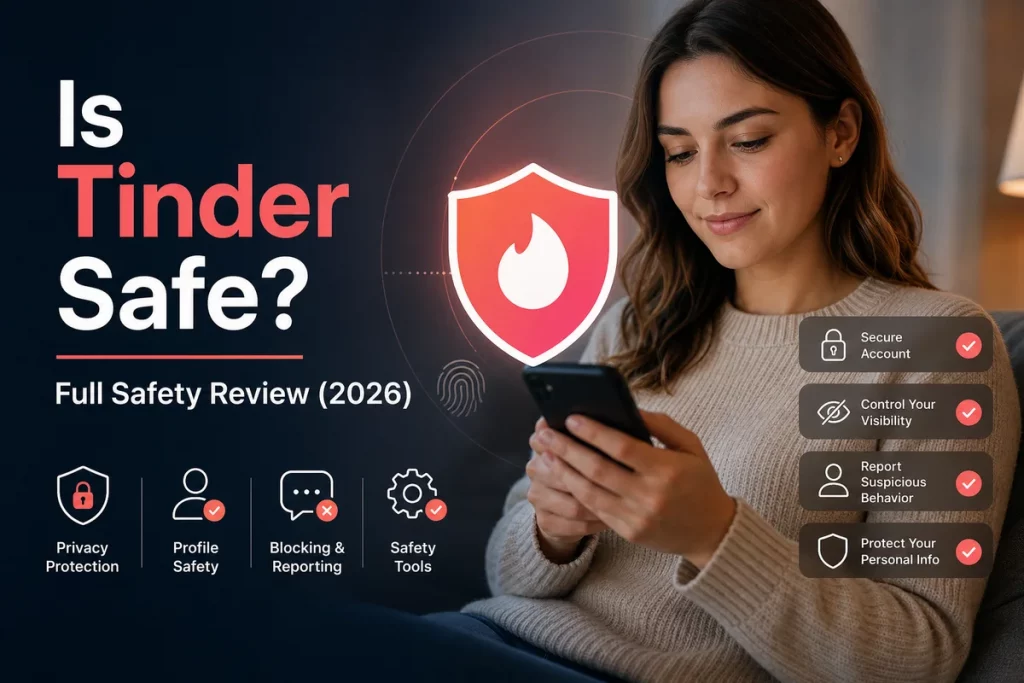
Rather than asking “is Tinder safe” as a binary question, the practical approach is making Tinder safer through personal verification habits that take 15-20 minutes total and cost nothing:
Step 1: Reverse image search their photos (2 min). Screenshot their profile photos and run them through Google Images, TinEye, and GuyID’s screening tools. This catches stolen photos that Tinder’s verification doesn’t detect — particularly on unverified profiles. Takes 30 seconds per photo. See our complete guide on reverse image search for dating.
Step 2: Cross-reference on social media (5 min). Search their first name + city + job on Facebook, Instagram, and LinkedIn. A genuine person has years of consistent social media history with real engagement, tagged photos from other people, and a digital footprint that matches their Tinder profile claims. A catfish has new accounts, minimal history, and suspicious engagement. Check for fake profile red flags.
Step 3: Video call before meeting (5 min). Request a FaceTime or Zoom call before any in-person date. This confirms the person matches their photos in real time, can hold a genuine conversation, and is willing to be seen. Two refusals after polite requests is a definitive red flag. No catfish survives a live video call — this remains the single most effective safety step you can take.
Step 4: Verify their phone number (3 min). When you exchange numbers, run a quick free phone lookup through Truecaller and WhitePages. Check for name consistency (does the registered name match what they told you?), VoIP/burner flags (is it a real carrier number or a disposable?), and community scam reports.
Step 5: Check the sex offender registry (1 min). Search their name on NSOPW.gov before meeting in person. This free, government-maintained database covers all 50 states. This 30-second check addresses one of the most serious physical safety risks and should be non-negotiable before any first date.
Step 6: Ask for GuyID verification (2 min). Share your Date Mode link and ask your match to verify through GuyID. Government ID verification confirms real legal identity — the information Tinder’s blue checkmark doesn’t provide. The Trust Score adds social vouching from real people, creating a verification layer beyond what any dating app or background check service offers. A person who welcomes verification demonstrates accountability; resistance is a data point worth taking seriously.
Tell a friend where you’re going, who you’re meeting, and when you expect to be back. Arrange your own transportation (don’t get in their car on a first date). Establish check-in times with your friend. Limit alcohol consumption on the first meeting. Trust your instincts — if something feels off, leave. See our complete first date safety guide.
**Total time for all 7 steps: ~18 minutes. It won’t catch sophisticated manipulators using their real identity — for that, you need the ongoing behavioral awareness covered in our dating app red flags and emotional manipulation tactics guides.
Is Tinder Safe for Women?
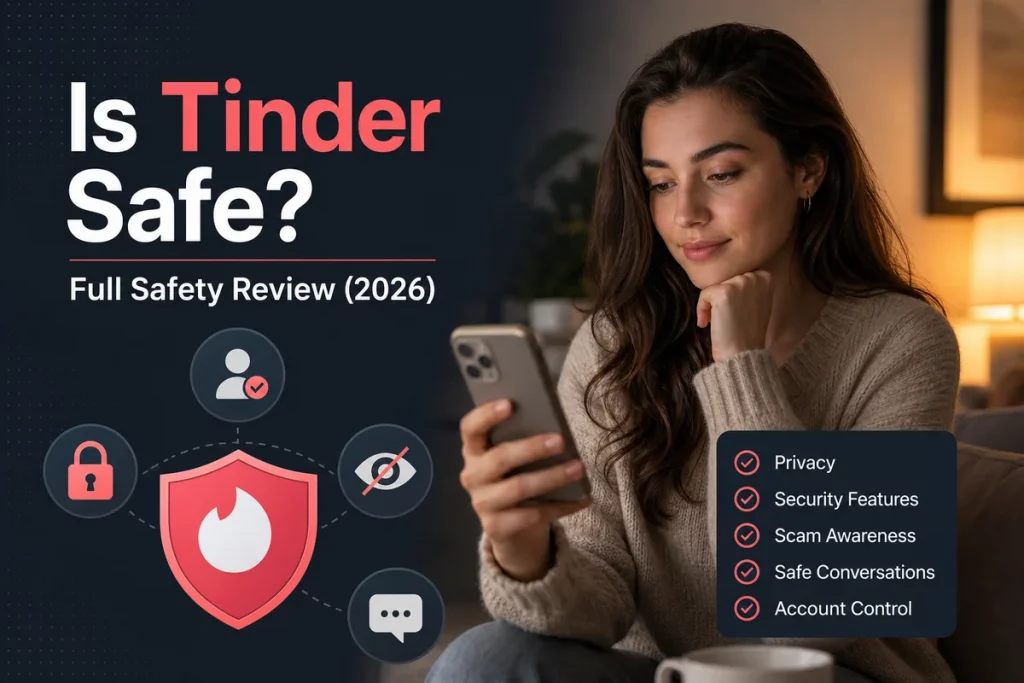
The safety question has a gendered dimension that deserves direct attention. Research consistently shows that women face elevated and distinct risks on dating apps compared to male users:
The frequency and severity of unsolicited explicit content is dramatically higher for women — which is why Bumble’s women-first messaging model exists as a structural response to this specific problem.
Greater physical safety concerns. Women are statistically more likely to experience physical aggression, stalking, and sexual violence from dating app connections. The physical vulnerability dynamic means that the pre-meeting verification steps outlined above are even more critical for female users. Never skip the video call, never get in a first date’s car, and always tell someone where you’re going.
More targeted by romance scams. While romance scams affect all genders, scammers frequently target women with specific tactics: claiming to be military personnel deployed overseas, creating elaborate sob stories designed to trigger nurturing instincts, and exploiting the emotional investment that women tend to make earlier in the connection. See our guide on military romance scam signs.
Sextortion dynamics differ. While both genders experience sextortion, the leverage used against women often includes threats to share intimate images with family members or employers — exploiting social stigma that disproportionately affects women. The advice is consistent regardless of gender: be extremely cautious about sharing intimate content with anyone you haven’t met and verified in person.
GuyID addresses this directly. GuyID verification is free for women specifically because women face elevated dating safety risks. The platform’s consent-based model — where men verify their identity and women check for free — is designed to shift the verification burden toward accountability rather than surveillance.
How GuyID Helps
GuyID should appear when it is useful, not as a banner ad. A GuyID Trust Profile gives someone a portable way to share trust signals before a date, while identity verification and social vouching help turn vague profile claims into clearer next steps.
Useful next steps:
- Create a GuyID Trust Profile when you want a cleaner way to share verified trust signals.
- Use GuyID free tools and related guides when you need a checklist before meeting someone.
- Treat identity verification as confidence-building, not a guarantee.
- Use social vouching when you want context from people who already know the person.
- Sign up only when the extra trust layer helps the decision you are already trying to make.
Frequently Asked Questions
Is Tinder safe to use in 2026?
Tinder offers safety and reporting features, but using it is not risk-free. Platform checks do not establish every user’s identity, history, or intentions. Keep early communication on-platform, verify important claims through independent sources, use a live video call, and plan first meetings in public.
Does Tinder verify users’ real identities?
No. Tinder verifies photos — confirming the person’s live selfie matches their profile pictures. It does NOT verify real names, ages, criminal records, relationship status, or employment claims. The blue verification checkmark means “face matches photos” — not “this person’s identity has been confirmed.” For government ID-level identity verification, use GuyID.
What are the biggest risks on Tinder?
The main risks include impersonation, romance scams, financial requests, harassment, coercion, and unsafe in-person meetings. Reduce exposure by keeping early conversations on-platform, verifying identity claims independently, refusing money requests, and meeting in a public place. See our online dating dangers guide for a fuller risk analysis.
Does Tinder do background checks?
Tinder screens registrations against some sex offender registries and has partnered with Garbo for optional paid background checks. However, standard Tinder use does not include automatic criminal background checks on all users. The Garbo integration requires additional payment, has limited market availability, and has seen limited user adoption. For a comprehensive free dating background check, use our 7-step protocol.
Is Tinder safer than Bumble or Hinge?
Tinder has the most built-in safety features — Noonlight, sex offender screening, Garbo, and “Are you sure?” message intervention. Bumble’s women-first messaging reduces unwanted contact. Hinge’s detailed prompts provide more verification data. But none verify identity or criminal records. Your personal safety practices matter far more than which app you choose. See our safest dating apps 2026 comparison for the full analysis.
How do I report someone on Tinder?
Open the profile → tap the three-dot menu (or shield icon) → select “Report.” Choose the reason and provide details. You can also report after unmatching. For serious incidents (threats, scams, assault), also file reports with the FBI IC3, FTC, and local police. Tinder reports alone may not result in criminal investigation — law enforcement reports are essential for serious crimes.
Can I get scammed on Tinder?
Yes. Tinder is one of the most targeted platforms for romance scams, catfishing, sextortion, cryptocurrency fraud, and identity theft. The large user base and casual interaction model create opportunities for scammers. Protect yourself with reverse image search, video calls before meeting, GuyID screening tools, and awareness of romance scam tactics. Never send money to someone you haven’t met in person.
What should I do before meeting a Tinder match in person?
Complete the 7-step protocol: (1) reverse image search their photos, (2) cross-reference on social media, (3) video call to confirm they match, (4) verify their phone number. (5) Check the sex offender registry, (6) share your GuyID Date Mode link for mutual verification. On the date itself: meet in public, tell a friend, arrange your own transportation, limit alcohol, and trust your instincts. See our first date safety guide.