
How Does Tinder Verification Work? What the Blue Check Really Proves (2026)
Tinder is the world’s most-downloaded dating app — and its blue verification checkmark is the most recognized trust signal in online dating. But how does Tinder verification work? What does the blue check actually confirm about the person you’re swiping on? And in a world where deepfake technology can generate convincing fake identities and AI bots send 60+ messages in 12 hours (McAfee Labs, 2026), is Tinder’s blue check still enough? With Tinder accounting for approximately 50% of all malicious dating app activity (McAfee Labs, 2026) and $1.3 billion lost to romance scams annually (FTC, 2026), understanding how Tinder verification works — and where it falls short — could save you thousands of dollars and weeks of emotional distress.
This guide explains the complete Tinder verification process, what the blue check proves and doesn’t prove, how it compares to competing platforms, how scammers bypass it, and the supplementary verification that actually closes the safety gaps Tinder leaves open. Whether you’re deciding whether to verify your own Tinder profile or evaluating a match’s blue check, this is the complete guide Tinder doesn’t give you.
How Does Tinder Verification Work: The Complete Step-by-Step Process
Understanding how Tinder verification works means understanding the exact sequence Tinder uses when you request the blue checkmark. The system is designed for speed — completing in under 30 seconds — with the goal of confirming that a real person’s face matches the profile photos.
Step 1: Access Photo Verification
Open Tinder, go to your profile, and tap the verification prompt. Tinder surfaces verification through multiple touchpoints — profile settings, the blue checkmark icon on your profile, and periodic in-app prompts encouraging unverified users to complete the process. Tinder has increasingly emphasized verification visibility, giving verified profiles preferential placement in the swipe stack.
Step 2: Pose-Based Selfie Capture
Tinder displays a specific pose for you to mimic — turning your head to a certain angle, tilting your chin, or positioning your face in a particular way. You take a live selfie while matching the on-screen pose. This is the core mechanism of how Tinder verification works: the pose ensures the verification is performed in real time (not pre-captured), and the facial positioning provides multiple angles for the AI to match against your profile photos.
Unlike Bumble’s gesture-based system (which requires performing an action like touching your ear), Tinder’s pose matching is purely facial positioning — you don’t need to use your hands or perform a specific action. This makes Tinder’s verification the fastest among major apps but also the most vulnerable to certain bypass techniques.
Step 3: AI Facial Matching
Tinder’s facial recognition AI compares the verification selfie against every photo in your profile. The system checks facial geometry (distance between eyes, nose bridge width, jawline shape), skin tone consistency, and overall facial structure. If the match exceeds Tinder’s similarity threshold across multiple profile photos, verification passes.
Step 4: Blue Checkmark Appears
Successfully verified profiles receive the blue checkmark — Tinder’s most recognizable trust indicator. The checkmark appears next to your name on your profile card, in the conversation list, and in the matching stack. Other users see the checkmark before deciding whether to swipe right, making it a significant first-impression factor.
Step 5: Algorithmic Benefits
Tinder verified users aged 18-25 see approximately 10% higher match rates (Tinder via Imagga, 2025). Verified profiles also receive enhanced visibility in the swipe stack — Tinder’s algorithm prioritizes showing verified profiles to other users, particularly to other verified users. This creates a verification flywheel: more verified users prefer matching with other verified users, increasing the incentive to verify.
What the Blue Checkmark Actually Proves
Now that you know the mechanics of how Tinder verification works, here’s what the resulting blue check genuinely confirms.
- Photo authenticity: The person who completed verification has the same face as the profile photos. The photos weren’t entirely stolen from someone else — the real human behind the verification selfie matches the uploaded images.
- Liveness (basic): A live person was present during verification. The system confirms the selfie was captured in real time, not a pre-recorded image or a photo of a photo. However, Tinder’s pose-based liveness check is the weakest among major apps — it doesn’t require hand gestures (Bumble) or sustained video capture (Hinge).
- Algorithmic preference: Tinder’s systems identify this profile as verified and give it enhanced visibility, creating a matching advantage that is itself a form of soft validation (the profile has been through an additional screening step).
In straightforward terms: Tinder’s blue check says “a real person who looks like these photos was present when this verification was taken.” For the majority of casual catfish — people using entirely stolen photos from Instagram or Facebook — this is sufficient to expose the deception. The photos won’t match a different human’s face.
What Tinder Verification Does NOT Prove: The Gaps That Matter
Understanding how Tinder verification works is incomplete without understanding what it explicitly does not check. These gaps explain why Tinder accounts for 50% of malicious dating app activity despite having verification — the badge confirms appearance, not identity, character, or safety.
| What Users Think the Blue Check Means | What It Actually Means |
|---|---|
| “Tinder confirmed this person’s identity” | A selfie matched profile photos in a specific pose |
| “This person’s name is real” | Name is self-reported — no verification against any document |
| “This person is the age they claim” | Age is self-declared — no ID or document check |
| “This person’s job/school is real” | Career and education are self-reported with zero verification |
| “Tinder screened this person for safety” | No criminal background check, no screening of any kind |
| “This person is single” | Relationship status is not checked or verified |
| “I can trust this person more than unverified profiles” | The badge means photos match — scammers with AI photos can also receive badges |
Every field on a Tinder profile — name, age, job, school, bio, distance, and interests — is self-reported with zero cross-referencing against any external source. The blue check adds one layer: the photos show a real person. Everything else attached to those photos remains unverified. This is the trust gap in its most visible form — a badge that implies comprehensive verification while delivering only photo matching.
The 50% Problem: Why Tinder Has the Most Scam Activity Despite Verification
A critical context for understanding how Tinder verification works: Tinder accounts for approximately 50% of all malicious dating app activity (McAfee Labs, 2026). This makes Tinder simultaneously the world’s most popular dating app and the platform with the most fraud. Understanding why explains the limitations of verification at scale.
Scale Creates Opportunity
Tinder’s 75+ million monthly active users create the largest attack surface in online dating. For scammers, volume matters — more potential targets means more potential victims. Tinder’s swipe-based model, where users evaluate profiles in seconds and match in volume, is optimized for speed over scrutiny. Users spend an average of 2-3 seconds evaluating each profile before swiping — insufficient time for meaningful assessment, even with a blue checkmark visible.
Verification Doesn’t Scale Against Sophistication
Tinder’s photo-matching verification was designed when the primary threat was stolen photos (pre-2024). In 2026, the threat landscape includes AI-generated photos that no reverse image search can find, deepfake face-swapping that can pass pose-based verification, and AI chatbots that maintain convincing conversations across dozens of targets simultaneously. The verification system hasn’t fundamentally evolved while the threats have transformed entirely.
The Verification Paradox on Tinder
Because Tinder users trust verified profiles more (10% higher match rates for verified users 18-25), a scammer who obtains a blue check receives disproportionate trust. The badge becomes an amplifier — making the scammer appear more credible than an unverified scammer while providing no more actual safety than an unverified profile. This is why understanding how Tinder verification works matters: the blue check can increase your risk if you treat it as proof of safety rather than one limited data point.

How Scammers Get Verified on Tinder
The most sobering dimension of how Tinder verification works is how organized scam operations circumvent it. Each bypass method exploits specific weaknesses in the pose-based photo matching approach.
Method 1: Deepfake Pose Bypass
Real-time deepfake face-swapping software overlays an AI-generated face onto the scammer’s real face during the verification selfie. The scammer’s face moves into the required pose; the software renders the synthetic face in the same position. The AI-generated verification selfie matches the AI-generated profile photos — and Tinder’s system approves the verification. Because Tinder requires only a static pose (not Bumble’s gesture or Hinge’s video), this is the easiest major-app verification to bypass with deepfakes.
Method 2: Accomplice Verification
A real person — friend, paid participant, or recruited accomplice — provides their real photos for the profile and completes verification using their actual face. The badge is awarded legitimately. The scammer then takes over operational control of the account, using the accomplice’s photos and earned badge to approach targets. The verification is technically valid — a real person matched real photos — but the operator is now someone else entirely.
Method 3: Verify-Then-Swap
The scammer creates a Tinder profile with their own real photos, completes verification legitimately (their real face matches their real photos), and receives the blue check. They then gradually replace profile photos with AI-generated or stolen images of a more attractive person. If Tinder’s system doesn’t require re-verification after photo changes — or only flags dramatic changes — the blue check persists despite the profile now displaying photos of a different (fictional) person.
Method 4: Account Purchase
A growing underground market sells pre-verified Tinder accounts. Someone creates an account, completes verification with their real identity, and sells the verified account to a scammer who replaces the photos and operates the profile. The verification was legitimately earned by the original account creator — but the current operator is a fraud. Understanding that Tinder verification can be transferred through account sales reveals a structural vulnerability in the badge system.
A Tinder blue check means “someone passed a photo matching test on this account at some point.” It does not mean “the person currently operating this account is the person who verified it.” It does not mean “the photos currently on this profile are the same ones that were verified.” And it definitely does not mean “this person is safe to trust.” Every bypass method above is documented and used at scale by the 630,000+ scam operators identified by SpyCloud (Feb 2026).
How Tinder Verification Compares to Bumble, Hinge, and GuyID
Placing how Tinder verification works against competing platforms reveals where Tinder sits in the verification spectrum — and what’s needed to close the gaps.
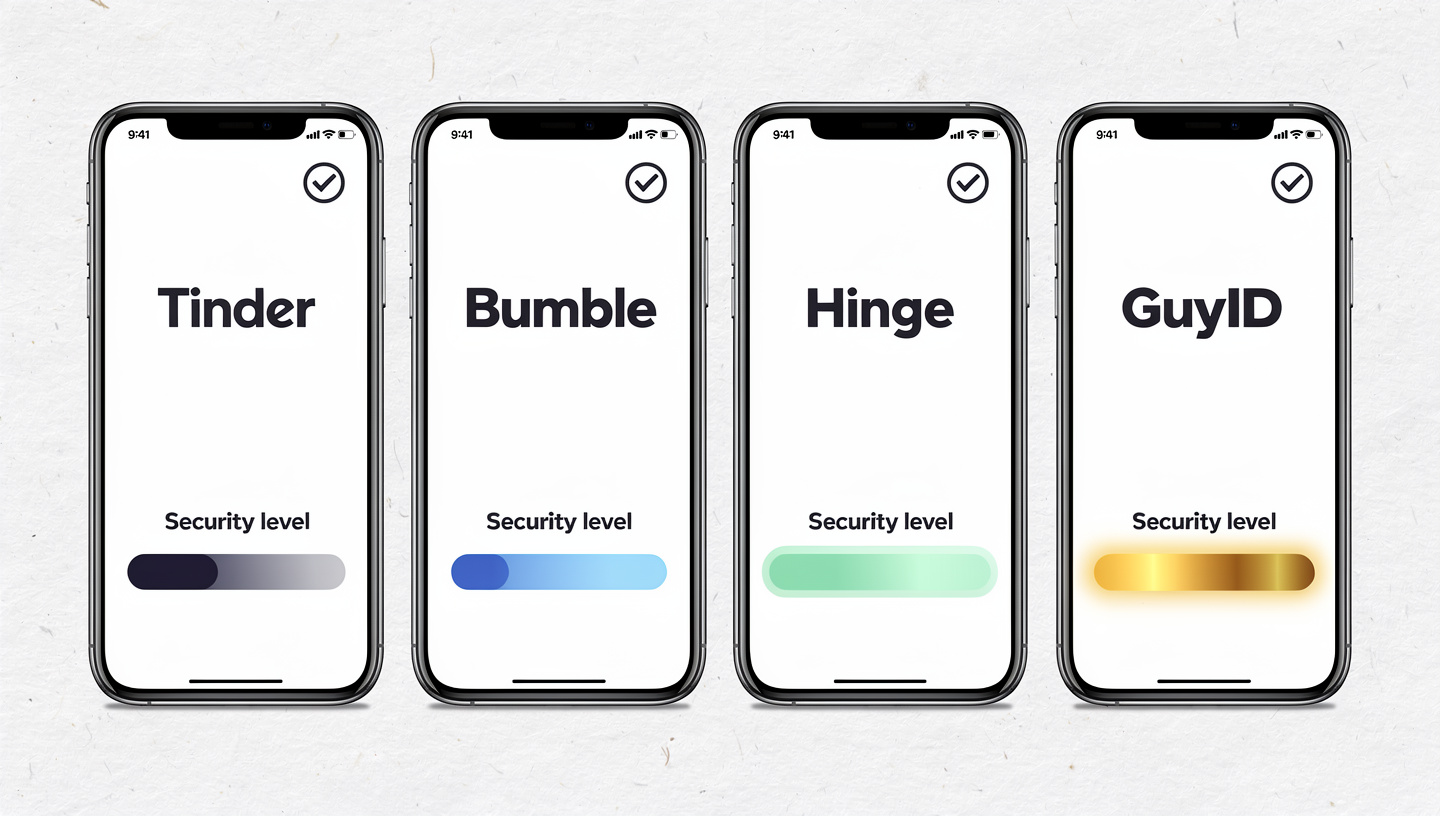
| Feature | Tinder | Bumble | Hinge | GuyID |
|---|---|---|---|---|
| Method | Pose selfie | Gesture + selfie | Video selfie | Gov ID + vouching |
| Liveness strength | Basic (static pose) | Medium (gesture) | Strong (video) | N/A (document-based) |
| Deepfake resistance | Low | Low-Medium | Medium | Very High |
| Confirms legal identity | ❌ | ❌ | ❌ | ✅ |
| Confirms character | ❌ | ❌ | ❌ | ✅ (social vouching) |
| Cross-platform | ❌ | ❌ | ❌ | ✅ (portable link) |
| Matching impact | ~10% higher (18-25) | 80% Gen Z preference | 200%+ more dates | All platform benefits |
Tinder has the weakest liveness confirmation (static pose vs. Bumble’s gesture vs. Hinge’s video) and the highest scam activity (50% of malicious dating app activity). This combination makes Tinder the platform where supplementary verification is most critical — and where understanding the limits of how Tinder verification works has the most direct safety implications.
For the detailed comparison across all platforms, see our complete guide to which dating apps have identity verification.
Should You Get Verified on Tinder? (Yes — But Don’t Stop There)
Despite Tinder verification’s limitations, getting verified is unambiguously worth it for every Tinder user. The question isn’t whether to verify on Tinder — it’s what to do beyond Tinder’s verification to actually ensure your safety.
Why You Should Verify
- Matching advantage: Verified users 18-25 see ~10% higher match rates (Tinder via Imagga, 2025). In a volume-based matching environment, 10% more matches translates to significantly more conversations and potential connections.
- Algorithmic visibility: Tinder’s algorithm shows verified profiles more prominently, meaning more people see your profile even before swiping decisions are made.
- Trust signal: The blue check tells potential matches “I’m a real person willing to take a basic verification step” — differentiating you from the estimated 25% of profiles that are fake or bot-operated (McAfee, Feb 2026).
- Speed: The process takes under 30 seconds. No reason not to.
Why You Shouldn’t Stop at Tinder Verification
On the platform with 50% of malicious dating app activity, the blue check catches casual catfish but provides no protection against the sophisticated operations that constitute the real danger. Tinder’s verification is the floor of your safety strategy, not the ceiling. The proactive dating safety approach layers additional verification on top of Tinder’s badge.
The Optimal Tinder Strategy: Blue Check + GuyID
Get verified on Tinder (30 seconds) for the matching advantage and basic trust signal. Then create a GuyID Trust Profile (government ID + social vouching + Trust Tiers) for comprehensive identity verification that Tinder can’t provide. Add your GuyID Date Mode link to your Tinder bio — this gives every potential match instant access to your verified real-world identity, turning a basic blue check into a comprehensive trust profile.
A Tinder profile that reads “Blue check verified ✓ + identity verified on GuyID → [Date Mode link]” communicates: “I’ve passed Tinder’s photo check AND confirmed my real identity through government ID AND real people vouch for me.” On a platform where 50% of activity is malicious, this layered signal is the most powerful differentiator available.
How to Evaluate a Verified Tinder Match’s Authenticity
When you encounter a verified Tinder match, the blue check is your starting point — not your conclusion. Here’s the complete evaluation process, building on your understanding of how Tinder verification works and its limitations.
The 5-Step Tinder Match Verification
- GuyID reverse image search — Screenshot their main photo and search. Even verified profiles may use AI-generated photos that passed the pose check, or the profile may have been photo-swapped post-verification. (30 seconds)
- Catfish probability detector — Enter profile details for an objective, holistic risk assessment. Particularly valuable on Tinder where the swipe-speed environment suppresses critical evaluation. (10 seconds)
- Bio red flag detector — Tinder bios are short, making scam-language patterns harder to spot manually. The automated detector catches what the character limit obscures. (10 seconds)
- Video call within the first week — Tinder doesn’t have built-in video calling in all regions. If unavailable, move to FaceTime/WhatsApp video for this step. Apply active deepfake detection: full head turns, hand-over-face, room changes. (5-15 minutes)
- Request their GuyID Trust Profile — The definitive confirmation: government ID verified, social vouches confirmed, Trust Tier earned. The one check no scammer can pass, regardless of how they obtained their Tinder blue check. (2 minutes to check, free for women)
Red Flags Specific to Verified Tinder Profiles
- Blue check + immediate off-platform pressure: A verified profile that pushes to WhatsApp within the first few messages may have obtained the badge specifically to build trust before migrating to an unmonitored channel. Verification adds credibility to the migration request — “I’m verified, you can trust me, let’s continue on WhatsApp.” This is the verification paradox in action.
- Blue check + zero Spotify/Instagram links: Tinder allows linking Spotify and Instagram accounts. These additional connections provide organic identity signals (years of listening history, real social media activity). A verified profile with no linked accounts may have been created specifically for scam purposes — verified but with no depth of digital identity.
- Blue check + suspiciously perfect photos: If every photo looks like it came from the same AI generation session (consistent lighting, similar aesthetic, no friends, no variety of settings), the profile may have been verified with deepfake technology. A genuine person’s camera roll includes casual, imperfect photos alongside good ones. A uniformly perfect photo set — even with a blue check — warrants suspicion.
- Blue check + generic bio: Tinder’s 500-character bio limit makes specificity harder, but genuine people still include concrete details. “Love hiking, coffee, dogs” is so generic it could be auto-generated. “Section hike of the AT last summer, pour-over snob, rescue mutt named Doug” is specific, verifiable, and human. A blue check combined with a purely generic bio suggests a profile created for volume operation rather than genuine connection.
Supplementing Tinder Verification: How GuyID Closes the Gaps
The complete picture of how Tinder verification works reveals specific gaps. GuyID was designed to close exactly these gaps — providing the verification layers that Tinder’s photo matching cannot deliver.
What GuyID Adds to Your Tinder Experience
- Government ID verification: Biometric matching against official documents confirms legal identity — the verification that no dating app provides. Real name, real face, government-confirmed existence. AI cannot generate legitimate government ID.
- Social vouching: Real friends and colleagues confirm identity and character — the human judgment layer that no algorithm or document can replace. A scammer cannot produce genuine vouches from real people who will stake their reputation.
- Trust Tiers: Progressive indicators (GHOST → STARTER → BUILDER → TRUSTED → ELITE → LEGEND) show sustained trustworthiness over time. Scammers operating disposable accounts can’t accumulate trust that requires weeks and months of consistent verified behavior.
- Portability beyond Tinder: When your conversation inevitably moves from Tinder to WhatsApp or text, your Tinder blue check disappears. Your GuyID Trust Profile travels via a portable Date Mode link — maintaining verified trust across every channel your relationship traverses.
The Safety Math
Tinder verification alone: photo matching with known bypass vulnerabilities. Tinder verification + GuyID free safety tools: photo matching + reverse image search + catfish detection + bio analysis. Tinder verification + GuyID Trust Profile: photo matching + government ID + social vouching + progressive trust tiers + cross-platform portability. Each layer reduces risk. Together, they close the trust gap that Tinder’s blue check alone leaves open.
For women on Tinder: checking a match’s GuyID Trust Profile is free, always. The 2 minutes it takes to check a Trust Profile before meeting provides the safety information that Tinder’s blue check — and all your swiping intuition — cannot deliver. For men on Tinder: creating a verified GuyID Trust Profile and sharing the Date Mode link in your bio produces a competitive advantage that goes beyond the 10% match rate improvement of Tinder’s blue check alone.
Summary: The Full Truth About How Tinder Verification Works
How does Tinder verification work? It uses a pose-based selfie to confirm that a real person’s face matches the photos on a Tinder profile. The process takes under 30 seconds, produces the recognizable blue checkmark, and provides a ~10% match rate advantage for users 18-25. It’s fast, free, and every Tinder user should complete it.
What the blue check proves: someone who looks like the profile photos was alive and present during verification. What it does NOT prove: name, age, career, education, relationship status, criminal background, character, or intentions. Every biographical field on a Tinder profile remains self-reported and unverified. The blue check is a photo check, not an identity check.
Tinder accounts for 50% of malicious dating app activity (McAfee Labs, 2026) despite having verification — because photo matching doesn’t prevent AI-generated identities, deepfake verification bypass, accomplice-based verification, or post-verification photo swapping. These aren’t theoretical vulnerabilities — they’re operational techniques used by 630,000+ scam operators daily.
The proactive safety strategy on Tinder: verify your own profile (30 seconds, matching advantage), add your GuyID Trust Profile Date Mode link to your bio (comprehensive identity verification), evaluate every match using GuyID’s free tools (reverse image search, catfish detection, bio analysis), request video calls with active deepfake testing, and check matches’ GuyID Trust Profiles before meeting.
Understanding how Tinder verification works is essential. Understanding its limitations is more important. And supplementing it with the verification tools and identity verification platforms that close its gaps is what actually keeps you safe. The blue check is where safety starts on Tinder — not where it ends.
GuyID provides the identity verification Tinder’s blue check doesn’t: government ID confirmation, social vouching, Trust Tiers, and portable trust profiles. 60+ free safety tools. Women check for free.
Frequently Asked Questions About How Tinder Verification Works
How does Tinder verification work?
Does the Tinder blue check mean someone is safe?
Can scammers get the Tinder blue check?
Should I get verified on Tinder?
How is Tinder verification different from Bumble’s?
Why does Tinder have so many scammers if it has verification?
How do I check if a verified Tinder match is real?
Does Tinder verification check your real identity?

Founder, GuyID · Dating Safety Researcher · 13+ Years in Data Analytics
Ravishankar Jayasankar is the founder of GuyID, a consent-based dating trust verification platform. With 13+ years in data analytics and a deep focus on consumer trust, Ravi built GuyID to close the safety gap in digital dating. His research found that 92% of women report dating safety concerns — validating GuyID’s mission to make online dating safer through proactive, consent-based verification. GuyID offers government ID verification, social vouching, a Trust Tiers system, and 60+ free interactive safety tools.


