Reader Briefing
Reader Briefing
Start here if you need a practical read on dating app safety features compared: every platform side by side: who should use verification, what signals to check, and what to do before moving from online interest to an in-person plan.
Who this is for
- People meeting someone from a dating app or social platform.
- Anyone checking identity, profile consistency, and trust signals.
- People trying to avoid romance scams, fake profiles, or pressure tactics.
- Online daters improving conversations, profiles, or match screening.
You’ll learn
- How to evaluate identity signals without treating any single check as certainty.
- Which trust signals matter and how to weigh them together.
- How to spot inconsistencies, pressure, or behavior patterns that deserve caution.
- How to move from online conversation to a safer first meeting.
- Where GuyID tools fit into a quick pre-date screening workflow.
- How to compare options using practical safety and trust criteria.
Bottom line
Verification reduces uncertainty; it does not guarantee future behavior. Use a layered approach: confirm identity signals, compare profile consistency, ask for a short video call, keep early plans public, and slow down when someone pressures you to skip normal safety steps.
Key takeaways
- Identity verification improves confidence, not certainty.
- Patterns matter more than isolated incidents.
- Verify before meeting privately or sharing sensitive details.
- A short video call can reveal many inconsistencies.
- Pressure to skip reasonable safety steps is useful information.
Free Tools
Catfish Probability Detector
Check whether a dating profile has suspicious identity or photo signals.
Dating Bio Red Flag Detector
Review a bio for scam, pressure, or trust-warning language.
Dating Safety Checklist
Use free GuyID tools before moving from chat to a real date.
Next step
Create your GuyID trust profile
Share consent-based trust signals before a date without turning the conversation into an interrogation.
Every dating app claims to prioritize safety. Tinder advertises its verification badge. Bumble markets women-first messaging. Hinge promotes its “designed to be deleted” philosophy. But when you compare dating app safety features side by side — stripping away the marketing and examining what each feature actually does — the picture is very different from what any single app’s marketing suggests.
This guide compares every safety feature across every major dating platform in 2026: Tinder, Bumble, Hinge, POF, Facebook Dating, OkCupid, Match.com, The League, and eHarmony. Each feature is evaluated on what it protects against, what it misses, and its real-world impact.
NavigateTable of Contents26 sections
⚡ Key Takeaways
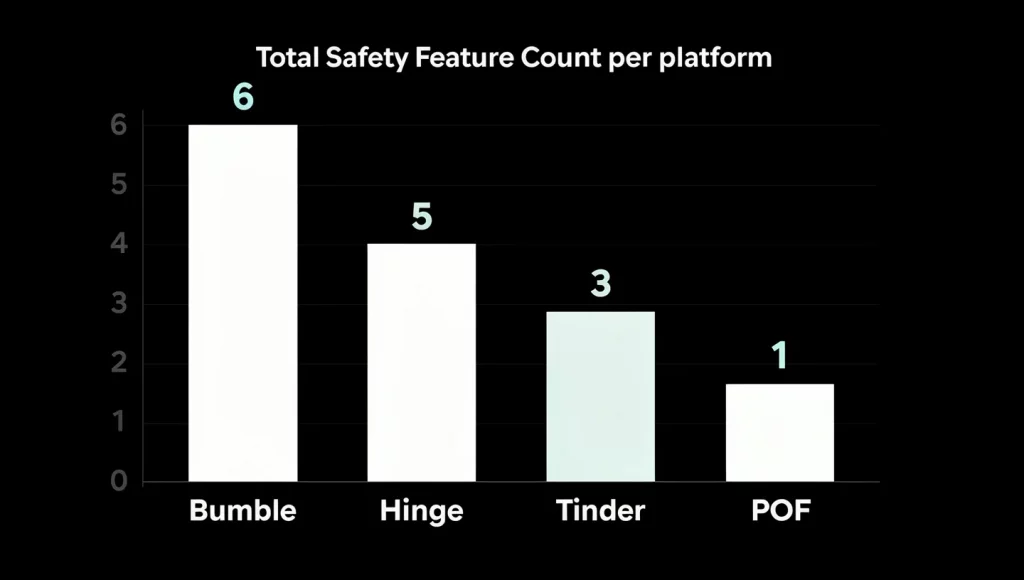
Bumble leads on feature breadth — Hinge leads on feature depth
Bumble has the most safety features (women-first, gesture verification, in-app video, Private Detector, match expiration).
Every app scores zero on identity verification
The most important safety feature — confirmed legal identity — is absent from every platform. All verify photos. None verify the person.
POF has the fewest features and highest fake rate
GuyID fills the gap that all apps share
GuyID provides government ID verification, social vouching, Trust Tiers, and 60+ free safety tools — the identity layer every app lacks.
The Complete Dating App Safety Features Matrix
This is the definitive side-by-side comparison of dating app safety features across all major platforms in 2026.
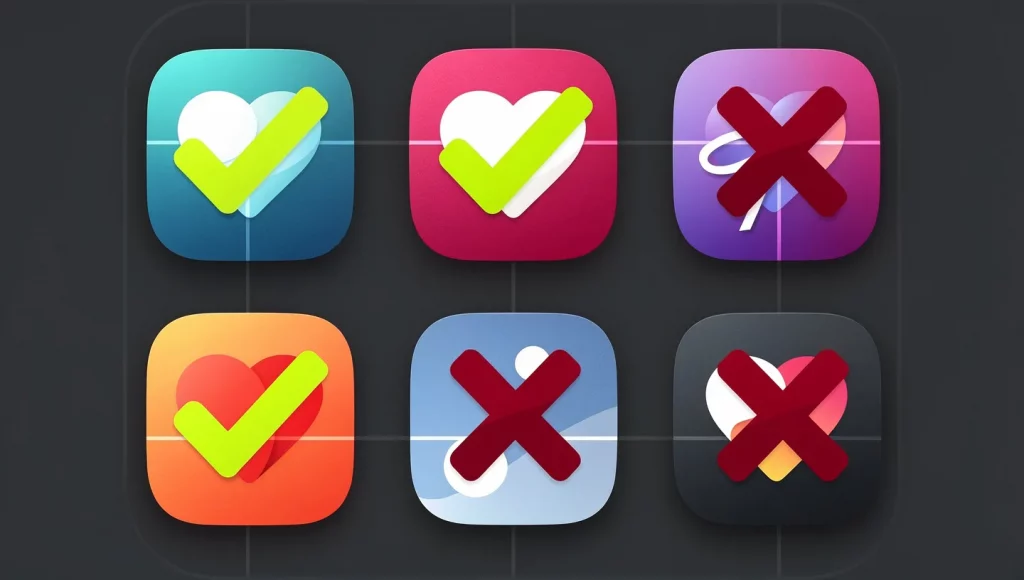
| Safety Feature | Bumble | Hinge | Tinder | Match | eHarmony | OkCupid | League | FB Dating | POF |
|---|---|---|---|---|---|---|---|---|---|
| Photo verification | ✅ Gesture | ✅ Video | ✅ Pose | ✅ Selfie | ⚠️ Optional | ⚠️ Optional | ✅ Photo | ❌ | ⚠️ Basic |
| Women-first messaging | ✅ | ❌ | ❌ | ❌ | ❌ | ❌ | ❌ | ❌ | ❌ |
| In-app video calling | ✅ | ❌ | ⚠️ Limited | ⚠️ Limited | ❌ | ❌ | ❌ | ❌* | ❌ |
| AI image screening | ✅ Private Detector | ❌ | ❌ | ❌ | ❌ | ❌ | ❌ | ❌ | ❌ |
| Match expiration | ✅ 24hrs | ❌ | ❌ | ❌ | ❌ | ❌ | ✅ 21 days | ❌ | ❌ |
| Block contacts | ✅ | ✅ | ✅ | ✅ | ✅ | ✅ | ❌ | ✅ | ⚠️ |
| Incognito mode | 💰 | ❌ | 💰 | 💰 | ❌ | 💰 | ❌ | ❌ | ❌ |
| Profile depth | ⚠️ Bio | ✅ Prompts | ⚠️ Bio | ⚠️ Bio | ✅ Quiz | ✅ Questions | ⚠️ Bio | ⚠️ Bio | ⚠️ Bio |
| LinkedIn auth | ❌ | ❌ | ❌ | ❌ | ❌ | ❌ | ✅ | ❌ | ❌ |
| Mutual friends | ❌ | ❌ | ❌ | ❌ | ❌ | ❌ | ❌ | ✅ | ❌ |
| Gov ID verification | ❌ | ❌ | ❌ | ❌ | ⚠️ Some | ❌ | ❌ | ❌ | ❌ |
| Background checks | ❌ | ❌ | ❌ | ❌ | ❌ | ❌ | ❌ | ❌ | ❌ |
*Facebook Dating: Messenger video available separately but not integrated into Dating interface.
The last two rows tell the story: government ID verification and background checks show ❌ across every platform.
Verification Systems Compared
The verification badge is the most visible dating app safety feature — and the most misunderstood. Here’s what each actually checks.
Tier 1: Hinge (Video Selfie — Strongest)
Hinge’s video selfie captures multiple frames, natural movement, and temporal consistency. Confirms: Live face matches photos with high confidence. Doesn’t confirm: Name, age, career, background, character — everything beyond photos.
Tier 2: Bumble (Gesture Selfie — Strong)
Bumble’s gesture selfie adds a liveness layer beyond static matching. More robust than Tinder’s static pose but less comprehensive than Hinge’s video. Same identity gap as Hinge.
Tier 3: Tinder (Pose Selfie — Basic)
Tinder’s pose selfie provides the weakest liveness confirmation among the top three. Most vulnerable to deepfake manipulation.
Tier 4: POF, OkCupid, Match (Basic/Optional — Weakest)
Basic, optional photo matching.
Despite tier differences, every system shares the same fundamental limitation: photos verified, identity unverified. The trust gap exists at every tier.
Messaging Controls Compared
| Platform | Messaging Model | Safety Impact |
|---|---|---|
| Bumble | Women message first (hetero) | Highest — eliminates unsolicited contact |
| Hinge | Like + comment before matching | High — requires personalized engagement |
| The League | Curated + time-limited | High — friction deters mass scam ops |
| Tinder | Mutual match then open | Medium — match-gating only |
| Match.com | Mutual match or paid | Medium — payment barrier |
| eHarmony | Guided or open messaging | Medium — optional friction |
| OkCupid | Like + message | Low-Medium |
| Facebook Dating | Like + optional message | Low-Medium |
| POF | Open — anyone messages anyone | Lowest — unrestricted scammer access |
Fewer barriers = more scam activity.
In-App Safety Tools Compared
In-App Video/Voice Calling
Bumble is the clear leader — built-in video and voice calling across regions, enabling live verification without sharing phone numbers. This eliminates the privacy risk of phone number sharing. Tinder and Match offer limited video in some regions. Hinge, OkCupid, POF, and eHarmony don’t offer built-in calling.
AI Image Screening
Bumble’s Private Detector is the only major platform offering AI-powered screening of incoming images for explicit content before viewing. This directly addresses unsolicited explicit photos — a threat disproportionately affecting women. No competitor matches this feature.
Match Expiration
Bumble (24 hours) and The League (21 days) use time-limited matching that discourages passive scam profile farming. All other platforms allow matches to persist indefinitely.
Contact Import Blocking
Bumble, Hinge, Tinder, and several others allow importing phone contacts to block known people from seeing your dating profile — preventing the uncomfortable situation of appearing in colleagues’ or exes’ swipe stacks.
Reporting and Moderation Compared
| Platform | Report Access | AI Moderation | Human Review | Reporter Feedback |
|---|---|---|---|---|
| Bumble | Easy | ✅ Active | ✅ | ⚠️ Generic |
| Hinge | Easy | ✅ Active | ✅ | ⚠️ Generic |
| Tinder | Easy | ✅ Active | ✅ | ⚠️ Generic |
| Match | Standard | ✅ | ✅ | ⚠️ Generic |
| FB Dating | Standard | ✅ FB-wide | ✅ | ⚠️ Generic |
| OkCupid | Standard | ⚠️ Basic | ⚠️ Limited | ❌ Minimal |
| POF | Basic | ⚠️ Basic | ⚠️ Limited | ❌ Minimal |
The top three (Bumble, Hinge, Tinder) have the most accessible reporting and active AI moderation. For step-by-step reporting instructions on every platform, see our complete reporting guide.
The Universal Gap: What No Dating App’s Safety Features Provide
The most important finding from comparing dating app safety features isn’t which app leads — it’s what every app fails to provide.
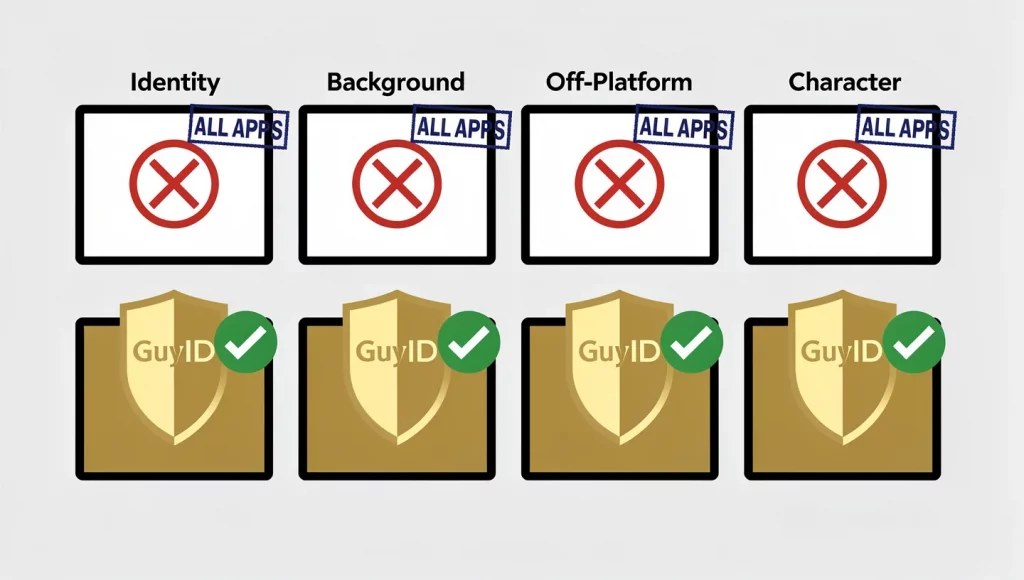
Gap 1: Identity Verification
No app confirms legal identity through government ID. Every “verified” badge means photos only.
Gap 2: Background Checks
No app does background checks. Criminal history and sex offender status are completely unscreened everywhere.
Gap 3: Off-Platform Protection
Every app’s features evaporate at platform transitions. Badges, controls, and reporting disappear when conversation moves to WhatsApp — exactly when exploitation begins.
Gap 4: Character Assessment
No app assesses character, honesty, or trustworthiness. Algorithms match on preferences — not on whether someone is truthful or kind.
These four gaps explain why the highest-ranked app still scores only 19/35 — and why GuyID fills a role no platform’s built-in features can.
Features That Reduce Harm vs Marketing Theater
Features That Meaningfully Reduce Harm
- Women-first messaging (Bumble): Structurally eliminates unsolicited contact — the primary harassment vector. Measurable impact.
- Video selfie verification (Hinge): Strongest camera-based verification. 200%+ behavioral impact. Catches crude catfish.
- In-app video calling (Bumble): Live verification without sharing phone numbers. Addresses both catfish and privacy.
- AI image screening (Bumble Private Detector): Prevents viewing unsolicited explicit images. Directly addresses a disproportionate threat to women.
Features That Sound Better Than They Perform
- Static pose verification (Tinder): Catches basic catfish but provides minimal liveness confirmation. Most vulnerable to deepfakes. Badge perception exceeds protection.
- Generic safety guides in apps: Repeat basic advice without providing tools or structural protection. Shift the burden to users.
- Block and report tools (all): Reactive, not preventive. The harm has already occurred before these tools are used.
How to Close the Safety Gap on Any Platform
Since the universal gaps in dating app safety features are identical everywhere, the solution is universal too.
What Every App Lacks → What GuyID Provides
☐ Identity: GuyID confirms legal identity through government ID biometrics
☐ Character: Social vouching from real people who know the person
☐ Trust: Trust Tiers (GHOST → LEGEND) track sustained trustworthiness
☐ Portability: Date Mode link works on every platform and channel
☐ Screening: 60+ free safety tools — reverse image search, catfish detection, bio analysis
The Universal Protocol (Works on Every App)
☐ Reverse image search via GuyID (30 sec)
☐ Catfish probability detector (10 sec)
☐ Bio red flag detector (10 sec)
☐ Video call within the first week (deepfake testing)
☐ GuyID Trust Profile before meeting (free for women)
☐ Monitor for red flags throughout
☐ NEVER send money — zero exceptions
Summary: What the Safety Feature Comparison Reveals
Comparing dating app safety features reveals three truths. First, Bumble leads on breadth and Hinge leads on depth — they’ve invested most meaningfully in safety. Third, the gap between the best platform and actual comprehensive safety is larger than the gap between the best and worst platforms.
Choose a platform at the top of the ranking (Bumble or Hinge) and supplement with GuyID. The best dating app safety features are built-in ones from a top platform plus external ones that fill the universal gaps. For the complete platform ranking, see our safest dating apps 2026 guide.
Every App Has Gaps. GuyID Fills Them All.
Government ID verification, social vouching, Trust Tiers, portable trust profiles, and 60+ free safety tools — the identity layer every dating app lacks. Works across all platforms. Women check for free.
Try Free Safety Tools
Get Verified on GuyID
Frequently Asked Questions
Do any dating apps verify your real identity?
Does Bumble’s women-first messaging actually make it safer?
What safety features are missing from ALL dating apps?
Is paying for premium safety features worth it?
How does GuyID compare to dating app safety features?
Can I rely on dating app safety features alone?
Related Reading
- Online Dating Safety for LGBTQ+: Complete Protection Guide (2026)
- Online Dating Safety Tips: The Complete 2026 Guide (26 Expert Tips)
Evidence note
The FTC reported 64,003 romance-scam reports in 2023, with $1.14 billion in reported losses and a $2,000 median reported loss (Federal Trade Commission, 2024).