Free Tools
Catfish Probability Detector
Check whether a dating profile has suspicious identity or photo signals.
Dating Bio Red Flag Detector
Review a bio for scam, pressure, or trust-warning language.
Dating Safety Checklist
Use free GuyID tools before moving from chat to a real date.
Next step
Create your GuyID trust profile
Share consent-based trust signals before a date without turning the conversation into an interrogation.
Dating app verification in 2026 is where airport security was before 9/11 — reactive, superficial, and built for a threat landscape that no longer exists. Selfie-matching badges were designed for an era of stolen photos and basic catfishing. Today’s threats include AI-generated identities that produce no reverse search results, deepfake video that passes live calls, chatbots sending 60+ emotionally intelligent messages per 12 hours (McAfee Labs, 2026), and organized criminal syndicates extracting $1.3 billion annually (FTC, 2026) through pig butchering operations. The question isn’t whether the future of dating verification will look radically different from today’s badge system — it’s how quickly the transition happens, what the destination looks like, and who gets there first. This guide maps that future.
From where dating verification is now (binary, photo-only, platform-locked) to where it’s heading (progressive, identity-based, portable, AI-proof), this article traces the evolution — the forces driving it, the resistance slowing it, the technologies enabling it, and why GuyID’s Trust Tiers represent the verification architecture that the industry will eventually adopt but that you can use today.
NavigateTable of Contents29 sections
⚡ Key Takeaways
Binary badges are a first-generation solution in a third-generation threat landscape
Selfie-matching badges were built for stolen-photo catfishing. Today’s threats — AI-generated identities, deepfake video, automated chatbots — have evolved two generations beyond what badges detect.
Five forces are driving verification evolution simultaneously
The future has three pillars: government ID, social vouching, and portable trust
Government ID is the one layer AI can’t defeat. Social vouching adds the human judgment algorithms can’t replicate. Portable trust eliminates the off-platform gap where scams operate. Together: the verification architecture for the AI era.
GuyID provides the future verification model — available today
The industry will eventually arrive at progressive, identity-based, portable verification. GuyID’s Trust Tiers implement this model now — you don’t have to wait for dating apps to catch up.
Where Dating Verification Is Now: The 2026 Baseline
Understanding the future of dating verification requires an honest assessment of the present — what verification actually provides versus what users believe it provides.
What Verification Is in 2026
| Platform | Verification Method | What It Confirms | What It Doesn’t Confirm |
|---|---|---|---|
| Tinder | Pose-based selfie | Face matches profile photos | Name, age, identity, character, intentions, criminal history |
| Bumble | Gesture-based selfie | Face matches profile photos | Name, age, identity, character, intentions, criminal history |
| Hinge | Video selfie | Face matches profile photos | Name, age, identity, character, intentions, criminal history |
The pattern: every major platform confirms exactly one thing (face matches photos) and confirms nothing about the six dimensions users actually need verified (name, age, identity, character, intentions, criminal history). The verification gap between what users think “verified” means and what it actually confirms is the foundational problem that the future of dating verification must solve.
The Numbers That Define the Crisis
These numbers describe a system that’s failing at its core mission: keeping people safe while they seek connection. The current verification model is insufficient by every measure — financial losses, encounter rates, user confidence, and demand for stronger verification. The future must be different because the present is demonstrably inadequate.
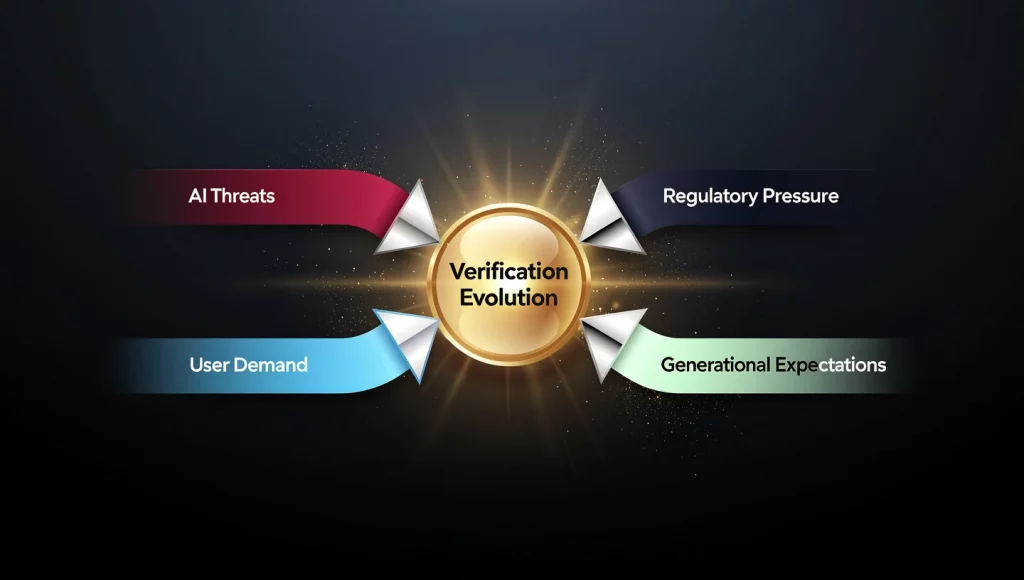
The Five Forces Driving Verification Evolution
The future of dating verification isn’t driven by any single factor but by five converging forces that together create irresistible pressure for change.
Force 1: AI Threat Escalation
AI-generated dating profiles neutralize the verification methods that work against traditional fakes. When AI photos produce no reverse search results, when chatbots write fluent personalized messages, and when deepfakes pass selfie verification, the entire detection and verification infrastructure built for the stolen-photo era becomes structurally inadequate. Each AI advancement forces verification to evolve — or become irrelevant.
Force 2: User Demand
The demand for stronger verification is overwhelming and growing. As the next generation of daters enters the market — digital natives who expect verified identities in every online interaction — platforms that don’t evolve verification will lose users to those that do.
Force 3: Regulatory Pressure
Governments worldwide are increasingly scrutinizing dating app safety. The UK’s Online Safety Act, the EU’s Digital Services Act, and emerging US state-level legislation all push platforms toward stronger user verification and accountability for harm occurring on their platforms. Regulatory pressure creates compliance mandates that voluntary market evolution wouldn’t produce on its own — forcing platforms to invest in verification upgrades regardless of business incentives.
Force 4: The Generational Expectation Shift
Gen Z and Gen Alpha are growing up in an environment where verified identity is normalized across platforms — identity verification for banking, social media account recovery, and age verification for content access. The expectation that dating partners should also be identity-verified isn’t a radical request for these generations — it’s a baseline expectation that dating platforms will eventually need to meet or lose relevance.
Force 5: The Financial Crisis Is Too Large to Ignore
Each high-profile scam victim, each media investigation, each congressional hearing on romance fraud adds cumulative pressure toward verification reform. The financial scale of the crisis ensures the issue cannot be permanently deflected.
What the Future of Dating Verification Looks Like
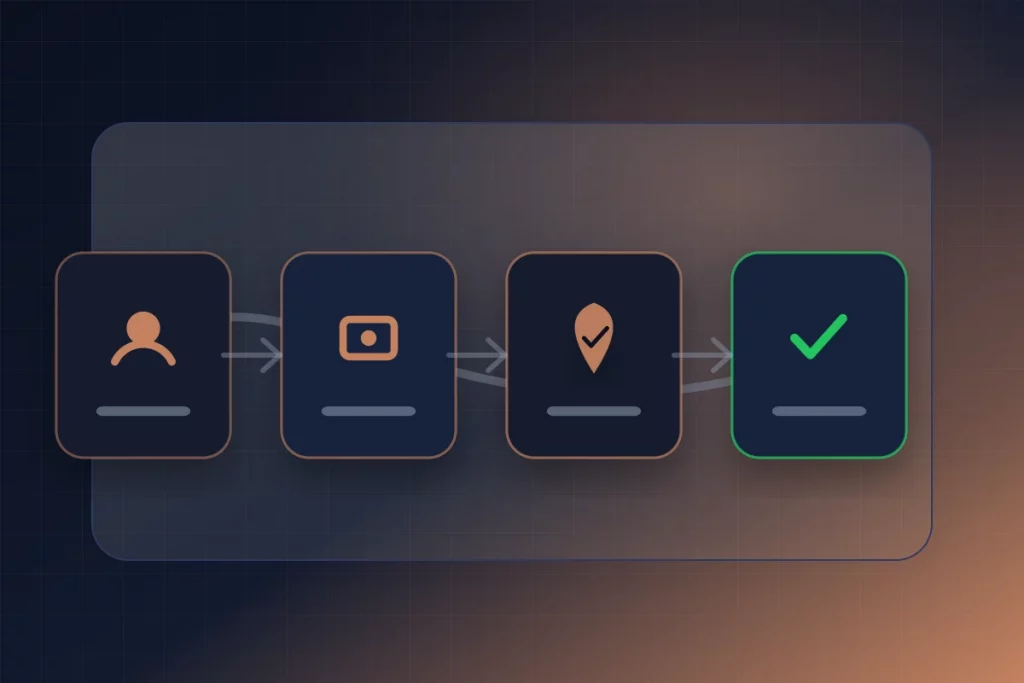
The convergence of these five forces points toward a verification model with specific characteristics — each addressing a failure of the current system.
| Current Model (2026) | Future Model | What Changes |
|---|---|---|
| Photo-matching only | Identity-based (government ID) | Confirms legal identity, not just facial similarity |
| Binary (verified/not) | Progressive (graduated levels) | Communicates how much trust is verified, not just whether any exists |
| Platform-locked | Portable (cross-platform) | Follows the person across every channel, not just one app |
| Algorithm-only | Human-informed (social vouching) | Includes real human character assessment alongside technical verification |
| Vulnerable to AI | AI-proof (document-based) | Uses verification methods that AI fundamentally cannot defeat |
| Point-in-time | Temporal (sustained over time) | Tracks trustworthiness over time, not just a single verification moment |
Each row represents one dimension of evolution — and each dimension addresses a specific, documented failure of the current system. The future of dating verification isn’t a speculative wish list — it’s the logical response to documented, measured, quantified problems that the current model cannot solve.
The AI Arms Race: Why Current Verification Can’t Keep Up
The most urgent driver of verification evolution is the AI arms race between platform detection systems and AI-powered fraud operations.
The Escalation Cycle
Platforms deploy AI to detect fakes → scammers deploy AI to create better fakes → platforms update detection → scammers update generation → the cycle continues. Both sides use the same underlying AI technology. Neither side achieves lasting advantage because advances in detection are matched by advances in generation. This symmetry means the arms race produces continuous escalation without resolution.
Why Photo-Matching Is Already Obsolete
Selfie-based verification relies on comparing a live face to profile photos. Deepfake technology overlays a synthetic face during the live capture — the synthetic face matches the synthetic profile photos, and verification passes. The fundamental assumption of photo-matching verification (the person taking the selfie is the person in the photos) is defeated by technology that separates the two. As deepfake quality improves — and it improves monthly — photo-matching verification approaches zero marginal value against AI-equipped scammers.
The Verification Method That Survives Every AI Generation
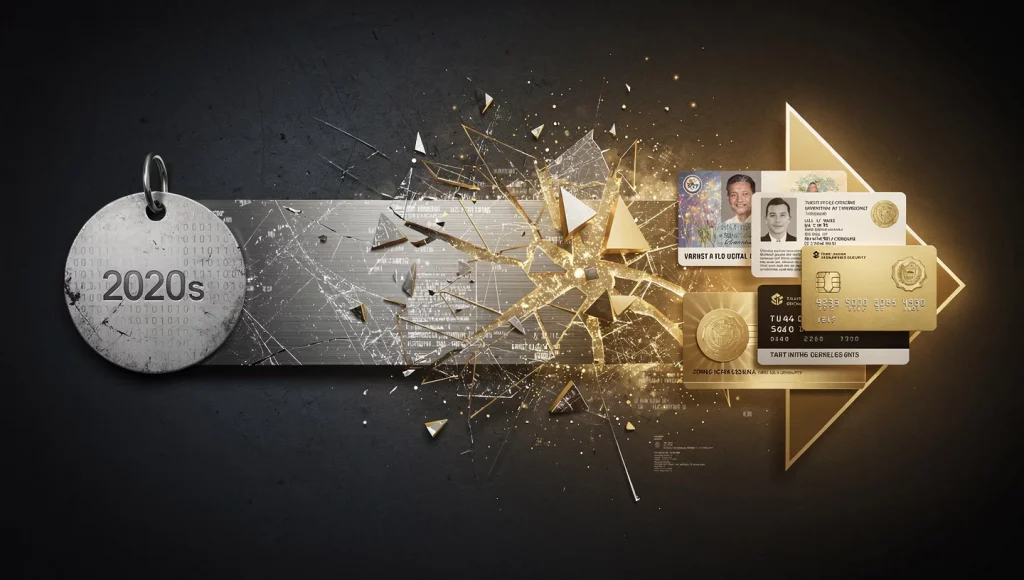
Amid the escalating arms race, one verification dimension remains structurally immune: government-issued identity documents. AI generates pixels. Government IDs are physical documents with security features (holograms, watermarks, embedded chips), biometric data linked to government databases, and issuance processes that require bureaucratic verification. No AI advancement changes this — generating a convincing face is fundamentally different from generating a legitimate government document. The future of dating verification is anchored to this structural immunity.
Government ID: The Verification Pillar That Survives Every Era
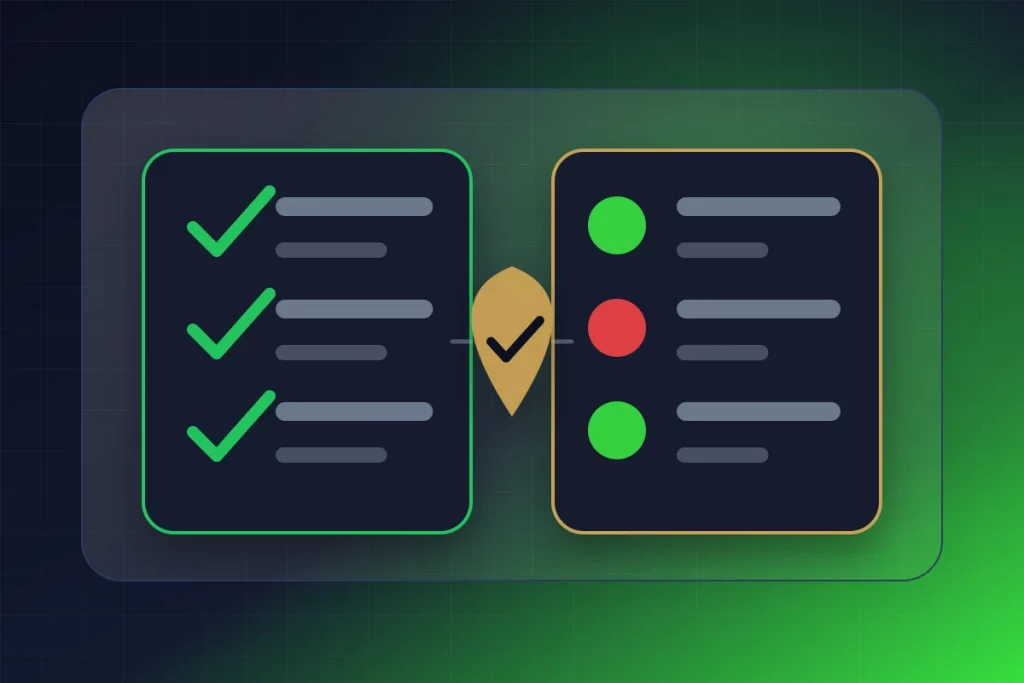
If one principle defines the future of dating verification, it’s this: verification must be anchored to something AI cannot generate. In 2026 and for the foreseeable future, that anchor is government identification.
Why Government ID Is Future-Proof
- Physical-digital gap: AI operates in the digital domain — generating images, text, video, and audio. Government IDs exist in the physical domain — manufactured by government agencies with security features impossible to digitally replicate.
- Biometric verification: Matching a live face to a government document’s photo confirms the person holding the document is the person on it — a verification that requires both a physical document and a physical person in the same place at the same time.
- Database backing: Government IDs correspond to records in government identity databases. The document isn’t self-contained — it’s linked to an institutional verification chain that AI cannot fabricate.
Government ID on GuyID
GuyID’s government ID verification — consent-based biometric matching against official documents — implements this future-proof pillar today. The same verification standard used in banking and financial services, applied to dating through a voluntary, privacy-respecting process. As AI threats escalate, government ID remains the one confirmation that “this person legally exists as claimed” — the identity bedrock that every other trust dimension builds on.
Social Vouching: The Human Layer AI Can’t Replace
The second pillar of future verification is human character assessment — not algorithmic scoring, but real people confirming real trust.
Why Algorithms Can’t Assess Character
Algorithms analyze behavior patterns. Scammers learn the patterns that algorithms reward and replicate them. A pig butchering operator who mimics genuine dating behavior (few matches, deep conversations, gradual escalation) looks algorithmically identical to a genuine person. Behavioral AI cannot distinguish intent — it can only match patterns. And sophisticated scammers produce the right patterns.
Real humans assess character through lived experience — years of friendship, professional collaboration, community involvement, and personal knowledge. This assessment includes dimensions that no algorithm captures: honesty, kindness, reliability, and integrity observed across contexts and over time. Social vouching translates this irreplaceable human assessment into a verifiable trust signal.
Social Vouching on GuyID
GuyID’s social vouching collects character attestations from real people who know the user — friends, colleagues, and community members each staking their reputation on the vouch. This human layer adds what government ID alone can’t provide: “This person is not just legally real — real people who know them confirm they’re trustworthy.” As the future of dating verification evolves, the social vouching layer becomes more valuable, not less — because it’s the one verification dimension that can never be automated, faked, or AI-generated at scale.
Portable Trust: The End of Platform-Locked Verification
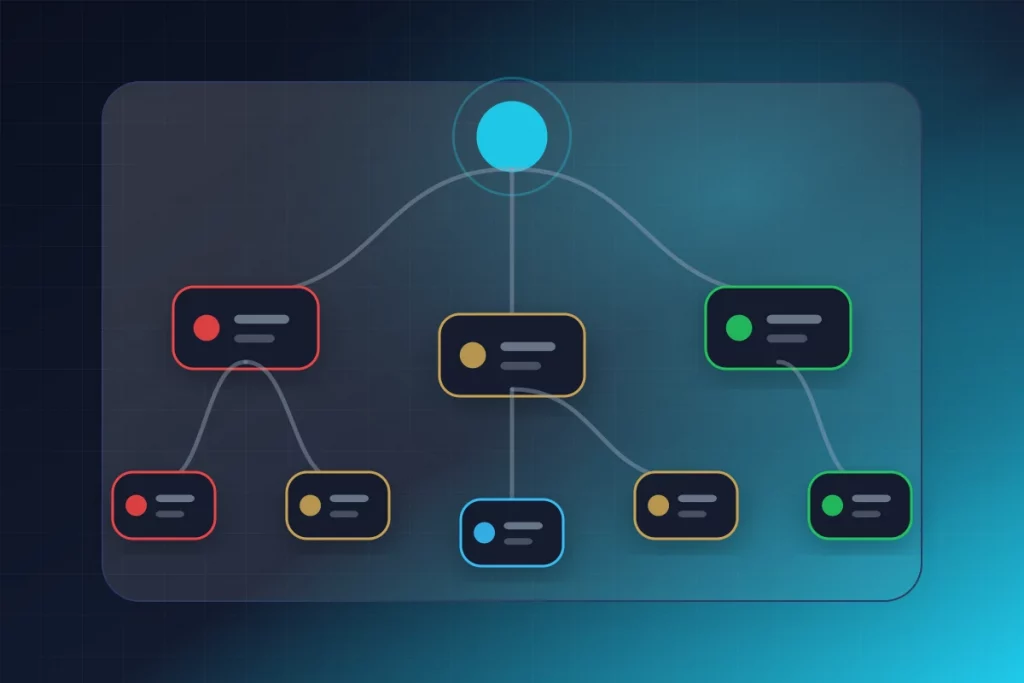
The third pillar of future verification is portability — trust that follows the person across every platform, every channel, and every relationship stage.
Why Platform-Locked Verification Is Structurally Doomed
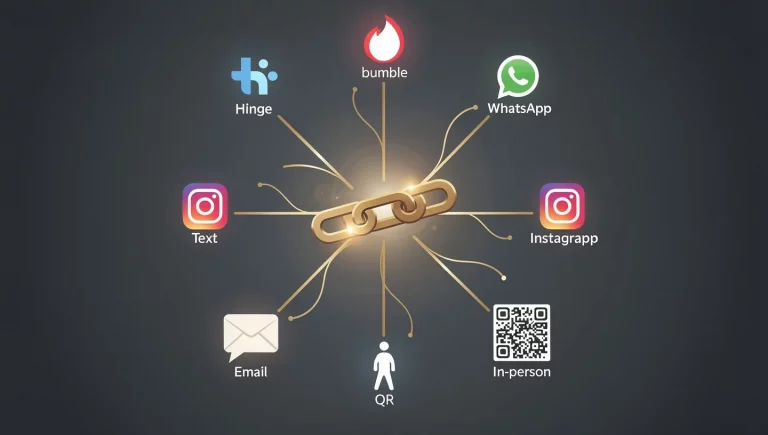
Dating is inherently multi-platform. People use 2-3 apps simultaneously. Conversations flow through 3-5 channels before meeting. The highest-risk moments (off-platform transitions, in-person meetings) occur outside any dating app. A verification model locked to one platform covers a shrinking fraction of the dating journey — and as communication channels proliferate (new messaging apps, social platforms, and AI-mediated interactions), the fraction will only shrink further.
The Convergence Toward Portable Trust
Every trend points toward portable verification: the competitive dynamics that prevent platforms from building cross-platform solutions create demand for independent trust layers. The generational expectation of verified identity across all interactions normalizes cross-platform trust checking.
Portable Trust on GuyID
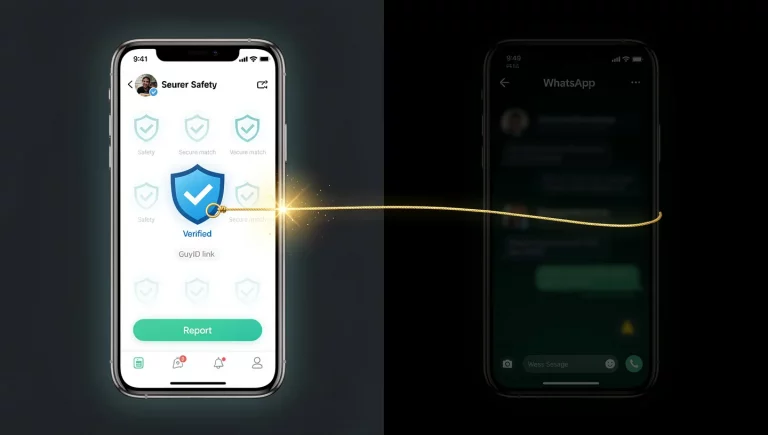
GuyID’s Date Mode link — one URL, viewable anywhere, no app required — implements portable trust today. The sharing strategy that works on all 11 communication channels will only become more natural as trust verification normalizes.
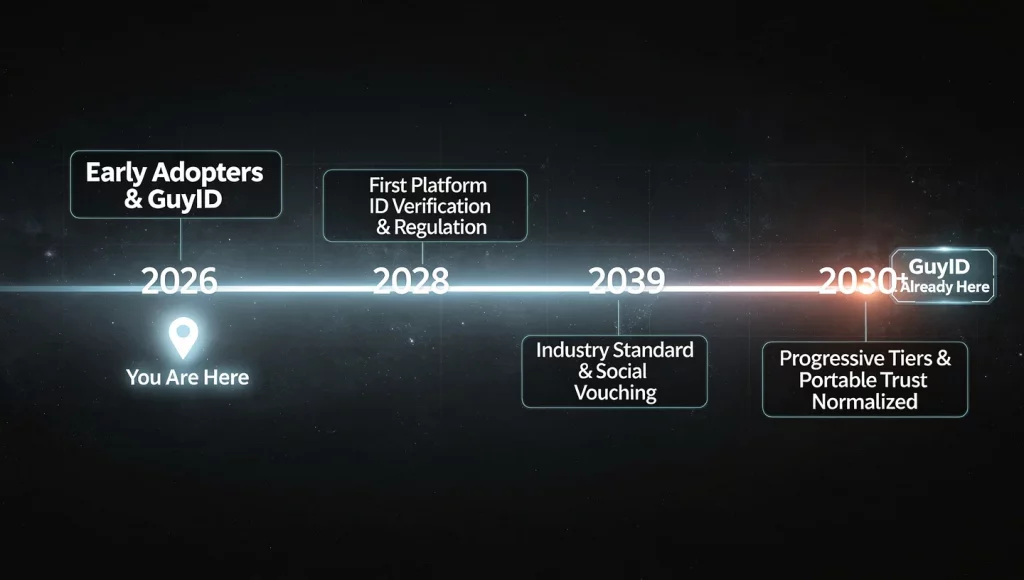
Timeline: When These Changes Arrive
The future of dating verification won’t arrive all at once. Here’s the projected timeline based on current forces and adoption patterns.
| Timeframe | What Happens | Driver |
|---|---|---|
| 2026-2027 | Early adopters normalize Trust Profile sharing. GuyID usage grows among safety-conscious daters. Dating app badges become recognized as insufficient by mainstream media. | User demand + AI threat visibility + early regulatory signals |
| 2027-2028 | At least one major dating platform introduces optional government ID verification. Regulatory frameworks begin mandating identity verification for dating platforms in key markets (UK, EU). | Regulatory pressure + competitive response to independent trust layers |
| 2028-2030 | Government ID verification becomes standard across major platforms. Social vouching or equivalent community trust features emerge. Portable verification between platforms becomes expected. | Generational expectations + regulatory mandates + market maturation |
| 2030+ | Progressive trust systems (tiers or equivalent) replace binary badges. Cross-platform trust interoperability becomes the norm. Unverified dating profiles face the same friction as unverified financial accounts. | Full adoption cycle + cultural normalization + AI-era necessity |
What This Means for You Today
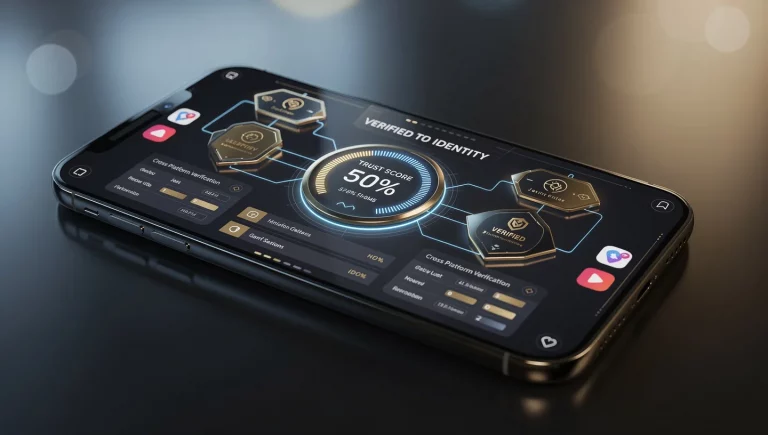
The industry will arrive at progressive, identity-based, portable, AI-proof verification — driven by forces too powerful to resist. But the timeline is years, not months. You can wait for dating apps to catch up. Or you can use the verification model that the industry will eventually adopt — available today through GuyID. Government ID verification, social vouching, progressive Trust Tiers, and portable Date Mode links. The future of dating verification isn’t a concept paper — it’s a product you can set up in 20 minutes.
Summary: The Future Is Available Today
The future of dating verification is defined by three pillars: government ID (the verification layer AI can’t defeat), social vouching (the human judgment algorithms can’t replicate), and portable trust (the cross-platform persistence that platform-locked badges can’t provide).
The industry timeline suggests major platforms will adopt elements of this model over the next 2-5 years. But the model itself — progressive Trust Tiers built on government ID + social vouching, shared via portable Date Mode links that work everywhere — exists today through GuyID. You don’t have to wait for Tinder to implement identity verification. You don’t have to wait for Bumble to add social vouching. You don’t have to wait for Hinge to make verification portable. The future of dating verification is available now.
Join the early adopters who are using the verification model the rest of the industry will eventually follow. The future is here. It’s just not evenly distributed yet.
The Future of Dating Verification Is Here. Use It Today.
Government ID + social vouching + Trust Tiers + portable Date Mode link. The verification architecture that survives every AI advancement, every platform transition, and every threat evolution. 20 minutes to set up. Works everywhere. Women check for free.
Build the Future-Proof Trust Profile
Try Free Safety Tools
Frequently Asked Questions
Will AI make current dating verification obsolete?
What will dating verification look like in 5 years?
Why can’t dating apps just improve their current badges?
How does GuyID already implement future verification?
Will portable verification become standard?
Evidence note
NIST Digital Identity Guidelines distinguish identity proofing, authentication, and federation as separate parts of digital identity risk management (NIST, 2025).