Reader Briefing
Reader Briefing
Start here if you need a practical read on character reference letter examples for dating: 5 templates: who should use verification, what signals to check, and what to do before moving from online interest to an in-person plan.
Who this is for
- People meeting someone from a dating app or social platform.
- Anyone checking identity, profile consistency, and trust signals.
- Online daters improving conversations, profiles, or match screening.
You’ll learn
- How to evaluate identity signals without treating any single check as certainty.
- Which trust signals matter and how to weigh them together.
- How to compare options using practical safety and trust criteria.
- When to slow down, ask for more context, or walk away.
- How to turn the article’s advice into a concrete next step.
Bottom line
Verification reduces uncertainty; it does not guarantee future behavior. Use a layered approach: confirm identity signals, compare profile consistency, ask for a short video call, keep early plans public, and slow down when someone pressures you to skip normal safety steps.
Key takeaways
- Identity verification improves confidence, not certainty.
- A short video call can reveal many inconsistencies.
- Pressure to skip reasonable safety steps is useful information.
- Use GuyID tools to turn vague concerns into specific checks.
Free Tools
Catfish Probability Detector
Check whether a dating profile has suspicious identity or photo signals.
Dating Bio Red Flag Detector
Review a bio for scam, pressure, or trust-warning language.
Dating Safety Checklist
Use free GuyID tools before moving from chat to a real date.
Next step
Create your GuyID trust profile
Share consent-based trust signals before a date without turning the conversation into an interrogation.
NavigateTable of Contents22 sections
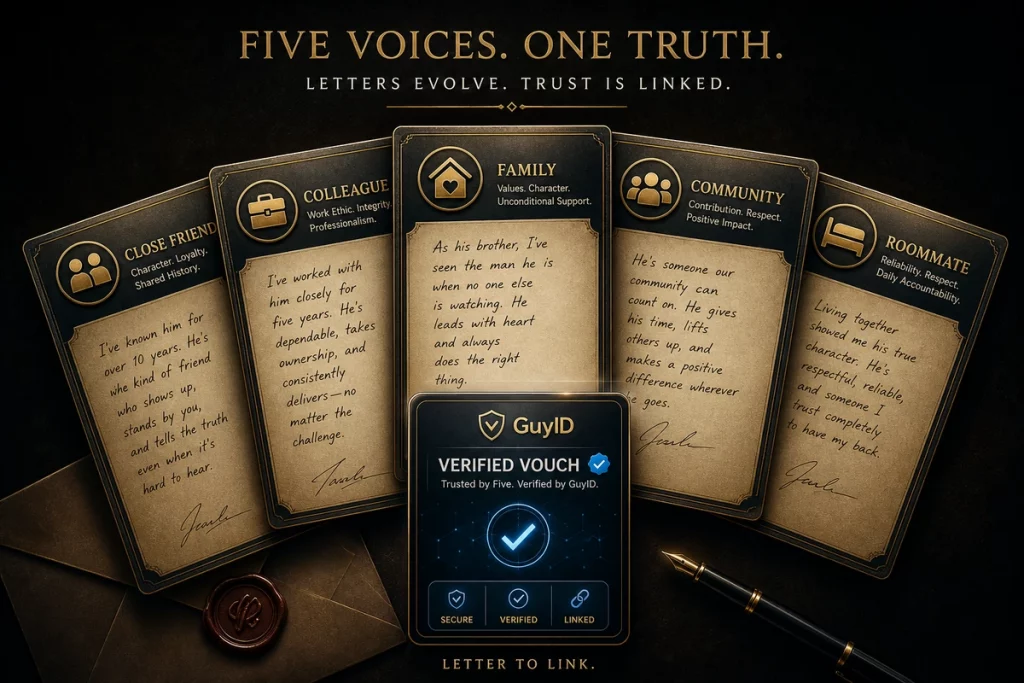
Character references exist for jobs, apartments, court proceedings, and immigration applications — contexts where someone’s trustworthiness needs to be confirmed by people who know them. Dating is arguably a higher-stakes trust decision than most of these: you’re deciding whether to spend time alone with a stranger, share personal information, become emotionally vulnerable, and potentially integrate someone into your life. Yet dating has never had a character reference system — until now. Character reference letters for dating are the formal version of what social vouching provides digitally: real people who know someone confirming that they’re who they claim and that their character is worth trusting. This guide provides templates, examples, and the practical framework for both requesting and writing dating character references — plus how the digital equivalent through GuyID’s vouch system makes the same trust confirmation instant and portable.
Why Character References Make Sense for Dating
We accept character references as normal in every high-stakes trust context. A landlord checks references before handing you keys to a property. An employer checks references before trusting you with responsibilities. A court accepts character references as evidence of trustworthiness. In each case, the principle is the same: the people who know someone are the most reliable source of information about their character.
Dating is a trust decision at least as consequential as renting an apartment — you’re potentially sharing your home, your time, your emotional life, and your physical safety with another person. Yet the dating industry provides zero character reference infrastructure. You evaluate strangers based on photos (appearance), bios (self-description), and badges (face confirmation) — none of which assess character. Character reference letters for dating close this gap by introducing the human judgment that every other trust domain relies on.
What References Confirm That Nothing Else Can
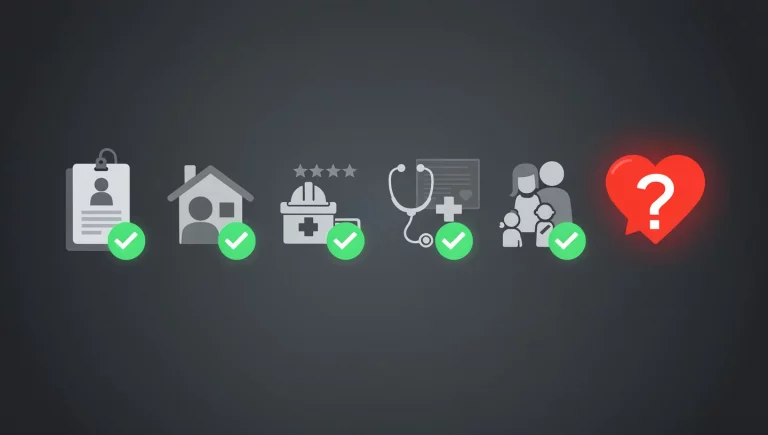
- How they treat people: Do they treat servers, colleagues, and strangers with respect? Are they kind when no one’s watching? Only people who’ve observed them in real life know.
- How they handle conflict: Do they communicate or stonewall? Escalate or de-escalate? The people who’ve disagreed with them know.
- Whether they follow through: Do they keep promises? Show up when they say they will? Reliability is only observable over time by people who depend on them.
- Whether their self-presentation is accurate: The person described in the dating profile — is that who they actually are? Friends and colleagues know the gap between presentation and reality.
Inline visual 1
Inline visual 2
What a Dating Character Reference Should Include
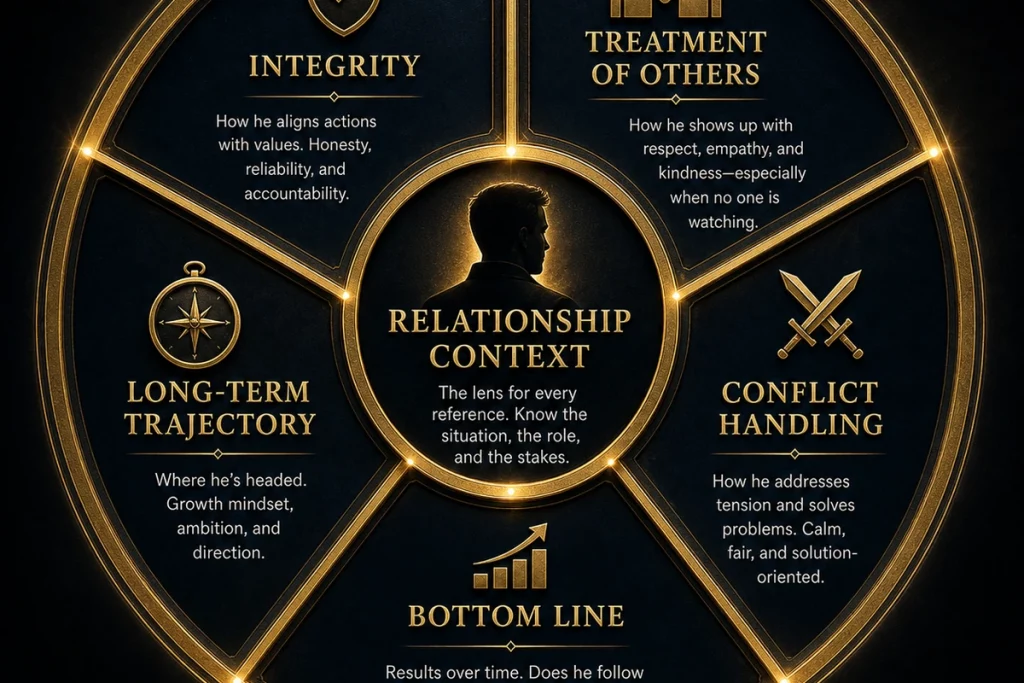
Effective dating character references address five dimensions — not generic praise but specific observations that a potential match can evaluate meaningfully.
| Dimension | What to Address | Why It Matters for Dating |
|---|---|---|
| Relationship to the person | How you know them, how long, in what context | Establishes the reference’s credibility and observation depth |
| Integrity and honesty | Specific examples of truthfulness, reliability, keeping commitments | The #1 quality that determines relationship viability |
| How they treat others | Observed behavior toward friends, family, strangers, people in service roles | Predicts how they’ll treat a partner over time |
| Conflict behavior | How they handle disagreements — communication style, emotional regulation | Conflict handling predicts relationship longevity |
| Character summary | Overall assessment — would you trust this person with someone you care about? | The bottom-line question every reference should answer |
5 Character Reference Letter Examples
Five templates for different relationship contexts — each demonstrating how to write a specific, credible dating character reference.
Example 1: Close Friend (Long-Term)
📝
Reference I’ve known [Name] for 12 years — we met in college and have stayed close through careers, moves, and everything in between. In that time, I’ve watched them navigate relationships, friendships, and professional life with consistent integrity.
What stands out: they show up. When they say they’ll be somewhere, they’re there. When they commit to something, they follow through. I’ve seen them handle disagreements with partners calmly — listening before responding, owning their part without defensiveness.
They treat everyone with respect — from close friends to the stranger behind the counter. I’ve never seen them be dismissive or unkind, even under stress.
Would I trust [Name] with someone I care about? Without hesitation. They’re one of the most genuine people I know — and what you see in their profile is who they actually are.
Example 2: Colleague / Professional Context
📝
Reference I’ve worked alongside [Name] for 4 years at [company/field]. In a professional setting, you see who someone really is under pressure — and [Name] consistently handles pressure with composure and respect for everyone around them.
They communicate directly but kindly — I’ve seen them deliver difficult feedback without being harsh and receive criticism without becoming defensive. They treat the intern the same way they treat the CEO.
Personally, they’re warm, thoughtful, and genuinely interested in people. They remember details about colleagues’ lives and follow up. That’s who they are — not a performance, just how they operate.
I’d trust them with anyone I care about. They’re honest, reliable, and one of the most considerate people I know.
Example 3: Family Member
📝
Reference I’m [Name]’s [sibling/cousin/close family]. I’ve known them their entire life — through every phase, every challenge, every version of who they’ve become.
The person you’re getting to know is genuinely kind. Not performatively kind — the kind where they help a neighbor without being asked, cook dinner for a friend going through something difficult, and call our parents every week not because they have to but because they want to.
In relationships, they’re loyal and communicative. They don’t play games. When something’s wrong, they talk about it — directly but respectfully. I’ve watched them grow through past relationships and come out more self-aware each time.
You’re getting the real thing. Trust them.
Example 4: Community Connection / Mentor
📝
Reference I’ve known [Name] through [volunteer organization/community group/sports league] for 3 years. I’ve watched them interact with dozens of people in settings that reveal character — team dynamics, stressful events, leadership roles.
They lead by example: calm under pressure, inclusive in group settings, first to help and last to take credit. They treat everyone as an equal regardless of role or status.
What impresses me most is their consistency — the person they are publicly is the person they are privately. No performance. No version-switching. What you see is what you get.
I’d vouch for their character without reservation.
Example 5: Roommate / Housemate (Practical Reliability)
📝
Reference I lived with [Name] for 2 years — which means I saw the unfiltered version. Early mornings, late nights, stressful days, good moods and bad. The person behind closed doors is exactly who you’d hope: respectful, considerate, and remarkably even-tempered.
They cleaned up after themselves (sounds small, reveals everything about respect). They communicated about shared space issues directly rather than letting resentment build. They were honest about rent, bills, and logistics — no games, no surprises.
If how someone treats a roommate predicts how they’ll treat a partner — and I believe it does — [Name] is someone worth trusting. Reliable, respectful, and genuine.
How to Request a Character Reference for Dating
The ask is simpler than most people expect — because the people who know you well WANT to support you.
The Ask Framework
The Direct Ask (Most Effective)
“I’m taking dating seriously and I’ve built a trust profile on GuyID — it lets matches verify my identity and see that real people vouch for me. Would you be willing to vouch for my character? It takes about 2 minutes.”
Why it works: Direct, explains the purpose, quantifies the time commitment, and frames it as a trust investment rather than a favor.
The Casual Ask
“Hey, I’m on this platform called GuyID that lets friends vouch for each other’s dating profiles — kind of like a character reference but digital. Would you vouch for me? Here’s the link.”
Why it works: Low-pressure, explains the context, and makes it easy to say yes by providing the link immediately.
Who to Ask
- Best choices: Close friends who’ve known you 2+ years, siblings or close family, colleagues who’ve seen you under pressure, community members who’ve observed your character in group settings
- Ideal mix: 2-3 vouchers from different life contexts (friend + colleague + family or community member) — diversity of sources strengthens credibility
- Avoid: Casual acquaintances (their vouch carries less weight), people you’ve dated (conflict of interest), anyone who might say yes but doesn’t actually know your character well
What Most People Discover
The overwhelming response is “Of course — happy to.” Most people are flattered to be asked for a character reference. The request communicates: “I trust your judgment about my character enough to make it visible to potential partners.” That’s a compliment.
How to Write a Character Reference for Someone’s Dating Life
If someone asks YOU to vouch for them — whether as a written reference or a GuyID digital vouch — here’s how to write something genuinely useful.
The Framework
- State your relationship: How you know them, how long, in what context. This establishes your credibility as a reference.
- Give specific observations: Not “they’re great” — but specific moments or patterns you’ve witnessed. “I’ve seen them handle [situation] with [quality].” Specificity is credibility.
- Address the dating-relevant dimensions: Honesty, reliability, how they treat people, how they handle conflict. These are the questions the reader actually has.
- Give the bottom line: Would you trust this person with someone you care about? A direct answer to the direct question.
What NOT to Write
- ❌ Generic praise without specifics: “They’re amazing!” — means nothing
- ❌ Physical descriptions: “They’re really attractive” — irrelevant to a character reference
- ❌ Past relationship details: “They were a great partner to [ex]” — inappropriate and potentially uncomfortable
- ❌ Qualifications rather than character: “They have a great job and make good money” — this is a resume, not a character reference
From Letters to Links: The Digital Vouch
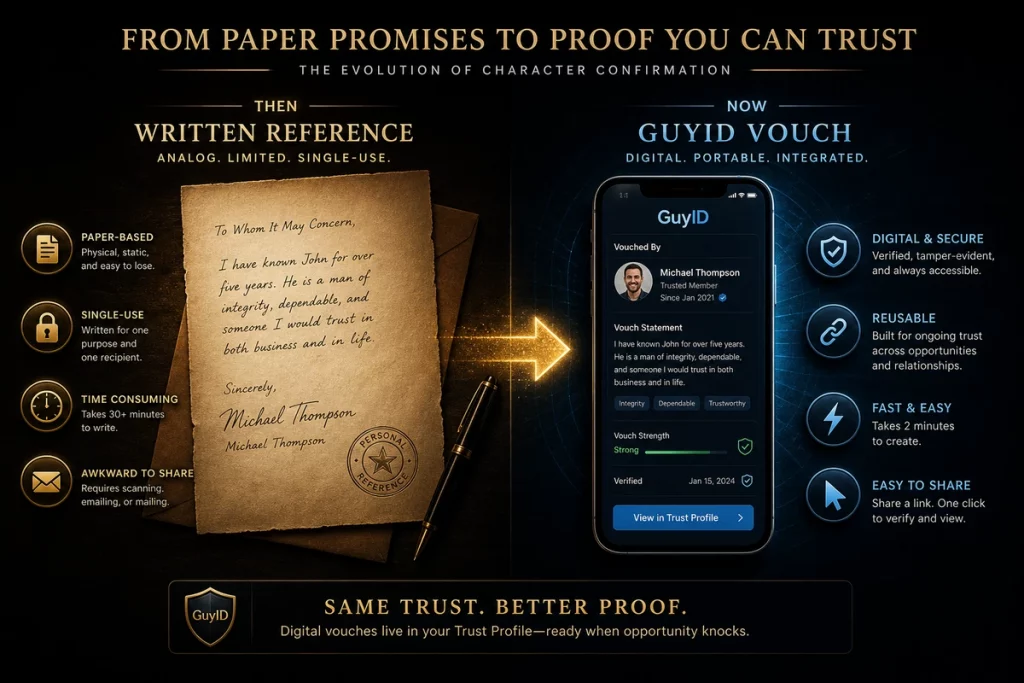
Written character reference letters work — but they’re impractical for modern dating. You can’t attach a letter to a Tinder bio. You can’t hand a reference to someone on Bumble. The concept is sound. The format needs updating.
GuyID Social Vouching: The Digital Character Reference
GuyID’s vouch system digitizes the character reference — making it instant, portable, and integrated into your dating presence.
- How it works: Real people who know you submit a vouch through GuyID confirming your identity and character. Each vouch is linked to a real person willing to publicly associate their name with yours.
- Where it appears: On your Trust Profile — visible when any match clicks your Date Mode link. The number and diversity of vouches contribute to your Trust Tier.
- Why it’s better than a letter: Instant (no documents to share), portable (works on every platform and off-platform), verifiable (linked to real people’s accounts), and integrated into the trust system that includes government ID and progressive tiers.
Written References vs Digital Vouches
| Feature | Written Reference | GuyID Vouch |
|---|---|---|
| Format | Document (PDF, text) | Digital vouch linked to real person |
| Shareability | Awkward to share in dating context | Automatic — visible on Trust Profile link |
| Portability | Must be reshared per platform | One link works everywhere — every app, WhatsApp, in person |
| Verifiability | Could be fabricated | Linked to verified person’s account |
| Integration | Standalone document | Combined with gov ID + Trust Tier in one profile |
| Time to create | 15-30 minutes to write | ~2 minutes per vouch |
Written references are useful if you want a detailed narrative about someone’s character. Digital vouches are useful for the practical reality of modern dating — where trust needs to be communicated instantly through a clickable link in a dating bio. The principles are identical. The format is evolved.
Summary: Trust Confirmed by the People Who Know Best
Character reference letters for dating apply a principle that works in every trust domain to the one domain that’s been missing it. Government ID confirms identity. Verification badges confirm appearance. But character — honesty, reliability, kindness, communication, conflict handling — is confirmed only by the people who’ve observed it firsthand.
The five templates above provide ready-to-adapt examples for close friends, colleagues, family, community connections, and roommates. The requesting framework makes the ask natural. And for modern dating practicality, GuyID’s digital vouch system provides the same character confirmation in a format that integrates into your dating presence: instant, portable, verifiable, and combined with government ID verification and progressive Trust Tiers in a single clickable Trust Profile link.
Request vouches from 2-3 people who know you well. Build your Trust Profile. Add the link to your dating bios. Now your character isn’t something you claim in a bio — it’s something real people confirm through a system that every match can check in 10 seconds. Character references, digitized and integrated. Trust confirmed by the people who know best.
Frequently Asked Questions
Are character references for dating actually a thing?
How do I ask someone for a dating character reference?
What should a dating character reference include?
Isn’t a GuyID vouch better than a written reference?
How many references/vouches do I need?
What if I don’t have anyone to vouch for me?
Evidence Note
NIST identity-proofing guidance addresses validation of identity evidence and attributes. A character reference serves a different purpose: it provides social context and should not be treated as identity proof.