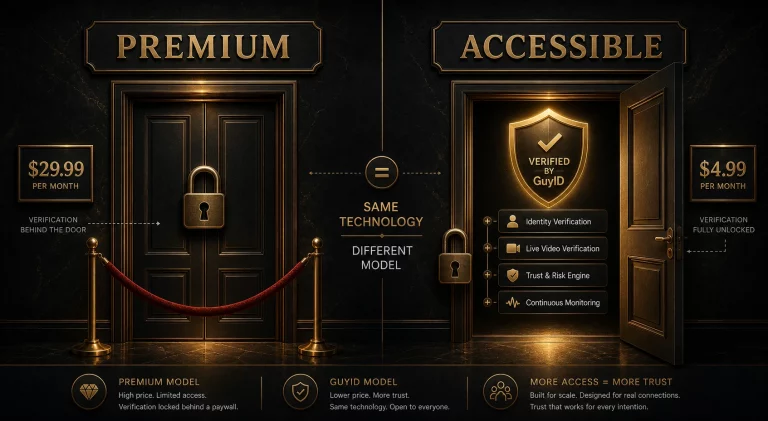
Reader Briefing
Reader Briefing
Start here if you need a practical read on hookupsecurity alternative: dating safety that works for every intention: who should use verification, what signals to check, and what to do before moving from online interest to an in-person plan.
Who this is for
- People meeting someone from a dating app or social platform.
- Anyone checking identity, profile consistency, and trust signals.
- People trying to avoid romance scams, fake profiles, or pressure tactics.
- Online daters improving conversations, profiles, or match screening.
You’ll learn
- How to evaluate identity signals without treating any single check as certainty.
- Which trust signals matter and how to weigh them together.
- How to spot inconsistencies, pressure, or behavior patterns that deserve caution.
- How to move from online conversation to a safer first meeting.
- Where GuyID tools fit into a quick pre-date screening workflow.
- How to compare options using practical safety and trust criteria.
Bottom line
Verification reduces uncertainty; it does not guarantee future behavior. Use a layered approach: confirm identity signals, compare profile consistency, ask for a short video call, keep early plans public, and slow down when someone pressures you to skip normal safety steps.
Key takeaways
- Identity verification improves confidence, not certainty.
- Patterns matter more than isolated incidents.
- Verify before meeting privately or sharing sensitive details.
- A short video call can reveal many inconsistencies.
- Pressure to skip reasonable safety steps is useful information.
Free Tools
Catfish Probability Detector
Check whether a dating profile has suspicious identity or photo signals.
Dating Bio Red Flag Detector
Review a bio for scam, pressure, or trust-warning language.
Dating Safety Checklist
Use free GuyID tools before moving from chat to a real date.
Next step
Create your GuyID trust profile
Share consent-based trust signals before a date without turning the conversation into an interrogation.
NavigateTable of Contents20 sections
Safety platforms that focus exclusively on hookup or casual dating solve one problem while creating another: they protect a narrow use case while leaving the broader dating safety landscape unaddressed. If you’re searching for a HookupSecurity alternative, you’re likely looking for dating safety verification that works regardless of what kind of relationship you’re seeking — casual, serious, or still figuring it out. The reality: the safety threats in online dating don’t change based on your relationship intentions. Romance scammers, fake profiles, and predatory behavior target people across every dating intention — from casual encounters to long-term commitment. The verification platform that protects you should work across the full spectrum, not just one end of it.
The Problem With Niche-Only Safety Platforms
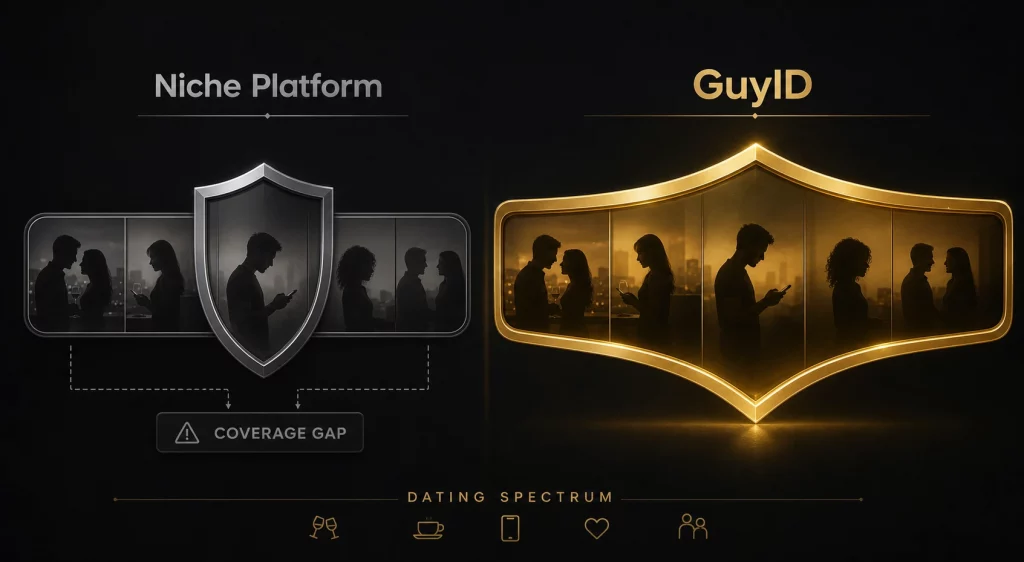
Platforms that brand around a specific dating type — “hookup safety,” “casual encounter verification,” “one-night-stand protection” — solve a branding problem but create a practical one.
The Branding Limitation
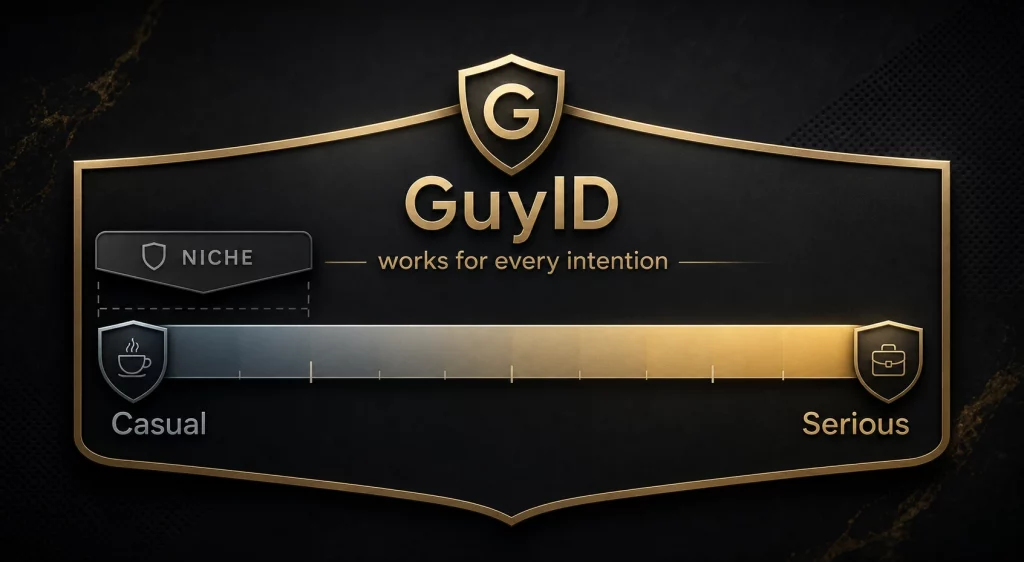
A verification badge from “HookupSecurity” communicates one thing before anything else: this person uses hookup-specific safety tools. That label may be exactly right for some contexts — and completely wrong for others. If you’re also using Hinge for relationship-focused dating, a hookup safety badge in your bio sends a mixed signal. If you shift from casual to serious dating, your existing verification is branded for the wrong context. Niche branding locks your verification into one dating identity — when most people’s dating intentions exist on a spectrum that shifts over time.
The Fragmentation Problem
If hookup safety requires one platform, serious dating safety requires another, and over-50 dating safety requires a third — you’re building verification across multiple services, each with different accounts, different costs, and different trust signals. Your match has to check multiple platforms to get a complete picture. Nobody does this. Fragmented verification is functionally no verification — because the friction of checking multiple services exceeds anyone’s willingness to investigate.
The Threat Reality
The threats in online dating are intention-agnostic. Romance scammers target people seeking both casual and serious connections. Fake profiles appear on every platform regardless of its positioning. Predatory individuals exploit every dating context. Sextortion operations specifically target casual encounters. The safety platform that protects you must address the full threat landscape — not just the threats associated with one dating category.
Inline visual 1
What to Look for in a Dating Safety Platform
Whether you’re evaluating HookupSecurity, GuyID, or any other service, six criteria determine whether the platform provides genuine protection.
| # | Criterion | What It Means |
|---|---|---|
| 1 | Intention-agnostic | Works regardless of whether you’re seeking casual, serious, or exploring — no branded limitation |
| 2 | Multi-factor verification | Confirms identity through multiple independent factors — not just face-matching |
| 3 | Character assessment | Includes human judgment (social vouching) — not just document checks |
| 4 | Cross-platform portability | Works on every dating app AND off-app channels (WhatsApp, text, in person) |
| 5 | Progressive trust | Measures trust over time (tiers) — not just a one-time check |
| 6 | Free checking | Zero barrier for the person evaluating your verification — if checking costs money, nobody checks |
How Hookup-Focused Safety Services Typically Work
Hookup safety platforms generally offer some combination of the following.
Common Features
- Identity verification: Photo matching, sometimes government ID — confirming the person is real before a casual encounter.
- STI testing status: Some platforms integrate health screening results — relevant specifically to casual/sexual encounters.
- Consent documentation: Digital consent records — addressing the unique consent considerations of casual encounters.
- Location sharing: Safety check-in features for meeting strangers — relevant across all dating but marketed to casual daters.
- Emergency contacts: Quick-access SOS features — again universal but branded as casual-specific.
What Hookup-Focused Platforms Get Right
Addressing the specific safety dimensions of casual dating is valuable. Faster meeting timelines, less conversation history, and the physical vulnerability of intimate encounters create genuine safety needs. Platforms that acknowledge these needs serve a real market.
What They Miss
- Narrow branding limits adoption: People who use the service for hookup safety can’t use the same verification for relationship-focused dating without the brand association
- No character dimension: Identity confirmation doesn’t assess whether someone is kind, honest, or safe to be around — the same gap that plagues badge services
- No progressive trust: A verification earned once doesn’t track behavior over time
- Category-specific features (STI, consent docs) don’t address the primary threats: Romance scams, fake profiles, sextortion, and emotional manipulation are the primary safety threats — and they operate identically in casual and serious dating
GuyID: Safety That Works Across Every Dating Intention
GuyID is designed as an intention-agnostic verification platform — confirming identity and character regardless of what you’re looking for in dating.
Why Intention-Agnostic Design Matters
Your dating intentions change. You might be casual this month and open to something serious next month. You might use Tinder for casual and Hinge for serious simultaneously. You might not know what you’re looking for yet. A verification platform that works across the full spectrum means: one Trust Profile, every context, every platform, no branding mismatch.
What GuyID Provides
- Government ID verification: Legal identity confirmed — relevant whether you’re meeting for coffee or a casual encounter
- Social vouching: Real people confirming character — “Is this person safe to be around?” matters equally in every dating context
- Progressive Trust Tiers: GHOST through LEGEND — sustained trustworthiness measured over time, not just a one-time check
- Date Mode link: One link in every bio — works on every platform, every channel, every context. No hookup branding. No relationship branding. Just verified trust.
- 60+ free screening tools: Reverse image search, catfish probability, bio red flags — applicable to every match regardless of dating intention
- Free for women to check: Zero adoption barrier for the person most likely evaluating your verification
Head-to-Head: Hookup Safety Platform vs GuyID
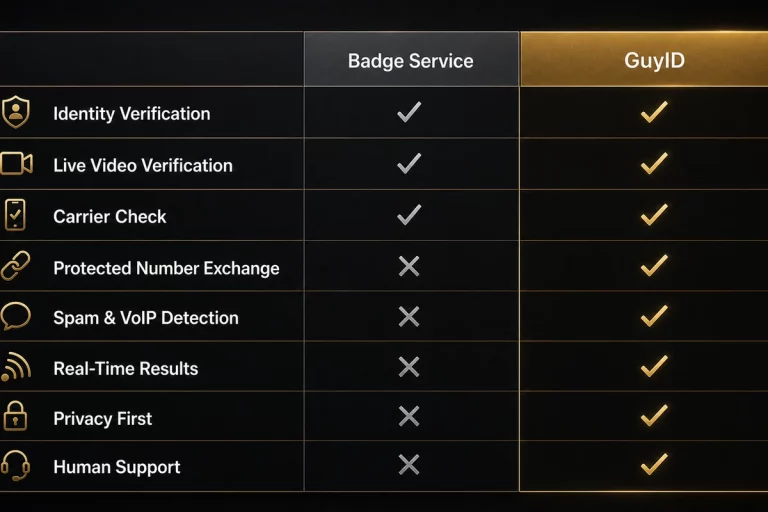
| Criterion | Typical Hookup Safety Platform | GuyID |
|---|---|---|
| Intention scope | Casual/hookup only — branded limitation | All intentions — casual, serious, exploring |
| Identity verification | Photo match, sometimes gov ID | Government ID — AI-proof |
| Character assessment | ❌ None | ✅ Social vouches |
| Progressive trust | ❌ Static badge | ✅ 6-tier progression |
| Portability | Limited — branded to hookup context | ✅ Universal — every platform, every channel |
| STI integration | ✅ Some platforms | ❌ Not applicable — health is separate from identity/character |
| Free screening tools | ❌ Usually none | ✅ 60+ free tools |
| Scam/fake profile protection | Limited — focus on physical safety | ✅ Comprehensive — reverse image search, catfish detection, bio analysis, identity confirmation |
| AI-era resilience | Varies — photo-only = vulnerable | ✅ Gov ID + real vouchers = AI-proof |
The comparison reveals complementary strengths: hookup-focused platforms may offer STI integration and consent features that GuyID doesn’t (because these are health-specific, not identity/character-specific). GuyID provides the multi-factor identity and character verification that hookup platforms don’t. For casual daters who want both: use GuyID for identity/character verification (the universal layer) and any hookup-specific platform for health-specific features (the context-specific layer).
Why Casual Daters Need Multi-Factor Verification Too
A common assumption: casual dating is lower-stakes, so it needs less verification. The opposite is true for safety purposes.
Casual Dating Is HIGHER Risk for Identity-Based Threats
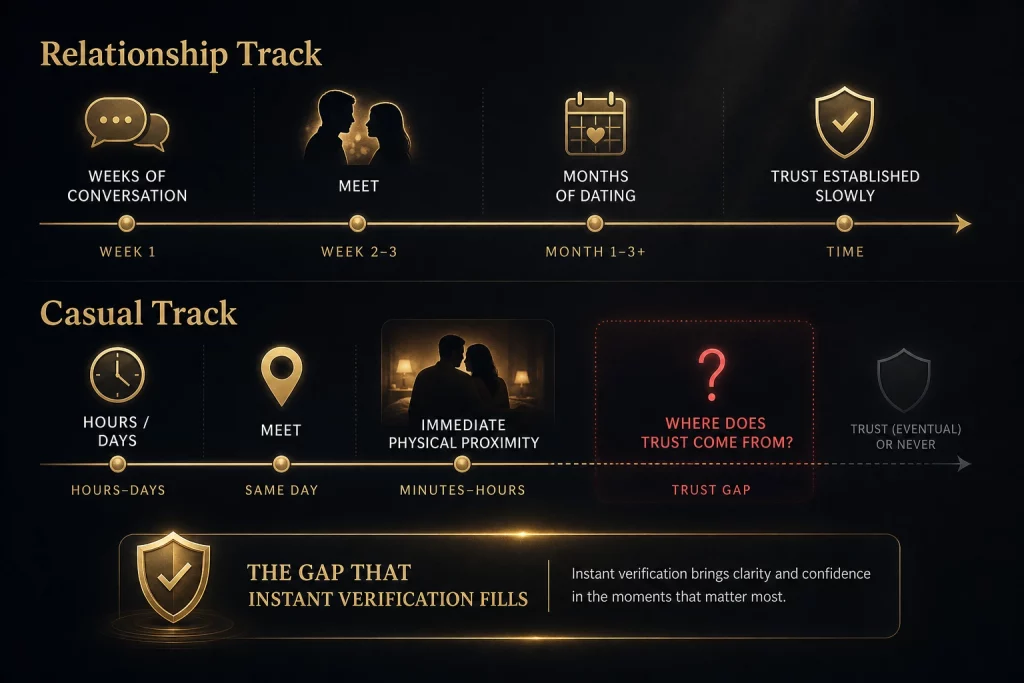
- Faster meeting timelines: Casual encounters typically involve meeting sooner — sometimes within hours of matching. Less conversation time = less opportunity to detect red flags through conversation. Pre-meeting verification becomes more important, not less.
- Less social vetting: Casual encounters are less likely to involve introducing the person to friends first. The social screening that naturally occurs in relationship-track dating doesn’t happen. Formal verification through social vouches substitutes for the informal social vetting that casual dating skips.
- Higher physical vulnerability: Casual encounters may involve intimate settings earlier — private homes, hotels, unfamiliar locations. The physical safety stakes are high from the first meeting. Knowing who someone actually is (government ID) and that real people trust them (vouches) is more consequential when the first meeting involves physical vulnerability.
- Sextortion risk: Casual encounters involve a higher likelihood of intimate content exchange — which is exactly what sextortion operations exploit. Identity verification deters sextortion operators because verified, traceable individuals don’t blackmail people.
The Counterintuitive Truth
Casual dating’s faster timeline and higher physical proximity make verification MORE important, not less. A 10-second Trust Profile check before a same-night meeting provides the trust confirmation that relationship-track daters build over weeks of conversation. For casual daters, instant verification isn’t a nice-to-have — it’s the only safety checkpoint that fits the timeline.
Inline visual 2
Next Steps: Choose Safety That Fits Your Dating Intentions
The best HookupSecurity alternative isn’t another hookup-specific platform — it’s a verification system that works across every dating intention, every platform, and every context. Dating threats don’t check your relationship preferences before targeting you. Your safety platform shouldn’t require a relationship-type label to protect you.
GuyID provides intention-agnostic, multi-factor verification: government ID (identity confirmed), social vouching (character confirmed), progressive Trust Tiers (sustained trust measured), and universal portability (one link, every platform). Whether you’re on Tinder looking for tonight or Hinge looking for the next ten years — the same Trust Profile confirms you’re real, your identity is verified, and real people vouch for your character.
For casual daters specifically: the faster timeline and higher physical proximity of casual dating make instant verification more valuable, not less. A 10-second Trust Profile check provides the safety confirmation that slower-paced dating builds through weeks of conversation. Build your Trust Profile once. Use it everywhere. Let your matches verify you in 10 seconds — regardless of what either of you is looking for.
Frequently Asked Questions
What’s the best alternative to hookup-specific safety platforms?
Do casual daters really need verification?
Can I use GuyID for casual dating AND serious dating?
Does GuyID include STI testing or consent features?
Will a GuyID link in my Tinder bio signal that I’m looking for something serious?
How quickly can I verify before a same-day date?
Evidence note
The FTC reported 64,003 romance-scam reports in 2023, with $1.14 billion in reported losses and a $2,000 median reported loss (Federal Trade Commission, 2024).