Reader Briefing
Reader Briefing
Start here if you need a practical read on datebadge alternative: why multi-factor verification beats single badges: who should use verification, what signals to check, and what to do before moving from online interest to an in-person plan.
Who this is for
- People meeting someone from a dating app or social platform.
- Anyone checking identity, profile consistency, and trust signals.
- People trying to avoid romance scams, fake profiles, or pressure tactics.
- Online daters improving conversations, profiles, or match screening.
You’ll learn
- How to evaluate identity signals without treating any single check as certainty.
- Which trust signals matter and how to weigh them together.
- How to spot inconsistencies, pressure, or behavior patterns that deserve caution.
- Where GuyID tools fit into a quick pre-date screening workflow.
- How to compare options using practical safety and trust criteria.
- When to slow down, ask for more context, or walk away.
Bottom line
Verification reduces uncertainty; it does not guarantee future behavior. Use a layered approach: confirm identity signals, compare profile consistency, ask for a short video call, keep early plans public, and slow down when someone pressures you to skip normal safety steps.
Key takeaways
- Identity verification improves confidence, not certainty.
- Patterns matter more than isolated incidents.
- A short video call can reveal many inconsistencies.
- Pressure to skip reasonable safety steps is useful information.
- Use GuyID tools to turn vague concerns into specific checks.
Free Tools
Catfish Probability Detector
Check whether a dating profile has suspicious identity or photo signals.
Dating Bio Red Flag Detector
Review a bio for scam, pressure, or trust-warning language.
Dating Safety Checklist
Use free GuyID tools before moving from chat to a real date.
Next step
Create your GuyID trust profile
Share consent-based trust signals before a date without turning the conversation into an interrogation.
NavigateTable of Contents19 sections
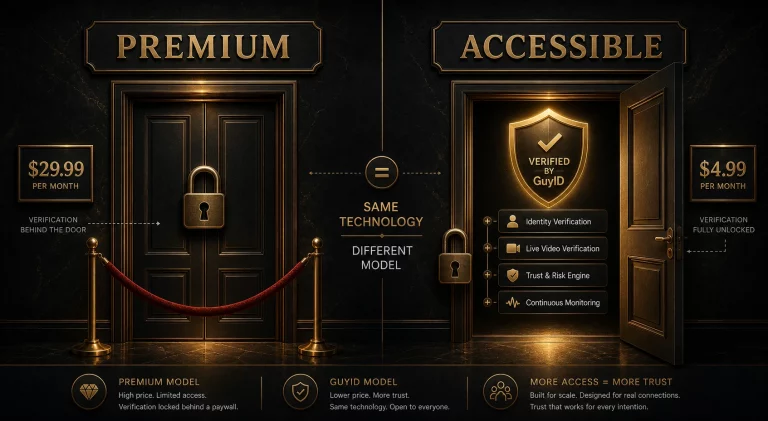
If you’ve been searching for dating verification services, you may have come across DateBadge — one of several platforms offering identity badges for online daters. The concept is sound: verify your identity, display a badge, build trust with potential matches. But not all verification services are equal. The differences in what gets verified, how verification is confirmed, whether it’s portable across platforms, and what it costs determine whether the badge actually makes you safer — or just makes you feel safer. This guide compares DateBadge alternatives on the dimensions that matter: verification depth, portability, trust measurement, and cost — and explains why the verification approach you choose determines the quality of protection you actually receive.
What to Look for in a Dating Verification Service
Before comparing specific services, understanding what separates meaningful verification from cosmetic badging helps you evaluate any DateBadge alternative — including services that don’t exist yet.
The Core Question
When a match sees your verification badge, what can they actually confirm? If the answer is “their face matches their photos” — that’s single-factor verification, the same level every dating app already provides for free. If you’re paying for a service that provides the same confirmation as a free Tinder badge, you’re paying for a duplicate.
Meaningful verification goes beyond facial matching to confirm: legal identity (government documents), character (human attestation), and sustained trustworthiness (progressive measurement). These are the dimensions that single-badge services typically don’t address — and the dimensions that determine whether verification actually protects you or merely decorates your profile.
Inline visual 1
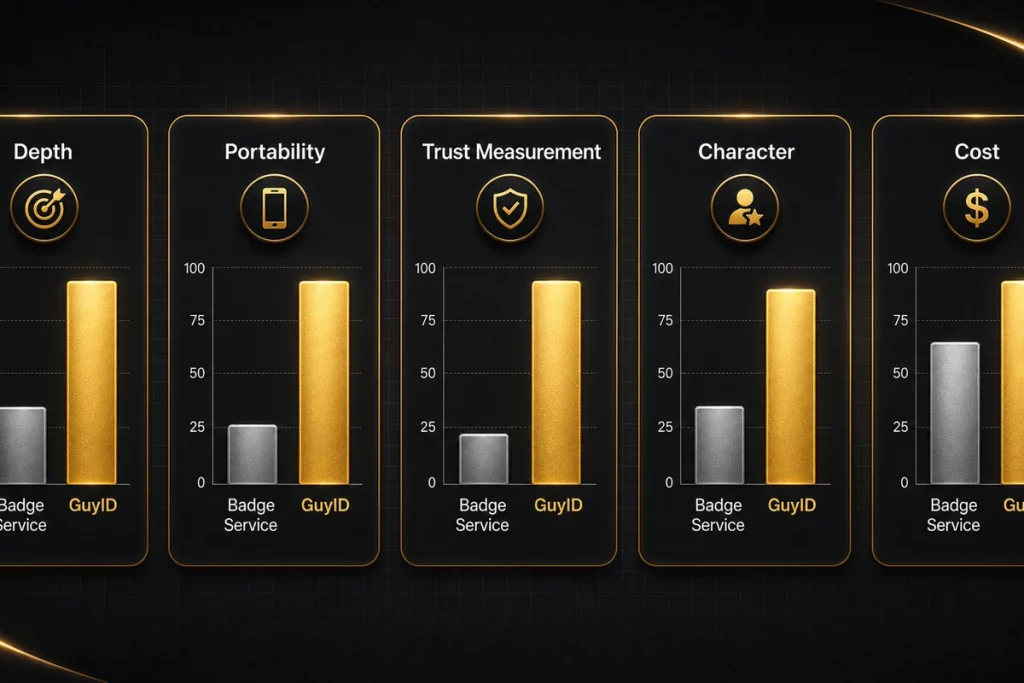
The 5 Dimensions That Differentiate Verification Services
| # | Dimension | What to Evaluate | Why It Matters |
|---|---|---|---|
| 1 | Verification Depth | What exactly is confirmed? Face only? Government ID? Character? | Deeper verification = harder to fake = more reliable trust |
| 2 | Portability | Does the verification work on one platform or everywhere? | Platform-locked verification vanishes at the WhatsApp transition |
| 3 | Trust Measurement | Is trust binary (badge/no badge) or progressive (measured over time)? | Static badges capture one moment. Progressive tiers track sustained trust |
| 4 | Character Assessment | Does the service include human vouching or character evaluation? | Documents confirm identity. Only humans confirm character |
| 5 | Cost Structure | Free? One-time fee? Monthly subscription? Free for checkers? | Verification that costs recipients to check creates adoption barriers |
A service that scores well on all five dimensions provides genuine protection. A service that scores well on one dimension (e.g., verification depth) but poorly on others (e.g., not portable, no character assessment) provides partial protection at best.
How DateBadge and Similar Badge Services Typically Compare
Badge-based verification services — whether DateBadge, VerifyMyDate, TrustBadge, or similar — generally follow the same model. Understanding the model’s strengths and limitations helps you evaluate any service in this category.
The Typical Badge Service Model
- Verification method: Photo selfie matching, sometimes with government ID. Typically a single-factor or dual-factor check resulting in a static badge.
- Output: A badge image or link placed in your dating profile — “Verified by [Service Name].”
- Portability: The badge link usually works across platforms (placed in bio). Better than platform-locked badges but limited to visual confirmation.
- Trust measurement: Binary — you either have the badge or you don’t. No progressive tiers, no trust trajectory, no sustained measurement.
- Character assessment: None — badge services confirm identity documents, not character. No social vouching, no human attestation.
- Cost: Pricing and checker access vary by service. Confirm the current fee, renewal terms, and whether the recipient must pay before relying on a badge.
What Badge Services Get Right
The concept is sound: verified identity displayed on your dating profile builds trust. Cross-platform portability (badge link in any bio) is better than platform-locked badges. And any verification beyond the dating app’s free badge adds a layer. Badge services address a real need — the trust gap — and represent a meaningful step beyond the dating industry’s minimum.
What Badge Services Miss
- No character dimension: A verified identity can belong to an untrustworthy person. Badge services confirm documents, not character. The person who passes government ID verification but lies about their relationship status, manipulates partners, or has a pattern of dishonesty receives the same badge as a genuinely trustworthy person.
- Static trust: A badge earned once is displayed forever — regardless of behavior after verification. There’s no mechanism to revoke, downgrade, or evolve the trust signal based on ongoing conduct.
- No AI-era resilience for face-only badges: Services that rely solely on facial matching (no government ID) share the deepfake vulnerability of dating app badges — the single factor that has been structurally defeated.
- Adoption friction: Subscription or checker fees can discourage recipients from opening a verification result, reducing the practical reach of the trust signal.
GuyID: The Multi-Factor Alternative
GuyID approaches dating verification differently — not as a static badge but as a multi-factor trust system that confirms identity, assesses character, measures trust progressively, and works everywhere.
What GuyID Verifies
- Government ID verification: Biometric matching against official identity documents — the same standard used in banking. Confirms legal identity through the AI-proof digital-physical boundary.
- Social vouching: Real people — friends, colleagues, community connections — publicly confirming identity and vouching for character. The human dimension that documents alone can’t provide.
- Progressive Trust Tiers: GHOST → STARTER → BUILDER → TRUSTED → ELITE → LEGEND. Trust isn’t binary — it’s measured and evolves over time. Higher tiers require more verification factors and sustained consistency.
How GuyID Is Displayed
A Date Mode link in your dating bio — clickable on every platform. When a match clicks: they see your Trust Tier, government ID status, social vouches, and Anti-Scammer Badge. Ten seconds to check. Works on Tinder, Bumble, Hinge, OkCupid, WhatsApp, text, Instagram, and in person. Portable everywhere — no platform dependency.
What GuyID Costs
Under GuyID’s current product policy, women can check a Trust Profile without a fee. Men build Trust Profiles through a subscription that includes government ID verification, vouch management, and progressive tier tracking. Check the current product and pricing pages before making a purchase decision because availability and terms can change.
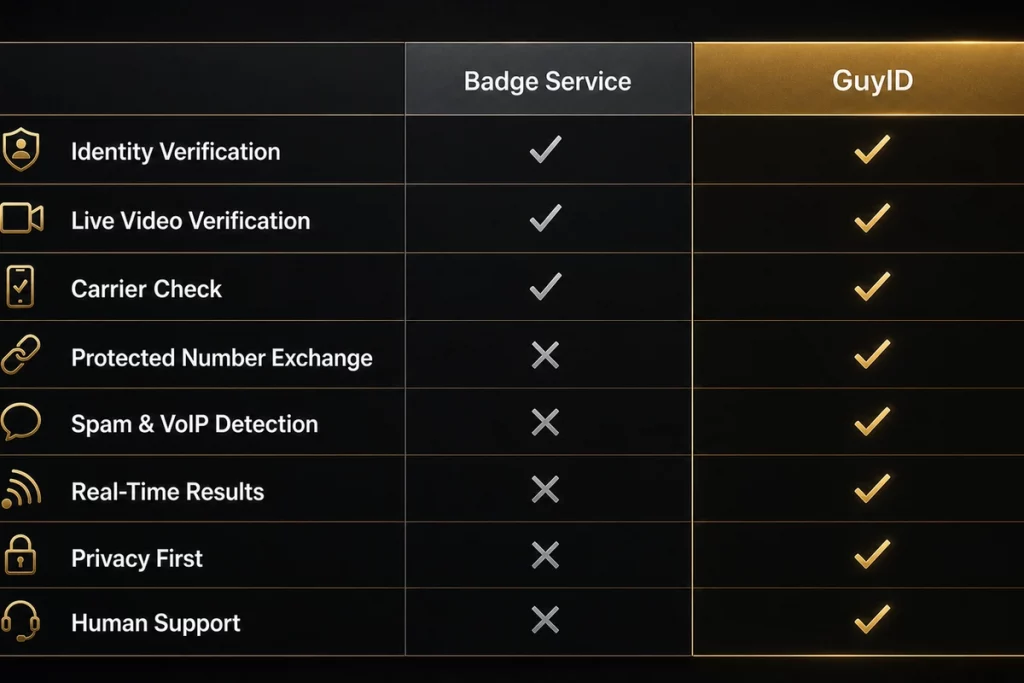
Head-to-Head: Badge Services vs GuyID
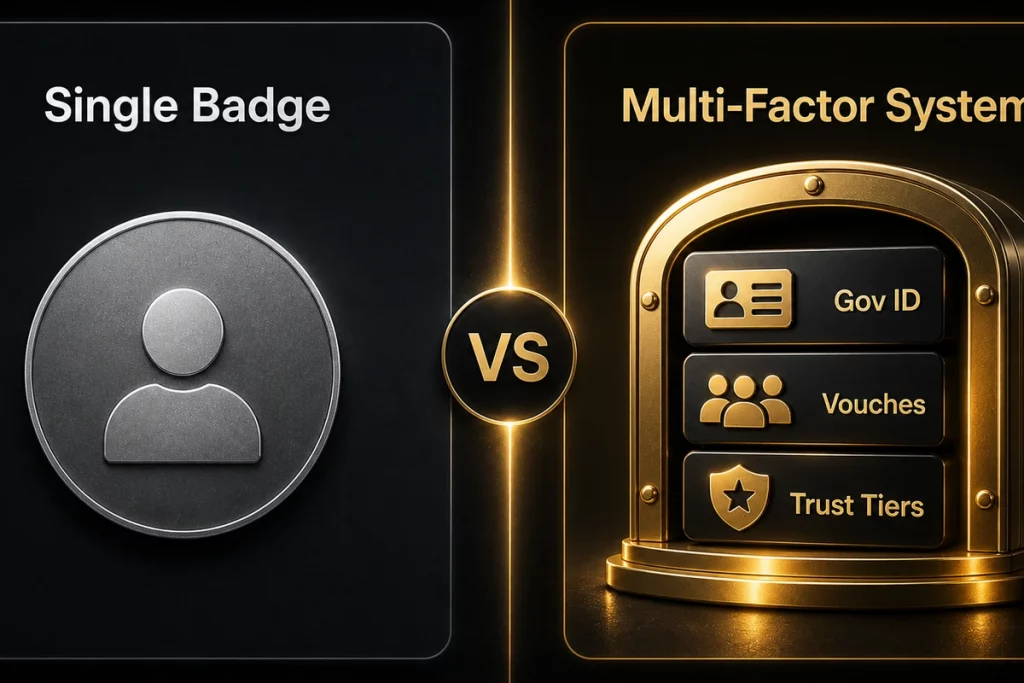
Single-badge and multi-factor verification compared across identity, character, portability, and ongoing trust.
| Dimension | Typical Badge Service | GuyID |
|---|---|---|
| Verification depth | Face matching, sometimes gov ID (1-2 factors) | Gov ID + social vouching + behavioral consistency (3 factors — multi-factor) |
| Character assessment | ❌ None — documents only | ✅ Social vouches — real people confirming character |
| Trust measurement | Binary (badge or no badge) | Progressive (6 tiers measuring sustained trust) |
| Portability | Badge link in bios (moderate) | Date Mode link — every platform, WhatsApp, in person (maximum) |
| AI resilience | ❌ Face-only badges defeated by deepfakes | ✅ Gov ID + real vouchers = AI-proof |
| Free tools for screening | ❌ Typically none — verification only | ✅ 60+ free tools (reverse image, catfish detector, bio analysis) |
| Checker access | Varies by provider; verify current terms | GuyID currently offers no-fee Trust Profile checking for women |
| Ongoing trust tracking | ❌ Static badge — no change after verification | ✅ Trust Tiers evolve based on sustained behavior and verification |
The comparison reveals a structural difference: badge services provide a point-in-time identity check. GuyID provides a multi-factor trust system — identity confirmed, character assessed, trust measured progressively, and portable across every channel. The gap isn’t cosmetic — it’s the difference between a lock (single factor, pickable) and a vault (multi-factor, structurally secure).
Why Single-Factor Badge Services Fall Short in 2026
The dating safety landscape has changed since most badge services were designed. Three developments have made single-factor approaches insufficient.
1. Deepfakes Defeated Facial Verification
Any service relying solely on face-matching verification has been structurally compromised. Real-time deepfake overlays pass selfie checks. This doesn’t mean facial verification is worthless — it still catches low-effort fakes. But it means a face-only badge no longer provides the trust confirmation it implies.
2. AI Generates Convincing Entire Identities
AI systems create photorealistic faces, fluent bios, and conversational text. A complete fake identity — photos, bio, conversation — can be generated at near-zero cost. Badge services that verify photos without confirming government documents are verifying pixels, not people.
3. Character Is the Missing Dimension
The most consequential dating safety failures aren’t identity fraud — they’re genuine people with genuine documents who are dishonest, manipulative, or harmful. A badge that confirms identity but ignores character leaves the most common trust failure unaddressed. Only social vouching — real people confirming character — addresses this dimension.
Summary: Choose Verification That Actually Verifies
The best DateBadge alternative isn’t just a cheaper badge — it’s a fundamentally more comprehensive verification system. The five evaluation dimensions — verification depth, portability, trust measurement, character assessment, and cost — reveal which services provide genuine protection versus cosmetic trust signals.
GuyID provides multi-factor verification across all five dimensions: government ID (identity depth), social vouching (character assessment), progressive Trust Tiers (sustained measurement), Date Mode link (universal portability), and free checking for women (zero adoption barrier). Plus 60+ free screening tools that no badge service offers.
In the AI era, verification that confirms only face or only documents is insufficient. The verification that protects in 2026 must confirm identity through government documents (AI-proof), assess character through human vouching (AI-proof), measure trust progressively (time-proof), and work everywhere (platform-proof). That’s the standard. Evaluate every verification service — DateBadge or otherwise — against it.
Frequently Asked Questions
What’s the best alternative to DateBadge?
Are dating verification badges worth paying for?
How does GuyID compare to other verification services?
Can deepfakes defeat verification badges?
Do I need a verification badge AND a GuyID Trust Profile?
Is verification checking free on GuyID?
Evidence note
NIST Digital Identity Guidelines distinguish identity proofing, authentication, and federation as separate parts of digital identity risk management (NIST, 2025).