Reader Briefing
Reader Briefing
Start here if you need a practical read on what is multi-factor identity verification for dating?: who should use verification, what signals to check, and what to do before moving from online interest to an in-person plan.
Who this is for
- People meeting someone from a dating app or social platform.
- Anyone checking identity, profile consistency, and trust signals.
- People trying to avoid romance scams, fake profiles, or pressure tactics.
- Online daters improving conversations, profiles, or match screening.
You’ll learn
- How to evaluate identity signals without treating any single check as certainty.
- Which trust signals matter and how to weigh them together.
- How to spot inconsistencies, pressure, or behavior patterns that deserve caution.
- How to move from online conversation to a safer first meeting.
- Where GuyID tools fit into a quick pre-date screening workflow.
- How to compare options using practical safety and trust criteria.
Bottom line
Verification reduces uncertainty; it does not guarantee future behavior. Use a layered approach: confirm identity signals, compare profile consistency, ask for a short video call, keep early plans public, and slow down when someone pressures you to skip normal safety steps.
Key takeaways
- Identity verification improves confidence, not certainty.
- Patterns matter more than isolated incidents.
- Verify before meeting privately or sharing sensitive details.
- A short video call can reveal many inconsistencies.
- Pressure to skip reasonable safety steps is useful information.
Free Tools
Catfish Probability Detector
Check whether a dating profile has suspicious identity or photo signals.
Dating Bio Red Flag Detector
Review a bio for scam, pressure, or trust-warning language.
Dating Safety Checklist
Use free GuyID tools before moving from chat to a real date.
Next step
Create your GuyID trust profile
Share consent-based trust signals before a date without turning the conversation into an interrogation.
NavigateTable of Contents22 sections
Your bank doesn’t verify your identity with just a password. It uses multi-factor authentication — something you know (password), something you have (phone), and sometimes something you are (fingerprint). The principle: a single verification factor can be compromised, but multiple independent factors together are exponentially harder to defeat. The question isn’t whether dating needs multi-factor verification. It’s how many factors are needed, what each factor confirms, and where you can access them today.
This guide explains multi-factor identity verification as it applies to dating: what each verification factor is, what it catches, why single-factor verification fails in the AI era, and how GuyID’s three-pillar system implements multi-factor verification for the dating context.
What Multi-Factor Verification Means
Multi-factor identity verification is a security principle that requires confirming identity through multiple independent methods — so that compromising one method alone is insufficient to fake an identity. The principle is established across every high-security domain: banking, government access, corporate security, healthcare. Dating is the last major trust domain that still relies on single-factor verification.
The Factor Categories
In traditional security, verification factors fall into three categories:
- Something you know: Password, PIN, security answer — knowledge only the real person possesses.
- Something you have: Phone, hardware token, physical ID card — a physical object only the real person possesses.
- Something you are: Fingerprint, face scan, voice print — biometric characteristics unique to the real person.
Adapted for Dating
In dating contexts, the verification factors translate differently — because the goal isn’t accessing an account but confirming that a person is real, is who they claim, and is trustworthy. The dating-adapted factors are:
- Something you look like: Photo matching, selfie verification, video confirmation — confirming facial identity.
- Something you possess: Government-issued identity document — a physical object confirming legal identity.
- Something others confirm: Social vouching — real people in your life attesting to your identity and character.
- Something you demonstrate: Behavioral consistency over time — sustained trustworthy behavior tracked through progressive tiers.
- Something institutions record: Criminal history, public records — institutional documentation accessible through background checks.
Each factor operates independently. Compromising one (deepfaking a selfie) doesn’t compromise the others (you still need a government ID, real vouchers, and consistent behavior). The independence is what makes multi-factor verification exponentially more secure than single-factor.
Why Single-Factor Verification Fails in Dating
Every major dating app uses exactly one verification factor: face matches photos. Here’s why this single factor is insufficient in 2026.
The One Factor Dating Apps Use
| Platform | Verification Method | Factor Type | What It Confirms |
|---|---|---|---|
| Tinder | Pose selfie | Something you look like | Face matches photos |
| Bumble | Gesture selfie | Something you look like | Face matches photos |
| Hinge | Video selfie | Something you look like | Face matches photos |
| OkCupid | Photo selfie | Something you look like | Face matches photos |
Every platform verifies the same single factor: facial appearance. This means the entire industry’s verification infrastructure has a single point of failure — and deepfake technology has found it.
How the Single Factor Gets Defeated
- Deepfake face-swapping: Real-time overlay of a synthetic face during the selfie check — passing facial verification with a face that belongs to no real person.
- AI-generated photos: Profile photos of faces that never existed — passing visual inspection because they look photorealistic, though they represent nobody real.
- Photo manipulation: Modified photos that pass the selfie-to-photo comparison while misrepresenting age, appearance, or other visual characteristics.
When the only factor is “face matches photos,” defeating that single factor grants full verified status — a badge that communicates “verified” despite the underlying identity being unconfirmed. This is the single-point-of-failure problem that multi-factor verification eliminates.
The Five Verification Factors Available in Dating
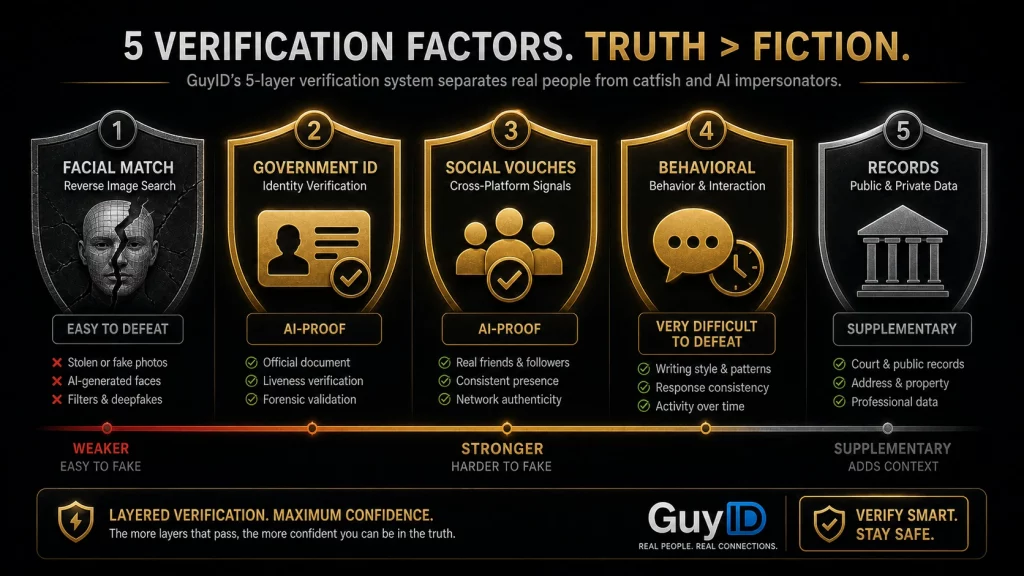
Five independent verification factors can be applied to dating identity — each confirming a different dimension and each resistant to different attack methods.
| Factor | What It Confirms | How It’s Defeated | Who Provides It |
|---|---|---|---|
| 1. Facial matching | Face matches profile photos | Deepfakes, photo manipulation | Dating app badges (Tinder, Bumble, Hinge) |
| 2. Government ID | Legal identity confirmed by official document | ❌ Not defeatable by AI (physical document with security features) | GuyID |
| 3. Social vouching | Character confirmed by real humans | ❌ Not defeatable at scale (requires real people willing to vouch publicly) | GuyID |
| 4. Behavioral consistency | Trustworthy behavior sustained over time | Extremely difficult (requires maintaining deception over months/years) | GuyID Trust Tiers |
| 5. Institutional records | Criminal history, public records | N/A (records exist or they don’t) | Background check services |
Factors 2, 3, and 4 are the three that are either undefeatable or extremely difficult to defeat — and these are the three factors that GuyID implements. Factor 1 (facial matching) is the one that dating apps provide. Factor 5 (institutional records) is the one that third-party background check services provide. Together, all five factors create the maximum verification stack — though factors 2-4 alone provide dramatically more security than factor 1 alone.
Inline visual 1
How Dating Apps Use Verification Today: The Single-Factor Problem
Understanding why multi-factor identity verification matters for dating requires seeing how thin the current verification actually is.
What a Dating App Badge Actually Proves
A verified badge on any major dating app proves exactly one thing: the person who completed the verification selfie has the same face as the profile photos. That’s the complete scope. It doesn’t prove their name is real. It doesn’t prove their age is accurate. It doesn’t prove they’re single. It doesn’t prove their career claims. It doesn’t prove their location. It doesn’t assess their character. And as deepfake technology demonstrates, it doesn’t even definitively prove the face is a real, unmanipulated human face.
What This Means for Users
A “verified” profile on a dating app may belong to: a real person who is exactly who they claim (the intended outcome), a real person misrepresenting their age, career, or relationship status (undetected by facial verification), a real person with a pattern of manipulative or abusive behavior (invisible to facial verification), or a sophisticated fake identity using deepfake technology to pass the selfie check (the single factor, defeated). The badge communicates “verified” — but the verification is so narrow that the badge’s implied trust far exceeds its actual confirmation. This gap between implied and actual verification is the badge-versus-trust problem that multi-factor verification solves.
How GuyID Implements Multi-Factor Verification for Dating
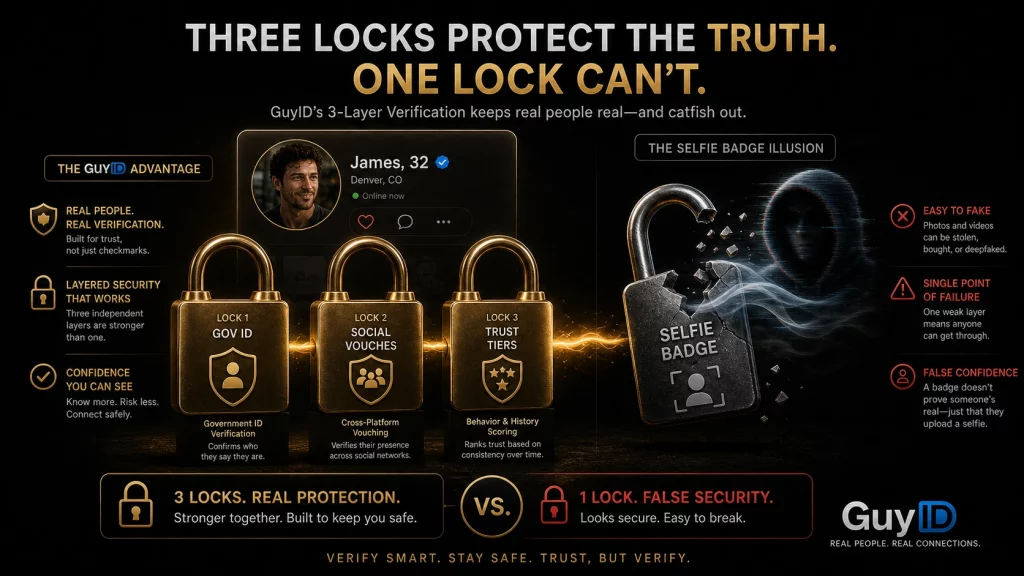
GuyID’s dating trust score is a multi-factor verification system — implementing three independent factors that collectively provide the trust confirmation that single-factor badges can’t.
Factor 1: Government ID (Something You Possess)
Biometric matching against a government-issued identity document — passport, driver’s license, or national ID. This factor confirms legal identity through the same standard used in banking. Unlike facial matching (which compares photos to selfies within the digital domain), government ID verification bridges the digital-physical gap: the document is a physical object issued by a government institution, with security features that AI cannot replicate.
What it catches: Every fake identity, every AI-generated persona, every catfish using someone else’s face. No legitimate government document exists for a fictional person.
Factor 2: Social Vouching (Something Others Confirm)
Real people — friends, colleagues, community connections — publicly confirming the person’s identity and vouching for their character. This factor is independent of both facial matching and government ID: it assesses character through human judgment, not documents or photos.
What it catches: Verified identities with bad character — people whose documents are real but whose trustworthiness is not. The character dimension that no document or photo can assess. Also catches sophisticated identity theft (where someone uses another person’s real documents) — because the vouchers know the PERSON, not just the document.
Factor 3: Progressive Consistency (Something You Demonstrate)
Trust Tiers — GHOST through LEGEND — track sustained trustworthy behavior over time. This temporal factor catches what point-in-time checks miss: disposable scam accounts abandoned after weeks, recently created profiles with no history, and behavior that changes after initial verification.
What it catches: Hit-and-run scam operations that pass point-in-time checks but can’t sustain verification over months. Behavior changes that occur after initial verification. The temporal dimension that static checks miss entirely.
Why Three Factors Together Are Exponentially Stronger Than One
To defeat GuyID’s multi-factor system, a scammer must simultaneously: produce a legitimate government identity document (Factor 1 — requires physical document forgery or identity theft), convince multiple real humans to publicly vouch for a fraudulent identity (Factor 2 — requires real accomplices accepting legal/reputational risk), AND maintain consistent trustworthy behavior over months (Factor 3 — requires sustained operational investment per fake identity). Defeating all three simultaneously is structurally impractical for scam operations — while achieving all three is naturally easy for every genuine person.
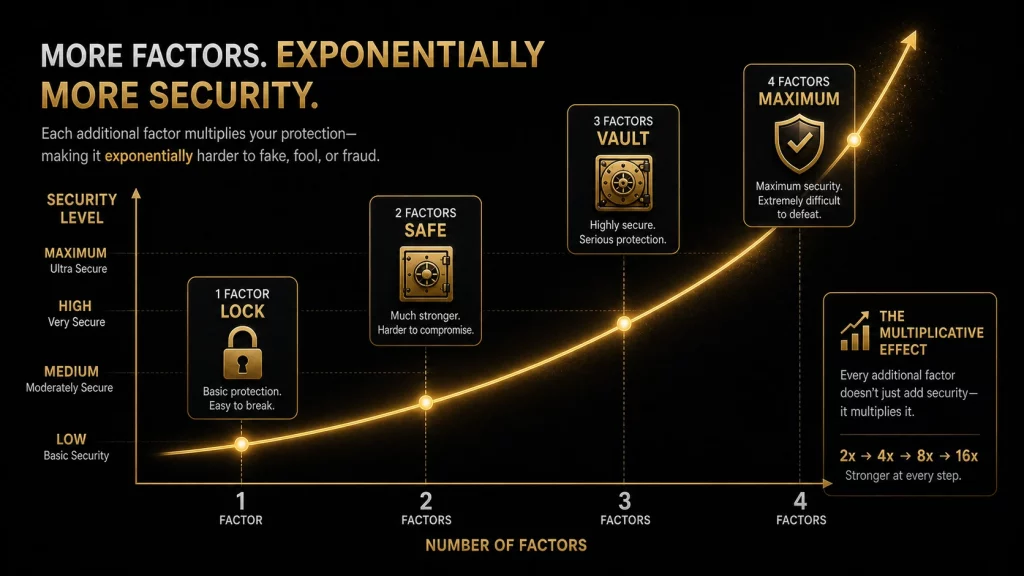
Why Each Additional Factor Exponentially Increases Security
The security benefit of multi-factor verification isn’t additive — it’s multiplicative. Understanding why explains the enormous gap between single-factor and multi-factor systems.
The Multiplicative Effect
| Factors | Probability of ALL Factors Being Defeated | Security Level |
|---|
The jump from one factor to three factors is a 100x improvement in security. This multiplicative effect explains why multi-factor authentication is the standard in banking, government, and every domain where identity matters — and why dating’s reliance on single-factor verification represents a structural security failure.
Inline visual 2
Multi-Factor Verification vs Background Checks
Background checks and multi-factor verification serve different but complementary purposes.
| Dimension | Multi-Factor Verification (GuyID) | Background Check |
|---|---|---|
| What it confirms | Identity (gov ID) + character (vouches) + consistency (tiers) | Criminal history + public records |
| Time dimension | Present + ongoing (current identity, current character, sustained behavior) | Past (historical records) |
| Information required | Click a Date Mode link — no personal info needed | Full legal name + DOB required |
| Scalable for every match | ✅ Check every match in 10 seconds | ❌ Too expensive/info-intensive for routine use |
| Catches non-criminal character issues | ✅ Social vouching assesses character broadly | ❌ Only criminal records |
| AI-proof | ✅ Gov ID + real humans operate outside digital domain | N/A (searches records, not identities) |
Multi-factor verification through GuyID is the everyday verification — scalable to every match, free for women, confirming identity and character in the present. Background checks are the commitment-stage supplement — screening criminal history that verification and vouching can’t see. Together: the maximum verification stack. See the complete comparison.
Summary: One Factor Is a Lock. Three Factors Is a Vault.
Multi-factor identity verification is the security principle that every high-stakes domain uses — and that dating has been missing. Banking requires multiple factors. Government access requires multiple factors. Healthcare requires multiple factors. Dating — where you’re deciding whether to meet a stranger in person, share personal information, invest emotionally, and potentially share your life — has been relying on a single factor: face matches photos. In the AI era, that single factor has been defeated.
GuyID implements three-factor verification for dating: government ID (confirmed legal identity — AI-resistant), social vouching (confirmed character through real humans), and progressive Trust Tiers (consistency observed over time, which is harder to fabricate quickly). Each factor is intended to address a different type of uncertainty. Verification describes evidence that has been checked; it does not assess a person’s intent or predict future behavior.
One factor is a lock — pickable with the right tool. Three factors is a vault — structurally impractical to breach. Your dating safety deserves vault-level verification. It takes 20 minutes to build. It takes 10 seconds to check. And it provides the multi-factor trust confirmation that single-factor badges will never match.
Frequently Asked Questions
What is multi-factor identity verification in dating?
How does GuyID implement multi-factor verification?
Can deepfakes defeat multi-factor verification?
How many verification factors do I need to be safe?
How long does multi-factor verification take?
Related Reading
Evidence note
NIST Digital Identity Guidelines distinguish identity proofing, authentication, and federation as separate parts of digital identity risk management (NIST, 2025).