Reader Briefing
Reader Briefing
Start here if you need a practical read on stand out dating profile: how verification signals add context: who should use verification, what signals to check, and what to do before moving from online interest to an in-person plan.
Who this is for
- People meeting someone from a dating app or social platform.
- Anyone checking identity, profile consistency, and trust signals.
- People trying to avoid romance scams, fake profiles, or pressure tactics.
- Online daters improving conversations, profiles, or match screening.
You’ll learn
- How to evaluate identity signals without treating any single check as certainty.
- Which trust signals matter and how to weigh them together.
- How to spot inconsistencies, pressure, or behavior patterns that deserve caution.
- How to move from online conversation to a safer first meeting.
- How to compare options using practical safety and trust criteria.
- When to slow down, ask for more context, or walk away.
Bottom line
Verification reduces uncertainty; it does not guarantee future behavior. Use a layered approach: confirm identity signals, compare profile consistency, ask for a short video call, keep early plans public, and slow down when someone pressures you to skip normal safety steps.
Key takeaways
- Identity verification improves confidence, not certainty.
- Patterns matter more than isolated incidents.
- Verify before meeting privately or sharing sensitive details.
- A short video call can reveal many inconsistencies.
- Pressure to skip reasonable safety steps is useful information.
Free Tools
Catfish Probability Detector
Check whether a dating profile has suspicious identity or photo signals.
Dating Bio Red Flag Detector
Review a bio for scam, pressure, or trust-warning language.
Dating Safety Checklist
Use free GuyID tools before moving from chat to a real date.
Next step
Create your GuyID trust profile
Share consent-based trust signals before a date without turning the conversation into an interrogation.
Introduction
You’ve optimized your photos. You’ve written a specific, personality-rich bio. You’ve applied every profile tip in every guide. Your profile may be polished, but other daters can make similar presentation choices. Profile optimization therefore has a ceiling. A stand out dating profile is not only well-crafted; it also makes its identity and trust claims easier to inspect. Those signals must be earned rather than created through better copy.
This guide explains how verification signals can complement a well-written profile, what different checks do and do not establish, and how to share those signals without overstating their meaning. No available evidence establishes that a verification badge or trust profile will increase matches or produce dates.
Quick Answer
Verification can make a dating profile more informative by adding inspectable evidence about a narrow claim, such as completion of an issuer’s photo, account-control, or identity-document process. It does not prove that a person is compatible, honest, safe, or likely to behave well. Use verification as one optional layer alongside conversation, consent, boundaries, and ordinary meeting precautions.
NavigateTable of Contents23 sections
Key Takeaways
Profile presentation and verification answer different questions
Photos and biography communicate interests and personality. A verification record may add inspectable evidence about a defined identity, account-control, or social-context signal, depending on the issuer and method.
Verification does not resolve every dating-safety question
An interesting profile can earn attention, but it does not answer every identity or safety question a reader may have. A disclosed trust profile can add evidence about narrower verification signals before a meeting. It cannot resolve every concern or guarantee that a match will continue.
Verification signals vary in scope
An app badge, identity-document check, social attestation, and longitudinal account signal are not interchangeable. Inspect what each issuer checked, when it was checked, what is disclosed, and which questions remain unanswered.
Verification adds a different kind of information
Building a GuyID Trust Profile can add disclosed identity and social-context signals that profile editing cannot provide. Completion time varies with document review, technical checks, and whether additional information is required.
The Profile Optimization Ceiling
Profile guides commonly recommend recent photos, specific biography details, and prompts that make conversation easier. Those choices can communicate interests and presentation quality, but they do not independently corroborate identity claims.
When Everyone Optimizes, Nobody Stands Out
A polished profile can still leave a viewer uncertain about who controls the account or whether a narrow identity claim has been checked. Optional verification can provide additional context, but participation should be voluntary and the result should never be treated as a command to trust someone.
The Trust Gap That Optimization Can’t Close
No matter how good your profile is, it can face a fundamental credibility question from a viewer: “Is this person who they claim?” A biography could be fabricated, photos could be AI-generated, and personality claims may be difficult to assess before meeting. Profile optimization does not resolve that trust gap. Verification can add evidence about defined signals, but it still cannot prove intentions or future behavior.
What Verification Adds That Optimization Can’t
| What Profile Optimization Provides | What Verification Adds |
|---|---|
| Recent photos and a specific bio | An issuer-defined identity or account-control signal |
| Stated interests and personality | Social attestations whose source and scope can be inspected |
| Conversation prompts | A dated Trust Tier or other disclosed account-history signal |
| Platform profile context | A portable Date Mode link that remains available after a WhatsApp transition |
| Platform badge | A separate GuyID record with its own methodology and limitations |
Optimization and verification answer different questions. Presentation can communicate personality and interests, while verification can add evidence about identity or account control. Match decisions, compatibility, intentions, future conduct, and safety remain separate questions.
The Decision Context
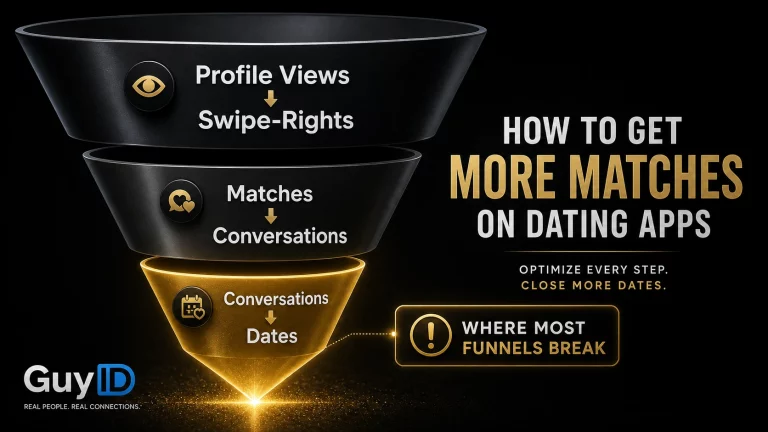
Dating decisions can include several stages: viewing a profile, matching, talking, and deciding whether to meet. Presentation and verification may inform different parts of that evaluation, but individual responses vary. GuyID does not currently have controlled evidence showing that its signals change match or meeting rates.
Expert Insights: What the Available Evidence Does and Does Not Show
Pew Research Center found that 47% of people who had used online dating supported requiring background checks for dating profiles (Pew Research Center, 2023). That finding measures an attitude toward one screening policy; it does not establish that a badge, identity check, or trust profile increases matches, produces dates, or makes a person safe.
Platform claims about verification should be evaluated separately because their populations, definitions, and commercial incentives differ. A useful comparison identifies the issuer, methodology, date, signal checked, and limitations instead of combining unlike measurements into a universal conversion claim.
For a meaningful outcome study, researchers would need a disclosed sample, a comparison group, consistent definitions of verification and conversion, and controls for profile quality, geography, platform, age, and user intent. Without that design, an observed difference cannot be attributed to verification alone. GuyID should publish such evidence before making performance claims.
The Three Levels of Dating Profile Verification
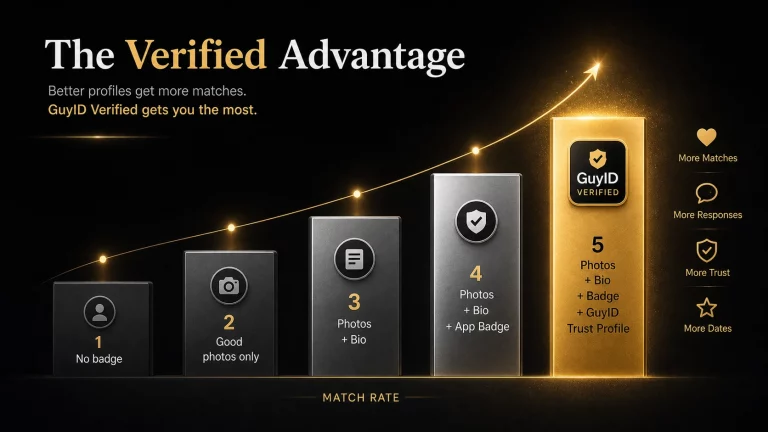
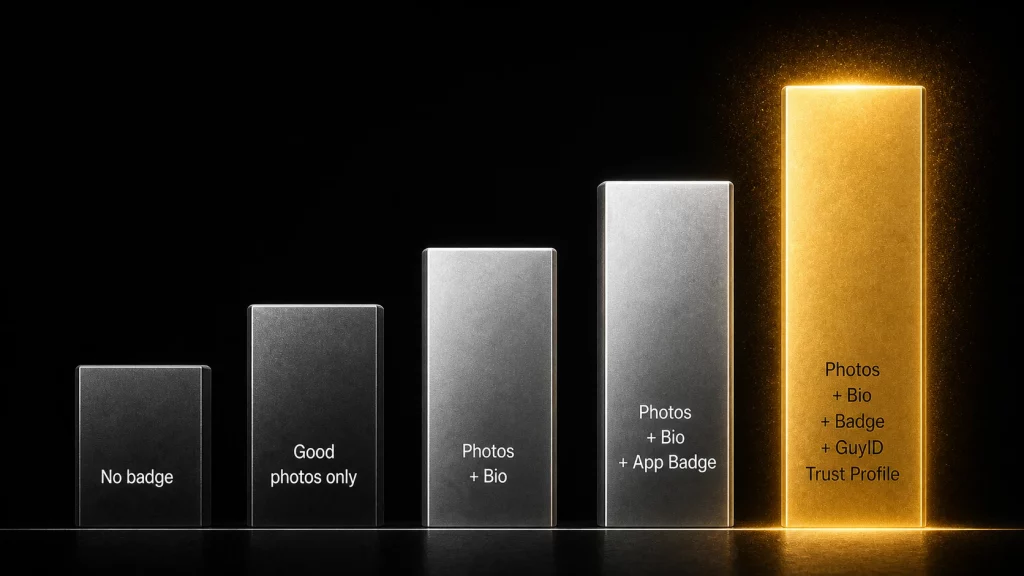
Verification methods differ in scope. The following framework organizes signals by the kind of evidence disclosed; it is not a safety ranking and does not predict dating outcomes.
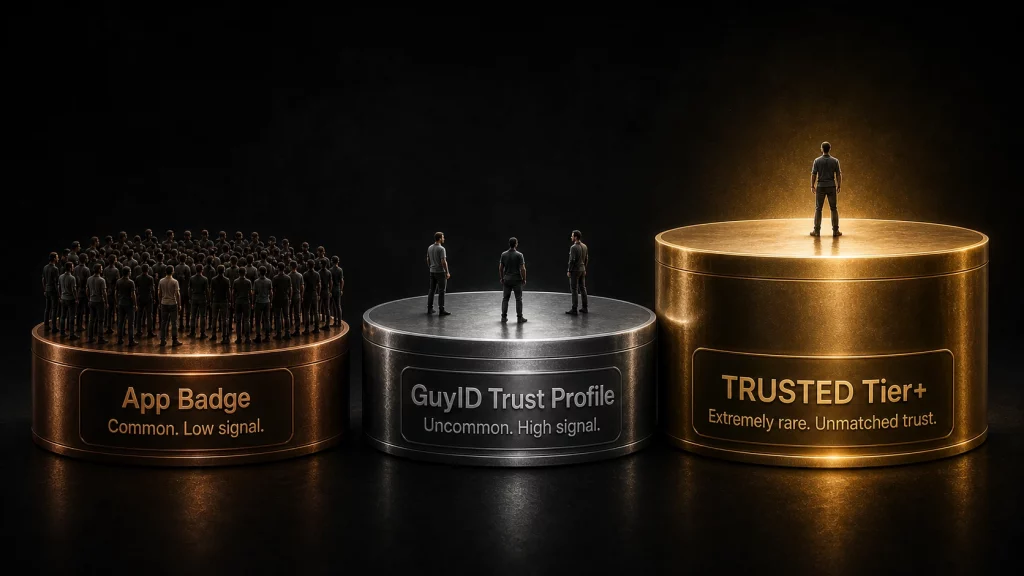
Level 1: Platform Badge
What it is: an issuer-defined check within a dating app, such as the photo or video processes described by Tinder, Bumble, or Hinge. The scope varies by platform and can change, so read the current explanation before interpreting a badge.
Level 2: Portable Trust Profile
What it is: a GuyID Trust Profile that can disclose selected identity-check, social-attestation, and account-tier information through a Date Mode link. Each displayed signal should state its issuer, date, scope, and limitations. A vouch records another person’s attestation; it does not independently establish character.
Level 3: Longitudinal Account Signals
What it is: a dated GuyID tier based on the platform’s stated criteria and account history. A tier can summarize which requirements were met; it does not establish compatibility, character, intentions, criminal history, or future conduct.
Compare Scope, Not Just Labels
Do not assume that a higher level in this framework is universally better. Compare the claim being checked, the evidence source, consent model, privacy controls, date, issuer, and limitations. Use only the checks that are relevant to the information you choose to share.
Common Mistakes
- Treating a badge as a character assessment rather than reading the issuer’s stated scope.
- Calling a profile “safe” because one technical or document check was completed.
- Sharing sensitive identity details that the verification result does not require a viewer to see.
- Pressuring a match to complete the same check or treating refusal as evidence of deception.
- Assuming that a portable link is permitted in every dating app, profile field, or region.
Best Practices
Use plain language to name the issuer and the signal shown. Keep participation voluntary, disclose only the information needed for the intended purpose, and review privacy settings before sharing a link. Recheck the date and status of any displayed signal, because an old result may not describe the current account state. Continue normal dating precautions regardless of which verification records are available.
Step-by-Step Guide: Sharing Verification Across Platforms
Tinder
☐ Review Tinder’s current verification description and complete it only if you understand the data use
☐ Review the methodology and privacy terms before building a GuyID Trust Profile
☐ Add a clearly labeled Date Mode link only if Tinder’s current profile-link policy permits it
☐ Describe the link’s limited scope rather than calling the profile safe or trustworthy
Bumble
☐ Review Bumble’s current verification scope and privacy terms
☐ Decide which GuyID signals, if any, you are comfortable disclosing
☐ Confirm that the current bio and link rules permit an external trust-profile link
☐ Keep the label factual, such as “Identity signals and scope: [link]”
Hinge
☐ Read Hinge’s current explanation of its verification process
☐ Complete optional checks only after reviewing the information collected
☐ Confirm whether external links are currently allowed in the placement you plan to use
☐ Avoid language that pressures a match to verify or implies that one signal proves authenticity
OkCupid and other platforms
☐ Check whether native verification is available in your region and what it covers
☐ Review any external trust profile independently of the dating platform’s badge
☐ Add a link only where current platform rules permit it
☐ Remember that portability describes access to a link, not acceptance by every service
Implementation time varies by platform, document review, link policy, and whether additional checks are required. Review the current instructions and terms for every service you use.
Practical Advice
Before adding a link, open it in a private browser window and inspect exactly what another person can see. Remove unnecessary personal details, confirm that the status and date are legible, and label the link by function rather than with a broad trust claim. After sharing it, answer questions about its scope directly. A useful signal should make a limited claim easier to understand, not make the viewer responsible for decoding marketing language.
Examples: What a Match Can Inspect in a Trust Profile
The information visible through a Date Mode link depends on the profile’s current settings and GuyID’s methodology. A viewer should be able to distinguish the displayed record from conclusions it cannot support.
| Element | Narrow interpretation | Important limitation |
|---|---|---|
| Trust Tier | The account met the published criteria for that tier at the displayed time | It is not a prediction of behavior or a general character score |
| Identity-document signal | The stated document-check process was completed | It does not establish intentions, relationship status, or future conduct |
| Account or anti-scam signal | The account met the issuer’s stated checks | No technical check detects every fake profile or scam tactic |
| Social vouches | Identified people submitted the displayed attestations | A vouch is an opinion or attestation, not an independent background check |
A viewer can inspect these disclosed signals before deciding whether to continue a conversation. The record may reduce uncertainty about a narrow claim, but it does not answer every safety question and should not replace conversation, boundaries, independent judgment, or meeting precautions.
Verified vs Unverified: The Match Decision Framework
Verification changes the information available to inspect, not the outcome a viewer should choose. A detailed profile supplies presentation context. A platform badge adds the platform’s stated signal. A separate GuyID Trust Profile can add other disclosed records. The viewer should compare each source’s scope and limitations without inferring compatibility, intentions, or future conduct.
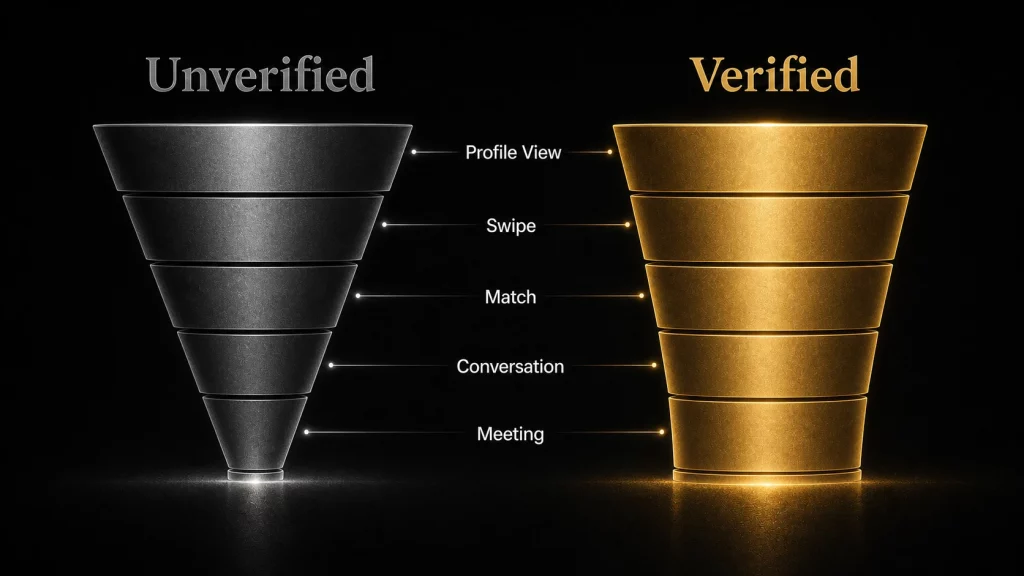
Each verification layer supplies different information, from a platform-specific photo check to a portable collection of disclosed signals. A reader may find that context useful, but the effect on any match decision depends on the individual and cannot be guaranteed.
Conclusion: Add Context Without Overclaiming
A stand out dating profile can combine clear presentation with optional, inspectable verification signals. Those layers answer different questions: one communicates interests and personality, while the other may corroborate a narrowly defined identity or account claim.
Verification is useful only when the issuer, method, date, scope, consent model, and limitations are clear. It should add context rather than create an unsupported promise about match rates, character, compatibility, intentions, or future conduct.
The implementation depends on the services you choose. Complete only checks whose scope and privacy terms you understand, request social vouches with consent, and add a Date Mode link only where the dating platform permits it. Verification should make claims easier to inspect, not pressure another person to trust them.
Build a GuyID Trust Profile when transparent identity and social-context signals are relevant to your dating profile. Review the scope of every check and share the link only where it is appropriate and permitted.
Related Resources
- How to build a dating trust score
- How Date Mode links work
- What verified means on dating apps
- How to share a dating trust profile
Build Your Trust Profile
Add Your Link Everywhere