Reader Briefing
Reader Briefing
Start here if you need a practical read on dating site profiles: how to build trust before matching: who should use verification, what signals to check, and what to do before moving from online interest to an in-person plan.
Who this is for
- People meeting someone from a dating app or social platform.
- Readers preparing for a first in-person date.
- Anyone checking identity, profile consistency, and trust signals.
- People trying to avoid romance scams, fake profiles, or pressure tactics.
You’ll learn
- How to evaluate identity signals without treating any single check as certainty.
- Which trust signals matter and how to weigh them together.
- How to spot inconsistencies, pressure, or behavior patterns that deserve caution.
- How to move from online conversation to a safer first meeting.
- How to compare options using practical safety and trust criteria.
- When to slow down, ask for more context, or walk away.
Bottom line
Verification reduces uncertainty; it does not guarantee future behavior. Use a layered approach: confirm identity signals, compare profile consistency, ask for a short video call, keep early plans public, and slow down when someone pressures you to skip normal safety steps.
Key takeaways
- Identity verification improves confidence, not certainty.
- Patterns matter more than isolated incidents.
- Verify before meeting privately or sharing sensitive details.
- A short video call can reveal many inconsistencies.
- Pressure to skip reasonable safety steps is useful information.
Free Tools
Catfish Probability Detector
Check whether a dating profile has suspicious identity or photo signals.
Dating Bio Red Flag Detector
Review a bio for scam, pressure, or trust-warning language.
Dating Safety Checklist
Use free GuyID tools before moving from chat to a real date.
Next step
Create your GuyID trust profile
Share consent-based trust signals before a date without turning the conversation into an interrogation.
NavigateTable of Contents23 sections
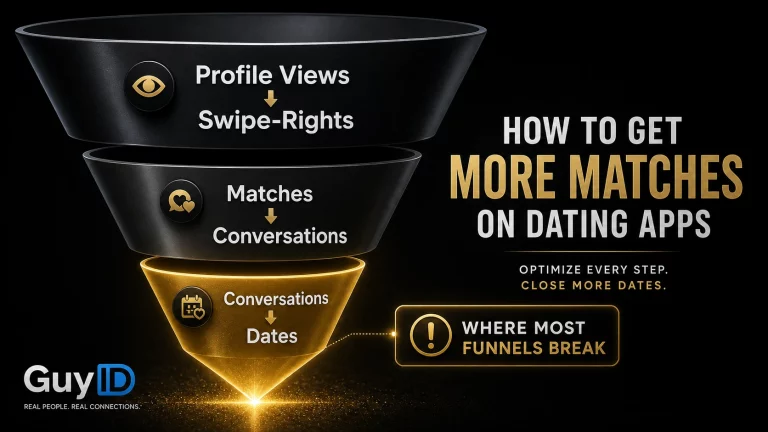
Trust doesn’t start on the first date. It doesn’t start in conversation. It starts the moment someone views your profile — and in 3-7 seconds, decides whether you seem trustworthy enough to engage with. Your dating site profile isn’t just a showcase for your personality. It’s a trust document. Every element either builds or erodes the viewer’s confidence that you’re real, genuine, and worth the risk of a conversation. This guide teaches you how to build trust into every element of your profile — so that by the time someone swipes right, they’ve already answered “Is this person trustworthy?” with a confident yes.
Why Trust Is Built Before the First Message
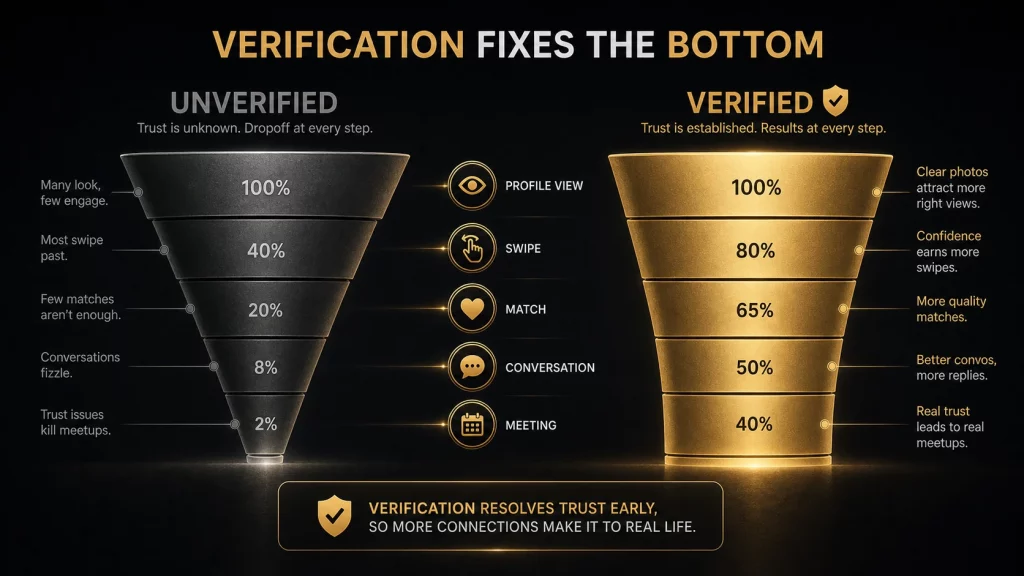
The trust timeline in online dating isn’t: match → conversation → trust builds → meeting. It’s: profile viewed → trust assessed → match decision → conversation begins with pre-established trust level. The trust assessment happens at the profile stage — before any interaction. Understanding this changes how you build your dating site profile.
The Subconscious Trust Assessment
When someone views your profile, their brain processes multiple trust signals simultaneously — mostly subconsciously. Within 3-7 seconds, they’ve evaluated: does this person’s face look genuine (not overly filtered, not stock-photo quality)? Does the bio reveal a real personality (not a template)? Is there a verification badge? Do the photos show a real life (friends, activities, different settings)? Do all elements tell a consistent story? This assessment happens before any conscious analysis. The viewer doesn’t think “I’m evaluating trust signals.” They think “This person seems real” or “Something feels off” — and the feeling drives the swipe.
Inline visual 2
Why This Matters More Now Than Ever
The trust gap in online dating has widened: AI-generated profiles are indistinguishable from real ones at casual inspection, romance scam operations have professionalized, and awareness of these threats means viewers are more skeptical than ever. In this environment, profiles that actively signal trustworthiness don’t just perform well — they perform dramatically better than profiles that leave trust to chance. The viewer is asking “Is this real?” about every profile they see. The profiles that answer “Yes, and here’s the proof” win the matches the cautious viewers give.
The 7 Trust Signals in a Dating Site Profile
Every dating site profile contains seven dimensions that contribute to or detract from trust. Activating all seven creates maximum credibility.
| # | Trust Signal | What It Communicates | How to Activate It |
|---|---|---|---|
| 1 | Photo Authenticity | “These photos show a real person living a real life” | Mix of casual + polished. Multiple settings. Friends present. No heavy filters. |
| 2 | Bio Specificity | “This person is real enough to have specific stories and opinions” | Stories over statements. Named details. Interest amplifiers. Conversation hooks. |
| 3 | Verification Badge | “This person was willing to confirm their face is real” | Complete app’s native verification (30 sec, free). Table stakes. |
| 4 | Identity Verification | “This person’s legal identity is confirmed by government documents” | GuyID Date Mode link in bio. Government ID + social vouches checkable in 10 sec. |
| 5 | Social Context | “This person exists in a real social world with real people” | Photos with friends. References to social activities. Social vouches on Trust Profile. |
| 6 | Consistency | “Every element of this profile tells the same coherent story” | Photos match bio claims. Personality consistent across elements. No contradictions. |
| 7 | Transparency of Intent | “This person is honest about what they’re looking for” | Clear statement of dating intentions. No ambiguity about what they seek. |
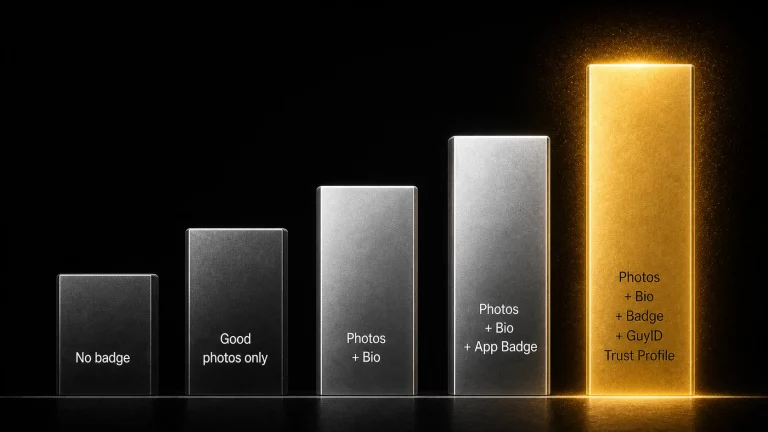
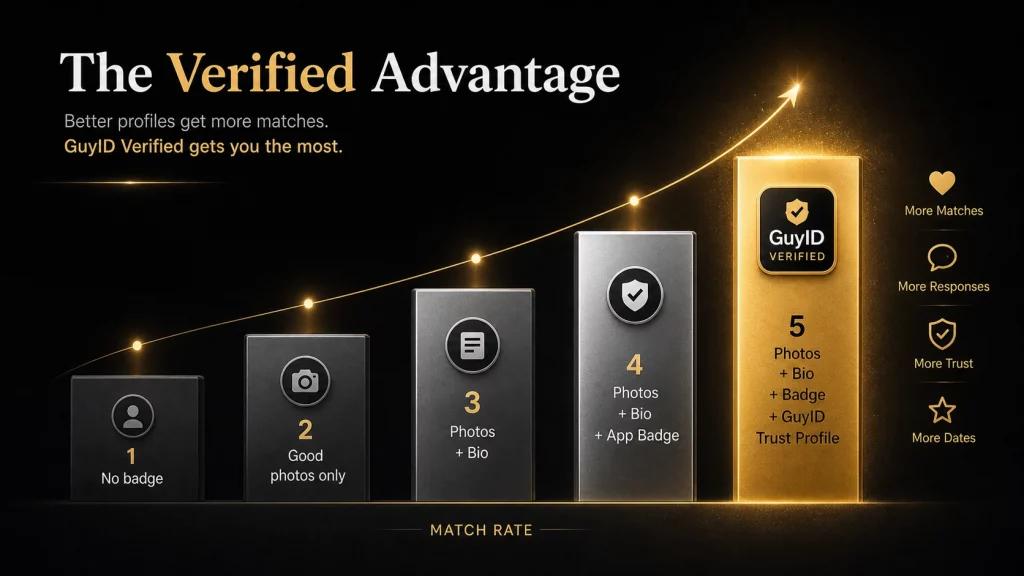
Fake profiles typically activate 0-2 of these signals (a stolen photo, maybe a badge). Average real profiles activate 3-4 (decent photos, some bio, maybe a badge). Trust-optimized profiles activate all 7 — and the difference in trust impression is the difference between “maybe” and “definitely.”

Inline visual 1
Photo Trust: What Builds Confidence vs What Creates Doubt
Photos are the primary trust input — the visual evidence that your viewer processes before reading a single word.
Photos That Build Trust
- Mix of quality levels: One polished photo + several casual/candid shots = a real person who sometimes looks great and sometimes looks normal. All professional photos = potential stock photos or stolen images. The imperfection of casual photos is itself a trust signal.
- Multiple environments: Kitchen, trail, restaurant, friend’s apartment, travel destination = a person who exists in multiple real-world contexts. Same background every photo = limited evidence of a real life.
- Friends visible: Photos with 2-3 other people confirm you exist within a social network. Completely solo photos across the entire profile raise the question: does this person have anyone in their life? The friends don’t need to be the focus — their presence is enough.
- Clear, unfiltered face: Your actual face, clearly visible, in natural or adequate lighting. Heavy filters, extreme angles, and obscured faces communicate concealment — whether intentional or not. Clarity communicates transparency.
- Temporal variety: Different seasons, different outfits, different hair stages = photos from different periods of your life. All photos from one night = minimal visual evidence of your actual ongoing existence.
Photos That Create Doubt
- 🟡 All professional-quality photos with studio lighting → could be a model, influencer… or AI-generated
- 🟡 Sunglasses or hats in every photo → hiding face features
- 🟡 Only group photos → which person is the profile owner?
- 🟡 All photos from the same event/outfit → very narrow evidence of real life
- 🔴 No clear face photo at all → definitive trust failure
- 🔴 Photos with visible cropping (ex removed) → recently separated + poor effort
Bio Trust: Language That Signals Authenticity
Your bio’s trust impact comes not from what you claim about yourself (self-reported claims carry low credibility) but from HOW you write — the specificity, voice, and structure that signal genuine personality versus template fabrication.
Language That Builds Trust
- Specific details that only a real person would include: “Currently on attempt #4 of homemade pasta” is too specific to be fabricated. “I love cooking” could be written by anyone — or by an AI. Specificity IS authenticity because it requires real lived experience to generate.
- Self-deprecating honesty: “My sourdough is improving — from inedible to merely questionable” communicates vulnerability that performative profiles avoid. Fabricated profiles present perfection. Real people present progress.
- Named references: “My golden retriever, Theo” is more trustworthy than “I have a dog” — the name implies real attachment to a real animal. Naming things (pets, projects, places) creates the granularity that authenticity requires.
- Clear intentions stated directly: “Looking for someone to build something real with” is a direct statement of intent. Vague non-commitments (“Let’s see where it goes” after weeks) signal that the person is avoiding accountability for their stated intentions.
Language That Erodes Trust
- 🟡 Entirely generic descriptions (“adventurous, loyal, fun”) → could describe anyone, including a bot
- 🟡 No bio at all → zero personality evidence, zero effort visible
- 🟡 Copy-paste quotes or song lyrics as the entire bio → borrowed personality
- 🔴 Defensive or aggressive tone (“Don’t waste my time”) → suggests negative past experiences projected onto every viewer
- 🔴 Inconsistencies with photos → bio claims outdoor lifestyle, every photo is a bathroom selfie
Verification Trust: The Signal Nobody Can Fake
Of all seven trust signals in a dating site profile, verification is the only one that’s objectively unfakeable. Good photos can be stolen. Specific bios can be AI-generated. Social context can be fabricated. But verification through government documents and real human vouches cannot be manufactured by anyone who isn’t the actual verified person.
The Verification Hierarchy
Level 1: App Badge (Minimum)
What it is: Selfie check on the dating app (Tinder, Bumble, Hinge).
Trust level: “This face matches these photos.”
Limitation: Deepfake-bypassable. No identity confirmation. Platform-locked.
Status: Table stakes — get it, but don’t stop here.
Level 2: GuyID Trust Profile (Competitive Advantage)
What it is: Government ID verification + social vouches + Trust Tier.
Trust level: “This person’s legal identity is confirmed AND real people vouch for their character.”
Advantage: AI-proof. Portable across every platform. Checkable in 10 seconds.
Implementation: Date Mode link in your bio on every platform.
The viewer who clicks your GuyID link and sees TRUSTED tier + government ID verified + social vouches has every safety question answered before sending a message. That viewer matches with confidence — and confident matches convert to conversations and dates at dramatically higher rates than cautious ones.
Social Proof Trust: Showing You Exist in the Real World
Social proof — evidence that you exist within a real community of real people — is one of the most powerful trust signals because it’s one of the hardest for fake profiles to replicate.
How to Show Social Proof in Your Profile
- Photos with friends: 1-2 photos where you’re clearly with real people in genuine social settings. Not posed lineups — natural interaction.
- References to social activities: “Coaching Little League on Saturdays” or “Monthly dinner party host” implies ongoing community involvement.
- Social vouches on your Trust Profile: The most direct form of social proof available — real, named people publicly confirming they know you and trust your character. Visible through your Date Mode link.
- Mentions of specific people (without naming them): “My best friend thinks I should mention that I do a great impression of our old college professor” — the reference implies real relationships without violating anyone’s privacy.
Why Social Proof Matters for Trust
A person who exists within a visible social network is accountable. Their behavior is observed by people who know them. Their identity is confirmed by their presence in others’ lives. A person with zero social proof — no friends in photos, no social references, no vouches — could be anyone. The social vacuum that surrounds a completely isolated profile is itself a yellow flag in the trust assessment.
Consistency Trust: When Everything Tells the Same Story
The final trust dimension in dating site profiles: consistency across every element. When photos, bio, verification, and social context all align — telling the same coherent story about the same real person — trust is at maximum. When elements contradict — the trust assessment fails.
Consistency Wins
- Bio says “outdoorsy” + photos show trails, camping, natural settings = consistent ✅
- Bio mentions cooking + photo of them in a kitchen = consistent ✅
- Bio says “looking for something serious” + profile on a relationship-focused app = consistent ✅
- Bio mentions friends + social photos visible + social vouches on Trust Profile = deeply consistent ✅✅
Inconsistency Erodes
- Bio says “active lifestyle” + every photo is indoors/seated = inconsistent 🟡
- Bio claims specific career + LinkedIn shows different job = inconsistent 🔴
- Bio says “love spending time with friends” + zero social photos + zero vouches = inconsistent 🟡
- Bio tone is warm and open + first messages are cold and demanding = inconsistent (post-match, but viewers who sense pre-match inconsistency will avoid this) 🔴
The consistency audit: read your entire profile as a stranger. Do all elements tell the same story? If your photos suggest one lifestyle, your bio suggests another, and your verification is absent — the profile creates cognitive dissonance that the viewer resolves by swiping left. Alignment across every element creates the coherence that trust requires.
The Trust Audit: Rate Your Current Profile
Score your current dating site profile against the seven trust signals. For each, honestly assess whether your profile activates it.
Your Trust Audit
☐ Photo Authenticity: Mix of casual + polished? Multiple settings? Face clearly visible? No heavy filters?
☐ Bio Specificity: Named details? Stories not statements? Conversation hooks? Self-aware honesty?
☐ Verification Badge: App’s native verification completed?
☐ Identity Verification: GuyID Date Mode link in bio? Government ID + vouches?
☐ Social Context: Friends in 1-2 photos? Social references in bio? Vouches on Trust Profile?
☐ Consistency: Photos, bio, and verification all tell the same story?
☐ Transparency of Intent: Clear about what you’re looking for?
| Score | Trust Level | Action |
|---|---|---|
| 7/7 | Maximum trust — your profile builds confidence before the match | Maintain and update periodically. |
| 5-6/7 | Strong — most trust signals active | Identify the 1-2 missing signals. Usually: identity verification (add GuyID link) or social context (add a friend photo). |
| 3-4/7 | Moderate — some trust, some doubt | The 20-minute overhaul: fix photos, rewrite bio with specificity, add both verification layers. See the profile tips guide. |
| 0-2/7 | Low — your profile triggers doubt | Full rebuild needed. Follow the bio guide, photo framework, and verification stack. 30-60 minutes. |
Summary: Build Trust Into Every Pixel and Word
A dating site profile that builds trust before matching isn’t an accident — it’s a design choice. Every photo, every bio line, every verification element, and every consistency signal either builds or erodes the trust that determines whether someone swipes right with confidence or left with doubt.
The seven trust signals — photo authenticity, bio specificity, verification badge, identity verification, social context, consistency, and transparency of intent — are the building blocks. Activating all seven creates the maximum trust profile: a profile that answers “Is this person real?” (photos + verification), “Is this person genuine?” (bio + consistency), “Is this person trustworthy?” (identity verification + social vouches), and “Is this person worth my time?” (transparency + personality) — all before a single message is exchanged.
The audit scores your current profile against all seven. The action plans fix the gaps. And the verified advantage — GuyID Trust Profile with government ID + social vouches + Date Mode link — provides the trust signal that no amount of profile optimization alone achieves. Build trust into every pixel and word. The matches you want are giving their attention to the profiles they trust most — make yours one of them.
Frequently Asked Questions
How do I build trust in my dating profile?
What’s the most important trust signal in a dating profile?
How do fake profiles differ from real profiles in trust signals?
Does this advice apply to all dating sites?
How do I score higher on the trust audit?
Related Reading
- How GuyID Is Building the Trust Layer Dating Needs (2026)
- Dating Websites in Vietnam: A Guide to Meeting Vietnamese Singles
- Online Dating Sites in Germany: The Complete Guide for 2026
Evidence note
Pew Research Center found that 48% of Americans considered online dating at least somewhat safe while 49% considered it not too safe or not at all safe (Pew Research Center, 2023).