Free Tools
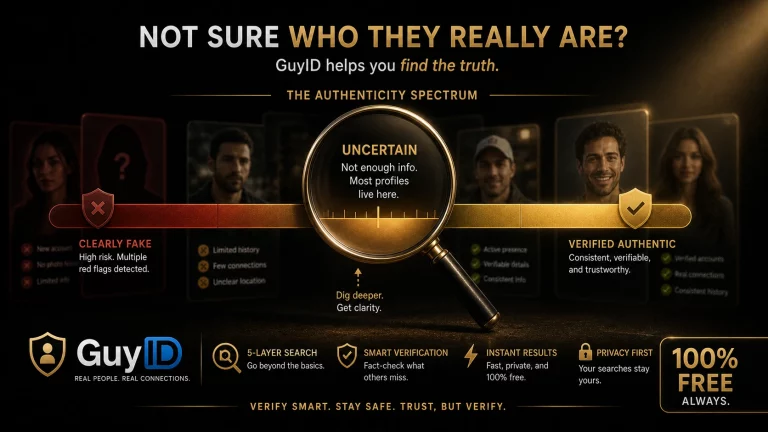
Catfish Probability Detector
Check whether a dating profile has suspicious identity or photo signals.
Dating Bio Red Flag Detector
Review a bio for scam, pressure, or trust-warning language.
Dating Safety Checklist
Use free GuyID tools before moving from chat to a real date.
Next step
Create your GuyID trust profile
Share consent-based trust signals before a date without turning the conversation into an interrogation.
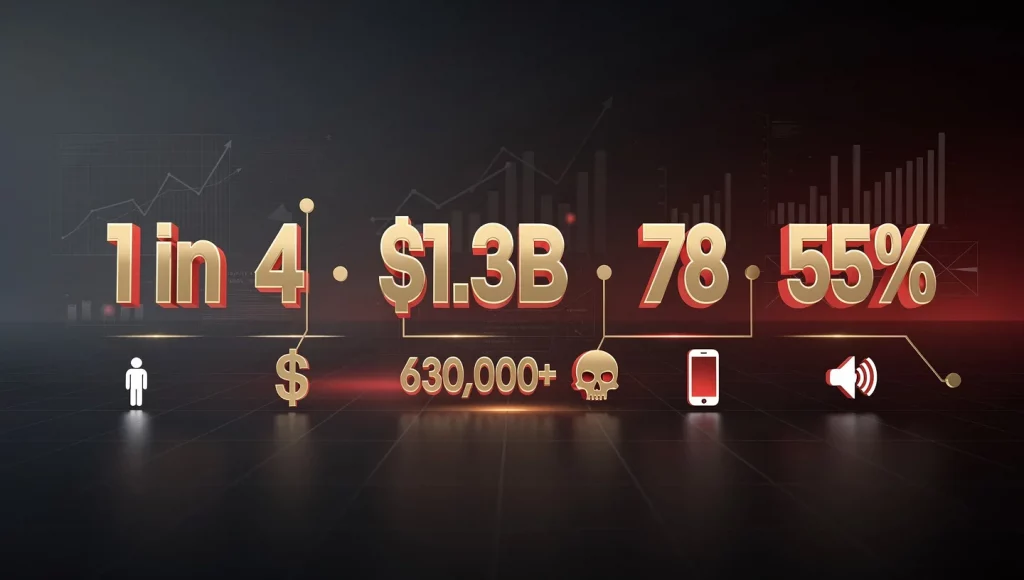
How big is the fake dating profile problem? The numbers tell a story that no dating app’s marketing department wants you to hear. And the financial damage — $1.3 billion annually in the US alone (FTC, 2026) — makes fake dating profiles one of the most costly consumer fraud categories in existence.
This guide compiles every verified fake dating profile statistic from 2026 research into a single reference — organized by category: scale of the problem, financial impact, platform-specific data, demographic targeting, AI-era threats, and detection and reporting. Every statistic is sourced, every number is current, and the complete picture reveals why the trust gap in online dating demands the verification solutions that detection alone can’t provide.
NavigateTable of Contents18 sections
⚡ Key Takeaways
If you use dating apps, the probability of encountering a fake is substantial.
Fake profiles aren’t just annoying — they’re the entry point for billion-dollar fraud operations. The average individual loss is thousands of dollars; extreme cases reach hundreds of thousands.
Romance scams can be operated by organized criminal networks.
This is not limited to amateur catfishing. Some operations use coordinated teams, repeatable scripts, and AI-powered tools.
Every statistic in this guide represents the documented cases. With more than half of victims never reporting, the actual scale of fake profile fraud is significantly larger than any published number suggests.
Scale: How Big Is the Fake Dating Profile Problem
Available reporting confirms that fake profiles are used in romance scams, but it does not provide a reliable global count of fake dating profiles or scam operators. Treat precise global totals without a primary methodology as estimates, not established facts.
What These Numbers Mean
Behind some fake profiles are organized scam operations with training, infrastructure, and AI tools. The scale of the problem makes fake profile detection an important safety skill for anyone who dates online — and explains why proactive verification through tools like GuyID’s free safety suite can add useful context.
Financial Impact: What Fake Dating Profiles Cost
Fake profiles aren’t just a nuisance — they can be the entry point for costly consumer fraud. Financial-loss reporting measures detected and reported cases, so it should not be interpreted as a complete count of harm.
The Hidden Financial Damage
The full cost of fake dating profiles includes both the quantifiable financial losses and the unquantifiable emotional, psychological, and physical harms.
Platform-Specific Fake Dating Profile Statistics
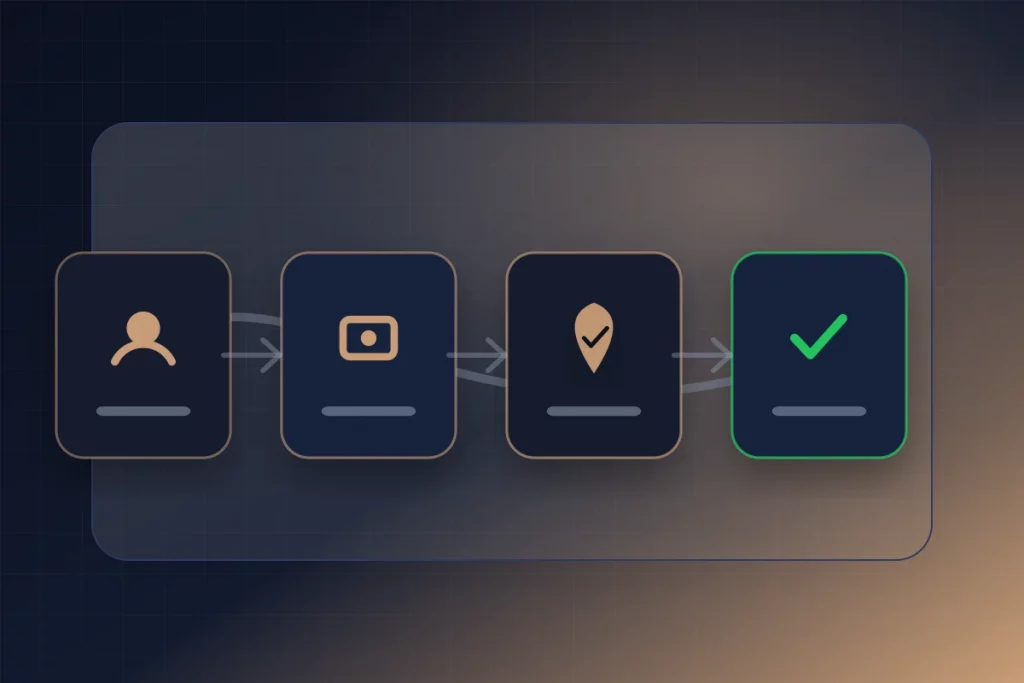
Fake profiles aren’t distributed evenly across platforms. These fake dating profile statistics show which platforms carry the highest and lowest risk.
| Platform | Key Statistic | Safety Ranking | Source |
|---|
| Facebook Dating | Hacked accounts with years of genuine social proof | #6 (11/35) | Platform analysis |
The Platform Concentration Effect
The fake profile problem is not equally distributed. POF alone accounts for more fake installations than all other dating apps combined. Tinder’s massive user base (75+ million) creates the largest attack surface by volume. The safety features comparison explains why: platforms with weaker verification and fewer messaging controls attract more scam operations because the barrier to entry and cost per target are lowest. Choosing a platform higher on the safety ranking reduces — but doesn’t eliminate — fake profile exposure.
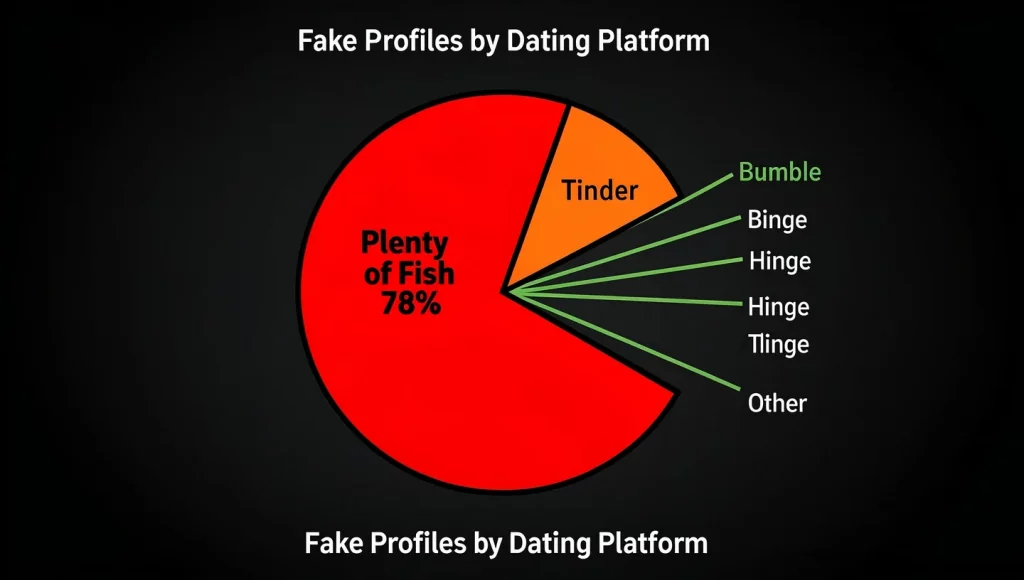
Demographic Targeting Statistics
Fake profiles don’t target everyone equally. These fake dating profile statistics reveal which demographics face the highest risk.
| Statistic | Number | Source |
|---|
The Targeting Pattern
Men face higher scam frequency and higher financial loss rates — targeted for financial extraction. Women face broader safety concerns including physical threats — targeted for financial, emotional, and physical exploitation. The fake profile problem isn’t just harming current users — it’s preventing potential users from entering the market entirely. For the complete demographic analysis, see our guides on safe dating apps for women and safe dating apps for over 50.
AI-Era Fake Dating Profile Statistics
The newest dimension of the fake profile problem: AI-powered fraud. These fake dating profile statistics document the AI threat that most users are only beginning to recognize.
| Statistic | Number | Source |
|---|
| AI bots sending messages in scam operations | 60+ messages in 12 hours | McAfee Labs, 2026 |
The AI Acceleration
AI has transformed fake dating profiles from a manual craft into an automated industry. AI-generated photos create fictional people with no source photos to detect through reverse image search. AI chatbots maintain 60+ emotionally intelligent messages in 12 hours — volume and quality impossible for a single human operator. Deepfake face-swapping defeats selfie-based verification by overlaying synthetic faces during liveness checks.
The AI dimension makes traditional detection methods increasingly insufficient. Stolen photos (detectable through reverse image search) are being replaced by generated photos (invisible to reverse search). Broken English (a traditional scam indicator) is being replaced by fluent AI-generated text. Refusal of video calls (the classic catfish tell) is being replaced by deepfake video calls that look convincing. The detection techniques in our complete fake profile detection guide include the AI-era methods that address these evolving threats — but the statistics make clear why identity verification through GuyID (government ID that AI can’t generate) is the one detection layer that AI cannot defeat.
Detection and Reporting Statistics
These fake dating profile statistics reveal how effectively the current system detects and responds to fake profiles — and where the critical gaps remain.
| Statistic | Number | Source / Implication |
|---|
The Reporting Gap
55% of victims never report. The true scale is likely double the published numbers.
The gap between user demand for safety and platform supply of safety is the trust gap — and it’s what GuyID exists to close.
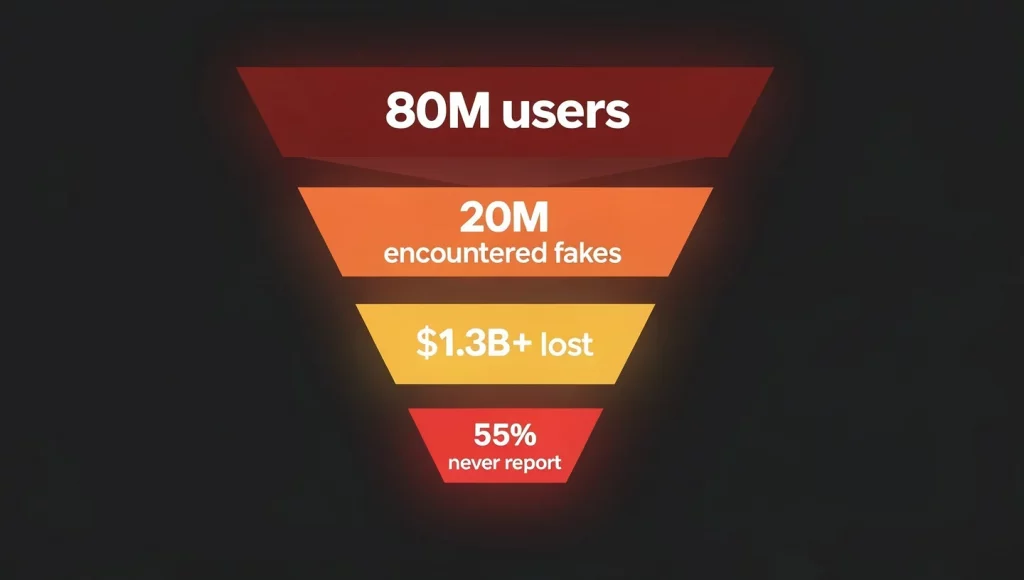
Verification and Trust Statistics
| Statistic | Number | Implication |
|---|---|---|
| Dating apps that verify legal identity (government ID) | 0 mainstream platforms | All verify photos only |
| Dating apps that do background checks | 0 mainstream platforms | None screen users |
The supply-demand mismatch is enormous. The dating trust score concept — implemented through GuyID’s Trust Tiers — represents the market response to this mismatch: providing the identity verification (government ID), character assessment (social vouching), and progressive trust measurement that every statistic in this section proves users want and platforms don’t deliver.
What the Statistics Mean for You: The Practical Takeaway
These fake dating profile statistics aren’t abstract research — they’re the operating environment you navigate every time you open a dating app. Here’s what the data means for your practical safety decisions.
The Probability Assessment
The Response
The statistics validate three conclusions. The 60-second check through GuyID’s free tools is the minimum rational response. Second, platform choice matters — the difference between POF (7/35 safety score) and Bumble (19/35) is statistically meaningful in your probability of encountering fakes. Choose platforms at the top of the safety ranking. GuyID Trust Profiles fill this gap: government ID + social vouching + Trust Tiers, free for women to check.
The fake dating profile statistics describe the problem. The online dating safety framework — proactive screening, identity verification, and absolute financial rules — is the solution. The statistics prove the solution is necessary. The tools to implement it are free.
The Numbers Are Clear. The Tools Are Free.
$1.3B lost annually. 0 apps verify identity. GuyID provides the verification the statistics prove is needed: reverse image search, catfish detection, bio analysis, and Trust Profiles (gov ID + social vouching). Women check for free.
Try Free Safety Tools
Learn About GuyID
Frequently Asked Questions
How common are fake dating profiles in 2026?
How much money is lost to romance scams?
Are fake dating profiles and romance scams the same thing?
How can I tell whether a dating statistic is reliable?
Does identity verification prove someone is safe?
Evidence note
Pew Research Center found that 48% of Americans considered online dating at least somewhat safe while 49% considered it not too safe or not at all safe (Pew Research Center, 2023).
The same Pew survey found that 60% of United States adults favored required background checks for dating profiles; among people who had used online dating, 47% supported that requirement (Pew Research Center, 2023).
The FTC reported 64,003 romance-scam reports in 2023, with $1.14 billion in reported losses and a $2,000 median reported loss (Federal Trade Commission, 2024).