

Reader Briefing
Reader Briefing
Start here if you need a practical read on signs of sexual predators in dating: behavioral patterns to recognize: who should use verification, what signals to check, and what to do before moving from online interest to an in-person plan.
Who this is for
- People meeting someone from a dating app or social platform.
- Readers preparing for a first in-person date.
- Anyone checking identity, profile consistency, and trust signals.
- People trying to avoid romance scams, fake profiles, or pressure tactics.
You’ll learn
- How to evaluate identity signals without treating any single check as certainty.
- Which trust signals matter and how to weigh them together.
- How to spot inconsistencies, pressure, or behavior patterns that deserve caution.
- How to move from online conversation to a safer first meeting.
- Where GuyID tools fit into a quick pre-date screening workflow.
- When to slow down, ask for more context, or walk away.
Bottom line
Verification reduces uncertainty; it does not guarantee future behavior. Use a layered approach: confirm identity signals, compare profile consistency, ask for a short video call, keep early plans public, and slow down when someone pressures you to skip normal safety steps.
Key takeaways
- Identity verification improves confidence, not certainty.
- Patterns matter more than isolated incidents.
- Verify before meeting privately or sharing sensitive details.
- A short video call can reveal many inconsistencies.
- Pressure to skip reasonable safety steps is useful information.
Free Tools
Catfish Probability Detector
Check whether a dating profile has suspicious identity or photo signals.
Dating Bio Red Flag Detector
Review a bio for scam, pressure, or trust-warning language.
Dating Safety Checklist
Use free GuyID tools before moving from chat to a real date.
Next step
Create your GuyID trust profile
Share consent-based trust signals before a date without turning the conversation into an interrogation.
Sexual predators don’t look like the stereotype. They look like charming dates, attentive partners, and promising matches on your dating app. Research consistently shows that predatory individuals are more likely to present as exceptionally charismatic, emotionally attuned, and romantically invested than the average person — because the ability to build trust quickly is the primary tool of predation. Recognizing the signs of sexual predators in dating contexts isn’t about paranoia or assuming the worst about every match. It’s about understanding the specific behavioral patterns that distinguish predatory intent from genuine interest — and knowing these patterns well enough to detect them before vulnerability is established.
This guide identifies the behavioral patterns associated with predatory behavior in dating — the grooming tactics, boundary-testing sequences, and manipulation techniques that research and law enforcement have documented — along with the protective measures and verification tools that help you screen for safety before meeting someone in person.
NavigateTable of Contents25 sections
⚡ Key Takeaways
Predatory behavior follows documented patterns — learning the patterns is protection
Grooming, boundary testing, isolation, and escalation follow a recognizable sequence. The sequence is documented across decades of research and law enforcement investigation. Knowing it transforms invisible manipulation into detectable behavior.
Charm and attentiveness can be genuine — or can be tools of predation
The difference isn’t in the charm itself but in what follows: genuine people respect boundaries when set. Predatory individuals test, push, and escalate against boundaries — using the trust built through charm as leverage.
Boundary testing is the most reliable early indicator
Small boundary violations — “accidentally” touching after you’ve pulled away, showing up uninvited, reading your phone “jokingly” — are calibration tests. The response to your boundary enforcement determines whether violations escalate or stop.
Identity verification adds accountability that predatory individuals avoid
People planning harmful behavior require anonymity. GuyID Trust Profiles — government ID verified, social vouches from real people — create the accountability trail that predatory individuals structurally need to avoid.
Why Predatory Behavior Is Harder to Detect Than You Think
The reason signs of sexual predators are difficult to recognize in dating contexts is that predatory behavior is specifically designed to be undetectable during the trust-building phase.
The Charm Paradox
Research on predatory behavior consistently identifies a common trait: above-average social skill and charm. This seems counterintuitive — shouldn’t dangerous people seem dangerous? But predation depends on access, and access requires trust. The ability to build trust quickly, make someone feel special, and create emotional dependency is the functional skill that predatory behavior requires. A person who can’t build trust can’t get close enough to cause harm. The charm isn’t incidental to the danger — it’s the mechanism that creates it.
This creates a detection problem: the same behaviors that indicate genuine romantic interest (attentiveness, compliments, focused attention, expressed commitment) can also indicate predatory grooming. The difference isn’t in the behaviors themselves but in the pattern they follow and the response when boundaries are tested.
Why Dating Apps Create Additional Vulnerability
Dating apps introduce specific conditions that predatory individuals exploit: access to large numbers of potential targets through efficient matching, limited pre-meeting information that prevents screening, the private nature of dating conversations that isolates the interaction from external observation, and the expectation of rapid trust development that normalizes accelerated intimacy. The combination creates an environment where predatory behavior can operate efficiently — which is why dating safety practices aren’t optional caution but necessary protection.
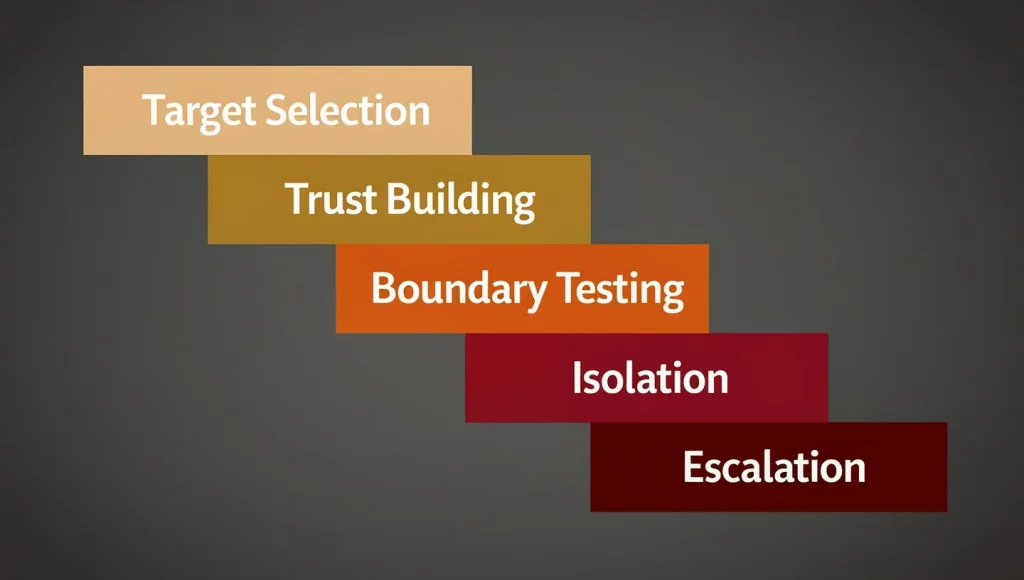
The Grooming Sequence: How Predatory Behavior Unfolds in Dating
Predatory behavior in dating follows a documented sequence — understanding each phase makes the pattern recognizable before harm occurs.
Phase 1: Target Selection
Predatory individuals select targets based on perceived vulnerability: emotional isolation, recent breakups or divorce, low self-esteem signals in profiles, eagerness for connection, or limited dating experience. In online dating, profile content and early conversation provide the information needed for selection: a bio mentioning recent divorce signals emotional vulnerability, enthusiasm about the connection signals eagerness, and limited dating app experience signals reduced awareness of red flags.
Phase 2: Trust Building
The predatory individual invests heavily in building trust through techniques that mirror genuine romantic interest at amplified intensity. This phase resembles love-bombing: excessive compliments, constant communication, expressions of deep connection, mirroring the target’s interests and values, and creating a sense of unique compatibility. The trust-building phase serves a functional purpose: it creates the emotional dependency that makes later boundary violations tolerable (“They wouldn’t do that — they care about me so much”).
Phase 3: Boundary Testing
Once trust is established, small boundary violations begin — disguised as accidents, jokes, or expressions of passion. These tests serve a calibration purpose: they determine how the target responds to boundary violations. If the target enforces the boundary clearly, the predatory individual may back off and try again later — or move to a different target. If the target minimizes, excuses, or ignores the violation, the predatory individual registers that this boundary is permeable and escalation is possible.
Phase 4: Isolation
Gradually reducing the target’s connection to friends, family, and support networks — through subtle criticism (“Your friend doesn’t seem supportive of us”), time monopolization (“I just want to spend all our free time together”), or manufactured conflict with the target’s social circle. Isolation removes external perspectives that would otherwise help the target recognize the escalating pattern.
Phase 5: Escalation
With trust established, boundaries tested, and support networks reduced — the harmful behavior escalates from small violations to serious ones. The escalation feels gradual from inside the relationship (each step slightly beyond the last) but looks dramatic from outside (where the pattern is visible as a whole). By this phase, the target’s emotional investment, isolation from support, and conditioned tolerance of boundary violations make exit psychologically difficult.
Behavioral Warning Signs in Dating Contexts

These signs of predatory behavior are documented across research and law enforcement — adapted here for dating contexts where detection is most critical.
Excessive Charm with Strategic Purpose
- Mirroring everything you like: They love the same music, share the same values, have the same life goals, find the same things funny — an alignment so perfect it feels like fate. Some alignment is natural. Total alignment across every dimension is performance. Genuine people have differences. Manufactured personas are calibrated for maximum appeal.
- Intensity disproportionate to time: Declarations of deep feelings within days. Planning future milestones (trips, moving in, meeting parents) before the relationship has established itself. The speed serves the predatory timeline — building dependency before the target has time for objective evaluation.
- Flattery that targets insecurities: Not just compliments — compliments specifically addressing the things you’re insecure about. “I can’t believe your ex didn’t appreciate how beautiful you are.” “You’re so much smarter than you give yourself credit for.” This targeted flattery creates an emotional dependency: they become the source of the validation you were lacking.
Control Disguised as Care
- “I just worry about you”: Monitoring your location, questioning your plans, needing to know who you’re with — framed as protective concern. The concern is genuine in that they want to control your whereabouts. The care framing makes objecting feel like rejecting someone who loves you.
- “I know what’s best for us”: Making decisions for the relationship without consultation — choosing restaurants, planning schedules, deciding how you spend weekends, determining the pace of physical intimacy. When questioned: “I just want to make things easy for you.” Removing your agency is control, regardless of the care framing.
- Insisting on being your primary support: Discouraging you from talking to friends about relationship issues (“That’s between us”), positioning themselves as the only person who truly understands you, and subtly undermining your trust in others’ perspectives. If your only trusted advisor is the person whose behavior you should be questioning, the questioning never happens.
Reaction to Boundaries
- Guilt-tripping when you set limits: “I thought you trusted me.” “I guess you don’t feel the same way I do.” “Fine, if that’s how you want it.” Making you feel that your boundary is a rejection of them rather than a protection of yourself.
- Testing physical boundaries “playfully”: Physical contact you didn’t invite, framed as playful or spontaneous. When you pull away: “I was just being affectionate” or “Don’t be so uptight.” The response to your withdrawal is the data point — not the initial contact. Genuine people apologize and adjust. Predatory individuals minimize your reaction and test again.
- Anger or withdrawal after hearing “no”: Any “no” — to a physical advance, to meeting their timeline, to sharing information you’re not comfortable sharing — met with disproportionate anger or extended emotional withdrawal. This punishes boundary enforcement, conditioning you to avoid saying “no” to avoid the consequence.
How Predatory Individuals Use Dating Apps Specifically
Dating apps provide specific features that predatory behavior exploits.
- Volume and efficiency: Swiping through hundreds of profiles to identify vulnerable targets efficiently — recently divorced, emotionally expressive bios, low confidence signals.
- Information asymmetry: Profiles and early conversation reveal the target’s vulnerabilities, interests, and emotional state — while the predatory individual controls what they reveal. The information flows one direction until verification tools equalize it.
- Private communication: Moving to WhatsApp or phone quickly removes the conversation from any platform monitoring — creating a private channel with no oversight or record accessible to the platform.
- Normalizing fast intimacy: Dating app culture normalizes meeting strangers for dates within days of matching — a timeline that serves predatory behavior by minimizing the screening period between initial contact and physical proximity.
- Anonymity: Photo verification badges confirm facial similarity but not legal identity. A predatory individual using their real face but a fake name operates with functional anonymity — their behavior isn’t traceable to their real identity through the platform alone.
The Boundary-Testing Progression: The Most Reliable Early Indicator

Of all signs of predatory behavior, the boundary-testing progression is the most consistently documented and the most reliably detectable in dating contexts.
How It Works
Small boundary violations escalate incrementally — each step slightly beyond the last, each calibrated based on the target’s response to the previous test. The progression is functional: it maps the target’s boundary enforcement to determine how far escalation can go.
| Test Level | Example Behavior | What It Tests |
|---|---|---|
| 1. Informational | Asking for personal details you haven’t offered (address, workplace, schedule) | Whether you share information under social pressure |
| 2. Temporal | Showing up early, staying late, extending dates beyond your stated availability | Whether you enforce time boundaries or yield to avoid awkwardness |
| 3. Social | Reading your phone “jokingly,” contacting your friends, appearing at places you mentioned | Whether you tolerate surveillance framed as enthusiasm |
| 4. Physical space | Standing too close, touching your arm/back uninvited, insisting on sitting beside rather than across | Whether you physically enforce personal space or accommodate invasion |
| 5. Explicit physical | Uninvited physical intimacy, ignoring verbal or nonverbal signals to stop, continuing after “not yet” | Whether you enforce consent boundaries under emotional and physical pressure |
The Critical Observation
The test isn’t the behavior itself — many of these behaviors can occur innocently once. The test is the pattern: does the behavior repeat after you’ve set a boundary? Does each violation escalate slightly beyond the last? Does the person apologize genuinely and adjust — or apologize performatively and test again? Genuine people respect boundaries when clearly communicated. Predatory individuals treat boundary communication as intelligence about which boundaries are enforced and which are flexible.

Protective Measures for Dating Safety
Protecting yourself from predatory behavior in dating combines awareness (recognizing the patterns) with practical measures (creating conditions that make predation difficult).
🟢 Before Meeting Anyone from a Dating App
☐ GuyID 60-second screen: reverse image search + catfish detector + bio red flags
☐ Request their GuyID Trust Profile — government ID verified + social vouches
☐ Video call within the first week with active testing
☐ Social media cross-reference (LinkedIn, Instagram, Facebook)
☐ Key question: Can you verify this person’s real name through any independent source?
🟡 First Date Safety (Non-Negotiable)
☐ Public venue you know well — with staff presence, lighting, and other people
☐ Friend informed of your plans: where, who (share verified identity), when you’ll check in
☐ Drive yourself or arrange your own transportation — never depend on them
☐ Don’t leave food or drink unattended
☐ Limit first date to 1-2 hours
☐ Trust your instincts — leave if anything feels wrong. No explanation required.
🔵 Ongoing Boundary Enforcement
☐ Set boundaries clearly and verbally — not through hints or body language alone
☐ Note how they respond to “no” — the response IS the assessment
☐ Watch for the boundary-testing progression (table above)
☐ Maintain your friendships and social network — never allow isolation
☐ Share dating experiences with trusted friends — external perspective detects patterns you may rationalize
☐ If boundary violations repeat after clear communication: this is the information. Act on it.
How Verification Reduces Risk: The Accountability Factor
Identity verification doesn’t screen for predatory behavior directly — but it creates conditions that predatory individuals actively avoid.
Anonymity Enables Predation
Predatory behavior requires low accountability. A person who plans to violate boundaries, manipulate, or harm needs to operate without their real identity being traceable to their behavior. Dating app anonymity — where a photo badge exists but legal identity is unconfirmed — provides this operational environment. The face is visible but the name, address, workplace, and social network remain hidden.
How Verification Creates Accountability
A GuyID Trust Profile at TRUSTED tier confirms: government ID verified (their real name is on record), social vouches present (real people in their life have publicly confirmed their identity and character). This verification creates accountability that predatory individuals need to avoid. A person whose real identity is confirmed through government documents, whose character is vouched by friends and colleagues, and whose Trust Tier reflects sustained consistency has created a permanent accountability trail. Harmful behavior is now traceable to a verified real person — not an anonymous dating profile.
The Screening Signal
Requesting identity verification is itself a safety measure. “Do you have a GuyID Trust Profile?” produces informative responses: a person with nothing to hide cooperates. A person who needs anonymity for their behavior deflects, dismisses, or refuses. The response to the verification request provides safety information before any meeting occurs.
Summary: Pattern Recognition Is Protection
Recognizing signs of predatory behavior in dating isn’t about assuming the worst in every match. It’s about understanding documented behavioral patterns well enough to detect them when they appear — and knowing that detection is most effective before emotional investment makes objective evaluation difficult.
The patterns are recognizable: excessive charm calibrated to your vulnerabilities, control disguised as care, boundary testing that escalates incrementally, isolation from support networks, and reactions to “no” that punish rather than respect. Each pattern is documented, each is detectable, and each is most visible in the early stages of dating — before emotional investment creates the rationalization bias that makes red flags invisible.
The protective measures are practical: screen every match before engaging (60 seconds), verify identity through GuyID Trust Profiles before meeting (government ID + social vouches = accountability), follow first date safety protocol without exception (public venue, friend informed, own transport), enforce boundaries clearly and observe the response (the response is the assessment), and maintain your social network throughout (external perspectives detect what internal rationalization conceals).
The most important protective practice: trust the pattern over the feeling. A person whose behavior follows the grooming sequence — regardless of how good the relationship feels — is demonstrating the pattern. The pattern predicts the outcome. Trust it. And use the tools, verification, and support network that help you see clearly when emotion alone would not.
Accountability Is the Predator’s Enemy
GuyID Trust Profiles create the accountability trail that predatory individuals need to avoid: government ID verified, social vouches from real people, progressive Trust Tiers. Screen every match with 60+ free tools. Verify identity before meeting. Women check for free.
Screen Your Match in 60 Seconds
Check a Trust Profile
Frequently Asked Questions
What are the warning signs of predatory behavior in dating?
How do predatory individuals use dating apps?
What is the boundary-testing progression?
How does identity verification protect against predatory behavior?
How do I tell the difference between genuine charm and predatory grooming?
What should I do if I recognize these patterns in someone I’m dating?
Evidence note
The National Domestic Violence Hotline advises that even one or two warning behaviors can indicate that abuse may be present and offers confidential safety-planning support (National Domestic Violence Hotline).