
Reader Briefing
Reader Briefing
Start here if you need a practical read on red flag quiz: is your relationship showing warning signs?: who should use verification, what signals to check, and what to do before moving from online interest to an in-person plan.
Who this is for
- Readers preparing for a first in-person date.
- Anyone checking identity, profile consistency, and trust signals.
- People trying to avoid romance scams, fake profiles, or pressure tactics.
- Online daters improving conversations, profiles, or match screening.
You’ll learn
- How to evaluate identity signals without treating any single check as certainty.
- Which trust signals matter and how to weigh them together.
- How to spot inconsistencies, pressure, or behavior patterns that deserve caution.
- How to move from online conversation to a safer first meeting.
- Where GuyID tools fit into a quick pre-date screening workflow.
- When to slow down, ask for more context, or walk away.
Bottom line
Verification reduces uncertainty; it does not guarantee future behavior. Use a layered approach: confirm identity signals, compare profile consistency, ask for a short video call, keep early plans public, and slow down when someone pressures you to skip normal safety steps.
Key takeaways
- Identity verification improves confidence, not certainty.
- Patterns matter more than isolated incidents.
- Verify before meeting privately or sharing sensitive details.
- A short video call can reveal many inconsistencies.
- Pressure to skip reasonable safety steps is useful information.
Free Tools
Catfish Probability Detector
Check whether a dating profile has suspicious identity or photo signals.
Dating Bio Red Flag Detector
Review a bio for scam, pressure, or trust-warning language.
Dating Safety Checklist
Use free GuyID tools before moving from chat to a real date.
Next step
Create your GuyID trust profile
Share consent-based trust signals before a date without turning the conversation into an interrogation.
You’ve noticed something that doesn’t feel right — but you can’t tell if it’s a genuine warning sign or just normal relationship friction. This red flag quiz helps you move beyond gut feeling to structured assessment, evaluating 25 specific behavioral patterns across five critical categories: communication, control, emotional manipulation, trust violations, and boundary respect. Each question targets a documented relationship warning sign with scoring that reflects clinical severity — because not all red flags carry equal weight, and a quiz that treats “they forget my birthday” the same as “they monitor my location” doesn’t serve the people who need this assessment most.
NavigateTable of Contents41 sections
Before You Take the Red Flag Quiz
This red flag quiz is designed as a self-assessment tool — not a clinical diagnosis. According to the American Psychological Association, structured self-assessment helps individuals recognize patterns they might minimize or rationalize during the normal course of a relationship, providing the external framework that cuts through the cognitive biases that keep people in harmful situations.
Answer each question based on the PATTERN of behavior — not a single incident. Every relationship has bad moments. What this red flag quiz measures is whether those moments form a consistent pattern that predicts escalation or ongoing harm. Score each question honestly: 0 = Never, 1 = Rarely (happened once or twice), 2 = Sometimes (happens occasionally), 3 = Often (regular pattern). Write your score for each question, then total each category.
Take this assessment alone, in a private setting, without your partner present. If you feel the need to hide this red flag quiz from your partner — that reaction itself is informative about the relationship dynamic you’re evaluating. The fear of your partner discovering that you’re assessing the relationship for warning signs reveals the kind of environment where honest evaluation feels dangerous — which is precisely the kind of environment this quiz is designed to identify.
The 25-Question Red Flag Quiz
Category A: Communication Patterns (Questions 1-5)
Q1: Does your partner shut down or leave during important conversations?
Score 0-3. Occasional overwhelm is normal; consistent shutdown that prevents resolution is a documented predictor of relationship dissolution.
Q2: When you raise a concern, does the conversation become about YOUR behavior instead?
Score 0-3. Deflection systematically prevents accountability by redirecting focus from the deflector’s behavior to yours. If your concerns consistently evaporate during discussion and you end up apologizing for raising them, deflection has become a control mechanism.
Q3: Does your partner use the silent treatment as punishment?
Score 0-3. Sustained withdrawal of communication, warmth, and engagement after conflict — lasting hours or days — functions as emotional punishment. The National Domestic Violence Hotline classifies the sustained silent treatment as a form of emotional abuse. See our is stonewalling abuse guide for the complete assessment framework.
Q4: Does your partner dismiss your feelings as “overreacting” or “being too sensitive”?
Score 0-3. Chronic invalidation of emotional responses erodes self-trust and trains you to suppress your needs. When your feelings are consistently reframed as inappropriate, you stop trusting your own emotional responses — which is the first step toward accepting treatment you wouldn’t have tolerated before the invalidation began.
Q5: Does your partner bring up your past mistakes during unrelated arguments?
Score 0-3. Historical excavation — retrieving past offenses during current discussions — prevents resolution of present issues and maintains a permanent debt that keeps you in a one-down position. If your mistakes are never truly forgiven but stored as ammunition, the relationship operates on accumulated leverage rather than mutual grace.
Category B: Control Behaviors (Questions 6-10)
Q6: Does your partner monitor your phone, social media, or location?
Score 0-3. Surveillance disguised as caring (“I just want to know you’re safe”) removes privacy and autonomy. Healthy trust doesn’t require monitoring — it’s built through consistent behavior over time. If your partner needs to verify your whereabouts to feel secure, the issue is their insecurity, not your trustworthiness.
Q7: Does your partner discourage your relationships with friends or family?
Score 0-3. Isolation from support systems is one of the most reliable early indicators of an abusive trajectory. It may present as jealousy (“you spend more time with them than me”), criticism of your people (“your friends are a bad influence”), or manufactured conflicts that make spending time with others feel too costly.
Q8: Does your partner make you feel guilty for spending time on yourself?
Score 0-3. Independent activities, friendships, and personal time are healthy relationship components. A partner who frames your independence as abandonment, selfishness, or disloyalty is attempting to collapse your identity into the relationship — a precursor to full emotional dependency.
Q9: Does your partner make financial decisions without consulting you?
Score 0-3. In committed relationships, unilateral financial decisions that affect both partners constitute financial control — one of the least-recognized but most impactful forms of relationship power imbalance. This includes both spending AND restricting: overspending shared resources or limiting your access to money.
Q10: Does your partner pressure you into decisions before you’re ready?
Score 0-3. Rushing major decisions — moving in, exclusivity, financial integration, lifestyle changes — before you’ve had time to evaluate deliberately is a control tactic. The urgency serves the presser’s timeline, not the relationship’s health. Healthy partners respect the pace that allows genuine informed consent.
Category C: Emotional Manipulation (Questions 11-15)
Q11: Has your partner alternated between intense affection and sudden withdrawal?
Score 0-3. The love bombing → withdrawal cycle creates the intermittent reinforcement that produces trauma bonding. If the relationship oscillates between “the best I’ve ever had” and “the worst I’ve experienced,” the alternation itself is the red flag — not the highs or the lows individually.
Q12: Do you question your own memory or perception of events after conversations?
Score 0-3. This is the signature impact of gaslighting — the systematic undermining of your reality-testing capacity. If you frequently think “Maybe I’m remembering this wrong” or “Maybe that didn’t happen the way I thought,” someone may be actively destabilizing your perception.
Q13: Does your partner use your vulnerabilities against you during arguments?
Score 0-3. Weaponizing intimate disclosures — insecurities, traumas, fears, or secrets you shared in vulnerable moments — transforms trust into a liability. If sharing vulnerably has taught you that your disclosures will be used as ammunition later, the relationship has inverted the trust dynamic that healthy partnerships require.
Q14: Does your partner blame you for their emotional state?
Score 0-3. “You MADE me angry.” “If you hadn’t done that, I wouldn’t have reacted this way.” Blame-shifting for emotional responses removes the partner’s agency and positions you as responsible for managing their emotions — a dynamic that places unbearable burden on you while eliminating their accountability.
Q15: Does your partner threaten the relationship during arguments?
Score 0-3. “Maybe we should just break up.” “I don’t know if I can do this anymore.” Threats of abandonment during conflict weaponize your attachment fear to win arguments. Research from the National Library of Medicine classifies relationship-threatening as a form of coercive control that produces anxiety and compliance in the threatened partner.
Category D: Trust Violations (Questions 16-20)
Q16: Has your partner lied to you about significant matters?
Score 0-3. One lie might be a mistake. A pattern of lies — about whereabouts, finances, past relationships, current contacts, or intentions — indicates that honesty is not the person’s default setting. Our scam detection guide covers deception patterns that apply to both online and in-person relationships.
Q17: Does your partner maintain secret communications with others?
Score 0-3. Hidden texts, secret social media accounts, undisclosed friendships with potential romantic interests — secrecy differs from privacy. Privacy is “I don’t need to share every conversation.” Secrecy is “I’m deliberately hiding specific interactions because you wouldn’t approve if you knew.”
Q18: Does your partner’s story about their past change or contain inconsistencies?
Score 0-3. Consistent identity narrative is a baseline trust indicator. When stories shift, details contradict earlier versions, or timelines don’t add up, you’re receiving manufactured identity rather than authentic self-disclosure. Use reverse image search and GuyID’s verification tools to validate identity claims.
Q19: Does your partner break promises regularly?
Score 0-3. Chronic promise-breaking — not occasional forgetfulness but systematic failure to follow through on commitments — reveals that their words and actions are disconnected. Genuine interest manifests as consistent behavior, not consistent promises.
Q20: Has your partner cheated or maintained inappropriate boundaries with others?
Score 0-3. Infidelity or boundary violations that the partner minimizes (“it was just texting,” “nothing physical happened”) indicate that the relationship agreement doesn’t hold when the partner faces temptation. The minimization compounds the violation by denying its significance.
Category E: Boundary Respect (Questions 21-25)
Q21: Does your partner ignore or minimize your stated boundaries?
Score 0-3. When you say “I’m not comfortable with that” and they proceed anyway — whether the boundary is physical, emotional, financial, or social — they’re communicating that their desires override your boundaries. Boundary respect is the non-negotiable foundation of every healthy relationship.
Q22: Does your partner use physical intimidation during conflict?
Score 0-3. Slamming doors, punching walls, throwing objects, blocking exits, invading physical space, looming, or using size to intimidate — these are physical threat behaviors that precede physical violence in documented escalation patterns. Score any instance as 3 regardless of frequency.
Q23: Does your partner make you feel unsafe expressing disagreement?
Score 0-3. If disagreeing with your partner produces fear — of anger, retaliation, punishment, or abandonment — the relationship has created an environment where honest communication is dangerous. Healthy relationships tolerate disagreement; unsafe ones punish it.
Q24: Does your partner pressure you physically or sexually?
Score 0-3. Pressure that overrides your stated boundaries — whether through guilt, persistence, anger, or withdrawal of affection — violates consent regardless of relationship status. “You’re my partner, so you should…” is never a valid argument for overriding physical boundaries.
Q25: Does your partner respect your right to say no?
Score inversely: 3 = Never respects “no”, 2 = Sometimes respects, 1 = Usually respects, 0 = Always respects. The response to “no” is the most reliable single indicator of how a person relates to your autonomy. A partner who consistently overrides, argues against, or punishes “no” doesn’t respect you as an autonomous person — they relate to you as a compliance opportunity.
Understanding Your Red Flag Quiz Score
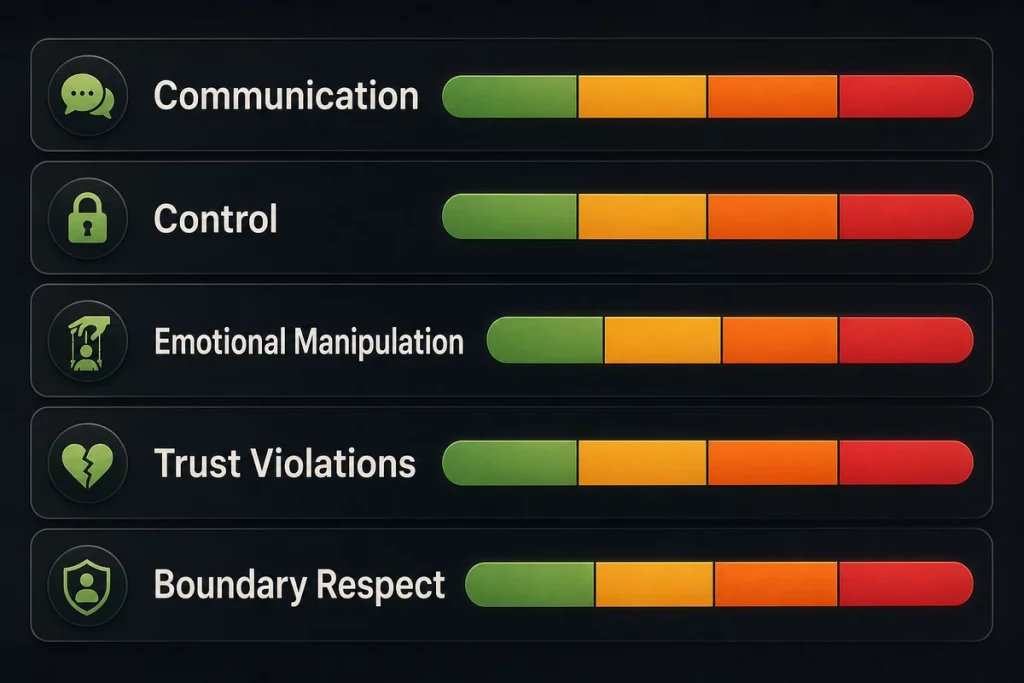
Tally your scores for each category (A through E) separately, then calculate your total. The category breakdown matters as much as the total because different categories indicate different types of relationship dysfunction — and different intervention approaches. A relationship scoring high in Communication but low in everything else is fundamentally different from a relationship scoring high in Control or Emotional Manipulation, even if the total numbers are similar.
Category scores (0-15 each): 0-3 = Healthy range (normal relationship friction that every partnership experiences). 4-7 = Caution zone (patterns worth monitoring, discussing openly, and potentially addressing through couples communication work). 8-11 = Concern zone (patterns actively causing psychological damage to one or both partners — professional intervention recommended rather than self-help approaches alone). 12-15 = Danger zone (patterns consistent with clinical definitions of emotional abuse — individual professional support needed immediately, and safety assessment warranted).
Total score (0-75): 0-15 = Generally healthy relationship with normal friction areas. 16-30 = Yellow flag — several concerning patterns that warrant attention and potentially couples therapy to address before they escalate into entrenched dynamics. 31-45 = Orange flag — multiple concerning patterns causing measurable harm to psychological wellbeing; individual therapy and honest relationship evaluation recommended before couples work. 46-60 = Red flag — pattern consistent with emotional abuse across multiple domains; individual therapy, safety assessment, and potential exit planning recommended rather than couples work. 61-75 = Critical — pattern consistent with severe, multi-dimensional emotional and psychological abuse; contact the National Domestic Violence Hotline (1-800-799-7233) for confidential, specialized support and safety planning.
Important caveat: ANY single question scored as 3 in Category E (boundary respect) — particularly Q22 (physical intimidation) or Q24 (physical/sexual pressure) — indicates immediate safety concern regardless of total score. Physical intimidation and sexual pressure are standalone red flags that don’t require cumulative context to be dangerous.
What Each Category Reveals
High Communication scores suggest that the relationship is struggling to process conflict, express needs, or resolve disagreements. These patterns deserve attention, but a self-assessment cannot predict the relationship’s outcome. A qualified couples therapist may help both partners examine communication patterns when participation is voluntary and the relationship is not abusive; individual support is safer when coercion or fear is present.
High Control scores indicate power imbalance — one partner making decisions that affect both while limiting the other’s autonomy, privacy, and independent relationships. Control patterns are more resistant to couples therapy than communication patterns because the controlling partner often doesn’t perceive their behavior as problematic. Individual therapy that specifically addresses control dynamics is typically required before couples work can be effective.
High Emotional Manipulation scores indicate the relationship operates through psychological tactics rather than genuine engagement — gaslighting, love bombing, manipulation, and narcissistic patterns. This category is the strongest indicator of emotional abuse and the least responsive to couples therapy (which can provide manipulators with better tools). Individual therapy for the affected partner is the priority.
High Trust Violation scores indicate the relationship’s foundation has been compromised by deception, secrecy, and broken commitments. Trust violations require the violating partner to demonstrate accountability and behavioral change over time — not just apologies. The player warning signs guide helps identify whether trust violations are isolated incidents or chronic character patterns.
High Boundary Respect scores indicate the most dangerous category — the partner’s disregard for your physical, emotional, and relational boundaries. This category includes the behaviors most predictive of escalation to physical violence. High scores here warrant immediate safety assessment regardless of other category scores.
Next Steps Based on Your Red Flag Quiz Results
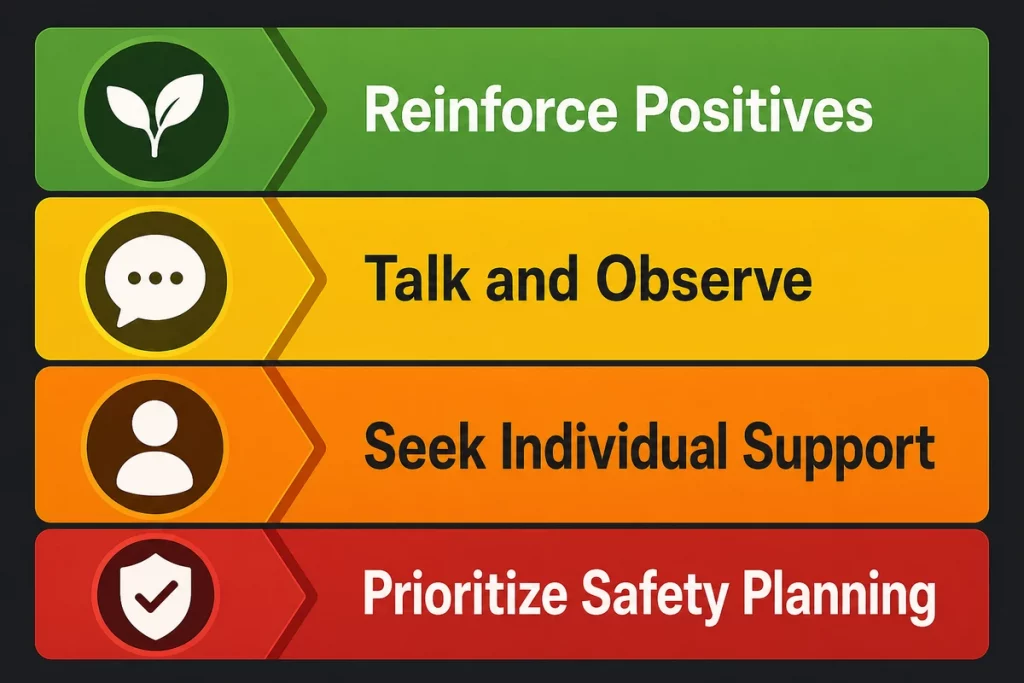
Green zone (0-15): Your relationship shows normal friction. Continue building communication skills and maintaining healthy boundaries. Watch for green flags and reinforce positive patterns. Celebrate what’s working while remaining aware that patterns can shift over time — periodic reassessment (every 6-12 months) helps catch emerging concerns before they solidify.
Yellow zone (16-30): Address concerning patterns before they solidify. Couples therapy can be effective at this stage. Have an honest conversation about the specific patterns you’ve identified. Both partners engaging with change at this stage produces the best outcomes.
Orange zone (31-45): Individual therapy first — for you, to rebuild the self-trust and clarity that the patterns may have eroded. Then evaluate whether couples therapy is appropriate based on your therapist’s assessment. Take our toxic relationship quiz for additional assessment.
Red/Critical zone (46+): Contact the National Domestic Violence Hotline (1-800-799-7233). Individual therapy focused on safety planning. Do NOT pursue couples therapy in the presence of active abuse. Take the trauma bonding test to evaluate whether intermittent reinforcement is creating psychological dependency that makes leaving feel impossible.
When you’re ready to date again — or if this quiz helped you evaluate a new relationship early — use GuyID’s free screening tools for identity verification and share your Date Mode link through GuyID. Building your next connection on verified transparency gives you the foundation this red flag quiz is designed to protect.
How GuyID Helps
GuyID should appear when it is useful, not as a banner ad. A GuyID Trust Profile gives someone a portable way to share trust signals before a date, while identity verification and social vouching help turn vague profile claims into clearer next steps.
Useful next steps:
- Create a GuyID Trust Profile when you want a cleaner way to share verified trust signals.
- Use GuyID free tools and related guides when you need a checklist before meeting someone.
- Treat identity verification as confidence-building, not a guarantee.
- Use social vouching when you want context from people who already know the person.
- Sign up only when the extra trust layer helps the decision you are already trying to make.
Frequently Asked Questions
How accurate is this red flag quiz?
This red flag quiz is a self-assessment tool based on documented relationship warning signs from Gottman’s research, APA clinical frameworks, and NDVH abuse indicators. It’s not a clinical diagnosis — it’s a structured way to evaluate patterns you might minimize or rationalize. The accuracy depends on your honesty in answering. If you’re unsure about your results, share them with a therapist for professional interpretation. The quiz’s value is in making invisible patterns visible — giving you a framework for what you may already sense but haven’t articulated.
Should I share my quiz results with my partner?
In green-to-yellow zone relationships: sharing can open productive conversation about patterns both partners want to address. In orange-to-red zone relationships: sharing may be unsafe because abusive partners often respond to being identified by escalating control or manipulation. If you scored in the orange zone or above, discuss your results with a therapist before deciding whether and how to share with your partner.
What if my partner scores high on this quiz but is usually wonderful?
The alternation between wonderful and harmful IS the pattern — it’s the love bombing/withdrawal cycle that creates trauma bonding. The wonderful periods don’t cancel out the harmful ones — they make the harmful ones harder to leave because the highs create hope that “the real them” is the wonderful version. The quiz measures patterns, not moments — and patterns that include high-severity behaviors are concerning regardless of how good the intervals between them feel.
Can I use this quiz to evaluate someone I’m newly dating?
Absolutely — early assessment is the best use of any red flag quiz because patterns are easier to identify before emotional investment creates cognitive bias. Many questions apply even in early dating: how do they handle mild disagreement? Do they respect your pace? Are their stories consistent? The green flags guide provides the complementary positive-indicator assessment for early relationships.