
Reader Briefing
Reader Briefing
Start here if you need a practical read on slow fade meaning in dating: who should use verification, what signals to check, and what to do before moving from online interest to an in-person plan.
Who this is for
- Readers preparing for a first in-person date.
- Anyone checking identity, profile consistency, and trust signals.
- Online daters improving conversations, profiles, or match screening.
You’ll learn
- How to evaluate identity signals without treating any single check as certainty.
- Which trust signals matter and how to weigh them together.
- How to move from online conversation to a safer first meeting.
- Where GuyID tools fit into a quick pre-date screening workflow.
- How to compare options using practical safety and trust criteria.
- When to slow down, ask for more context, or walk away.
Bottom line
Verification reduces uncertainty; it does not guarantee future behavior. Use a layered approach: confirm identity signals, compare profile consistency, ask for a short video call, keep early plans public, and slow down when someone pressures you to skip normal safety steps.
Key takeaways
- Identity verification improves confidence, not certainty.
- Verify before meeting privately or sharing sensitive details.
- A short video call can reveal many inconsistencies.
- Pressure to skip reasonable safety steps is useful information.
- Use GuyID tools to turn vague concerns into specific checks.
Free Tools
Catfish Probability Detector
Check whether a dating profile has suspicious identity or photo signals.
Dating Bio Red Flag Detector
Review a bio for scam, pressure, or trust-warning language.
Dating Safety Checklist
Use free GuyID tools before moving from chat to a real date.
Next step
Create your GuyID trust profile
Share consent-based trust signals before a date without turning the conversation into an interrogation.
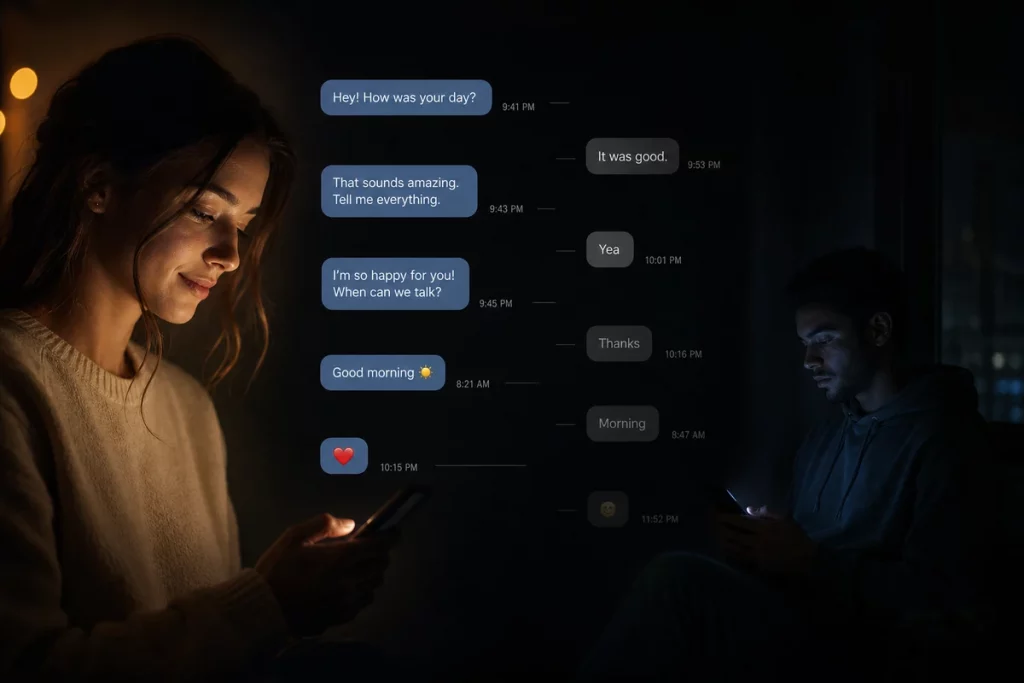
The texts get shorter. The response times get longer. Plans become vague. The enthusiasm that defined your early interactions is replaced by something polite but diminished — and you can feel the connection evaporating even though nobody has said anything is wrong. Understanding slow fade meaning is essential for modern dating because the slow fade is arguably more psychologically torturous than ghosting: at least ghosting is definitive. The slow fade keeps you in an extended liminal state where the connection is clearly declining but hasn’t officially ended — leaving you wondering whether to address it, wait it out, or accept the writing on the wall. This guide defines what slow fade meaning encompasses, how to distinguish it from normal busy-schedule fluctuations, why people choose the slow fade over honest communication, and how to respond when you recognize the pattern.
NavigateTable of Contents21 sections
What Slow Fade Meaning Actually Is
The slow fade meaning in dating: the gradual, deliberate reduction of communication, enthusiasm, and availability by someone who has lost interest but lacks the willingness to say so directly. Unlike ghosting (which is abrupt and conclusive), the slow fade is incremental — each individual interaction seems slightly less engaged than the last, but no single interaction is definitively “the end.” This gradualism is what makes the slow fade meaning so difficult to pin down in real-time: by the time the pattern is undeniable, weeks or months may have passed.
The American Psychological Association’s research on ambiguous social rejection identifies the slow fade as a particularly distressing rejection method because it denies the recipient a clear decision point. With ghosting, you eventually accept that the silence IS the answer. This perpetual “maybe” state generates anxiety that accumulates without resolution.
What slow fade meaning does NOT include: natural communication fluctuation (everyone has busy weeks), seasonal life disruptions (work deadlines, family events, health issues), or the normal settling of a relationship from honeymoon-phase intensity to sustainable everyday communication. The distinction between a slow fade and normal fluctuation is trajectory: normal fluctuation is temporary and self-correcting (communication returns to baseline); a slow fade is directional and progressive (each week is slightly worse than the last, and baseline never recovers).
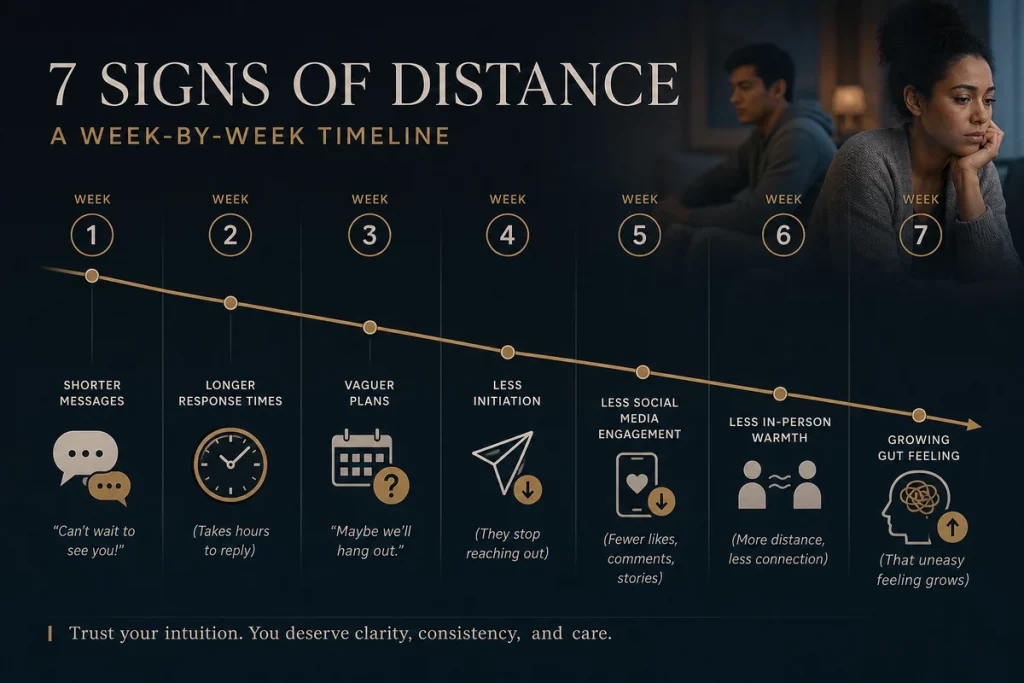
7 Signs You’re Being Slow Faded
1. Response Times Are Progressively Longer
They used to reply within minutes or hours. Now it’s hours to a day. Then a day becomes two days. Each delay feels individually explainable (“They’re probably busy”), but the pattern tells a different story. When you plot response times on a mental timeline, the trend is unmistakably increasing — and each new delay is slightly longer than the one before. The pattern is most visible in this progression because response time is quantifiable: you can literally track whether the gaps are growing.
2. Messages Get Shorter and Less Engaged
Early messages were paragraphs — sharing thoughts, asking questions, continuing threads from previous conversations. Slow-faded messages become: “Haha nice.” “Sounds good.” “Busy week.” The substance disappears while the contact technically continues. They’re maintaining the minimum required to not be “ghosting” while investing the minimum effort that signals declining interest. If you find yourself doing all the conversational heavy lifting — asking questions, sharing stories, proposing topics — while they respond with minimal engagement, the slow fade meaning is in the effort imbalance.
3. Plans Become Vague and Never Materialize
“We should hang out sometime” replaces “Are you free Saturday?” “That sounds fun” replaces “Let’s book it.” The shift from concrete planning to abstract intention is a hallmark of the slow fade because it maintains the illusion of future connection without committing to it. If you suggest a specific date and time and they respond with “Maybe, let me check” and then never follow up, the non-commitment IS the communication — regardless of what the words technically say.
4. They Stop Initiating
If you stopped initiating, you suspect the communication would stop entirely — and that suspicion is the pattern crystallized into its most diagnostic form. The “stop initiating and see what happens” test is the single most reliable slow fade detection method: if 5-7 days pass without them reaching out, the slow fade is confirmed. A person who wants to talk to you doesn’t need to be prompted every time.
5. Social Media Engagement Drops
They used to react to your stories, comment on your posts, and share things that reminded them of you. Now your content goes unacknowledged while they’re clearly active (posting their own content, engaging with others). Social media provides the most objective slow fade meaning evidence because the engagement metrics are visible: you can see that they’re online, they’re interacting with content — just not yours.
6. Physical Affection or Enthusiasm Decreases
In in-person interactions (if they’re still happening), the warmth has cooled. Less eye contact, less physical closeness, less genuine laughter, more phone-checking, earlier endings. The conversations feel functional rather than connecting — going through relationship motions without the energy that made those motions meaningful. When someone is physically present but emotionally absent, the pattern has extended from digital communication to in-person interaction.
7. Your Gut Says Something Changed
Before any of these signs become individually undeniable, you feel the shift — a vague sense that the energy has changed, that the connection that once felt mutual now feels one-sided, that you’re working harder for less return. This intuitive sense often precedes the objective evidence by weeks. For people with anxious attachment, this intuition may fire earlier and with more intensity — but the underlying signal (something has changed) is often accurate even when the anxious response (catastrophizing) is disproportionate. Trust the direction of the signal while calibrating the intensity.
Slow Fade vs. Genuinely Busy: The Distinction That Matters
Not every decline in communication is a slow fade — and misdiagnosing a busy period as a slow fade can cause you to withdraw from a connection that’s still viable:
| Slow Fade | Genuinely Busy |
|---|---|
| Decline is progressive — each week slightly worse | Decline is episodic — tied to a specific event or period |
| When they DO communicate, the quality is low (short, generic) | When they DO communicate, the quality remains high (engaged, specific) |
| They don’t acknowledge or address the declining pattern | They proactively mention being busy and suggest future time |
| Plans become vague and never materialize | Plans may be delayed but eventually happen |
| They stop initiating contact | They still initiate, even if less frequently |
| The pattern persists beyond any identifiable busy period | Communication normalizes once the busy period ends |
The definitive test: does the connection have forward momentum, or is it stagnating? A genuinely busy person’s relationship still progresses — dates happen (even if they take longer to schedule), emotional intimacy deepens, and plans for the future remain concrete. A slow-fading person’s relationship flatlines: nothing progresses, nothing deepens, and the future remains permanently vague. Research from the National Library of Medicine on relationship satisfaction trajectories confirms that stagnation — rather than conflict — is the strongest predictor of eventual relationship dissolution.
Why People Slow Fade Instead of Communicating
It feels kinder (it’s not). Many slow-faders believe they’re being compassionate — “gradually pulling back is less hurtful than a blunt rejection.” In reality, the extended ambiguity of a slow fade typically causes more cumulative distress than a clear, direct ending. The slow fade meaning in practice: weeks of diminishing hope that produces more total anxiety than a single moment of honest rejection. But the slow-fader doesn’t experience this — they experience a series of comfortable, low-effort non-responses that allow them to avoid the discomfort of a direct conversation.
They want to keep you as an option. Unlike ghosting (which closes the door), the slow fade keeps the door cracked — just enough that the slow-fader can push it back open if their primary option doesn’t work out. This is the breadcrumbing adjacent motivation: maintaining access to your attention without committing their own. If someone is slow-fading you while actively dating others, you’re being bench-warmed — kept warm enough to remain available but not invested in enough to warrant honest communication about the situation.
They’re genuinely uncertain. Sometimes the slow fade meaning isn’t deliberate strategy — it’s genuine ambivalence made visible through behavior. The person isn’t sure how they feel, so their communication naturally reflects that uncertainty: engaged one day (when they feel connected), distant the next (when doubt surfaces). This ambivalence-driven slow fade is more sympathetic in motivation but equally harmful in effect — because you’re experiencing the declining pattern regardless of whether it’s intentional or unconscious.
They lack the vocabulary or skills for honest endings. Some people have simply never learned how to end a connection directly. They don’t have the conversational scripts, the emotional regulation to manage the other person’s disappointment, or the model for what a respectful, honest ending looks like. The slow fade is their default because it’s the only exit strategy they know — not because they’ve chosen it over better alternatives. This doesn’t excuse the behavior, but it contextualizes it as a skills deficit rather than malice.
The Emotional Impact of Being Slow Faded
The slow fade meaning includes its psychological impact — which is often more prolonged and insidious than the impact of more decisive rejection methods:
Extended uncertainty erodes confidence. Each day of declining communication chips away at your self-assurance — not through a single dramatic blow but through the accumulation of small diminishments. “Maybe they didn’t like what I said Tuesday.” “Maybe I texted too much last week.” “Maybe they found someone more interesting.” This slow erosion of confidence is particularly damaging because it operates below the threshold of a single recognizable event — no individual moment is traumatic enough to trigger your protective systems, but the cumulative effect over weeks is significant.
The slow fade trains you to accept less. As communication declines, your expectations adjust downward to match the new reality. A once-a-day text that would have felt insufficient three weeks ago now feels like a gift because it’s more than you got yesterday. This gradual expectation recalibration is the same mechanism that operates in emotional manipulation and breadcrumbing — the standard for “enough” keeps declining until you’re grateful for attention that would have been unacceptable at the relationship’s start. Recognizing this recalibration in real-time is one of the most important aspects of understanding slow fade meaning: if your standards have dropped to accommodate someone’s declining effort, the accommodation is the problem, not the solution.
Self-blame cycles activate. The gradual nature of the slow fade encourages self-blame in ways that ghosting doesn’t. With ghosting, the abruptness makes it clear that something external happened. With the slow fade, the gradualism invites forensic analysis: “Was it what I said on that date? The text I sent Thursday? Am I being too available? Not available enough?” This analysis is rarely productive because the actual cause (they lost interest, they met someone else, they’re avoidant) has nothing to do with your specific behaviors — but the slow fade’s ambiguity creates the perfect conditions for your insecurities to construct a self-blaming narrative.
It contaminates your ability to trust the next connection. After experiencing a slow fade, the early stages of a new connection can feel precarious — every slight delay in response time, every slightly shorter message, every day they’re a bit less enthusiastic triggers the fear: “It’s happening again.” This hypervigilance, while understandable, can damage genuinely healthy connections by introducing monitoring anxiety into relationships where the other person’s communication fluctuations are normal rather than ominous. A therapist experienced in attachment patterns can help you distinguish between protective awareness and trauma-driven hypervigilance in future dating.
How to Respond to a Slow Fade
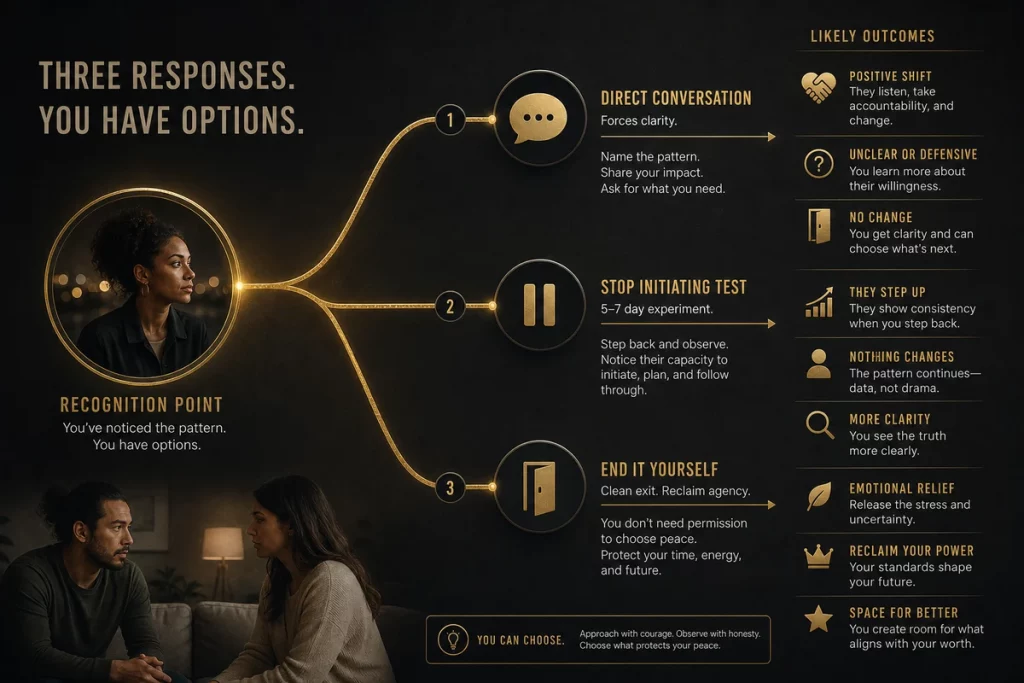
Understanding slow fade meaning gives you clarity; responding well gives you power and preserves your self-respect:
Option 1: The direct conversation. “I’ve noticed our communication has been declining over the past few weeks. I want to ask directly: are you still interested in pursuing this, or has something changed?” This approach forces clarity — the slow fade can’t survive a direct question because the whole strategy depends on avoiding direct conversation. Their response — whether honest engagement, defensive denial, or continued avoidance — tells you everything you need to know. A direct question about declining communication is not “being needy” — it’s practicing the boundary-setting that healthy relationships require from both partners. The National Domestic Violence Hotline identifies direct, honest communication as the foundation of all healthy relational dynamics — and asking for clarity about where you stand is one of the most basic forms of healthy communication.
Option 2: Stop initiating and observe. If you suspect a slow fade, stop texting first for 5-7 days. If they reach out with genuine engagement, the slow fade may have been a misread — or your pullback may have prompted a reset. If they don’t reach out at all, or reach out with minimal effort (“hey”), the pattern is confirmed: they were not invested enough to maintain the connection without your driving effort. This test is particularly valuable because it removes ambiguity without requiring a potentially uncomfortable conversation — the outcome speaks for itself.
Option 3: End it yourself. “I’ve enjoyed getting to know you, but I need consistency in my connections. I wish you well.” This approach reclaims agency — instead of waiting for the slow fade to reach its natural conclusion (complete silence), you define the ending on your terms. This is particularly empowering for people with anxious attachment who might otherwise spend weeks monitoring the declining pattern with increasing anxiety.
For future connections. The slow fade meaning teaches a valuable lesson: consistent behavior is the only reliable indicator of genuine interest. Apply this lesson forward by watching for green flags (consistency, follow-through, proportionate interest) and screening matches through GuyID’s free tools before emotional investment. Use GuyID verification and share your Date Mode link to establish mutual accountability from the start. People who verify their identity and commit to transparency are statistically less likely to slow-fade — because the accountability infrastructure they’ve embraced contradicts the avoidant communication style that slow-fading requires.
How GuyID Helps
GuyID should appear when it is useful, not as a banner ad. A GuyID Trust Profile gives someone a portable way to share trust signals before a date, while identity verification and social vouching help turn vague profile claims into clearer next steps.
Useful next steps:
- Create a GuyID Trust Profile when you want a cleaner way to share verified trust signals.
- Use GuyID free tools and related guides when you need a checklist before meeting someone.
- Treat identity verification as confidence-building, not a guarantee.
- Use social vouching when you want context from people who already know the person.
- Sign up only when the extra trust layer helps the decision you are already trying to make.
Frequently Asked Questions
What is the slow fade meaning in dating?
Slow fade meaning: the gradual, deliberate reduction of communication, enthusiasm, and availability by someone who has lost interest but avoids saying so directly. Unlike ghosting (abrupt disappearance), the slow fade is incremental — each interaction is slightly less engaged than the last, with no single moment definitively ending the connection. The extended ambiguity is what makes the slow fade uniquely distressing.
How do I tell if I’m being slow faded or if they’re just busy?
The key distinction: trajectory. A busy person’s communication dips temporarily then recovers, and the quality remains high when they do engage. A slow-fading person’s communication declines progressively and permanently — shorter messages, less initiation, vaguer plans, lower engagement quality. The definitive test: stop initiating for 5-7 days and observe. A busy person will reach out. A slow-fading person won’t.
Should I confront someone who’s slow fading me?
A direct question (“I’ve noticed our communication declining — are you still interested?”) forces clarity that the slow fade strategy is designed to avoid. The response — honest engagement, denial, or continued avoidance — tells you everything you need to know. This isn’t confrontation; it’s healthy communication. You deserve a clear answer about whether the connection you’re investing in is reciprocal. If asking a simple, reasonable question feels “too much,” the pattern has already succeeded in making you doubt your right to clarity.
Is the slow fade worse than ghosting?
Either experience can be distressing, and the impact varies by person and relationship. A slow fade can prolong uncertainty because communication declines without a clear ending, while ghosting may create a more abrupt loss of contact.
Can a slow fade be reversed?
Occasionally — particularly if the slow fade reflects genuine ambivalence rather than definitive disinterest. A direct, non-accusatory conversation (“I value this connection and want to understand where we stand”) can sometimes re-engage a person whose slow fade was driven by uncertainty rather than settled decision. However, if the direct conversation doesn’t produce genuine recommitment with visible behavioral change within 1-2 weeks, the diagnosis has been confirmed and continued investment is unlikely to change the outcome.
How do I protect myself from slow fades?
Verify matches through GuyID’s free tools before emotional investment — verified people tend to communicate more directly. Watch for green flags like consistency and follow-through early in the connection. Set internal benchmarks: if forward momentum stalls for 2+ weeks, address it directly rather than hoping it resolves.