
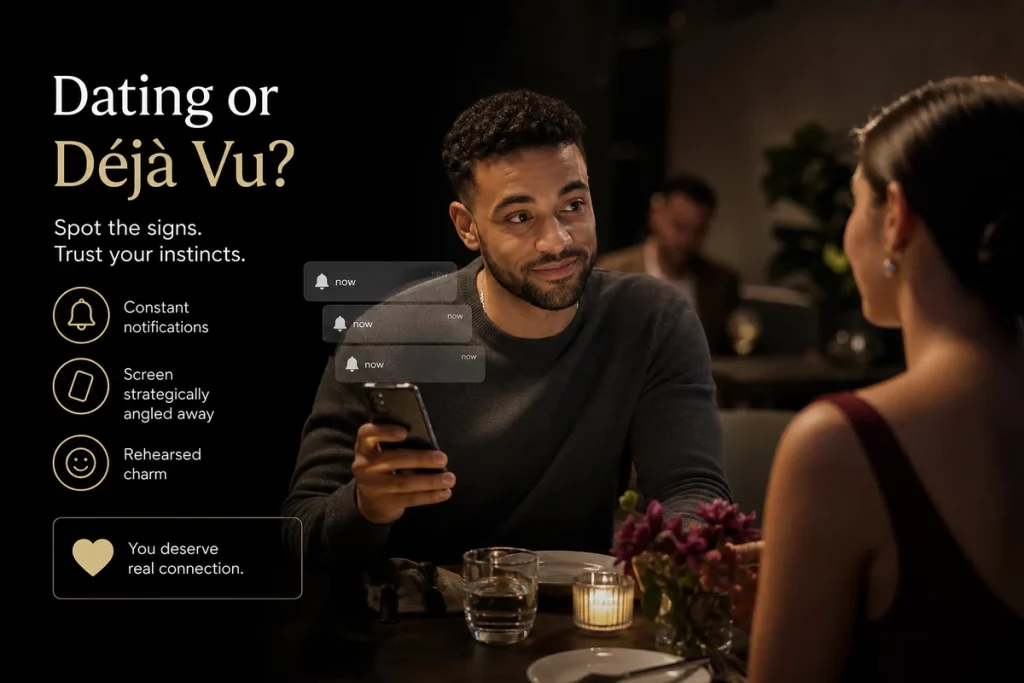
Reader Briefing
Reader Briefing
Start here if you need a practical read on signs of a player: 12 warning signs: who should use verification, what signals to check, and what to do before moving from online interest to an in-person plan.
Who this is for
- People meeting someone from a dating app or social platform.
- Readers preparing for a first in-person date.
- Anyone checking identity, profile consistency, and trust signals.
- People trying to avoid romance scams, fake profiles, or pressure tactics.
You’ll learn
- How to evaluate identity signals without treating any single check as certainty.
- Which trust signals matter and how to weigh them together.
- How to spot inconsistencies, pressure, or behavior patterns that deserve caution.
- How to move from online conversation to a safer first meeting.
- Where GuyID tools fit into a quick pre-date screening workflow.
- How to compare options using practical safety and trust criteria.
Bottom line
Verification reduces uncertainty; it does not guarantee future behavior. Use a layered approach: confirm identity signals, compare profile consistency, ask for a short video call, keep early plans public, and slow down when someone pressures you to skip normal safety steps.
Key takeaways
- Identity verification improves confidence, not certainty.
- Patterns matter more than isolated incidents.
- Verify before meeting privately or sharing sensitive details.
- A short video call can reveal many inconsistencies.
- Pressure to skip reasonable safety steps is useful information.
Free Tools
Catfish Probability Detector
Check whether a dating profile has suspicious identity or photo signals.
Dating Bio Red Flag Detector
Review a bio for scam, pressure, or trust-warning language.
Dating Safety Checklist
Use free GuyID tools before moving from chat to a real date.
Next step
Create your GuyID trust profile
Share consent-based trust signals before a date without turning the conversation into an interrogation.
A player doesn’t announce themselves — they perform sincerity so convincingly that by the time you recognize the signs of a player, you’re already emotionally invested. Players are distinct from people who are casually dating (honest about their intentions) and from love bombers (who create intensity for control). A player’s core skill is making you genuinely believe you’re the exception — the one who finally made them want something real — while simultaneously and deliberately running the same carefully refined playbook with multiple other people. This guide identifies the 12 most reliable signs of a player, explains the psychology behind the player dynamic, distinguishes players from genuinely interested people who happen to be charming, and provides the practical verification framework that exposes player behavior reliably before your emotional investment makes clear thinking difficult.
NavigateTable of Contents26 sections
What Makes Someone a Player
A player is someone who deliberately presents romantic interest to multiple people simultaneously while allowing each person to believe the connection is exclusive or heading toward exclusivity. The key distinguishing element is deliberate deception — not the dating of multiple people (which is normal in early dating), but the deliberate and sustained creation of false expectations about the nature, trajectory, and exclusivity of the connection. A person who says “I’m seeing a few other people casually” is being honest and transparent. A person who acts like you’re the only one while secretly texting and seeing three other people is a player.
Research from the National Library of Medicine on deceptive dating behavior identifies player dynamics as a specific form of relational exploitation where one party systematically misrepresents their intentions, availability, and emotional investment to maintain access to multiple partners’ attention, affection, and physical intimacy without the accountability that honest communication would require.
Understanding signs of a player is essential because player behavior operates in the gray zone between “normal dating” and “outright scam.” A romance scammer wants your money. A narcissist wants your psychological supply. A player wants your attention, affection, and physical availability — and unlike scammers, they’re often genuinely attractive, socially skilled, and capable of producing real chemistry. This makes the player signs harder to distinguish from genuine interest than red flags for more extreme manipulation patterns.
12 Signs of a Player
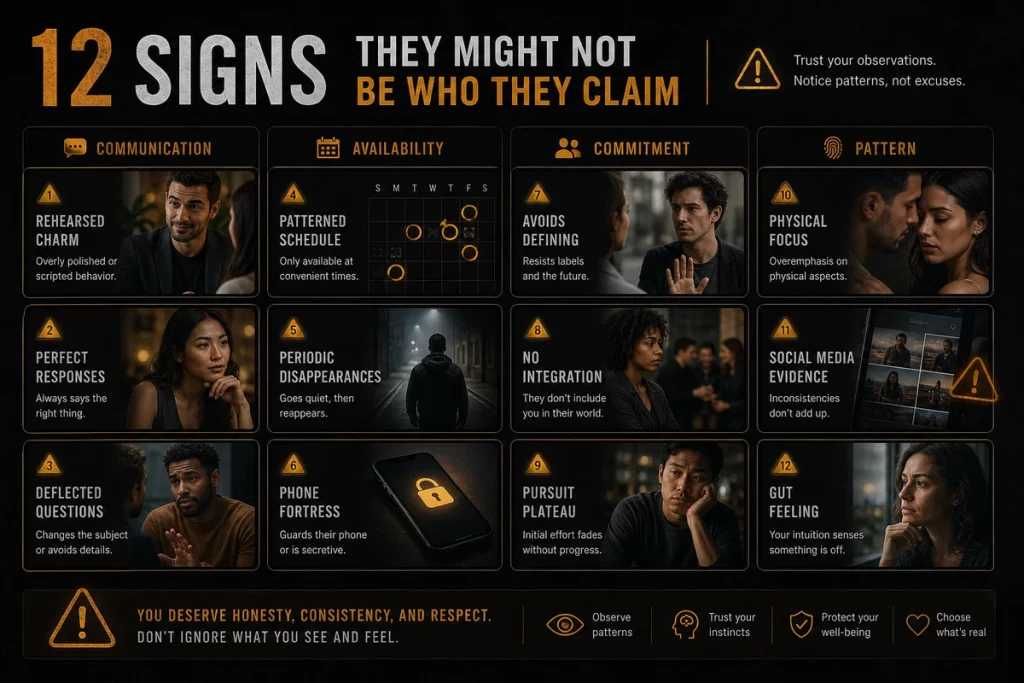
1. Charm That Feels Rehearsed
The compliments land perfectly. The lines feel crafted. The conversation flows like a script that’s been performed before — because it has. A player’s charm has a polished quality that differs from genuine attraction: genuine interest produces slightly awkward, imperfect, authentic expression. Player charm produces smooth, calibrated, practiced delivery. The difference is subtle but detectable: does their charm feel like it was designed for YOU specifically, or does it feel like it would work on anyone? If you feel interchangeable — like the recipient of a performance rather than the inspiration for it — that’s one of the earliest signs of a player.
2. They’re Only Available at Specific, Limited Times
Weeknight evenings yes, weekends no. Available after 9 PM but never during the day. Free on Tuesdays and Thursdays but mysteriously busy every other day. When someone’s availability follows a suspicious pattern — particularly one that leaves large, unexplained blocks of time — they may be scheduling around other relationships. Genuine real-life busy-ness produces naturally variable availability; player scheduling produces suspiciously consistent, patterned availability that carefully accommodates multiple different people without scheduling overlap.
3. They Avoid Defining the Relationship
Weeks or months pass, and every attempt to discuss exclusivity or relationship status is deflected: “Let’s just enjoy what we have.” “Labels ruin things.” “Why do we need to define this?” Consistent reluctance to define is among the most reliable signs of a player because definition creates accountability. An exclusive relationship means they can’t see other people. A defined relationship means they can be held to standards. Players consistently resist definition because clear definition is the exact opposite of what serves their interests — maximum romantic and physical access with absolute minimum accountability.
4. Their Phone Is a Fortress
Face-down on every surface. Notifications silenced. Screen angled away during conversations. They step out of the room to take calls. They’re hyper-responsive to their phone when you’re not around but noticeably less attentive to it (or to your messages) when they’re with you. Phone security itself isn’t a red flag — privacy is legitimate. But defensive phone behavior combined with other signs of a player suggests the phone contains evidence they don’t want you to see.
5. They Love Bomb Early, Then Plateau
Intense initial pursuit — constant texting, elaborate dates, declarations of interest — that peaks quickly and then settles into a maintenance level that’s significantly lower than the initial investment. The love bombing phase secured your emotional investment; the plateau is their actual effort level. A genuine connection builds gradually and sustains; a player connection peaks early (during the pursuit phase) and then levels off once the “conquest” is achieved.
6.
When you’re upset, they say the perfect thing. When you’re pulling away, they escalate with exactly the right reassurance. When you confront them, they defuse with charm. This emotional precision isn’t genuine empathy — it’s sophisticated pattern recognition from extensive practice. Players have navigated these conversations many times with many people. Their “perfect” responses are rehearsed scripts, not genuine emotional intelligence. True empathy includes natural imperfection and occasional missteps — sometimes saying the wrong thing, apologizing, and learning. Player empathy is consistently, suspiciously flawless.
7. Their Social Media Tells a Different Story
Multiple women commenting familiar emojis. Tagged photos with different people at different times. A following list heavy on attractive potential partners. Social media provides the most objective evidence because a player’s multiple connections often leave digital traces they can’t entirely manage. Reverse image search their photos and cross-reference their social media for patterns that suggest the connection you think is unique isn’t.
8. They Never Integrate You Into Their Life
Months of dating, and you haven’t met their friends, family, or anyone from their real life. Plans happen in private — their apartment, yours, restaurants where they won’t run into people they know. This deliberate compartmentalization is essential for players because any integration creates the unacceptable risk of exposure: a friend might mention “the other girl,” or a family member might reference previous partners in ways that contradict the player’s narrative. See our committed relationship vs dating guide for how integration signals genuine commitment versus its absence signals compartmentalized dating.
9. They Deflect Questions About Past Relationships
“I don’t really talk about exes.” “The past is the past.” Vague non-answers about relationship history prevent you from detecting the pattern: short-term connections, overlapping relationships, or a trail of people who felt exactly the way you do now. A person comfortable with their relationship history discusses it openly. A person whose relationship history reveals a player pattern avoids the topic because the pattern speaks for itself.
10. The Relationship Revolves Around Physical Intimacy
Dates consistently end at someone’s place. Conversations are steered toward physical topics. Time spent together is disproportionately intimate versus genuinely connecting. While physical chemistry is important in any relationship, a connection that’s primarily or exclusively physical — where non-physical dates are rare and deeper emotional conversations are avoided — may indicate that physical access is the primary goal rather than a component of a broader connection.
11. They Disappear Periodically Without Explanation
Gone for a weekend with no advance notice. Unreachable for days at a time. The explanations when they resurface are vague: “Crazy week.” “Family stuff.” “Just needed some space.” Periodic disappearances that follow a pattern (coinciding with other partners’ availability, for example) are among the most telling signs of a player — because a person managing multiple connections inevitably has scheduling conflicts they can’t always explain convincingly.
12. Your Gut Says Something’s Off
Everything looks right on paper — they’re attractive, charming, attentive (when present). But something feels wrong. The connection feels performative rather than authentic. You feel managed rather than loved. You feel like an audience rather than a partner. This intuitive sense that the connection lacks depth despite having all the surface indicators of a relationship is your attachment system detecting incongruence between what’s being presented and what’s actually happening. Unlike anxious attachment false alarms (which are triggered by uncertainty), player-detection intuition is triggered by incongruence — the mismatch between what they say and what they do.
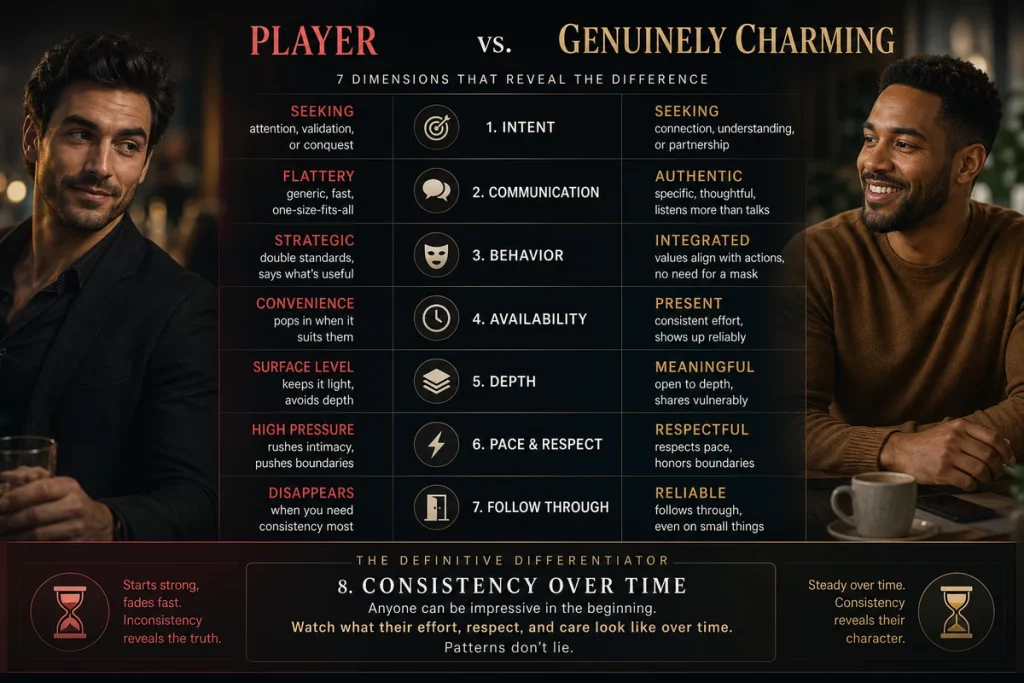
Signs of a Player vs. Genuinely Charming Person
Not every charming person is a player — and mislabeling genuine charisma as player behavior pushes away potentially wonderful partners:
| Signs of a Player | Genuinely Charming Person |
|---|---|
| Charm feels practiced and works on anyone | Charm feels personal and specific to you |
| Avoids defining the relationship | Welcomes the conversation when the time is right |
| Compartmentalizes you from their life | Gradually integrates you into their world |
| Defensive about phone and schedule | Naturally transparent without being asked |
| Peaks early then maintains low effort | Consistent effort that builds over time |
| Perfectly says what you want to hear — every time | Sometimes says the wrong thing and genuinely apologizes |
| Resists verification | Welcomes transparency as a green flag |
The definitive test: consistency over time. Player behavior is sustainable for weeks but not months — the scheduling conflicts, the availability gaps, and the resistance to commitment accumulate until the pattern becomes undeniable. The American Psychological Association identifies behavioral consistency as the most reliable character indicator — because sustained consistent behavior requires genuine investment that performance-based behavior can’t maintain indefinitely. Give it 8-12 weeks of observation before drawing conclusions. If the warning signs accumulate, trust the pattern.
Why Smart People Fall for Players
Players are genuinely skilled. A player who’s been running the same interpersonal playbook for years or even decades has developed social skills, emotional intelligence (or its convincing simulation), and situational awareness that make them genuinely attractive. They’ve refined their approach through hundreds of interactions, learning exactly which behaviors produce the desired response. This isn’t natural charisma — it’s deliberately developed expertise refined through repetition. And expertise is hard to see through, especially when the neurochemistry of attraction is reducing your analytical capacity.
The exception fantasy. “I know they have a reputation, but they’re different with me.” The belief that you’re the one who finally changed the player is one of the most powerful psychological hooks — because it combines romantic idealism with ego gratification. Being “the exception” feels powerfully special precisely because the pattern is known. But statistically, there are no exceptions to behavioral patterns that have been reinforced over years. You’re not special to the player — you’re next in line in an ongoing pattern. This isn’t a reflection of your value or your desirability; it’s a statement about the player’s deeply ingrained behavioral pattern, which existed long before you entered the picture and will continue long after you leave it.
Confirmation bias in action. Once you’re emotionally invested, your brain selectively filters information to support the desired conclusion: “They’re genuinely interested in me.” Evidence that supports this conclusion (the romantic texts, the intense connection during dates) is weighted heavily. Evidence that contradicts it (the availability gaps, the phone secrecy, the commitment avoidance) is minimized, rationalized, or dismissed. The National Domestic Violence Hotline identifies confirmation bias as one of the primary cognitive mechanisms that keeps people in deceptive or harmful relationship dynamics — because once the brain has committed to a narrative about someone’s character, contradictory evidence is processed as noise rather than signal. This confirmation bias isn’t stupidity — it’s a documented cognitive process that affects everyone, including people who are fully aware of the signs of a player and understand the psychology behind their own susceptibility.
How to Protect Yourself from Players
Verify before investing emotionally. Reverse image search their photos. Cross-reference their social media for patterns (multiple romantic interests, compartmentalized online presence). Check for a Tinder profile or active dating app presence that contradicts claims of exclusivity. Use GuyID’s free screening tools for comprehensive profile analysis and ask for GuyID verification — because someone willing to verify their government ID is demonstrating the accountability that players systematically avoid.
Watch actions, not words. Words are a player’s primary tool — they cost nothing and can be customized for any audience. Actions require investment, create accountability, and are harder to fake across multiple simultaneous connections. Do they follow through on plans? Do they integrate you into their real life? Do they welcome transparency? Is their availability consistent and explained? Actions answer questions that words are designed to avoid.
Set a commitment timeline — internally. Decide in advance: “After 8 weeks of consistent dating, I expect either a commitment conversation or an honest statement about their intentions.” This internal boundary prevents the indefinite drift into “we’re seeing each other but haven’t defined it” territory that players exploit. You don’t need to announce this timeline — you just need to hold yourself to it. At 8 weeks, if multiple signs of a player are present and commitment is actively avoided, the pattern IS the answer regardless of what they say when confronted.
Share your Date Mode link. Mutual verification through GuyID establishes accountability from the first interaction. A player’s response to verification — resistance, deflection, or “why don’t you trust me?” — reveals the accountability avoidance that is fundamental to player behavior. A genuine person’s response — cooperation, interest, “great idea” — reveals the transparency that players can’t offer because transparency is incompatible with their multi-partner strategy. The verification response is one of the most efficient player indicators (or their absence) available in modern dating.
How GuyID Helps
GuyID should appear when it is useful, not as a banner ad. A GuyID Trust Profile gives someone a portable way to share trust signals before a date, while identity verification and social vouching help turn vague profile claims into clearer next steps.
Useful next steps:
- Create a GuyID Trust Profile when you want a cleaner way to share verified trust signals.
- Use GuyID free tools and related guides when you need a checklist before meeting someone.
- Treat identity verification as confidence-building, not a guarantee.
- Use social vouching when you want context from people who already know the person.
- Sign up only when the extra trust layer helps the decision you are already trying to make.
Frequently Asked Questions
What are the biggest signs of a player?
The most reliable indicators: patterned availability (specific windows that suggest scheduling around others), commitment avoidance despite months of dating, compartmentalization from their real life (no friend/family introductions). Defensive phone behavior combined with other indicators, and the feeling that their charm is performed rather than genuine. No single sign in isolation is conclusive — but 3-4 concurrent signs from this list create a pattern that’s difficult to explain innocently.
Can a player change?
People can change — but player behavior is typically sustained by rewards (attention, physical access, ego gratification) that make change unlikely without significant internal motivation. A player who changes does so because they genuinely want different outcomes for themselves, not because one specific person “inspired” them to change. If someone claims to have changed for you specifically, apply the behavioral framework to their current behavior — not their words about changed behavior. Actions over time are the only reliable evidence of change.
How do I confront someone I think is a player?
Direct is best: “I’ve noticed [specific behaviors] and I want to understand where this is going. Are you seeing other people?” A player will typically: deflect (“Why are you being so serious?”), gaslight (“You’re being paranoid”), or produce a perfectly crafted reassurance that addresses your concern without actually committing to anything concrete. A genuine person will engage honestly — even if the answer isn’t what you want to hear. The response to your direct question is more diagnostic than any sign on this list.
Is someone a player if they’re dating multiple people?
Not necessarily. Dating multiple people in the early exploratory stages of getting to know potential partners is normal and healthy — it becomes player behavior when the person deliberately creates the impression of exclusivity or serious intent with each person while maintaining the others secretly. The distinction isn’t the number of connections — it’s the deception about them. A person who says “I’m seeing a few people casually right now” is honest. A person who acts like you’re the only one is a player. Transparency about intentions is the dividing line.
How do I verify if someone is a player?
Reverse image search their photos for presence on multiple dating platforms. Cross-reference their social media for patterns suggesting multiple romantic interests. Use GuyID’s free screening tools for profile analysis. Ask for GuyID verification — players typically resist accountability measures. Check for active dating profiles that contradict exclusivity claims. The combination of digital verification and behavioral observation over 8-12 weeks provides the most reliable assessment.
Why do I keep attracting players?
You’re not attracting players — players approach everyone. The question is why you’re receptive to their approach. Common patterns include: anxious attachment that interprets pursuit intensity as love, confusion between charm and genuine interest, the “exception fantasy” that overrides pattern recognition, and insufficient verification habits that allow player behavior to go undetected during the critical early weeks. A therapist experienced in attachment patterns can help you identify and address the specific vulnerability that makes player dynamics feel compelling rather than suspicious.
What’s the difference between a player and a narcissist?
Players want attention, affection, and physical access from multiple people simultaneously through deception. Narcissists want psychological control and supply — which may include the player dynamic but extends to gaslighting, emotional manipulation, isolation, and the full abuse cycle. A player may break your heart; a narcissist may damage your mental health. Some players are narcissists; many are simply people who enjoy the pursuit without intending psychological harm. The red flags overlap but the severity and intent differ significantly.