

Reader Briefing
Reader Briefing
Start here if you need a practical read on is stonewalling abuse? the line between overwhelm and control: who should use verification, what signals to check, and what to do before moving from online interest to an in-person plan.
Who this is for
- Readers preparing for a first in-person date.
- Anyone checking identity, profile consistency, and trust signals.
- Online daters improving conversations, profiles, or match screening.
You’ll learn
- How to evaluate identity signals without treating any single check as certainty.
- Which trust signals matter and how to weigh them together.
- How to move from online conversation to a safer first meeting.
- Where GuyID tools fit into a quick pre-date screening workflow.
- When to slow down, ask for more context, or walk away.
- How to turn the article’s advice into a concrete next step.
Bottom line
Verification reduces uncertainty; it does not guarantee future behavior. Use a layered approach: confirm identity signals, compare profile consistency, ask for a short video call, keep early plans public, and slow down when someone pressures you to skip normal safety steps.
Key takeaways
- Identity verification improves confidence, not certainty.
- Verify before meeting privately or sharing sensitive details.
- A short video call can reveal many inconsistencies.
- Pressure to skip reasonable safety steps is useful information.
- Use GuyID tools to turn vague concerns into specific checks.
Free Tools
Catfish Probability Detector
Check whether a dating profile has suspicious identity or photo signals.
Dating Bio Red Flag Detector
Review a bio for scam, pressure, or trust-warning language.
Dating Safety Checklist
Use free GuyID tools before moving from chat to a real date.
Next step
Create your GuyID trust profile
Share consent-based trust signals before a date without turning the conversation into an interrogation.
You’ve been told it’s “just their communication style.” That they “need space.” That you’re “too emotional” for expecting them to actually talk through problems with you. But the silence isn’t neutral — it’s punishing. And you’re starting to wonder: is stonewalling abuse? The answer isn’t a simple yes or no, because stonewalling exists on a spectrum from genuine physiological overwhelm to deliberate emotional punishment. Where YOUR experience falls on that spectrum determines whether you’re dealing with a communication skills deficit that therapy can address — or a control strategy that represents emotional abuse. This guide gives you the framework to distinguish between the two, the clinical criteria that separate overwhelm from abuse, and the action steps for each scenario.
NavigateTable of Contents17 sections
The Stonewalling Spectrum: From Overwhelm to Abuse
Is stonewalling abuse? To answer this question accurately, you need to understand that stonewalling isn’t a single behavior — it’s a spectrum of withdrawal behaviors with fundamentally different motivations, patterns, and impacts:
End 1: Physiological overwhelm. The person genuinely cannot process emotional information during conflict because their nervous system has entered Diffuse Physiological Arousal (DPA) — heart rate above 100 BPM, stress hormone flooding, prefrontal cortex shutdown. The shutdown is involuntary, the person typically feels guilty about it afterward, and they’re willing to return to the conversation once regulated. This is not abuse. It’s a communication skills deficit with a physiological component, and it responds well to therapeutic intervention. Understanding this end of the spectrum matters when asking is stonewalling abuse because mislabeling overwhelm as abuse shames someone for a neurological response they didn’t choose — which makes them LESS likely to seek the help that would address it.
End 2: Deliberate punishment. The person uses silence, withdrawal, and emotional unavailability specifically to punish their partner for expressing needs, setting boundaries, or initiating conversations the stonewaller doesn’t want to have. The silence ends not when regulation occurs but when the partner capitulates — apologizes for raising the issue, withdraws the request, or demonstrates sufficient distress to satisfy the punishment. This IS abuse. It’s using emotional withdrawal as a weapon to control the partner’s behavior and suppress their voice within the relationship.
The gray zone. Most real-world situations aren’t purely one end or the other. A person may genuinely experience overwhelm AND deploy that overwhelm strategically — knowing that their shutdown punishes their partner and using the physiological response as cover for what has become a control strategy. The gray zone is particularly confusing because the stonewaller may not be fully conscious of the shift from involuntary response to habitual weapon — the transition happens gradually as the nervous system’s protective response gets reinforced by the interpersonal power it produces. Asking is stonewalling abuse in gray zone situations requires looking at patterns rather than individual incidents, and the 7-question assessment below helps you evaluate those patterns honestly.
When Stonewalling Is Overwhelm (Not Abuse)
Stonewalling driven by overwhelm has identifiable characteristics that distinguish it from abuse. If you’re asking is stonewalling abuse and your partner’s behavior matches most of these markers, you’re likely dealing with a skills deficit rather than a control strategy:
They Express Guilt or Remorse Afterward
After the shutdown passes, they acknowledge that they withdrew. They express regret about leaving you in emotional limbo. They may not have the words to explain WHY they shut down, but they clearly communicate that they know it wasn’t okay and that your feelings about it are valid. This guilt indicates that the stonewalling conflicts with their values — a marker of overwhelm, not intentional strategy.
They Return to the Conversation Voluntarily
Without you pursuing, pressuring, or ultimatum-delivering, they come back and attempt to re-engage with the topic. The return may be hours later (once their nervous system has regulated), but it happens because THEY initiate it, not because you forced it. Voluntary return demonstrates that the stonewalling was a temporary state, not a permanent position — a circuit breaker, not a barricade.
They’re Willing to Seek Help
When you explain how the stonewalling affects you and suggest therapy (individual or couples), they’re open to it — or at least not dismissive. Willingness to address the pattern through professional support indicates that they recognize it as a problem rather than defending it as acceptable. A person using stonewalling as a control strategy resists therapy because therapy would dismantle the tool they use to manage the relationship. Is stonewalling abuse when the person actively seeks to change it? Almost certainly not — it’s a problem they’re struggling with.
The Shutdown Is Consistent Across Conflicts, Not Strategic
Overwhelm-driven stonewalling happens across all types of conflict — not selectively in conversations where the partner’s requests would require the stonewaller to give something up. If your partner shuts down during disagreements about household chores with the same intensity as disagreements about major life decisions, the pattern suggests generalized overwhelm rather than strategic deployment.
When Stonewalling IS Abuse: The Warning Signs
Is stonewalling abuse? Yes — when it displays these characteristics:
The silence is punitive and sustained. The withdrawal extends for hours, days, or even weeks — far beyond any plausible physiological recovery time. The sustained silence communicates: “You did something wrong by having needs, and I’m punishing you until you demonstrate sufficient remorse for expressing them.” DPA recovery typically takes 20-30 minutes; sustained multi-day silence isn’t overwhelm — it’s punishment.
The silence ends when you capitulate, not when they regulate. Track what precedes the end of the stonewalling: Does communication resume when your partner has had time to calm down? Or does it resume when YOU apologize, withdraw your request, or otherwise signal that you’ve abandoned whatever need triggered the withdrawal? If the stonewalling consistently ends only when you give in, the withdrawal is functioning as a coercion mechanism — applying emotional pressure (isolation, rejection, withheld affection) until you comply with the stonewaller’s preferred outcome. This is emotional manipulation by any clinical definition.
They use the stonewalling to control which topics can be discussed. Certain subjects — their behavior, the relationship’s problems, your needs, financial decisions, parenting disagreements — consistently trigger shutdown, effectively making those topics undiscussable. Over time, the stonewalling has trained you to self-censor: you no longer raise certain issues because you know the punishment that follows. When your voice within the relationship has been systematically silenced through withdrawal, the answer to is stonewalling abuse is unambiguously yes — your autonomy and agency are being suppressed through emotional coercion.
They deny the stonewalling is happening. “I’m not doing anything — I’m just sitting here.” “I don’t know what you’re talking about.” “You’re being dramatic.” When the stonewaller not only withdraws but then denies the withdrawal, the pattern overlaps with gaslighting — making you question your own perception of reality. Denial of the behavior adds a layer of psychological manipulation on top of the withdrawal itself, compounding the harm.
Warmth and affection are weaponized. The stonewaller withholds all positive interaction — affection, conversation, shared activities, sexual intimacy — during the silent period, then restores them suddenly when the punishment is “complete.” This intermittent reinforcement pattern (withdrawal of connection followed by capitulation then sudden warmth) mirrors the trauma bonding cycle and is one of the most psychologically damaging relationship dynamics documented in clinical literature.
The 7-Question Assessment: Is Stonewalling Abuse in YOUR Relationship?
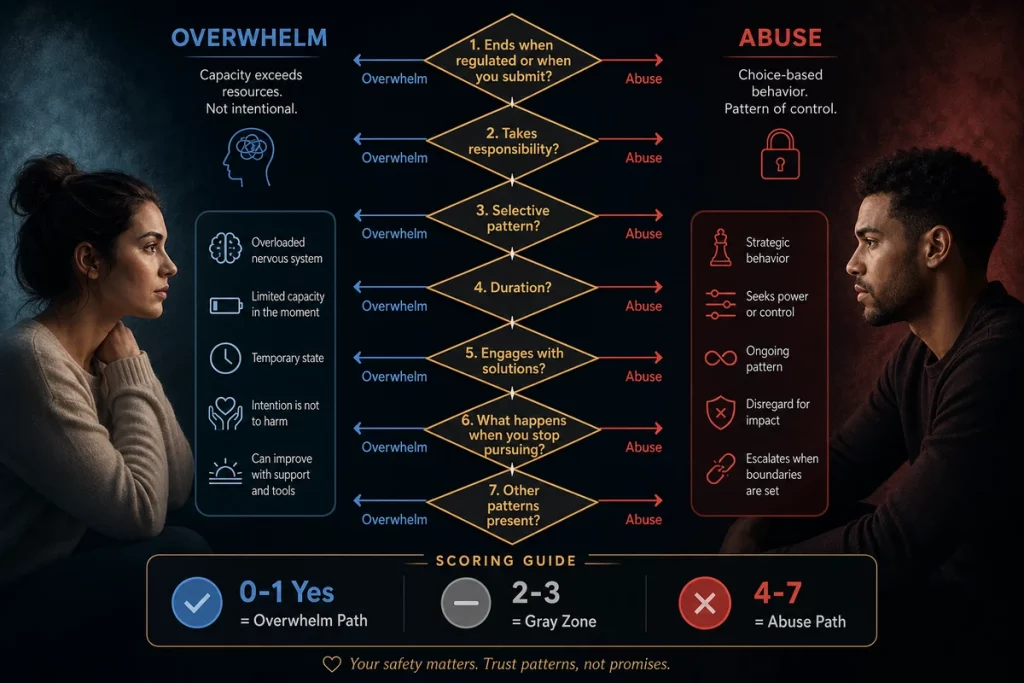
How to use this assessment: Answer each question honestly based on the overall pattern — not a single incident. Count the questions where your answer is YES. 0-1 = likely overwhelm. 2-3 = gray zone requiring professional evaluation. 4-7 = strong indicators of abusive stonewalling.
Question 1: Does the silence last significantly longer than 30 minutes without any communication about needing a break? Physiological regulation from DPA typically takes 20-30 minutes. Silence extending hours or days without communication (“I need time”) exceeds plausible overwhelm duration and enters punitive territory.
Question 2: Does the stonewalling end only when you apologize, capitulate, or withdraw your request? If you can predict WHEN the silence will end based on YOUR behavior (specifically, your submission) rather than the passage of time, the withdrawal is functioning as leverage rather than recovery.
Question 3: Are there topics you’ve stopped raising because you know they’ll trigger shutdown? If you’ve developed a mental list of “undiscussable” subjects — topics you avoid to prevent the punishment of withdrawal — your voice has been systematically suppressed through emotional coercion.
Question 4: Does your partner deny the stonewalling when you name it? Denial of observable behavior adds a gaslighting component to the withdrawal pattern, increasing the psychological harm by undermining your reality testing alongside the emotional rejection.
Question 5: Does your partner refuse therapy, couples counseling, or any form of intervention? A person struggling with overwhelm welcomes tools that would help them manage it. A person deploying stonewalling as a control strategy resists any intervention that would dismantle the tool — because the tool is working exactly as intended.
Question 6: Is the stonewalling selective — triggered by YOUR needs but absent in other conflicts? If your partner handles workplace disagreements, family conflicts, and friendships without shutting down — but consistently stonewalls when YOU express needs — the withdrawal is targeted, not generalized. Targeted withdrawal indicates strategy, not overwhelm.
Question 7: Has your mental health, self-worth, or sense of reality deteriorated during this relationship? If you’ve developed anxiety about expressing needs, started questioning whether your feelings are “too much,” lost confidence in your own perceptions, or find yourself constantly managing your partner’s emotional state to avoid triggering withdrawal — the pattern has produced the characteristic damage of emotional abuse regardless of the stonewaller’s internal motivation.
Stonewalling Combined With Other Abuse Patterns
Is stonewalling abuse on its own? Sometimes. When combined with other patterns? Almost always. Stonewalling rarely exists in isolation in abusive relationships — it typically operates alongside other control strategies that compound its effect. Understanding these combinations matters because individual behaviors that seem ambiguous in isolation reveal their abusive character when you see them operating as a system. Each additional pattern removes plausible deniability and moves the dynamic further from “overwhelm” toward “control.”
Stonewalling + Gaslighting: “I wasn’t being silent — you were being dramatic.” The stonewaller withdraws, then denies the withdrawal, making you question whether the silence happened or whether you misinterpreted neutral behavior as punishment. The combination erodes both your emotional connection (through withdrawal) and your reality testing (through denial), creating comprehensive psychological disorientation.
Stonewalling + Love Bombing: Intense withdrawal followed by sudden, overwhelming warmth — gifts, affection, declarations of love — once the punishment period ends. This creates the trauma bond that makes leaving feel impossible: the highs feel so good precisely BECAUSE the lows felt so bad, and your nervous system becomes addicted to the relief cycle. Read our love bombing then ghosting guide for the complete pattern.
Stonewalling + Narcissistic Patterns: The silent treatment as narcissistic supply control — withholding attention to devalue you, then restoring it to remind you that your emotional wellbeing depends entirely on their willingness to engage. When combined with narcissistic breadcrumbing, the pattern keeps you perpetually seeking the approval and connection that the narcissist strategically withholds.
Stonewalling + Deflection: Every attempt to address the stonewalling itself is deflected: “The real problem is that you won’t let anything go.” “If you didn’t attack me, I wouldn’t shut down.” The deflection reframes the stonewaller as the victim and the person seeking communication as the aggressor — inverting the power dynamic to prevent accountability. Our emotional abuse checklist helps you identify when multiple patterns are operating simultaneously.
The combination test: If you recognize two or more of the combinations above operating simultaneously in your relationship, the question “is stonewalling abuse?” has effectively been answered — because multiple control strategies operating together constitute a system of emotional abuse, not a collection of independent communication difficulties. Individual communication problems are random: they don’t coordinate with each other to produce a unified effect. Abuse patterns are systematic: they reinforce each other to maintain power imbalance. When stonewalling works alongside gaslighting, love bombing, narcissistic devaluation, or deflection, the systematic quality reveals the control function that individual instances of stonewalling might leave ambiguous. If you see this systematic pattern in your relationship, skip the gray-zone assessment below and proceed directly to the abuse action path — because the pattern combination has already provided the answer. The emotional abuse cycle guide provides the comprehensive framework for understanding how these patterns interconnect and reinforce each other within abusive relationship dynamics.
What to Do Next
Your score on the 7-question assessment determines your action path. Each path represents a different reality requiring fundamentally different responses — and mismatching the response to the reality makes things worse, not better. Treating overwhelm as abuse creates shame and defensiveness. Treating abuse as overwhelm enables continued harm. Getting the match right matters enormously for your safety, your wellbeing, and the relationship’s viability.
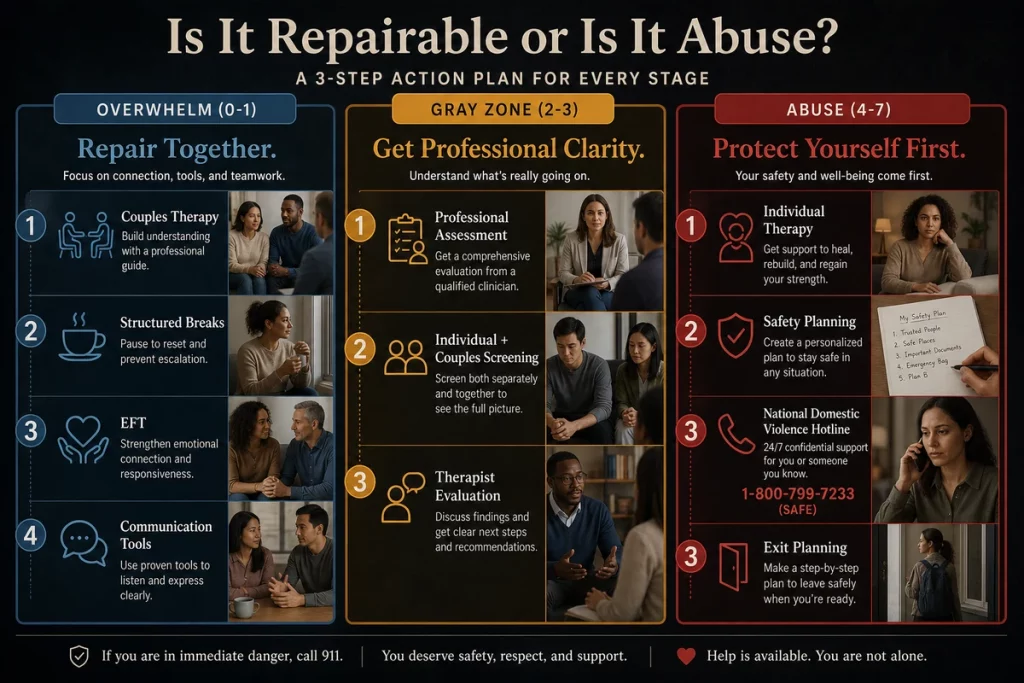
If your assessment suggests overwhelm (0-1 yes answers): Your partner’s stonewalling is likely a skills deficit rather than a control strategy. Share the stonewalling meaning guide and propose the structured break protocol: when overwhelm approaches, they communicate “I need a 20-minute break — I’ll come back” rather than shutting down silently. Suggest Emotionally Focused Therapy (EFT) or Gottman Method couples therapy. Individual therapy for emotional regulation benefits the stonewaller; individual therapy for self-soothing during withdrawal benefits you.
If your assessment suggests the gray zone (2-3 yes answers): You need professional evaluation to distinguish between a deeply entrenched overwhelm pattern and emerging abuse. Seek a therapist experienced in both Gottman Method AND domestic violence assessment — they can evaluate whether the stonewalling is a stuck communication pattern or a control strategy. Couples therapy is appropriate IF the therapist screens for abuse first; couples therapy in the presence of unidentified abuse can worsen the dynamic.
If your assessment suggests abuse (4-7 yes answers): Individual therapy — for YOU, not couples therapy. Couples therapy in abusive dynamics can provide the abuser with better tools for manipulation and retraumatize the victim through forced vulnerability with their abuser. Contact the National Domestic Violence Hotline (1-800-799-7233) for confidential support. Begin safety planning. Recognize that you cannot therapy someone out of using emotional abuse as a control strategy — the change must come from THEM, voluntarily, and your responsibility is to yourself. Take the trauma bonding test to assess whether the intermittent reinforcement cycle has created psychological dependency that makes leaving feel disproportionately difficult.
When you’re ready to date again. The experience of being stonewalled creates specific vulnerabilities in future relationships — hypervigilance about silence, over-accommodation to prevent conflict, and difficulty trusting that expressed needs won’t lead to punishment. Healing from this experience takes time, and rushing into a new relationship before processing the old one often recreates the dynamic with a new partner (because your own attachment patterns have been reshaped by the experience). Individual therapy focused specifically on recovering from emotional abuse helps reset your baseline before you begin dating again.
When you do begin dating, use GuyID’s free screening tools for identity verification and behavioral assessment. Watch for green flags around conflict: partners who engage with disagreement constructively, who say “that’s a fair point” during minor disputes, who circle back to resolve things rather than letting silence accumulate. Notice how they handle YOUR boundaries — do they respect them gracefully, or do they withdraw, sulk, or punish? Early dating behavior around mild disagreement is the most reliable predictor of how someone will handle serious conflict later. Share your Date Mode link through GuyID — verified, communicative partners are the antidote to everything this article describes.
How GuyID Helps
GuyID should appear when it is useful, not as a banner ad. A GuyID Trust Profile gives someone a portable way to share trust signals before a date, while identity verification and social vouching help turn vague profile claims into clearer next steps.
Useful next steps:
- Create a GuyID Trust Profile when you want a cleaner way to share verified trust signals.
- Use GuyID free tools and related guides when you need a checklist before meeting someone.
- Treat identity verification as confidence-building, not a guarantee.
- Use social vouching when you want context from people who already know the person.
- Sign up only when the extra trust layer helps the decision you are already trying to make.
Frequently Asked Questions
Is stonewalling abuse or just bad communication?
It depends on motivation and pattern. Stonewalling driven by genuine physiological overwhelm — where the person feels guilty afterward, returns voluntarily, and is willing to seek help — is a communication skills deficit, not abuse. Stonewalling used as punishment — where silence persists until the partner capitulates, certain topics become undiscussable, and the person denies or defends the pattern — is emotional abuse by clinical definition. Use the 7-question assessment above to evaluate your specific situation.
Is the silent treatment considered emotional abuse?
The sustained silent treatment — withholding all communication, warmth, and engagement for days as punishment — is recognized as emotional abuse by the National Domestic Violence Hotline and the World Health Organization’s framework on intimate partner violence. The silent treatment differs from stonewalling in that it extends beyond conflict moments into sustained withdrawal designed to punish and control. See our stonewalling in a relationship guide for the complete distinction.
Can couples therapy help if stonewalling is abusive?
No — couples therapy is contraindicated when abuse is present. Couples therapy assumes both partners are operating in good faith and can be vulnerable safely. In abusive dynamics, the sessions can provide the abuser with better manipulation tools and retraumatize the victim through forced vulnerability. If you’re asking is stonewalling abuse and the answer is yes, seek individual therapy first. Couples therapy may become appropriate later IF the abusive partner independently commits to and completes individual treatment for their abusive behavior patterns.
Am I being too sensitive about my partner’s stonewalling?
If you’re asking this question, you’ve likely been told you’re “too sensitive” — possibly by the person stonewalling you. Needing your partner to engage when you express legitimate needs is not sensitivity — it’s a basic relationship requirement. If your partner’s withdrawal has caused you to question whether your needs are reasonable, that self-doubt is itself a symptom of the stonewalling’s impact. The emotional abuse checklist and toxic relationship quiz provide structured frameworks for evaluating the situation objectively.
How do I protect myself from abusive stonewalling in future relationships?
Observe how potential partners handle early-stage disagreement. Someone who engages constructively with minor conflict will handle major conflict constructively. Someone who shuts down, sulks, or gives the silent treatment over minor differences will escalate those patterns under relationship stress. Watch for the green flags of healthy communication and verify identities through GuyID’s free tools. Build connections on verified transparency from the start through your Date Mode link.