

Reader Briefing
Reader Briefing
Start here if you need a practical read on platonic relationship: what it means and why it matters: who should use verification, what signals to check, and what to do before moving from online interest to an in-person plan.
Who this is for
- People meeting someone from a dating app or social platform.
- Readers preparing for a first in-person date.
- Anyone checking identity, profile consistency, and trust signals.
- People trying to avoid romance scams, fake profiles, or pressure tactics.
You’ll learn
- How to evaluate identity signals without treating any single check as certainty.
- Which trust signals matter and how to weigh them together.
- How to spot inconsistencies, pressure, or behavior patterns that deserve caution.
- How to move from online conversation to a safer first meeting.
- Where GuyID tools fit into a quick pre-date screening workflow.
- How to compare options using practical safety and trust criteria.
Bottom line
Verification reduces uncertainty; it does not guarantee future behavior. Use a layered approach: confirm identity signals, compare profile consistency, ask for a short video call, keep early plans public, and slow down when someone pressures you to skip normal safety steps.
Key takeaways
- Identity verification improves confidence, not certainty.
- Patterns matter more than isolated incidents.
- Verify before meeting privately or sharing sensitive details.
- A short video call can reveal many inconsistencies.
- Pressure to skip reasonable safety steps is useful information.
Free Tools
Catfish Probability Detector
Check whether a dating profile has suspicious identity or photo signals.
Dating Bio Red Flag Detector
Review a bio for scam, pressure, or trust-warning language.
Dating Safety Checklist
Use free GuyID tools before moving from chat to a real date.
Next step
Create your GuyID trust profile
Share consent-based trust signals before a date without turning the conversation into an interrogation.
In a culture obsessed with romantic relationships, close friendships are chronically undervalued — treated as a consolation prize for people who couldn’t make romance work, rather than what they actually are: one of the most important categories of human connection. A platonic relationship is a close, emotionally intimate bond between two people that doesn’t include romantic or sexual elements. But that definition — what a platonic relationship ISN’T — undersells what it IS: a connection built on mutual respect, shared history, emotional safety, and the kind of deep knowing that only develops when two people invest in each other over time without the complication (or distortion) of romantic attachment. This guide explores what makes a platonic relationship valuable, how to build and maintain one, and why your close friendships may be the most important connections in your life.
NavigateTable of Contents13 sections
What Is a Platonic Relationship?
A platonic bond is a close emotional bond between two people that exists without romantic or sexual involvement. The term comes from the Greek philosopher Plato, who described a form of love that transcends physical attraction and operates at the level of shared values, intellectual connection, and mutual admiration for the other person’s character. In modern usage, the term describes any close friendship or emotional bond that isn’t romantic — including best friendships, deep professional bonds, and cross-gender friendships that remain strictly non-romantic.
The American Psychological Association recognizes that platonic relationships fulfill many of the same psychological needs as romantic ones — belonging, emotional support, identity validation, and attachment security — without the vulnerability-intensity that romantic relationships introduce. In fact, research consistently shows that the quality and quantity of a person’s platonic relationships is one of the strongest predictors of overall life satisfaction, mental health, and even physical longevity — often outperforming romantic relationship status as a wellbeing predictor.
Understanding what a platonic relationship is requires understanding what it ISN’T — and that distinction is more nuanced than most people assume. A platonic relationship isn’t a “failed” romantic relationship. It isn’t a relationship where one person secretly wants more. It isn’t less valuable, less intimate, or less important than a romantic bond. It’s a fundamentally different type of connection that serves different functions and operates by different rules — and its differences are features, not limitations. The emotional safety of a platonic bond — the knowledge that your connection isn’t contingent on physical attraction, sexual performance, or romantic chemistry — creates a freedom for authentic self-expression that romantic relationships sometimes constrain because romantic partners are simultaneously audience, judge, and attachment figure in ways that friends typically aren’t.
The term “platonic” has been diluted in common usage to mean simply “non-sexual” — but its original philosophical meaning carries much more weight. Plato described a form of love that operates at the highest level precisely BECAUSE it transcends physical desire. In this framing, the platonic bond isn’t the lesser version of romantic love — it’s a different dimension of love entirely, one that values the other person’s character, growth, and essence rather than their ability to fulfill romantic or sexual needs. Reclaiming this fuller meaning helps people invest in their non-romantic connections with the seriousness and intentionality they deserve.
Why Platonic Relationships Matter More Than Culture Acknowledges
Western culture dramatically overvalues romantic relationships and undervalues platonic ones — a hierarchy that produces real harm by concentrating all emotional needs onto a single romantic partner rather than distributing them across a diverse network of meaningful connections. Here’s why every close friendship in your life deserves more investment than it probably receives:
Platonic relationships provide identity stability. Romantic relationships inevitably involve some degree of identity adaptation — you compromise, adjust, and co-create a “we” identity. Platonic relationships anchor your individual identity: your best friend knows who you are independent of any romantic partner, and they remember the version of you that existed before, during, and after your romantic relationships. This identity anchoring is particularly valuable during romantic transitions — breakups, divorces, and relationship crises — when the “we” identity dissolves and you need people who know the “I” underneath it. Our bad breakup recovery guide and friend breakup guide both emphasize the critical role of platonic support during romantic transitions.
Platonic relationships provide honest feedback. Romantic partners are incentivized (consciously or not) to maintain harmony — which sometimes means softening feedback to avoid conflict. Platonic relationships operate with different stakes: a best friend who tells you “your new partner is showing red flags and here’s what I’m seeing” is providing the outside perspective that romantic attachment makes difficult to access from inside the relationship. Research from the National Library of Medicine on social support networks confirms that people with strong non-romantic support networks exit abusive romantic relationships faster than those without — because platonic connections provide the reality-checking and logistical support that leaving requires.
Platonic relationships reduce romantic pressure. When your romantic partner is your ONLY source of emotional intimacy, every conversation carries the weight of being your only emotional outlet — which overloads the romantic relationship with expectations it can’t sustainably meet. A diverse network of close friendships distributes emotional needs across multiple connections, reducing the pressure on any single relationship (including the romantic one) to be everything. Paradoxically, the best thing you can do for your romantic relationship is invest in your friendships — because a supported, emotionally nourished individual makes a better partner than an emotionally isolated one who expects their romantic partner to fulfill every social and emotional need.
Platonic relationships outlast many romantic ones. The average romantic relationship lasts approximately 2-3 years. The average close friendship lasts significantly longer, with many lasting decades. A bond that survives career changes, relocations, marriages, divorces, and personal transformations provides a continuity of connection that most romantic relationships — even good ones — cannot match. Investing in close friendships is investing in connections that statistically will be present across more of your life than any single romantic partner.
Close friendships protect mental health. Research indexed in the National Library of Medicine on social connection and wellbeing confirms that people with strong non-romantic social bonds show lower rates of depression, anxiety, and cognitive decline compared to those who rely primarily on romantic partners for social connection. The protective effect is particularly pronounced during midlife and older adulthood, when social networks naturally contract and the risk of isolation increases. Every close friendship you maintain is functioning as a mental health buffer — absorbing stress, providing perspective, and preventing the isolation that compounds psychological distress into something far more dangerous.
Close friendships teach relationship skills. The communication, conflict resolution, empathy, and vulnerability skills that make romantic relationships successful are developed and practiced in friendships first. Learning to navigate disagreement with a friend — without the existential stakes of romantic attachment — builds the emotional toolkit you bring to romance. People who maintain healthy, communicative friendships consistently perform better in romantic relationships because the core relational skills transfer directly. A person who can hear honest feedback from a friend without deflecting, resolve conflict without stonewalling, and maintain connection through disagreement has already developed the capacities that romantic partnership demands.
Platonic Relationship vs. Romantic Relationship
| Platonic Relationship | Romantic Relationship |
|---|---|
| Emotional intimacy without sexual component | Emotional AND sexual/physical intimacy |
| Lower jealousy and possessiveness dynamics | Jealousy and exclusivity expectations common |
| Identity remains more independently defined | Shared “we” identity develops |
| Maintenance requires less constant attention | Requires consistent, daily investment |
| Multiple simultaneous close connections normal | Exclusivity is typically expected |
| Conflict is less existentially threatening | Conflict carries abandonment/attachment weight |
| Can coexist easily with romantic relationships | Romantic jealousy may complicate outside friendships |
Neither type is superior — they serve different functions and operate by different rules. The healthiest lives include BOTH: romantic connection for the specific intimacy it provides, and a platonic support network for the stability, diversity, and honest feedback that romantic exclusivity can’t replicate. People who rely exclusively on romantic relationships for all emotional needs consistently report lower life satisfaction than people who maintain both romantic and non-romantic close connections — because concentrating all emotional eggs in one romantic basket creates vulnerability that diversification prevents.
Common Challenges in Platonic Relationships
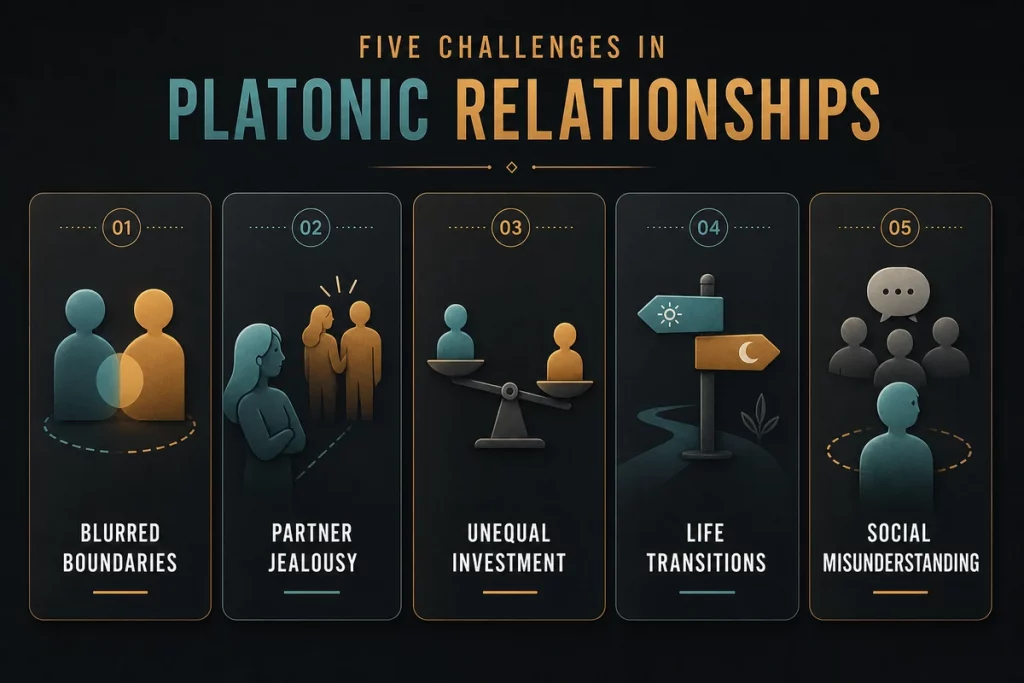
Blurred boundaries. Sometimes a platonic relationship develops romantic or sexual feelings on one side — creating a boundary challenge that threatens the friendship. When this happens, honest communication is essential: “I’ve noticed my feelings shifting, and I value our friendship too much to let that go unaddressed” opens the door to a conversation that either redefines the relationship or reinforces the platonic boundary with mutual awareness. Avoiding the conversation preserves comfort in the short term but builds resentment, confusion, and eventual rupture in the long term. Boundary-setting skills apply to friendships just as much as romantic ones.
Romantic partner jealousy. Close cross-gender friendships frequently trigger jealousy in romantic partners — and navigating this requires empathy for the partner’s insecurity while maintaining the friendship. Transparency helps: introduce the friend to the romantic partner, include the partner in group activities, and communicate openly about the friendship’s importance and boundaries. A romantic partner who demands you eliminate a close friendship entirely — without specific evidence of boundary violation — may be demonstrating the control patterns that predict broader relationship problems. The National Domestic Violence Hotline identifies isolation from friends as one of the earliest warning signs of coercive control — which means a partner who systematically undermines your friendships may be doing so for reasons that go far beyond simple jealousy.
Unequal investment. Close friendships need some form of mutual investment, though that investment may not look identical at every moment. If the relationship feels one-sided, describe the pattern without an absolute: “I’ve noticed I’ve been initiating most of our plans lately, and I’d like us to share that more equally.” Our slow fade guide explains how reduced investment can affect a friendship.
Life transitions that create distance. Marriage, parenthood, relocation, career changes — major transitions restructure priorities and available time, which naturally stresses these bonds. The friends who survive transitions are those who adapt: accepting that the form of the friendship must change (less frequent contact, different activities) while maintaining its substance (emotional availability, honest communication, genuine care). Our friend breakup guide addresses what happens when the adaptation fails and the friendship doesn.t survive the transition.
Societal misunderstanding. “Are you sure you’re JUST friends?” The cultural assumption that close emotional bonds between potential romantic partners must contain hidden romantic interest undermines platonic relationships by subjecting them to constant scrutiny and reinterpretation. This misunderstanding is particularly damaging to cross-gender and cross-orientation friendships, which must constantly justify their existence to people who can’t conceive of emotional intimacy without romantic or sexual components. The best response: refuse the premise. A platonic bond doesn.t need to justify its non-romantic nature any more than a romantic relationship needs to justify its romantic nature — both are valid forms of human connection.
Building and Maintaining Stronger Platonic Relationships
Treat close friendships as deliberately as romantic ones. Most people approach romantic relationships with intention — planning dates, communicating needs, addressing conflicts, investing time. Platonic relationships often receive the leftover attention after romantic and professional obligations are met. Reversing this default — scheduling friend time, initiating meaningful conversations, addressing conflicts instead of avoiding them — produces dramatically stronger platonic connections. A close friendship that receives intentional investment develops the depth and resilience that casual maintenance never achieves.
Communicate needs and boundaries. The assumption that friendships “should just be easy” prevents people from doing the communication work that all relationships require. Your platonic friend can’t read your mind any more than your romantic partner can. Expressing needs (“I’ve been going through something and I need more support right now”), setting boundaries (“I need you to stop making jokes about that topic — it genuinely bothers me”), and addressing conflicts directly (“What you said last week hurt, and I want to talk about it”) are the same communication skills that make romantic relationships healthy — and they’re equally essential in platonic ones.
Show up during crisis — not just during fun. The friendships that endure are the ones that demonstrate reliability during difficulty, not just availability during good times. Showing up when your friend is going through a breakup, a job loss, a health crisis, or a family emergency — even when it’s inconvenient — builds the trust and loyalty that transforms a casual friendship into a lifelong connection. The green flags guide applies here too: consistency, reliability, and showing up when it matters are positive indicators in EVERY type of relationship.
Accept that friendships have seasons. Not every close friendship will last forever — and that’s not failure. Some friendships serve a specific life chapter: college friends, early-career friends, new-parent friends, neighborhood friends. When the chapter changes and the friendship naturally fades, that doesn’t erase the value it provided during its active season. The ability to hold former friendships with gratitude rather than grief — appreciating what they were without mourning that they’re not what they used to be — is emotional maturity that serves you in every type of relationship. Not every bond needs to be permanent to be meaningful, and releasing friendships that have naturally concluded frees energy for the connections that are actively sustaining you now.
Practice reciprocal vulnerability. Deep friendship requires the same vulnerability that deep romance does — sharing fears, admitting mistakes, asking for help, expressing needs. Many people reserve their vulnerability exclusively for romantic partners, keeping friendships at a surface level that prevents genuine depth. Practicing vulnerability in friendships — “I’m struggling and I need to talk” or “That thing you said last week bothered me and I want to address it” — builds the emotional muscles that make ALL your relationships (romantic included) stronger. The cultural norm that says vulnerability is only for romantic contexts impoverishes friendships by denying them the very ingredient that produces depth.
Maintain close friendships alongside romantic ones. When new romantic relationships begin, many people unintentionally abandon their friendships — redirecting all social energy toward the new partner. This creates the isolation that makes romantic relationships more fragile (all emotional eggs in one basket) and produces the friend-loss that compounds the devastation when romantic relationships end. The healthiest approach: maintain your friendships at approximately the same investment level regardless of your romantic status. The friends who were there before the relationship need to be there during and after it — and that only happens if you invest in them consistently.
When navigating the intersection of platonic and romantic relationships — particularly in online dating where cross-gender friendships may raise questions — verified transparency helps. Use GuyID’s free screening tools for identity verification in romantic contexts, and share your Date Mode link through GuyID to demonstrate that your transparency extends across all your connections. Partners who respect your close friendships demonstrate the emotional security that predicts healthy long-term partnership — which is why our genuine interest signs guide includes respect for existing close connections as a key positive indicator.

How GuyID Helps
GuyID should appear when it is useful, not as a banner ad. A GuyID Trust Profile gives someone a portable way to share trust signals before a date, while identity verification and social vouching help turn vague profile claims into clearer next steps.
Useful next steps:
- Create a GuyID Trust Profile when you want a cleaner way to share verified trust signals.
- Use GuyID free tools and related guides when you need a checklist before meeting someone.
- Treat identity verification as confidence-building, not a guarantee.
- Use social vouching when you want context from people who already know the person.
- Sign up only when the extra trust layer helps the decision you are already trying to make.
Frequently Asked Questions
What does platonic relationship mean?
A platonic relationship is a close, emotionally intimate bond between two people that doesn’t include romantic or sexual elements. Named after the philosopher Plato, it describes connection based on shared values, mutual respect, intellectual engagement, and emotional support — without the physical or romantic dimensions that characterize romantic partnerships. Platonic relationships include best friendships, deep professional bonds, and cross-gender friendships that remain non-romantic.
Can a platonic relationship turn romantic?
Yes — many successful romantic relationships begin as platonic ones. The transition requires mutual interest and honest communication. If feelings develop on one side, addressing them directly (“I’ve noticed my feelings changing”) is healthier than suppression or assumption. If both people feel the shift, the existing trust foundation often produces stronger romantic relationships than those that begin with attraction alone. If only one person feels it, honest conversation preserves the friendship while acknowledging the feelings. See our platonic love guide for the complete framework.
Can men and women have platonic relationships?
Absolutely — and millions do. The cultural skepticism about cross-gender friendships reflects outdated assumptions about gender and attraction rather than the lived reality of countless genuine platonic friendships between men and women. The key ingredients are the same as any close friendship: mutual respect, clear boundaries, honest communication about feelings if they shift, and the emotional maturity to maintain appropriate limits.
How do I maintain platonic relationships while in a romantic relationship?
Intentionally. Schedule friend time as deliberately as you schedule date time. Include your romantic partner in group activities but maintain one-on-one time with close friends. Communicate with your romantic partner about the importance of your friendships and demonstrate transparency about those connections. Resist the pull to abandon friends during the new-relationship honeymoon — because the friends you maintain during romance are the ones who’ll support you through its challenges.
Is a platonic relationship less important than a romantic one?
No — research consistently shows that the quality and quantity of close friendships is one of the strongest predictors of overall life satisfaction, often outperforming romantic relationship status. Platonic and romantic relationships serve different functions, and both are essential for psychological wellbeing. The cultural hierarchy that places romantic relationships above platonic ones produces real harm by encouraging people to concentrate all emotional needs onto a single partner.