Free Tools
Catfish Probability Detector
Check whether a dating profile has suspicious identity or photo signals.
Dating Bio Red Flag Detector
Review a bio for scam, pressure, or trust-warning language.
Dating Safety Checklist
Use free GuyID tools before moving from chat to a real date.
Next step
Create your GuyID trust profile
Share consent-based trust signals before a date without turning the conversation into an interrogation.
You see a blue checkmark on Tinder. A verification badge on Bumble. A “selfie verified” tag on Hinge. And now, a Trust Tier on GuyID. They all signal some form of trust — but the difference between a trust score vs verification badge is the difference between a security camera that shows whether a door exists and a security system that confirms who walked through it, whether they belong, and whether they’ve been trustworthy over time. Dating app verification badges confirm one thing: a selfie matched photos. A dating trust score confirms identity through government ID, character through social vouching, and sustained trustworthiness through progressive tiers.
This guide puts trust scores and verification badges side by side across every dimension that matters for dating safety: what each confirms, what each misses, how scammers interact with each system, and which model better serves the 92% of women who report dating safety concerns and the broader dating population navigating $1.3 billion in annual scam losses (FTC, 2026).
NavigateTable of Contents23 sections
⚡ Key Takeaways
Badges confirm appearance — trust scores confirm identity and character
Verification badges answer: “Does this face match these photos?” Trust scores answer: “Is this person who they claim to be, and do real people trust them?” The questions are fundamentally different — and so is the safety value of the answers.
Badges are binary — trust scores are progressive
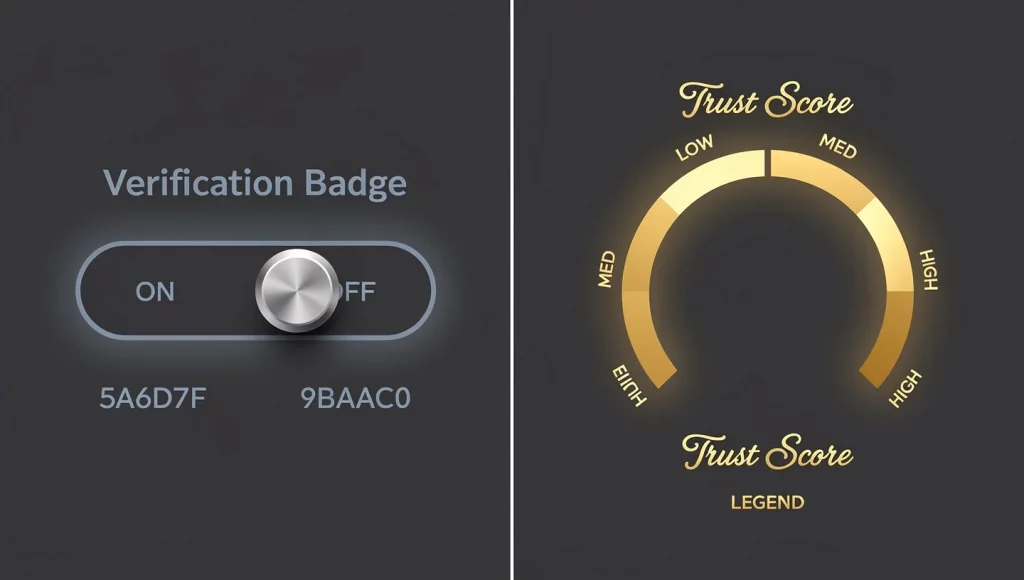
Verified or not. That’s all a badge communicates. A trust score communicates HOW MUCH trust has been verified — from GHOST (nothing) to LEGEND (maximum). Progressive measurement matches how trust actually works in human relationships.
Scammers can obtain badges — they can’t replicate trust scores
Deepfakes defeat selfie-based badges. Government ID verification, social vouching, and progressive tier advancement are structurally impossible for scam operations to replicate at scale.
Badges are platform-locked — trust scores are portable
Your Bumble badge means nothing on WhatsApp. Your GuyID Trust Tier works on every platform, every messaging app, and every communication channel — maintaining verified trust across every transition.
The Fundamental Difference Between a Trust Score and a Verification Badge
The trust score vs verification badge comparison starts with what each system is designed to answer.
A verification badge answers: “Does the person who completed this selfie check have the same face as the profile photos?”
A trust score answers: “Is this person’s legal identity confirmed, do real people vouch for their character, and have they demonstrated sustained trustworthiness over time?”
The badge answers a narrow technical question about facial similarity. The trust score answers the broad human question that actually matters for safety: “Can I trust this person?” Every other difference between the two systems flows from this fundamental distinction — the badge addresses appearance, while the trust score addresses trustworthiness.
“Verification badges tell you a face is real. Trust scores tell you a person is trustworthy. In dating, you don’t need to trust a face — you need to trust a person.”
What Each System Confirms: The Complete Comparison
The most revealing way to understand the trust score vs verification badge difference is to compare exactly what each system confirms across every dimension relevant to dating safety.
| Trust Dimension | Verification Badge (Dating Apps) | Trust Score (GuyID Trust Tiers) |
|---|---|---|
| Photos match a real face | ✅ Yes — this is its only function | ✅ Yes — included via government ID biometric matching |
| Legal name confirmed | ❌ No — name is self-reported | ✅ Yes — confirmed through government ID |
| Real age confirmed | ❌ No — age is self-declared | ✅ Yes — date of birth from government document |
| Government-verified existence | ❌ No | ✅ Yes — a government issued identity documents for this person |
| Character assessed | ❌ No — no character evaluation | ✅ Yes — social vouching from real people who know them |
| Sustained trustworthiness | ❌ No — badge is point-in-time, valid indefinitely | ✅ Yes — progressive tiers track trust over time |
| AI-generated identity detection | ⚠️ Partial — deepfakes can bypass | ✅ Yes — AI cannot generate government documents |
| Works off-platform | ❌ No — badge exists only within the app | ✅ Yes — portable Date Mode link works everywhere |
| Trust graduation (levels) | ❌ No — binary only (verified/not) | ✅ Yes — six tiers from GHOST to LEGEND |
| Cost to check | Free (visible on profile) | Free for women to check any profile |
| Time to obtain | 30 seconds (selfie) | Minutes (ID verification) to weeks (full tier progression) |
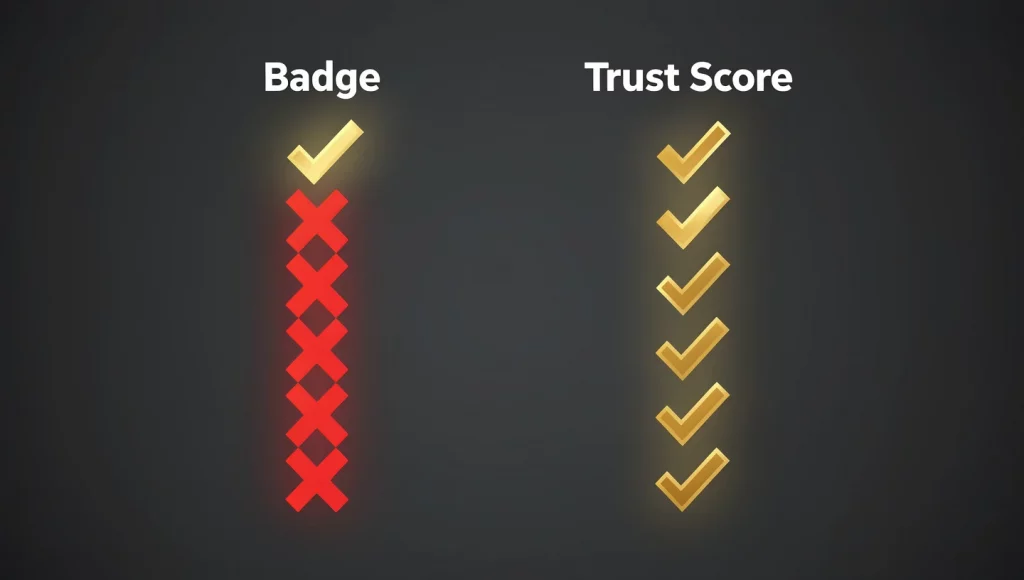
The badge column shows one ✅ and ten ❌ or ⚠️ entries. The trust score column shows ✅ across every dimension. This isn’t a close comparison — it’s a generational difference in what “verified” means. The badge confirms appearance. The trust score confirms identity, character, consistency, and trust across every platform.
Binary vs Progressive: Why Graduation Matters
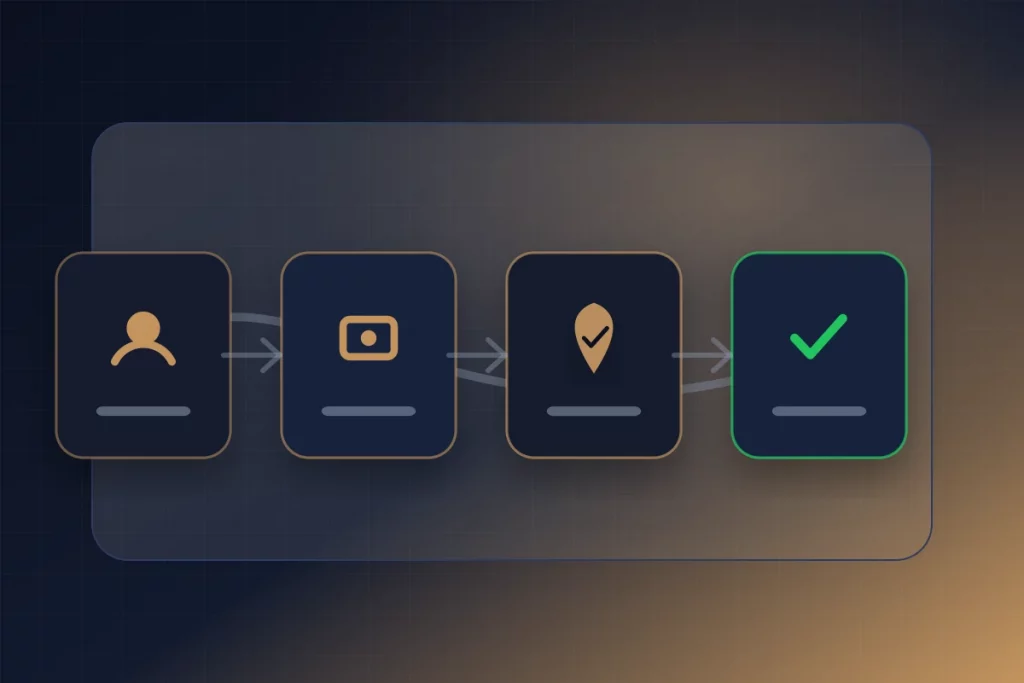
One of the most consequential differences in the trust score vs verification badge comparison is the model type: binary versus progressive.
How Binary Badges Work
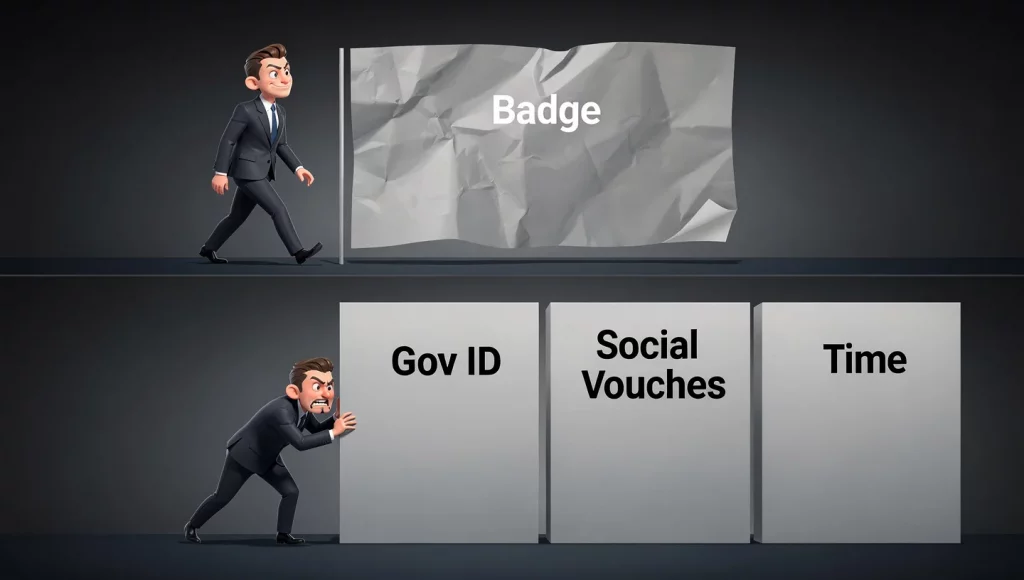
A verification badge has two states: present or absent. You either passed the selfie check or you didn’t. A person who verified 30 seconds ago and a person who verified two years ago and has been a consistently excellent community member both show the same badge. A person who barely passed the selfie threshold and a person with a perfect biometric match both show the same badge. Binary collapses all nuance into one bit of information.
How Progressive Trust Scores Work
GuyID’s Trust Tiers — GHOST, STARTER, BUILDER, TRUSTED, ELITE, LEGEND — provide six distinct levels of verified trust. Each level communicates proportionally different information. A GHOST just arrived. A BUILDER is investing. A TRUSTED has confirmed identity and earned vouches. An ELITE has sustained deep trust over time. A LEGEND has maximized every dimension. Six levels means six different trust signals — enabling six different trust decisions calibrated to the actual verified trust demonstrated.
Why This Matters for Real Dating Decisions
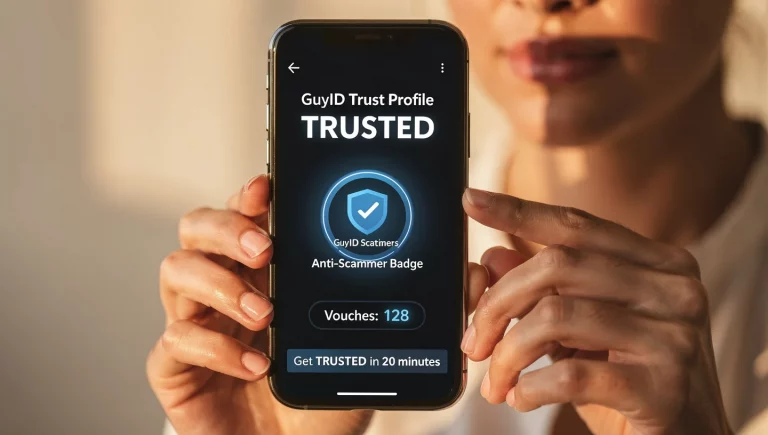
Consider two scenarios. Scenario A: you check a match’s dating app profile and see a verification badge. What do you know? Their selfie matched their photos. That’s it. No graduation. No context. No depth. Scenario B: you check a match’s GuyID Trust Profile and see TRUSTED tier with the Anti-Scammer Badge, government ID verified, and four social vouches. What do you know? Their legal identity is confirmed. Four real people vouch for their character. They’ve maintained this verification status consistently. The information difference between these scenarios is the difference between making trust decisions with one bit of data and making them with multi-dimensional verified intelligence.
Scammer Resistance: How Each System Performs Under Attack
The most safety-critical dimension of the trust score vs verification badge comparison is how each system resists manipulation by the organized scammers (FTC) targeting dating platforms.
How Scammers Defeat Verification Badges
As documented across our platform-specific guides (Tinder, Bumble, Hinge), scammers bypass verification badges through multiple proven methods.
- Deepfake face-swapping: AI overlays a synthetic face during the selfie check. The fake face matches the fake profile photos — verification passes because faces match, despite neither face belonging to the scammer.
- Accomplice verification: A real person (the “face”) completes the selfie check, then hands the account to the scammer (the “operator”). The badge is legitimate — the person operating the account is not.
- Account purchase: Pre-verified accounts are sold on dark web marketplaces. The scammer buys a verified account and begins operating it — badge included.
- Post-verification manipulation: On some platforms, profile photos can be changed after verification. The scammer verifies with real photos, then swaps to stolen or AI-generated photos.
Each method exploits the same underlying weakness: the badge verifies a face at a moment in time but doesn’t maintain an ongoing relationship between the badge holder and the account operator.
Why Scammers Can’t Defeat Trust Scores
GuyID’s Trust Tier system is designed with three structural barriers that each target a specific scammer limitation.
- Government ID verification: Requires authentic government-issued documents with valid biometric data and security features. AI cannot generate these. Stolen documents fail biometric selfie matching (the scammer’s face won’t match the document). Forged documents fail security feature validation. Unlike a selfie check that takes 30 seconds, government ID verification requires a document that took a government to issue.
- Social vouching: Requires real humans who know the person to stake their reputation on the vouch. A scam operation can create thousands of fake profiles but cannot create thousands of real humans willing to publicly vouch for a scammer’s character. The human requirement is the barrier that automation cannot cross.
- Progressive tiers: Require sustained, consistent behavior over weeks and months. Scam operations use disposable identities — create, exploit, abandon. The temporal requirement structurally conflicts with this cycle. A scammer who needs to extract money within weeks cannot simultaneously maintain the months of consistent behavior that tier advancement requires.
The Comparison in Practice
| Scam Technique | Defeats Verification Badge? | Defeats Trust Score? |
|---|---|---|
| Deepfake face-swapping | ✅ Yes — fake face matches fake photos | ❌ No — can’t generate government ID |
| Accomplice verification | ✅ Yes — real person verifies, scammer operates | ❌ No — accomplice’s ID doesn’t match scammer’s face |
| Account purchase | ✅ Yes — pre-verified accounts available | ❌ No — purchased account’s ID won’t match new operator |
| AI-generated identity | ⚠️ Possible — AI face matches AI photos | ❌ No — AI can’t generate government documents or real vouchers |
| Long-con emotional manipulation | ✅ Yes — badge doesn’t assess character | ⚠️ Harder — social vouches assess character, tiers require time |
Verification badges are defeated by four of five common scam techniques. Trust scores resist all five — with the long-con being the only technique that partially challenges the system (and even then, social vouching and tier requirements create significant barriers). In the trust score vs verification badge comparison, scammer resistance is where the difference is starkest and most consequential.
Portability: Platform-Locked vs Cross-Platform Trust
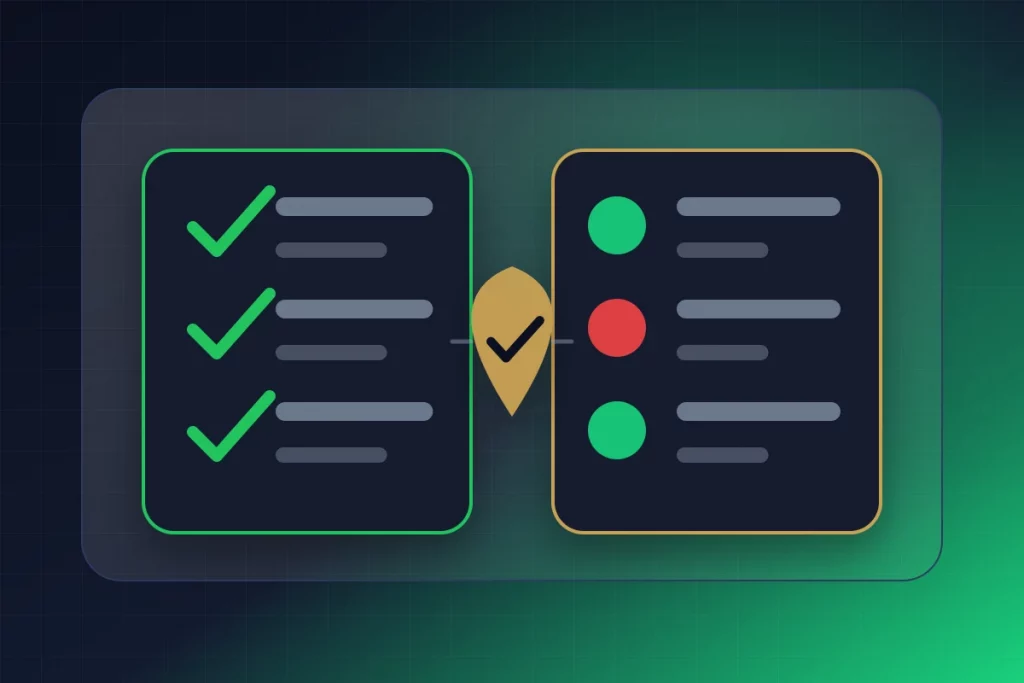
Another critical dimension of the trust score vs verification badge comparison: where does the trust signal work?
Badges: Platform-Locked
Your Bumble verification badge exists only on Bumble. Your Tinder checkmark exists only on Tinder. The moment you move a conversation to WhatsApp — which naturally happens in every developing relationship — the badge disappears. You become an unverified person talking to another unverified person on a platform with zero dating-specific safety features. This is the off-platform gap that every dating app shares and that the safety features comparison documents. Badges protect you within one app. The relationship develops across many channels.
Trust Scores: Portable Everywhere
GuyID’s Date Mode link works on every platform: Tinder, Bumble, Hinge, WhatsApp, Instagram, text messages, email, in-person (QR code). When a relationship transitions from dating app → WhatsApp → phone → in-person meeting, the Trust Tier travels with it. The government ID verification confirmed on GuyID remains confirmed on WhatsApp. The social vouches earned on GuyID remain visible on text. The trust isn’t locked to one platform — it’s attached to the person.
This portability matters most at the exact moments when safety matters most: the transition off a dating app (where platform safety features disappear), the decision to meet in person (where physical safety enters the equation), and the deepening of the relationship (where emotional and financial investment increases). At every critical transition, badges vanish and trust scores persist.
The User Experience Comparison
Beyond the technical differences, the trust score vs verification badge comparison has a human dimension — how each system feels to use as both the verified person and the person checking verification.
Getting Verified: Badges vs Trust Scores
| Dimension | Getting a Badge | Building a Trust Tier |
|---|---|---|
| Time investment | 30 seconds (one selfie) | Minutes (ID) to weeks (full progression) |
| Effort required | Minimal — mimic a pose or gesture | Moderate — verify ID, request vouches, maintain consistency |
| What it communicates about you | “I took 30 seconds for a selfie check” | “I invested meaningfully in proving my trustworthiness” |
| Differentiation from other users | Low — most active users are verified | High — each tier communicates different trust levels |
| Signal to potential matches | “My face is real” | “My identity, character, and trustworthiness are verified” |
The trust score requires more investment — and that’s the point. The investment itself is the signal. A person who invests minutes in ID verification and weeks in building vouches is communicating something fundamentally different from someone who spent 30 seconds on a selfie. For men specifically, building a GuyID Trust Tier is the most powerful statement available: “I take women’s safety seriously enough to prove who I am.”
Checking Verification: Badges vs Trust Scores
For the person evaluating a match, checking a verification badge takes 0 seconds (it’s visible on the profile) but provides almost no actionable information. Checking a GuyID Trust Profile takes 2 minutes (click the link, review the tier) but provides comprehensive trust information: tier level, ID verification status, Anti-Scammer Badge, social vouch count and sources. The time difference is trivial. The information difference is enormous.
Why Badges and Trust Scores Should Coexist
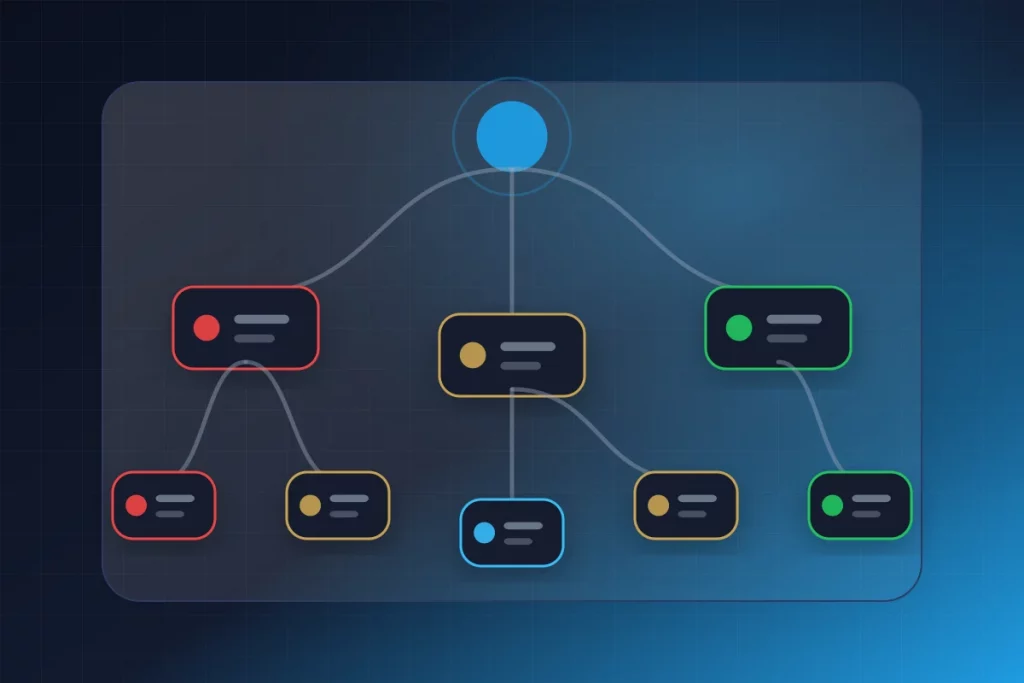
The trust score vs verification badge comparison isn’t about replacing badges — it’s about supplementing them. The optimal safety configuration uses both.
Badges as the First Layer
Verification badges on Tinder, Bumble, and Hinge serve a legitimate purpose: they catch the most basic catfish (entirely stolen photos with no live operator), create incentives for users to verify (matching advantages), and establish the expectation that some form of verification is normal in dating. These are real benefits. Badges are better than nothing.
Trust Scores as the Complete Layer
GuyID Trust Tiers add what badges miss: confirmed legal identity, character assessment, progressive measurement, off-platform portability, and AI-proof verification. The trust score doesn’t replace the badge — it completes it. A Hinge profile with a verification badge AND a GuyID TRUSTED tier provides two complementary trust signals: the badge confirms photo matching (basic), the tier confirms identity and character (comprehensive).
The Combined Safety Stack
- Layer 1 — Dating app badge: Basic catfish prevention. Confirms photos match a live face.
- Layer 2 — GuyID free safety tools: Proactive screening. Reverse image search, catfish detection, bio analysis. Catches what badges miss.
- Layer 3 — GuyID Trust Tier: Comprehensive identity + character verification. Government ID + social vouching + progressive trust. Portable across all platforms.
Together, these three layers cover the complete threat spectrum — from basic catfish (Layer 1) through sophisticated AI-generated identities (Layer 2) to comprehensive identity and character confirmation (Layer 3). No single layer is sufficient. All three together provide the most complete dating safety available in 2026.
Summary: The Evolution from Badges to Trust Scores
The trust score vs verification badge comparison reveals a generational shift in dating safety. Badges were the first generation — binary, photo-only, platform-locked, and vulnerable to AI-era attacks. Trust scores are the next generation — progressive, multi-dimensional, portable, and structurally resistant to every known scam technique.
Badges confirm appearance. Trust scores confirm identity. Badges are binary. Trust scores are graduated. Badges live on one platform. Trust scores work everywhere. Badges can be deepfaked. Trust scores require government documents that AI can’t generate. Every meaningful safety dimension favors trust scores — not because badges are useless, but because they represent a limited first step that trust scores complete.
The practical conclusion: get verified on your dating app (the badge provides basic value and matching advantages). Build your GuyID Trust Tier (the trust score provides comprehensive verification that badges can’t). Check your matches’ Trust Profiles before meeting (the trust tier tells you what the badge doesn’t). Use GuyID’s free safety tools to screen what both systems leave uncovered. The combination is the safest dating configuration available — badges as foundation, trust scores as completion.
The trust gap in online dating was created by the limitations of binary badges. The dating trust score is how it closes. One badge at a time was a start. One tier at a time is the future.
Badges Were the Start. Trust Scores Are the Future.
GuyID’s Trust Tiers go beyond what any badge provides: government ID + social vouching + progressive trust + portable across all platforms. Build your Trust Tier. Close the trust gap.
Build Your Trust Tier
Try Free Safety Tools
Frequently Asked Questions
What’s the difference between a trust score and a verification badge?
Can scammers get a verification badge?
Is a trust score better than a background check?
Will trust scores replace verification badges?
Evidence note
NIST Digital Identity Guidelines distinguish identity proofing, authentication, and federation as separate parts of digital identity risk management (NIST, 2025).