Reader Briefing
Reader Briefing
Start here if you need a practical read on red flags in dating: 20 warning signs: who should use verification, what signals to check, and what to do before moving from online interest to an in-person plan.
Who this is for
- People meeting someone from a dating app or social platform.
- Readers preparing for a first in-person date.
- Anyone checking identity, profile consistency, and trust signals.
- People trying to avoid romance scams, fake profiles, or pressure tactics.
You’ll learn
- How to evaluate identity signals without treating any single check as certainty.
- Which trust signals matter and how to weigh them together.
- How to spot inconsistencies, pressure, or behavior patterns that deserve caution.
- How to move from online conversation to a safer first meeting.
- Where GuyID tools fit into a quick pre-date screening workflow.
- When to slow down, ask for more context, or walk away.
Bottom line
Verification reduces uncertainty; it does not guarantee future behavior. Use a layered approach: confirm identity signals, compare profile consistency, ask for a short video call, keep early plans public, and slow down when someone pressures you to skip normal safety steps.
Key takeaways
- Identity verification improves confidence, not certainty.
- Patterns matter more than isolated incidents.
- Verify before meeting privately or sharing sensitive details.
- A short video call can reveal many inconsistencies.
- Pressure to skip reasonable safety steps is useful information.
Free Tools
Catfish Probability Detector
Check whether a dating profile has suspicious identity or photo signals.
Dating Bio Red Flag Detector
Review a bio for scam, pressure, or trust-warning language.
Dating Safety Checklist
Use free GuyID tools before moving from chat to a real date.
Next step
Create your GuyID trust profile
Share consent-based trust signals before a date without turning the conversation into an interrogation.
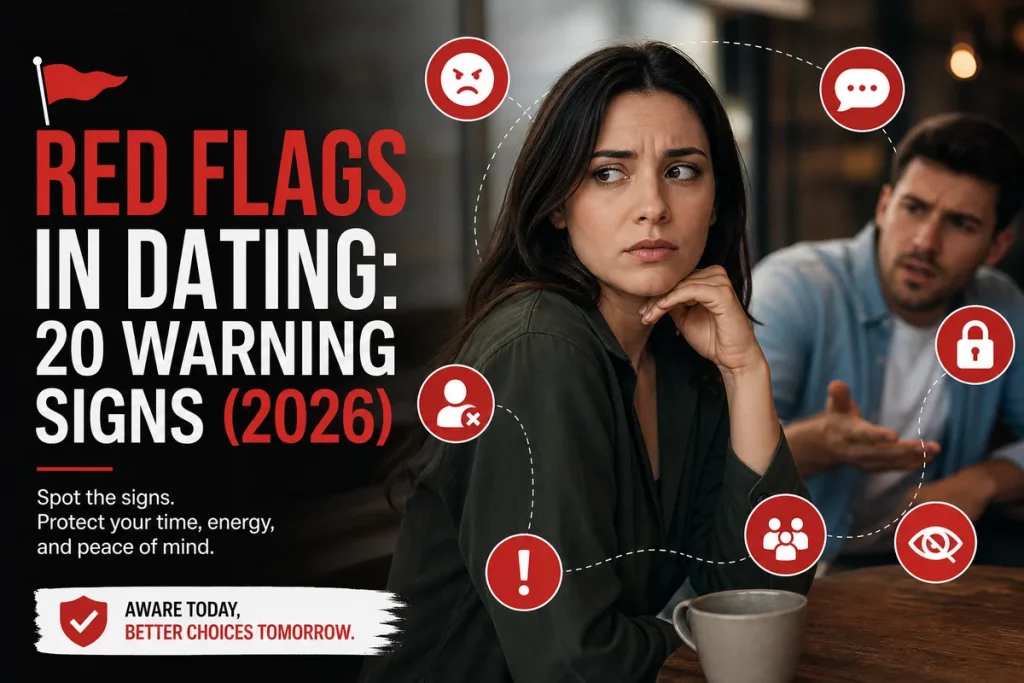
Most are subtle patterns that feel “off” without being obviously alarming: a joke that’s actually an insult, an explanation that doesn’t quite add up, enthusiasm that feels more like pressure than connection. This guide identifies 20 red flags in dating across five categories — from first-message warnings to behavioral patterns that predict emotional abuse — so you can make informed decisions before your heart overrides your judgment.
NavigateTable of Contents42 sections
Why Red Flags in Dating Matter More Than Ever
Dating apps have fundamentally changed the red flag landscape. In traditional dating, you met people through social circles that provided built-in accountability — mutual friends, shared communities, and observable behavior over time. Dating apps remove all of that. You’re evaluating strangers based on curated profiles and text-based conversations that allow careful impression management, as documented by research from the National Library of Medicine on deception in online dating.
This means red flags in dating are simultaneously harder to detect (because the person controls what you see) and more important to recognize (because you have less external validation of who they really are). The FTC reports over $1.3 billion in romance scam losses annually — and every one of those scams began with missed red flags. Beyond financial fraud, emotional manipulation, narcissistic abuse, and catfishing all announce themselves through early warning signs that are visible — if you know what to look for.
The goal of recognizing red flags in dating isn’t to become paranoid or to reject everyone who isn’t perfect. It’s to make informed decisions with your eyes open — to distinguish between the normal imperfections every human brings to dating and the specific patterns that predict harm. The 20 flags below are the ones that therapists, dating safety researchers, and abuse survivors identify most consistently as predictive of problems.
20 Red Flags in Dating
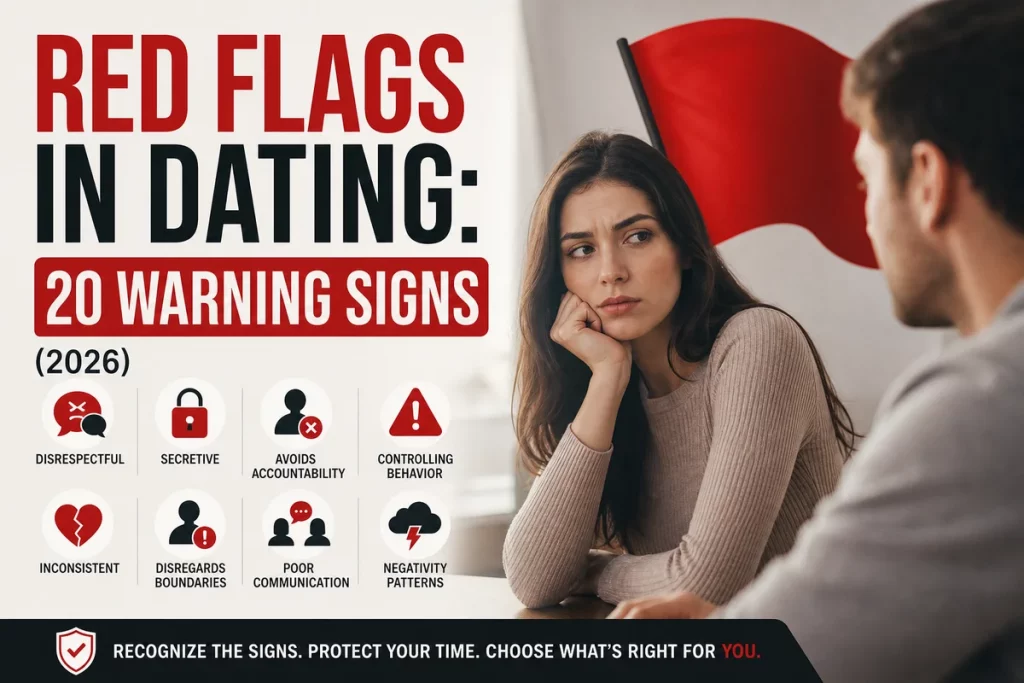
Communication Red Flags (1-4)
1. They Won’t Video Call Before Meeting
In 2026, refusing a video call before an in-person meeting is among the clearest dating warning signs. Every phone has a camera. Video calling takes five minutes. The only reason to refuse repeatedly is that they can’t show the face in their profile photos — which means catfish, scammer, or someone significantly misrepresenting their appearance. One polite decline is understandable (shy, bad timing). Two refusals is a pattern. Three is a definitive red flag. See our guide on how to spot a catfish.
2.
You share something about your day, and within two sentences the topic has shifted to their experience. You mention an accomplishment, and they mention a bigger one. You express a feeling, and they express a more dramatic version. Consistent conversational narcissism — where every topic redirects to them — indicates that your role in this relationship will be audience, not partner. Healthy conversations have natural back-and-forth; red flag conversations have a gravitational pull toward one person.
3. They Pressure You to Move Off the Dating App Immediately
“Let’s switch to WhatsApp” or “Give me your number” within the first few messages. While some people genuinely prefer texting over in-app chat, immediate pressure to leave the platform serves a strategic purpose: dating apps have reporting and banning systems. Off-platform, scammers and manipulators operate without oversight. A genuine match is comfortable chatting on the app for a few days. Among dating red flags, urgency to move off-platform is especially significant because it’s one of the earliest scam indicators.
4. Their Messages Are Inconsistent with Their Profile
Their profile says they’re a surgeon in Boston, but their messages contain grammatical patterns suggesting English isn’t their first language and they seem unfamiliar with Boston landmarks. Their profile shows an active outdoors lifestyle, but they can’t name a local hiking trail. Inconsistencies between the curated profile and the spontaneous conversation reveal that one of the two is fabricated — and it’s usually the profile. Cross-reference claims through reverse image search and social media verification.
Behavioral Red Flags (5-8)
5. Love Bombing — Overwhelming Intensity from Day One
Constant texting, excessive compliments, declarations of deep connection, “soulmate” language, and future planning — all within the first week. Love bombing is one of the most documented dating warning signs because it predicts the idealization-devaluation cycle of narcissistic relationships. Genuine enthusiasm builds naturally over time. Manufactured intensity maxes out immediately because the love bomber needs your emotional commitment before you have enough information to evaluate them accurately.
6. They Badmouth Every Ex
“My ex was crazy.” “My last girlfriend was toxic.” “Every person I’ve dated has been terrible.” If everyone they’ve ever dated was the problem, the common denominator is them. Healthy people can describe past relationships with nuance — acknowledging their own contributions to the dynamic.
7. They Push Past Your Boundaries Smoothly
You say you’re not ready to share your number; they give you theirs and say “text me whenever you’re comfortable” — but then follow up asking why you haven’t texted. You say you can’t meet this weekend; they suggest meeting “just for coffee, just 20 minutes.” The boundary is acknowledged verbally but circumvented practically. This smooth boundary-pushing is among the most dangerous warning patterns because it trains you to accept incremental violations — each one small enough to seem reasonable while the cumulative effect is the erosion of your ability to say no.
8. They Get Angry or Sulky When You Can’t Meet Their Timeline
You need more time before exclusivity, meeting their family, spending the night, or saying “I love you” — and their response is anger, guilt-tripping, withdrawal, or sulking. A healthy person’s response to “I need more time” is “I understand.” An unhealthy person’s response reveals that your comfort is less important than their agenda. The response to your pace-setting is one of the most reliable red flags in dating — or green flags, depending on what you see.
Consistency Red Flags (9-12)
9. Their Story Has Contradictions
They said they grew up in Seattle; a week later they reference their “hometown of Denver.” They claimed to work in marketing; later they mention their engineering team. Small factual contradictions across conversations reveal that they’re maintaining a fabricated narrative rather than describing a real life. A genuine person’s story is consistent because it’s true. A fabricator’s story contradicts because fiction requires tracking — and over multiple conversations, details slip.
10. They Have No Verifiable Online Presence
No Facebook, no Instagram, no LinkedIn, no Google results. In 2026, a complete absence of digital footprint for an adult is unusual — and among the more significant warning signs. While some people genuinely maintain minimal social media, the total absence of any verifiable online identity (combined with other red flags) strongly suggests the person is using a fake name or hiding their real identity. Verify with GuyID’s free screening tools.
11. They’re Evasive About Basic Personal Details
Where do they work? Vague answer. Where did they go to school? Changes the subject. What neighborhood do they live in? Deflects. People who are genuine about their identity share basic biographical information comfortably. Persistent evasion about details that most people share casually suggests they’re hiding something — a different name, a relationship they didn’t mention, or a reality that doesn’t match their dating profile.
12. Their Photos Don’t Match Across Platforms
The dating profile shows one appearance, but their Instagram (if you find it) shows a noticeably different person — different weight, different age appearance, different style. While everyone curates their best photos for dating, significant discrepancies between their dating profile and their real-life social media indicate deliberate misrepresentation. Run a reverse image search to check if the dating photos belong to someone else entirely.
Boundary Red Flags (13-16)
13. They Want Exclusivity Before You’ve Even Met
“Delete your dating apps — we don’t need them anymore.” “I can’t handle knowing you’re talking to other people.” “If this is real, you shouldn’t need other options.” Premature exclusivity pressure — before you’ve met in person or spent meaningful time together — is a control tactic framed as commitment. It eliminates your ability to compare their behavior against healthy alternatives. Among dating warning signs, premature exclusivity is particularly manipulative because it’s disguised as devotion.
14. They React Poorly to Your Safety Precautions
“You want to video call first? You have trust issues.” “You’re going to run a background check? That’s paranoid.” “You want to meet in public? What are you afraid of?” When reasonable safety measures are framed as personal flaws, the person is telling you that your safety is less important than their convenience. This is one of the most critical dating warning signs for physical safety — a genuine person supports your precautions because they want you to feel safe. Ask them to verify through GuyID and observe the response.
15. They Ask for Money, Financial Information, or Intimate Photos Early
Any request for money (regardless of the story), personal financial details, or intimate/explicit photos before a well-established in-person relationship is a definitive red flag. Romance scammers build emotional connection specifically to make these requests feel reasonable. No legitimate romantic interest asks for money before meeting you in person. Report immediately — see our guide on how to report a scammer.
16. They’re Jealous or Possessive Before a Relationship Exists
“Who was that guy who commented on your photo?” “Why were you online at midnight?” “I don’t like you hanging out with [male/female friend].” Jealousy before a relationship is established isn’t flattering intensity — it’s a preview of the monitoring, control, and restriction that will escalate if the relationship develops. Early possessiveness is one of the most predictive warning signs for eventual emotional or physical abuse.
Pattern Red Flags (17-20)
17. Hot-Cold Communication Cycling
Monday they’re texting enthusiastically. Tuesday, silence. Wednesday, they’re back with intense attention. Thursday, they disappear. This unpredictable cycling isn’t “playing hard to get” — it’s intermittent reinforcement, the same mechanism that makes gambling addictive. The unpredictability creates anxiety and preoccupation — you think about them more because you can’t predict their behavior. Hot-cold cycling is one of the dating warning signs that’s most commonly mistaken for exciting chemistry when it’s actually a manipulation pattern.
18. They Disrespect Service Workers or Others
Rude to waiters, dismissive of baristas, impatient with customer service, condescending to people they perceive as “beneath” them. How someone treats people who can’t benefit them reveals their character more accurately than how they treat you during courtship. Research from the American Psychological Association on personality consistency confirms this: behavior toward strangers is more predictive of long-term relationship conduct than early dating behavior. If they’re charming to you but cruel to the waiter, the charm is a performance and the cruelty is the character — and you’ll eventually be on the receiving end of that cruelty.
19. They Make You Feel Confused or Off-Balance Regularly
After conversations with them, you feel uncertain about what was said, whose fault something was, or whether your feelings are valid. This persistent confusion is an early sign of gaslighting — reality manipulation designed to make you doubt your own perceptions. Healthy interactions leave you feeling clear and understood. If you consistently feel confused, anxious, or like you need to replay conversations to figure out what happened, trust that confusion as a signal.
20. Your Gut Says Something Is Wrong
You can’t articulate exactly what it is, but something feels off. The facts seem to check out, the conversation is pleasant, they’re saying the right things — but your instinct keeps whispering that something isn’t right. Intuition isn’t mystical; it’s your subconscious processing patterns your conscious mind hasn’t identified yet. Among all red flags in dating, trusting your gut may be the most important — because it catches signals that checklists can’t enumerate. If you feel it, honor it.
Red Flags vs. Yellow Flags vs. Dealbreakers
Not every imperfection is a red flag. Understanding the spectrum helps you make proportionate decisions:
Yellow flags (proceed with awareness): They take a long time to respond sometimes (may indicate busy life, not disinterest). They have a few outdated photos on their profile (common, not deceptive). They seem nervous or awkward on the first date (anxiety, not red flag behavior). They mention an ex occasionally in conversation (processing is normal). Yellow flags warrant attention but not alarm — watch whether they escalate into red flags over time or resolve naturally.
Red flags (proceed with extreme caution or disengage): The 20 behaviors listed above. These are patterns that predict manipulation, deception, abuse, or exploitation. A single red flag in isolation might have an innocent explanation. Multiple red flags in combination are a reliable warning system. Three or more concurrent red flags in dating should trigger serious reconsideration of the connection.
Dealbreakers (disengage immediately): They ask for money. They refuse all forms of identity verification. They become threatening when you set a boundary. They’re a registered sex offender. Their photos are confirmed stolen. They admit to lying about fundamental facts. Dealbreakers require no further evaluation — exit immediately and report if applicable.
10 Green Flags That Indicate a Healthy Match
Red flags in dating get all the attention, but green flags deserve equal awareness — because recognizing what healthy looks like prevents you from settling for “not terrible”:
1. They respect your boundaries without needing to be asked twice. 2. They have established friendships that span years. 3. They speak about exes with nuance — taking some responsibility for past dynamics. 4. They welcome verification — video calls, social media sharing, GuyID verification. 5. Their enthusiasm builds gradually rather than peaking immediately. 6. They have their own interests, opinions, and social life independent of you. 7. They treat service workers, strangers, and people who can’t benefit them with kindness. 8. They communicate directly about needs and concerns rather than through manipulation or silent treatment. 9. After spending time with them, you feel more like yourself — not less. 10. When disagreements arise, they listen, acknowledge your perspective, and work toward resolution rather than dominance.
What to Do When You Spot Red Flags
Recognizing red flags in dating is the first step. Here’s the action framework:
Single red flag: Note it. Don’t ignore it, but don’t overreact. Watch for whether it repeats or escalates. Ask a trusted friend for their perspective — they’re not inside the emotional dynamic and can evaluate more objectively.
Two-three red flags: Slow down significantly. Do not increase emotional investment. Conduct active verification: reverse image search their photos, cross-reference on social media, run a phone lookup, and request a video call if you haven’t had one. Share your GuyID Date Mode link and observe whether they reciprocate transparency or resist it.
Four or more red flags: Disengage. Four concurrent red flags in dating is a pattern, not a coincidence. The specific combination matters less than the volume — multiple simultaneous warning signs indicate that the person is either dishonest, manipulative, or incompatible with healthy relationship dynamics. Trust the pattern.
Any dealbreaker: Immediate disengagement. Block, report the profile, and if applicable, file reports with the FBI IC3, FTC, and local police.
For complete pre-meeting verification: Our background check for dating guide provides the full multi-step protocol. Use GuyID’s free screening tools for reverse image search, catfish detection, and fake profile analysis before investing time in any connection.
How GuyID Helps
GuyID should appear when it is useful, not as a banner ad. A GuyID Trust Profile gives someone a portable way to share trust signals before a date, while identity verification and social vouching help turn vague profile claims into clearer next steps.
Useful next steps:
- Create a GuyID Trust Profile when you want a cleaner way to share verified trust signals.
- Use GuyID free tools and related guides when you need a checklist before meeting someone.
- Treat identity verification as confidence-building, not a guarantee.
- Use social vouching when you want context from people who already know the person.
- Sign up only when the extra trust layer helps the decision you are already trying to make.
Frequently Asked Questions
What are the biggest red flags in dating?
The strongest predictive red flags in dating are: refusing video calls (suggests catfish), love bombing (predicts narcissistic abuse cycle), requesting money before meeting (definitive scam). Reacting poorly to your safety precautions (prioritizes control over your comfort), and story inconsistencies (indicates fabricated identity). Multiple concurrent flags are more reliable than any single flag.
How many red flags are too many?
A single red flag warrants attention. Two-three warrant active verification and significantly slowed pace. Four or more concurrent red flags in dating constitute a pattern that should trigger disengagement. Any dealbreaker (money requests, threats, confirmed deception) warrants immediate exit regardless of other factors. Trust the cumulative weight of the evidence.
Am I being too picky by watching for red flags?
No. Recognizing red flags in dating is not pickiness — it’s discernment. Pickiness is rejecting someone because they don’t match a superficial preference. Discernment is recognizing behavioral patterns that predict manipulation, deception, or harm. Every person who’s been scammed, catfished, or emotionally abused wishes they’d paid more attention to the early red flags. Being informed protects you without making you cynical.
What if I see red flags but really like them?
Slow the relationship down and evaluate the behavior rather than relying on strong feelings alone. Maintain your boundaries, verify important claims with consent, and ask a trusted person for an outside perspective. Leave or seek support if the behavior involves threats, coercion, stalking, violence, or financial pressure.
Are red flags in dating different for men and women?
The core red flags — dishonesty, boundary violation, manipulation, love bombing — apply regardless of gender. However, some patterns manifest differently: men more commonly experience financial exploitation and false pregnancy claims; women more commonly experience physical safety threats and sexual coercion. For men-specific guidance, see our red flags for guys guide. The fundamental principle is universal: patterns that predict harm should be recognized and responded to by everyone.
Should I tell someone I’m seeing that I noticed red flags?
Discussing a concern can be appropriate when you feel safe and the issue is specific and non-threatening. Do not confront someone alone if you fear retaliation, coercion, stalking, or violence; create distance and consult a trusted person or support service instead.
What’s the difference between a red flag and a dealbreaker?
Red flags in dating are warning patterns that warrant caution, verification, and slowed pace. They may have innocent explanations and should be evaluated in context. Dealbreakers are absolute — behaviors so concerning that no context makes them acceptable: requesting money, confirmed deception about identity, threats when boundaries are set, registered sex offender status, or stolen photos. Red flags slow you down; dealbreakers stop you.
How do I verify if red flags are real concerns or my anxiety?
Use objective verification tools: reverse image search (confirms or denies photo authenticity), phone lookup (confirms or denies identity consistency), social media cross-reference (confirms or denies biographical claims), and GuyID verification (confirms or denies real identity). Objective data distinguishes between anxiety-driven suspicion and pattern-based concern. If verification confirms the flags, trust the evidence. If verification clears the flags, you can proceed with more confidence.